What makes film noir film noir? Like Supreme Court justice Potter Stewart making his famous pronouncement on obscenity, we can honestly claim to know it when we see it. But what elements, exactly, do we only see converge in the high, undisputed levels of the film noir canon? Designer Melanie Patrick and writer Adam Frost have, at the behest of the British Film Institute, come up with a handy infographic (click here to view it in a larger format) that explains and visualizes the particulars of the “shadowy world of one of classic Hollywood’s most beloved subgenres.”
First, film noir needs the right cast of characters, including an investigator with “relative integrity” like Sam Spade or Philip Marlowe, a criminal (“usually a murderer”), one “bad, beautiful” woman, and another “good, bland” woman. These characters should come from a script based on a piece of American pulp fiction such as The Maltese Falcon or Double Indemnity, ideallyadapted by a European émigré director like Fritz Lang or Billy Wilder and replete with heavy drinking and smoking, “stolen money or valuables,” and obsessions with the past, all wrapped up in a bleak, convoluted story that plays out in an urban setting by night.
The heyday of film noir lasted from the early 1940s to the late 1950s, right in the middle of the tyranny of the Motion Picture Production Code, better known as the Hays Code, which, in limiting “the amount of sex and violence that could be shown on screen,” forced filmmakers to get creative and convey dramatic tension primarily with lighting and composition. It also meant that the finest film noir made maximally effective use of its dialogue, producing such immortally snappy exchanges as the one in Murder My Sweet when Philip Marlowe shoots back to a woman who announces she finds men very attractive, “I imagine they meet you halfway.” The infographic above also highlights the importance of a stylish poster and a startling tagline, ultimately arriving at the name of the sole film that possesses every element of film noir — and hence “the noiriest film ever.”
FYI: If you sign up for a MasterClass course by clicking on the affiliate links in this post, Open Culture will receive a small fee that helps support our operation.
One hears much, these days, about the missions of new tech companies to “disrupt” existing industries, from retail to publishing to taxi cabs to education. We’ve regarded that as primarily the domain of Silicon Valley twentysomethings, but why can’t a German filmmaker with a nearly 55-year career under his belt get in on the action? Werner Herzog, having already done much to disrupt film as we know it, has in recent years turned his attention toward disrupting film schools, which compose an industry not especially compatible with his own vision of the honest and rigorous craft of cinema.
We’ve featured Herzog’s in-person Rogue Film School workshops before, but now, according to Entertainment Weekly’s Derek Lawrence, “online education platform MasterClass announced that Herzog is teaching an online class on feature and documentary filmmaking, where the various lessons will include storytelling, cinematography, interview techniques, and how to work with actors.” The article quotes the maker of features like Fitzcarraldo and Aguirre, the Wrath of God and documentaries like Little Dieter Needs to Fly and Grizzly Man offering something like a mission statement: “Ultimately, my own goal is to be a good soldier of cinema and if I can inspire one or two of you out there, to become a good soldier, then I have done everything I should do here.”
“You spend way too much time in the film school, it costs way too much money,” says the self-taught filmmaker in the course’s trailer above. “You can learn the essentials of filmmaking on your own within two weeks.” Or, in the format that MasterClass has developed as they go along just like Herzog did when he first began making movies (and, given his enduring inventiveness, continues to do today), you can ostensibly learn it in five hours of online video. You may not capture any of Herzog’s beloved “ecstatic truth” immediately afterward, but you’ll surely get your fee’s worth of thrilling stories of the filmmaking life along the way. Sign up for Herzog’s class here.
You can take this class by signing up for a MasterClass’ All Access Pass. The AllAccessPass will give you instant access to this course and 85 others for a 12-month period.
Sadly, despite great strides since the 1970s, Hollywood (and filmmaking in general) is still a boys’ club, especially when it comes to those behind the camera. Until Kathryn Bigelow won her 2010 Oscar for The Hurt Locker, no female director had claimed the prize. And not a single woman has even been nominated for Best Cinematography.
But as somebody on this Metafilter thread suggests, if we want to support female directors, we need to watch more films by female directors. This Google Doc lists 245 films directed by women that are currently available on Netflix. It’s a mix of art house and popcorn fare, and all worth checking out…and no doubt many Open Culture readers have seen quite a few already. Here’s our Top Ten suggestions from that list, with four more thrown in for good measure. And yes, we know that Netflix is a paid service, but, not to worry, you can sign up for a month-long free trial.
Ted Mills is a freelance writer on the arts who currently hosts the artist interview-based FunkZone Podcast. You can also follow him on Twitter at @tedmills, read his other arts writing at tedmills.com and/or watch his films here.
“What do you do when you change how the world thinks of cinema? What’s next? Do you keep making the same kind of film? If you’re a person like Rossellini, you try something experimental. You push further. Not experimental for experiment’s sake, but you push the boundaries further.” With these words, Martin Scorsese describes the situation of Roberto Rossellini, one of his predecessors in filmmaking he most admires, after completing Paisan in 1946. Where to take the movement “Italian neorealism” from there?
Scorsese discusses Rossellini’s next three major films, Stromboli, Europe ’51, and Journey to Italy in this Conversations Inside the Criterion Collection interview clip from Vice. Given his possession of an enthusiasm for cinema as strong as his mastery of the craft of cinema (making him a predecessor of such younger American indie-rooted cinephile-auteurs as Quentin Tarantino and Wes Anderson), it makes sense that Scorsese would want to engage with the Criterion Collection, whose painstakingly-produced video releases of respected films have for decades constituted a kind of film school, informal yet rich and rigorous.
When Criterion, whose catalog includes Scorsese’s own The Last Temptation of Christ, asked the director to name his ten favorite films in the Collection, he began with a paean to Paisan. (Note: You can watch Paisan for free if you start a free trial with Hulu. Also watch Fellini’s 8 1/2–listed below–free on Hulu here.) “I saw it for the first time on television with my grandparents, and their overwhelming reaction to what had happened to their homeland since they left at the turn of the century was just as present and vivid for me as the images and the characters,” he said. “I was experiencing the power of cinema itself, in this case made far beyond Hollywood, under extremely tough conditions and with inferior equipment. And I was also seeing that cinema wasn’t just about the movie itself but the relationship between the movie and its audience.”
Here are Scorsese’s nine other Criterion selections:
The Red Shoes(Michael Powell and Emeric Pressburger) “There’s no other picture that dramatizes and visualizes the overwhelming obsession of art, the way it can take over your life. But on a deeper level, in the movement and energy of the filmmaking itself, is a deep and abiding love of art, a belief in art as a genuinely transcendent state.”
The River(Jean Renoir) “This was Jean Renoir’s first picture after his American period, his first in color, and he used Rumer Godden’s autobiographical novel to create a film that is, really, about life, a film without a real story that is all about the rhythm of existence, the cycles of birth and death and regeneration, and the transitory beauty of the world.”
Ugetsu(Kenji Mizoguchi) “The boat slowly materializing from out of the mist and coming toward us… Genjuro collapsing on the grass in ecstasy and being smothered by Lady Wakasa… the final crane up from the son making an offering at his mother’s grave to the fields beyond. Just to think of these moments now fills me with awe and wonder.”
Ashes and Diamonds (Andrzej Wada) “I saw Ashes and Diamonds for the first time in 1961. And even back then, during that period when we expected to be astonished at the movies, when things were happening all over the world, it shocked me. It had to do with the look, both immediate and haunted, like a nightmare that won’t stop unfolding.”
L’avventura(Michelangelo Antonioni) “It’s difficult to think of a film that has a more powerful understanding of the way that people are bound to the world around them, by what they see and touch and taste and hear. I realize that L’avventura is supposed to be about characters who are ‘alienated’ from their surroundings, but that word has been used so often to describe this film and Antonioni’s films in general that it more or less shuts down thought.”
Salvatore Giuliano(Francesco Rosi) “On one level, it’s an extremely complex film: there’s no central protagonist (Giuliano himself is not a character but a figure around which the action pivots), and it shifts between time frames and points of view. But it’s also a picture made from the inside, from a profound and lasting love and understanding of Sicily and its people and the treachery and corruption they’ve had to endure.”
8 1/2(Federico Fellini) “8½ has always been a touchstone for me, in so many ways—the freedom, the sense of invention, the underlying rigor and the deep core of longing, the bewitching, physical pull of the camera movements and the compositions (another great black-and-white film: every image gleams like a pearl — again, shot by Gianni Di Venanzo). But it also offers an uncanny portrait of being the artist of the moment, trying to tune out all the pressure and the criticism and the adulation and the requests and the advice, and find the space and the calm to simply listen to oneself.”
Contempt(Jean-Luc Godard) “It’s a shattering portrait of a marriage going wrong, and it cuts very deep, especially during the lengthy and justifiably famous scene between Piccoli and Bardot in their apartment: even if you don’t know that Godard’s own marriage to Anna Karina was coming apart at the time, you can feel it in the action, the movement of the scenes, the interactions that stretch out so painfully but majestically, like a piece of tragic music.”
The Leopard (Luchino Visconti) “Time itself is the protagonist of The Leopard: the cosmic scale of time, of centuries and epochs, on which the prince muses; Sicilian time, in which days and nights stretch to infinity; and aristocratic time, in which nothing is ever rushed and everything happens just as it should happen, as it has always happened.”
For Scorsese’s full commentary on all ten of these pictures, see the article on Criterion’s site. The directors of his favorite Criterion Collection films all changed how the world thinks of cinema in one way or another, at different times, in different places, and in different ways. Scorsese, too, has changed how the world thinks of cinema, arguably more than once in his career — and given his penchant for trying new things, avoiding that treadmill where you “keep making the same film,” he may well make another movie that changes it again. And if he does, here’s another important question: what special features will Criterion include when they put out their deluxe edition?
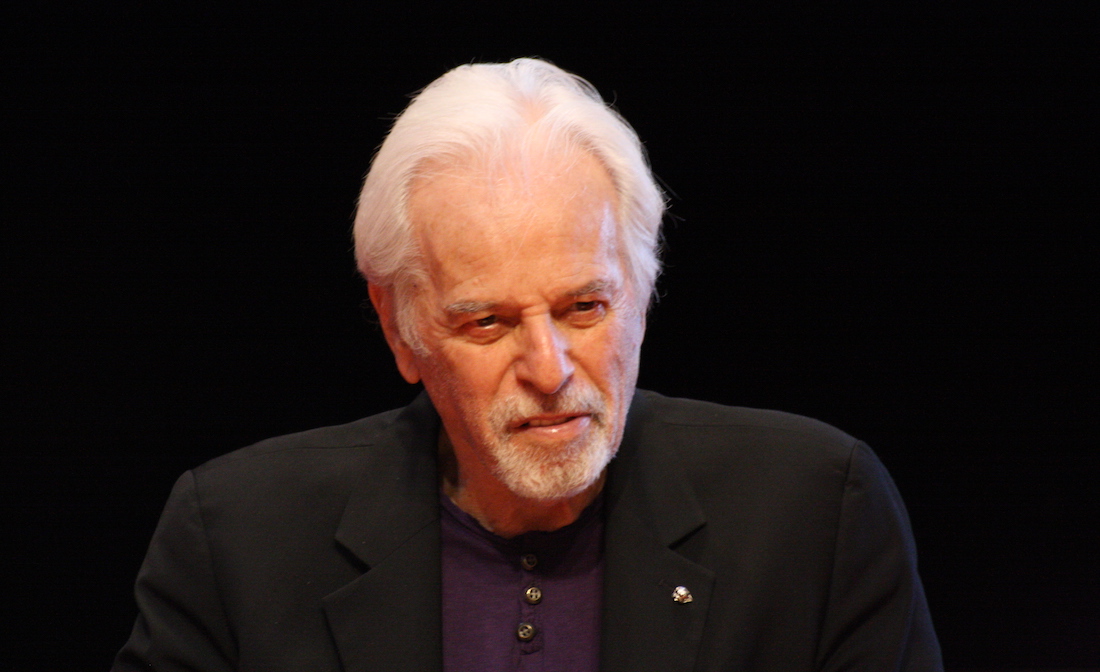
If you’re a fan of science fiction or the films of David Lynch, you’ve surely seen the 1984 film adaptation of Frank Herbert’s cult classic sci-fi novel, Dune (though Lynch himself may prefer that you didn’t). And indeed, it’s very likely that, by now, you’ve heard the incredible story of what Dune might have been, had it been directed ten years earlier by psychedelic Chilean filmmaker, writer, composer, and psychotherapist Alejandro Jodorowsky. Perhaps you even caught Jonathan Crow’s post on this site featuring Jodorowsky’s proposed storyboards—drawn by French artist Moebius—for what would most certainly would have been “a mind-bogglingly grand epic” of a movie. Alas, Jodorowsky’s Dune never came about, though it did later lead to the documentary Jodorowsky’s Dune, which Matt Zoller Seitz pronounced “a call to arms for dreamers everywhere.”
That description applies not only to the film about a film that could have been, but also to the entirety of Jodorowsky’s work, including his—thoroughly bizarre and captivating—early features, El Topo and The Holy Mountain, and the creation of a comic book universe like no other. Called “The Jodoverse,” the world of his comic books is, as writer Warren Ellis says, “astonishingly beautiful and totally mad”—again, a succinct description of Jodorowsky’s every artistic endeavor. Witness below, for example, the stunning trailer for his most recent feature film, 2014’s The Dance of Reality. You may find the visual excesses so overwhelming that you only half-hear the narration.
Listen (or read) carefully, however. Jodorowsky has as much to tell us with his cryptically poetic pronouncements as he does with his visionary imagery. Do you find his epigrams platitudinous, sententious, Pollyannaish, or naïve? Jodorowsky doesn’t mind. He calls, remember, to the dreamers, not the hard-bitten, cynical realists. And if you’re one of the dreamers who hears that call, you’ll find much to love in the list below of Jodorowsky’s 82 Commandments for living. But so too, I think, will the realists. These come from Jodorowsky’s memoir The Spiritual Journey of Alejandro Jodorowsky, and the list comes via Dangerous Minds, who adapted it from “the better part of three pages” of text.
As Jodorowsky frames these maxims in his book, they originated with influential Russian mystic George Gurdjieff, and were told to him by Gurdjieff’s daughter, Reyna d’Assia. Perhaps that’s so. But you’ll note, if you know Jodorowsky’s writing—or simply took a couple minutes time to watch the trailer above—that they sound enough like the author’s own words to have been brought forth from his personal storehouse of accumulated wisdom. In any case, Jodorowsky has always been quick to acknowledge his spiritual teachers, and whether these are his second-hand accounts of Gurdjieff or his own inventions has no bearing on the substance therein.
Often sounding very much like Biblical proverbs or Buddhist precepts, the commandments are intended, d’Assia says in Jodorowsky’s account, to help us “change [our] habits, conquer laziness, and become… morally sound human being[s].” As she remarks in the book, before she delivers the below in a lengthy monologue, “to be strong in the great things, we must also be strong in the small ones.” Therefore…
Ground your attention on yourself. Be conscious at every moment of what you are thinking, sensing, feeling, desiring, and doing.
Always finish what you have begun.
Whatever you are doing, do it as well as possible.
Do not become attached to anything that can destroy you in the course of time.
Develop your generosity ‒ but secretly.
Treat everyone as if he or she was a close relative.
Organize what you have disorganized.
Learn to receive and give thanks for every gift.
Stop defining yourself.
Do not lie or steal, for you lie to yourself and steal from yourself.
Help your neighbor, but do not make him dependent.
Do not encourage others to imitate you.
Make work plans and accomplish them.
Do not take up too much space.
Make no useless movements or sounds.
If you lack faith, pretend to have it.
Do not allow yourself to be impressed by strong personalities.
Do not regard anyone or anything as your possession.
Share fairly.
Do not seduce.
Sleep and eat only as much as necessary.
Do not speak of your personal problems.
Do not express judgment or criticism when you are ignorant of most of the factors involved.
Do not establish useless friendships.
Do not follow fashions.
Do not sell yourself.
Respect contracts you have signed.
Be on time.
Never envy the luck or success of anyone.
Say no more than necessary.
Do not think of the profits your work will engender.
Never threaten anyone.
Keep your promises.
In any discussion, put yourself in the other person’s place.
Admit that someone else may be superior to you.
Do not eliminate, but transmute.
Conquer your fears, for each of them represents a camouflaged desire.
Help others to help themselves.
Conquer your aversions and come closer to those who inspire rejection in you.
Do not react to what others say about you, whether praise or blame.
Transform your pride into dignity.
Transform your anger into creativity.
Transform your greed into respect for beauty.
Transform your envy into admiration for the values of the other.
Transform your hate into charity.
Neither praise nor insult yourself.
Regard what does not belong to you as if it did belong to you.
Do not complain.
Develop your imagination.
Never give orders to gain the satisfaction of being obeyed.
Pay for services performed for you.
Do not proselytize your work or ideas.
Do not try to make others feel for you emotions such as pity, admiration, sympathy, or complicity.
Do not try to distinguish yourself by your appearance.
Never contradict; instead, be silent.
Do not contract debts; acquire and pay immediately.
If you offend someone, ask his or her pardon; if you have offended a person publicly, apologize publicly.
When you realize you have said something that is mistaken, do not persist in error through pride; instead, immediately retract it.
Never defend your old ideas simply because you are the one who expressed them.
Do not keep useless objects.
Do not adorn yourself with exotic ideas.
Do not have your photograph taken with famous people.
Justify yourself to no one, and keep your own counsel.
Never define yourself by what you possess.
Never speak of yourself without considering that you might change.
Accept that nothing belongs to you.
When someone asks your opinion about something or someone, speak only of his or her qualities.
When you become ill, regard your illness as your teacher, not as something to be hated.
Look directly, and do not hide yourself.
Do not forget your dead, but accord them a limited place and do not allow them to invade your life.
Wherever you live, always find a space that you devote to the sacred.
When you perform a service, make your effort inconspicuous.
If you decide to work to help others, do it with pleasure.
If you are hesitating between doing and not doing, take the risk of doing.
Do not try to be everything to your spouse; accept that there are things that you cannot give him or her but which others can.
When someone is speaking to an interested audience, do not contradict that person and steal his or her audience.
Live on money you have earned.
Never brag about amorous adventures.
Never glorify your weaknesses.
Never visit someone only to pass the time.
Obtain things in order to share them.
If you are meditating and a devil appears, make the devil meditate too.
Writing, casting, shooting — all important parts of the filmmaking process, but the real making of a movie happens, so they say, in the editing room. Though often film editors themselves, “they” have a point: even moviegoers unfamiliar with the mechanics of editing can sense that, when something feels right onscreen, and even more so when something feels wrong, it has to do less with the pieces themselves than how those pieces have been put together.
“There’s an inbuilt relationship between the story itself, how to tell the story, and the rhythm with which you tell it,” says famed editor Walter Murch, known for his work with Francis Ford Coppola on the Godfather trilogy and Apocalypse Now, “and editing is seventy percent about rhythm.” Twenty years ago, in his book In the Blink of an Eye, Murch shed light on how an editor works. Now, cinema video essayist Tony Zhou has continued that mission with a new episode of his series Every Frame a Painting, “How Does an Editor Think and Feel?”
Zhou’s chosen medium places him well to address the question, since each video essay must require at least as much time spent editing as thinking about film in the first place. Still, asked by a friend how he knows where to cut, he can come up with only this unsatisfying answer: “Like a lot of editors, I cut based on instinct.” As to what exactly constitutes that editor’s instinct, Zhou spends the bulk of this ten-minute essay searching for answers himself, examining the cuts in pictures like Hannah and Her Sisters, In the Mood for Love, The Empire Strikes Back, Tampopo, Only Angels Have Wings, Pierrot le Fou, and All That Jazz.
He also turns to the words of editors with decades of experience in the game, including frequent Steven Spielberg collaborator Michael Kahn, frequent Martin Scorsese collaborator Thelma Schoonmaker, and even Murch himself. But ultimately, no matter how much wisdom about timing, emotions, tension, and rhythm you collect, you’ve got to sit down in the editing suite and go it alone. “If you watch anything over and over again,” Zhou says, “you eventually feel the moment when the shot wants you to cut.” If this seems like an overwhelming task, especially given hundreds of thousands of hours of footage an editor will work through in a career, do keep Kahn’s simple words in mind: “I see all that film up there — it doesn’t matter. I’m doing one piece at a time. One scene at a time. One cut at a time.”
In 1900, Thomas Edison traveled to Paris to document the many wonders of the Exposition Universelle, and the city itself. Among the sights captured with his kinetoscope cameras were the Expo’s moving sidewalks, the Champs-Élysées, and the previous Exposition Universelle’s crown jewel, the Eiffel Tower, now eleven years old.
It wasn’t all so high-minded. Edison and his kinetoscope also caught a performance by former Moulin Rouge star, Joseph Pujol, aka Le Pétomane, above. This elegantly attired gentlemen achieved fame and fortune with a series of impressions, carried out by a rather eccentric orifice. He was not so much artiste as fartiste, a title he wore with pride.
Pujol claimed to have discovered his unusual talent as a child, and soon set about achieving different effects by using his abdominal muscles to expel not gas, but odorless air. By varying the pressure, he was able to play simple tunes. By the time he turned 30, his act had expanded to include impersonations of celebrities, musical instruments, birds, a thunderstorm and such stock characters as a nervous bride. His grand finale included such feats as blowing out candles, smoking cigarettes and playing an ocarina (below), all with the aid of a rubber hose inserted into his anus via a modest trouser slit.
What a tragedy that Edison’s short film is silent! No live piano accompaniment could do justice to this magical artistic fruit, and if there were other recordings of Pujol, they’ve been lost to history.
He lives on in the imaginations of artists who followed him.
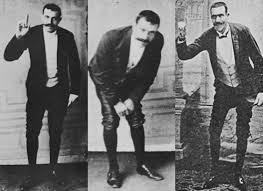
Actor Ugo Tognazzi, below, assumed the title role in a 1983 Italian language feature.
Sadly, Pujol was left on the cutting room floor of director Baz Luhrmann’s Moulin Rouge, but all is not lost. Reportedly, Johnny Depp has indicated interest in bringing this historic figure back to life. (Gentlemen, start your screenplays…)
Then there is the half hour biopic, below, directed by Monty Python alum Ian McNaughton and starring Leonard Rossiter as Pujol. Prepare to hear the opening session of the Congress of Vienna, a toad, and a four-part harmony.
But no one has solved the mystery of 1900’s Sherlock Holmes Baffled, above, the very first filmed entertainment to feature the character. The director and cinematographer was Arthur W. Marvin, who went on to serve as cameraman for D. W. Griffith’s early silent films. The identity of his starring actor has unfortunately been lost to the ages.
The film itself was believed lost, too, until Michael Pointer, a historian specializing in Sherlock Holmesiana, unearthed a paper copy in a Library of Congress archive. A series of individual cards, it was intended to be viewed by Mutoscope, a single viewer, crank-operated peep show device, common in turn-of-the-century arcades.
No doubt audiences who paid a penny to watch this fairly plotless 30-second adventure were more impressed by the special effects than the anonymous actor playing the iconic detective.
• The Adventures of Sherlock Holmes – Free – The film is adapted from the 1899 play “Sherlock Holmes” by William Gillette, and stars Basil Rathbone, Nigel Bruce, Ida Lupino, George Zucco and Alan Marshal. (1939)
• Dressed to Kill– Free – The last of 14 films starring Basil Rathbone as Sherlock Holmes and Nigel Bruce as Doctor Watson. (1941)
• Sherlock Holmes and the Secret Weapon – Free – Sherlock Holmes rescues an inventor of a new bomb site before the Nazis can get him. (1943)
• The Woman in Green – Free – Sherlock Holmes investigates when young women around London turn up murdered, each with a finger severed off. Scotland Yard suspects a madman, but Holmes believes the killings to be part of a diabolical plot. Stars Basil Rathbone as Holmes and Nigel Bruce as Dr. Watson. (1945)
• Terror by Night – Free – Sherlock Holmes film, the thirteenth to star Basil Rathbone and Nigel Bruce and was directed by Roy William Neill. The story revolves around the theft of a famous diamond aboard a train. (1946)
We're hoping to rely on loyal readers, rather than erratic ads. Please click the Donate button and support Open Culture. You can use Paypal, Venmo, Patreon, even Crypto! We thank you!
Open Culture scours the web for the best educational media. We find the free courses and audio books you need, the language lessons & educational videos you want, and plenty of enlightenment in between.