It is ironic that the ancient world that created the adage “moderation in all things” could disregard this counsel in flagrant fashion. We’ve recently written about a number of various Greco-Roman excesses, from certain Roman gastronomic overindulgences to grotesquely imaginative Greek torture methods. Today, continuing this trend, we bring you a short list of the most gruesome deaths of Roman emperors, based on The Awl’s 2012 post, “Roman Emperors, Up To AD 476 And Not Including Usurpers, In Order Of How Hardcore Their Deaths Were” compiled by Josh Fruhlinger.
Without further ado, and in no particular order, here is the list:
Caracalla & Geta (198–217 C.E.) – Unlike some of the other emperors we’ve gathered here, Caracalla really was a jerk of colossal proportions. After reigning over Rome for a few years alongside his father, Septimius Severus, Caracalla took charge of the Roman Empire in tandem with his younger brother, Geta, in 211. The reign of brotherly love didn’t last long: after failing to assassinate Geta during the revelry that was the festival of Saturnalia, Caracalla had him slaughtered in their mother’s arms by loyal centurions during a peace agreement meeting.
To follow with this fratricidal motif, Caracalla himself was murdered in 217 by a man whose brother Caracalla may have had killed just days earlier. Caracalla had stopped on the side of a road to urinate while journeying to Edessa, and was dispatched by Julius Martialis, one of his bodyguards, with a single sword blow. Martialis, in turn, succumbed to an arrow fired by an Imperial Guard archer. We presume that Martialis didn’t have any more brothers, because things seem to have ended there.
Joannes (423–425 C.E.) – By the rare extant accounts, Joannes seems to have been a senior civil servant of some ability who had, to his detriment, failed to establish a firm grip on the Empire. Although Procopius, an antique scholar, had called him “both gentle and well-endowed with sagacity and thoroughly capable of valorous deeds,” Joannes was quickly engulfed in conflict with the eastern part of the Empire. In 425, the eastern Empire’s army captured him, cut off his hands, and placed him on a donkey to be paraded and jeered at in a hippodrome. Having suffered both insult and injury, Joannes was put out of his misery and decapitated.
Commodus (177–192 C. E.) – On paper, Commodus should have made an exemplary emperor. Both his grandfather and father were emperors before him, and his father, Marcus Aurelius, was praised both as a ruler and one of Stoicism’s central thinkers. Commodus, however, inherited neither his father’s philosophical inclinations nor his political smarts. To cap off a reign plagued by political strife, Commodus let himself fall victim to some destructive megalomania: after Rome was engulfed in a conflagration, Commodus declared himself to be the new Romulus and ceremoniously re-founded the city under the new name of Colonia Lucia Annia Commodiana. The renaming of his empire’s foremost city didn’t quite cut it, however, and Commodus resorted to renaming the months of the year after his 12 names. As December of 192 (known, by this point, as Pius of 192) drew to a close, Commodus was poisoned by his concubine, but vomited the substance, whereupon his wrestling training partner was sent in by a number of senators to strangle the emperor in the bathtub.
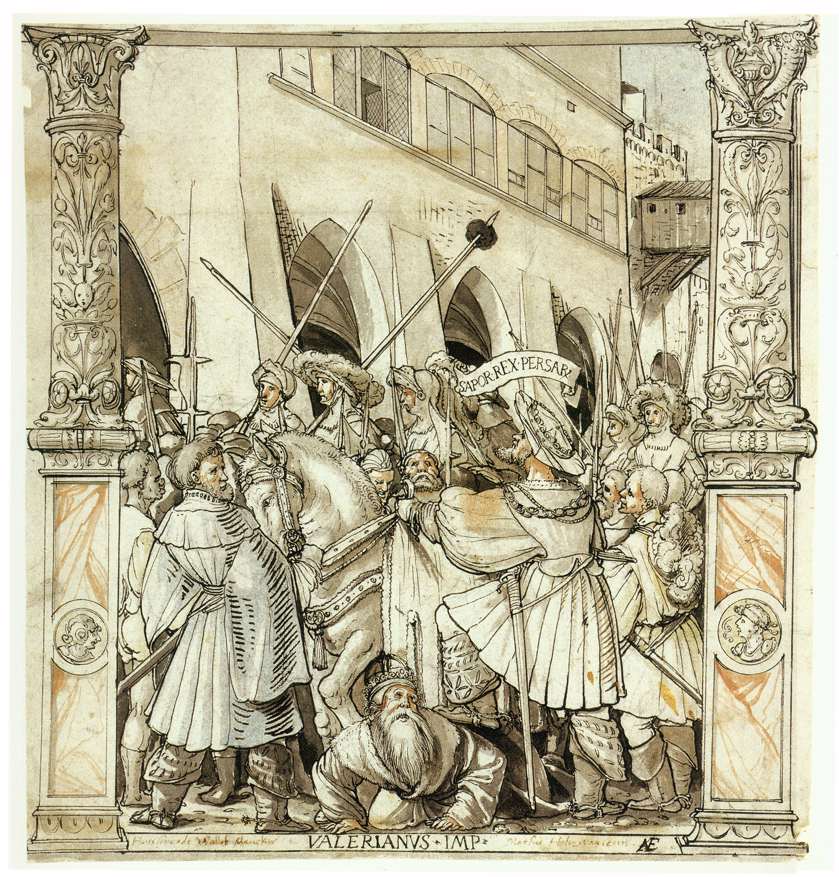
Valerian (253–259 C. E.) – If Joannes’ demise strikes you as having been somewhat undignified, Valerian’s end was a full-blown assault on human decency. Lactantius, an early Christian author, claimed that after his capture by the Persian king Shapur I, Valerian was put to use as a regal footstool to help the Persian ruler mount his horse. Valerian, understandably, expressed some consternation at such treatment, and offered Shapur a hefty sum in exchange for his freedom. There are two versions of what transpired next. In the first, Shapur expresses his disdain for Valerian’s measly offer by pouring molten gold down the former emperor’s throat. In the second, Shapur also expresses his disdain, albeit in a more creative fashion, this time by flaying Valerian’s skin and subsequently stuffing it with straw to be put on display. Thankfully, there’s evidence to contradict Lactantius’ account, which leads some historians to believe that Valerian was used as neither furniture nor gold receptacle, but rather lived a quiet life with some of his soldiers in an indeterminate Persian city. For his sake, we hope they’re right.
Above, you can see “The Humiliation of Valerian by Shapur,” a pen and black ink sketch created by Hans Holbein the Younger in 1521.
For a full list of gory deaths, head on over to The Awl.
Ilia Blinderman is a Montreal-based culture and science writer. Follow him at @iliablinderman.
Related Content:
Cook Real Recipes from Ancient Rome: Ostrich Ragoût, Roast Wild Boar, Nut Tarts & More
The History of Rome in 179 Podcasts
Courses on Roman history can be found in the History section of our collection of 800 Free Online Courses