While Terkel is famous for interviewing everyday people for his oral histories of the Depression, work, and World War II, and his radio show featured its fair share of students, domestic workers, and veterans, this particular archive is full of big names: Actress and comedian Lily Tomlin. Literary theorist Edward Said. Actor and activist Sidney Poitier.
Currently, there are about twenty audio files available, and the archive promises more to come, pending digitization and the clearing of rights. (Let’s hope they hurry up! Some of the placeholder entries for not-yet-available interviews—Buckminster Fuller, Margaret Mead, Arthur C. Clarke—are most tantalizing.)
The one downside to this archive is that you can’t download the interviews—a potential drawback for addicted podcast fans. However, if you have a smartphone and a good data connection, it’s simple enough to listen to the files straight from your phone’s Chrome browser.
Above you can listen to Terkel interview a young Bob Dylan in 1963. The remaining parts of the interview can be found here. Note: The Dylan interview isn’t actually in the Pop Up archive. But it is another one of Terkel’s legendary interviews. So we wanted to add it to the mix.
Rebecca Onion is a writer and academic living in Philadelphia. She runs Slate.com’s history blog, The Vault. Follow her on Twitter: @rebeccaonion.
Why? Because “Alexander kept pushing forward. He didn’t want to have to go home and be dominated by his mother.” The same impulse drove Tyson to box his way out of Brownsville, Brooklyn. That’s all covered in his autobiography.
At least since that 17th century architect of the scientific revolution, Sir Francis Bacon (who was mostly right), people have been making predictions about the technologies and social advancements of the future. And since Bacon, scientists and futuristic writers have been especially in demand during times of great change and uncertainty, such as at the turn of the last century. In 1900, civil engineer John Elfreth Watkins, Jr. in Ladies’ Home Journal claimed to have surveyed “the most learned and conservative minds in America… the wisest and most careful men in our greatest institutions of science and learning.”
Specifying advances likely to occur 100 years thence, “before the dawn of 2001,” Watkins culled 28 predictions about such things as travel and the transmission of information over great distances, biological and genetic mutations, and the domestic comforts of the average consumer. Several of the predictions are very Baconian indeed—as per the strange list at the end of Bacon’s science fiction fragment New Atlantis, a text obsessed with altering the appearance of the natural world for no particular reason other than that it could be done. Watkins’ list includes such predictions as “Peas as Large as Beets,” “Black, Blue, and Green Roses,” and “Strawberries as Large as Apples.” Some are Baconian in more sinister ways, and these are also a bit more accurate. Take the below, for example:
There will be No Wild Animals except in menageries. Rats and mice will have been exterminated. The horse will have become practically extinct. A few of high breed will be kept by the rich for racing, hunting and exercise. The automobile will have driven out the horse. Cattle and sheep will have no horns. They will be unable to run faster than the fattened hog of to-day. A century ago the wild hog could outrun a horse. Food animals will be bred to expend practically all of their life energy in producing meat, milk, wool and other by-products. Horns, bones, muscles and lungs will have been neglected.
I would defer to ecologists and meat industry watchdogs to confirm my intuitions, but it does seem that some of this, excepting the extermination of vermin and horns, has come to pass or is very likely in regard to several species. Another prediction, this one about our own species, is laughably optimistic:
Everybody will Walk Ten Miles. Gymnastics will begin in the nursery, where toys and games will be designed to strengthen the muscles. Exercise will be compulsory in the schools. Every school, college and community will have a complete gymnasium. All cities will have public gymnasiums. A man or woman unable to walk ten miles at a stretch will be regarded as a weakling.
We’re much closer to the future of Pixar’s Wall‑E than anything resembling this scenario (unless you live in the world of Crossfit). Another prediction is both dead on and dead wrong at once. Claiming that there will be “from 350,000,000 to 500,000,000 people in the Americas and its possessions by the lapse of another century” did in fact turn out to be almost uncannily accurate—current estimates are somewhere around 300,000,000. The “possessions” alluded to, however, display the attitude of blithe Monroe doctrine expansionism that held the nation in its sway at the turn of the century. The prediction goes on to say that most of the “South and Central American republics would be voted into the Union by their own people.” A few more of Watkins’ predictions, some prescient, some preposterous:
Telephones Around the World. Wireless telephone and telegraph circuits will span the world.
Store Purchases by Tube. Pneumatic tubes instead of store wagons, will deliver packages and bundles.
Hot and Cold Air from Spigots. Rising early to build the furnace fire will be a task of the olden times.
Ready-Cooked Meals will be Bought from establishments similar to our bakeries of to-day [see the above Wall‑E reference]
There will be No C, X, or Q in our every-day alphabet. They will be abandoned because unnecessary.
Aeriel War-Ships and Forts on Wheels. Giant guns will shoot twenty-five miles or more, and will hurl anywhere within such a radius shells exploding and destroying whole cities.
How Children will be Taught. A university education will be free to every man and woman.
Ah, if only that last one had come true! To read all of Watkins predictions in detail, click on the image above for a larger, readable, version of the full article.
The great British empiricist Francis Bacon once remarked that Johannes Gutenberg’sprinting press “changed the whole face and state of the world.” Although Gutenberg did not independently devise the press, he invented a mass-production process of moveable type and concocted an oil-based ink which, when combined with the wooden press, revolutionized the flow of information. Books could now be published in vast quantities, at only a fraction of the time required previously.
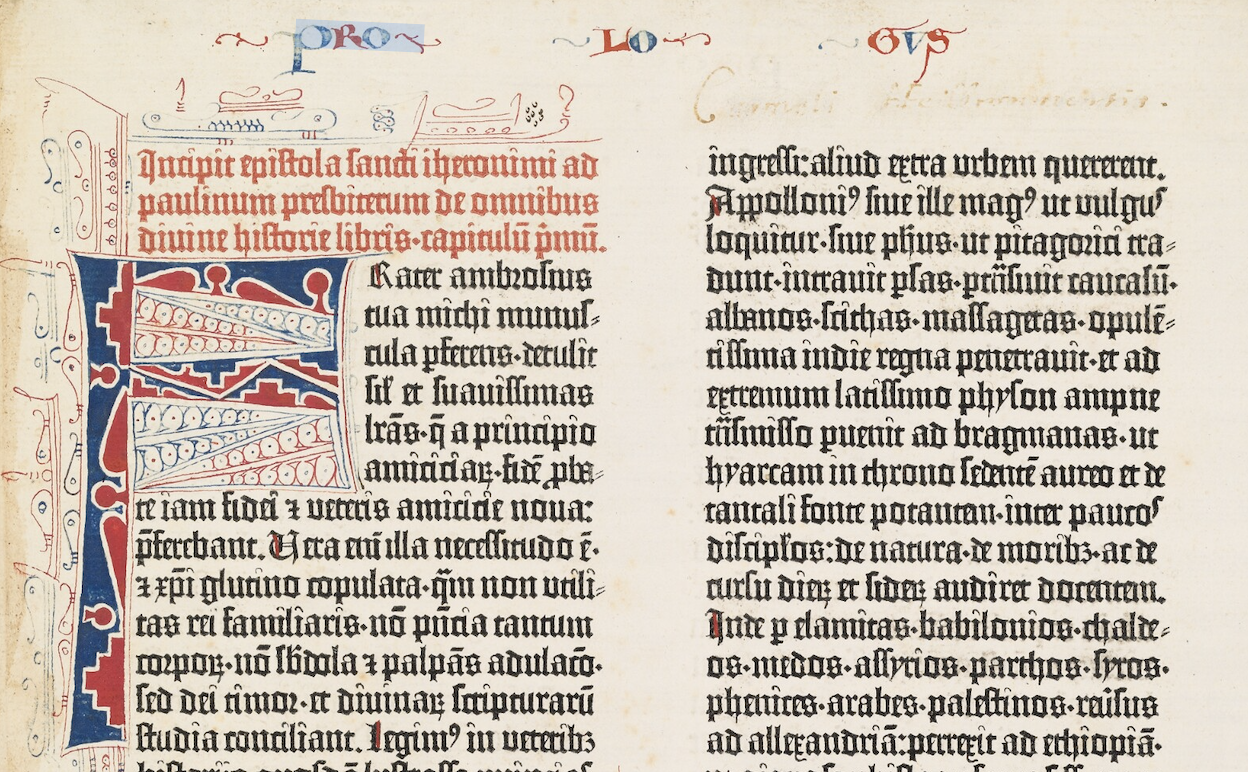
For his first seminal printing, Gutenberg picked the Bible — an obvious choice for a Christian, and in retrospect, perhaps the only book whose historical significance rivals that of Gutenberg’s invention. Produced in 1454 or 1455, the few surviving copies of Gutenberg’s Bible remain exemplars of the printer’s forethought and craftsmanship; the page dimensions, it is believed, were devised by Gutenberg to echo the golden ratio of Greek aesthetics. The first page appears above.
I believe it was Jacques Derrida, though I don’t recall exactly where, who said that some of the most revealing text of any work can be found in the footnotes. In documentarian Errol Morris’ recent photo-essay series on Lincoln for The New York Times, footnotes, chronologies, snippets of interview, and endlessly recursive references continuously intrude on the stories he tells. In this way, the series, called “The Interminable, Everlasting Lincolns,” enacts the tension Morris identifies as “the push-pull of history,” a contest between several ways of approaching the past: “Facts vs. beliefs. Our desire to know the origins of things vs. our desire to rework, to reconfigure the past to suit our own beliefs and predilections. Perhaps nothing better illustrates this than two radically different predispositions to objects—the storyteller vs. the collector.”
The way story after story inevitably nests within each historical artifact seems to be Morris’ overarching theme as he charts the history of Lincoln iconography by reference to a single image, a photo of Lincoln by Alexander Gardner that exists in only one known original print, called O‑118 after collector of Lincoln photography Lloyd Ostendorf (see the retouched version above, the original print below). This print, along with 13 others, was made either four or five days before Lincoln’s assassination.
Morris’ fascination with this photograph is as variously motivated as the number of different views he adopts in examining its provenance, its history, and its meaning. For one thing, O‑118 is supposedly the last photograph taken of Lincoln alive. In 1922, The New York Times published the original print (above) with text by James Young, who wrote:
Probably no other photograph of Lincoln conveys more clearly the abiding sadness of the face. The lines of time and care are deeply etched, and he has the look of a man bordering upon old age, though he was only 56. Proof that the camera was but a few feet away may be found by scrutiny of the picture…. The print has been untouched, and this picture is an exact likeness of the President as he looked in the week of his death.
The photo’s caption also included information that Morris makes a great deal of: “The Cracked Negative Caused it To Be Discarded. It Has Only Once Before Been Published, and Then in a Retouched Form.” For one thing, Morris seems to associate the photograph with what Walter Benjamin called “aura”; The print, it seems, was the only one Gardner was able to make before the cracked negative became useless and mass production from the source impossible. Un-retouched, the print shows a “fracture cutting through the top of Lincoln’s head.” For the storyteller, writes Morris, “the crack is the beginning of a legend—the legend of a death foretold. The crack seems to anticipate the bullet fired into the back of Lincoln’s head at Ford’s Theater on Good Friday, April 14, 1865.” Using the rhetorical term for “a figure of anticipation,” a narrative feature that foreshadows, foretells, or prophesies, Morris calls this “the proleptic crack.”
His winding narrative, replete with the antiquarian minutiae of collectors, moves from the day—February 5, 1865—that Lincoln and his son Tad walked to Gardner’s studio on 7th Street in Washington, DC for the photo session, through the use of photography as an aid to Lincoln painters and sculptors, to the meaning of Lincoln for such diverse people as Leo Tolstoy, Marilyn Monroe, and our current President. Morris’ series ranges far and wide, visiting with historians and collectors along the way, and telling many a story, some freely speculative, some wistful, some tragic, and all somehow circling back to O‑118. Like much of Morris’ documentary work, it’s an exercise in collage—of the methods of the scholar, the essayist, and the archivist—and like its subject, it’s a fractured, but everlastingly fascinating meditation. Follow Morris’ entire series below.
The French refer to the decade between 1920 and 1929 as les Années folles, “the crazy years,” which is apt when you consider how the French middle and upper classes generally loosened their brassieres and defined modern bohemia, à laCoco Chanel.
But the American moniker — the Roaring 20s — fits too. Nearly everything about that decade roared: cars, jazz, manufacturing, construction.
Din, in fact, came to define the age, particularly in big cities and especially in New York. An unnamed Japanese visitor was quoted upon his visit to that city in 1920: “My first impression of New York was its noise. When I know what they mean, I will understand civilization.”
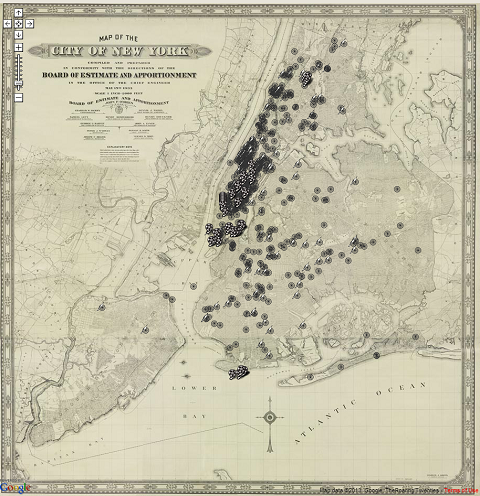
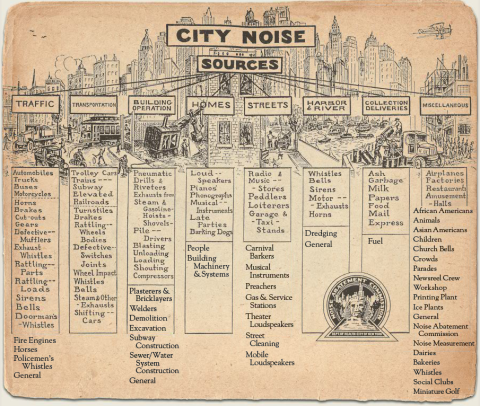
A Princeton history professor took that challenge at face value, while capturing a broader industrial era. The Roaring Twenties is an audio (and to some extent video) archive of what New York City sounded like from 1900 to 1933. Professor Emily Thompson and designer Scott Mahoy have created a lovely site that’s fun to explore. The archive includes a beautiful 1933 map of New York City loaded with links to noise complaints (screenshot at top), complete with documentation. New York had long been a place where people from all over the world lived on top of one another, but noise levels were shifting—getting louder and more varied, that is—and the city was inundated with complaints about ferry whistles, radio shops, street traffic, the clatter of restaurant dishwashing, and all manner of construction.
Sensitivity to the city’s volume was high. The city’s Noise Abatement Commission measured the “deafening effect” of sound in Times Square. The women’s cafeteria in the New York Life Insurance building was designed with state-of-the-art acoustics to keep the noise of the city out and the sound of office workers in.
Cortlandt Street in lower Manhattan was lined with radio shops, each broadcasting different music. Don’t miss that video, which you’ll find by scanning the Space tab map.
You can also move through time on the site, listening to the city’s cacophony from the early 1900s up to the 1930s, or browse a menu of noise sources from home sounds to the noise of the harbors and rivers. Again, you can visit the The Roaring Twenties site here.
Seventy-seven years ago, in a move unprecedented since the Glorious Revolution of 1688, King-Emperor Edward VIII abdicated the throne. Today’s audiences will recognize the episode from The King’s Speech: less than a year after having ascended to the British kingship in January of 1936, Edward became romantically entangled with a yet-to-be-divorced American socialite named Wallis Simpson. As long as the King’s liaisons remained discreet, the couple was afforded a respectable amount of privacy by the royal family and the British media. Things grew more complicated, however, when Simpson divorced her second husband in October of 1936, and the pair decided to marry, come hell or high water.
A King of the United Kingdom of Great Britain and Northern Ireland being wedded to a twice-divorced American socialite would have caused a furor. As the head of the Church of England, Edward could not marry a divorced woman whose former husband (let alone husbands) remained alive. Simpson’s first divorce proved even more problematic—it was granted based on “emotional incompatibility,” and may not have been recognized under both Church and English law. The King’s marriage to Simpson also raised the possibility of an American Queen, a sacrilegious idea in the eyes of his subjects.
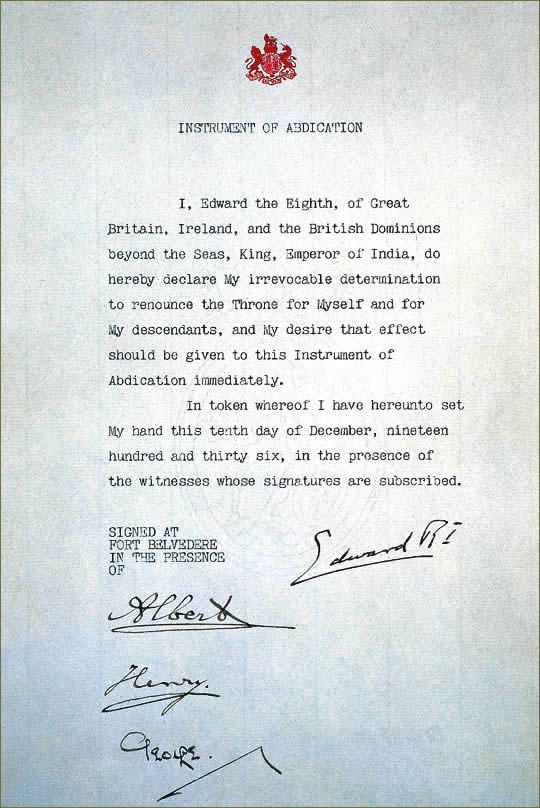
Faced with a choice between the crown and his love, Edward VIII chose to step down. On December 10, 1936, the King signed the following declaration of abdication:
In the audio clip at the top of the post, Edward VIII takes to the radio waves to declare his abdication on December 11. Brimming with hardly-contained emotion, Edward attempts to explain his reasons to the British people (read the full transcript here):
“You all know the reasons which have impelled me to renounce the Throne. But I want you to understand that in making up my mind I did not forget the country or the Empire which as Prince of Wales, and lately as King, I have for twenty-five years tried to serve. But you must believe me when I tell you that I have found it impossible to carry the heavy burden of responsibility and to discharge my duties as King as I would wish to do without the help and support of the woman I love.”
For those who had doubts about Simpson’s true feelings for the King (some suspected her of caring only about the king’s money), the next 35 years would provide sufficient proof. The pair remained married until Edward’s death in 1972.
Ilia Blinderman is a Montreal-based culture and science writer. Follow him at @iliablinderman.
Recently, Wired writer Steve Silberman (aka @stevesilberman) shot us a note on Twitter, saying, “@openculture, do not miss this brilliant ad. Most touching movie (in 3 mins!) I’ve seen in years.” Released on November 13th, the video has already clocked over 10 million views. But chances are you haven’t seen it. And that’s because it’s targeted to the web-enabled middle class of India and Pakistan. As The Dawn, Pakistan’s oldest English newspaper, describes it, the Google-created ad entitled “Reunion” “portrays two childhood friends, now elderly men, who haven’t seen each other since they were separated by the 1947 partition that created India and Pakistan from the old British empire in South Asia. Partition sparked a mass exodus as millions of Muslims and Hindus fled across the new borders amid religious violence.” Now Google search products are helping to bring old friends and neighbors back together.
Cynics may be quick to judge this a saccharine, manipulative ad. But others are seeing in it something else — a sign that “personal connections between Indians and Pakistanis run deep.” Even if their governments gain something from keeping the conflict alive, everyday people in India and Pakistan are increasingly ready to put history aside.
Note: If you click CC at the bottom of the video, you can use captions to translate the film into nine languages, including French, Malayalam and Urdu. It is preset to English.
Don’t miss anything from Open Culture. Sign up for our Daily Email orRSS Feed. And we’ll send quality culture your way, every day.
We're hoping to rely on loyal readers, rather than erratic ads. Please click the Donate button and support Open Culture. You can use Paypal, Venmo, Patreon, even Crypto! We thank you!
Open Culture scours the web for the best educational media. We find the free courses and audio books you need, the language lessons & educational videos you want, and plenty of enlightenment in between.