More sad news. J.D. Salinger, who brought us The Catcher in the Rye, has died at 91. Here’s the initial news release.
Boy, when you’re dead, they really fix you up. I hope to hell when I do die somebody has sense enough to just dump me in the river or something. Anything except sticking me in a goddam cemetery. People coming and putting a bunch of flowers on your stomach on Sunday, and all that crap. Who wants flowers when you’re dead? Nobody. ~J.D. Salinger, The Catcher in the Rye, Chapter 20
Rod Serling, the American screenwriter & television producer best known for The Twilight Zone, fielded questions from students about the whole art of writing for television. In the clip above, he gives a rather dramatic response to the question, “Where do ideas come from?” (They come from the Earth… They’re in the air. And, to put them on paper, you bleed!) If you keep watching, the conversation with Serling continues for a good while.
This contribution was sent to us by Elan, who dates the clip to around 1972. You can always write us and suggest a link here.
If you would like to support the mission of Open Culture, consider making a donation to our site. It’s hard to rely 100% on ads, and your contributions will help us continue providing the best free cultural and educational materials to learners everywhere. You can contribute through PayPal, Patreon, and Venmo (@openculture). Thanks!
Take the Coen Brothers’ 1998 cult film, The Big Lebowski, and put it in Shakespearean verse, and what do you get? Two Gentlemen of Lebowski as written by Adam Bertocci. It begins:
In wayfarer’s worlds out west was once a man,
A man I come not to bury, but to praise.
His name was Geoffrey Lebowski called, yet
Not called, excepting by his kin.
That which we call a knave by any other name
Might bowl just as sweet. Lebowski, then,
Did call himself ‘the Knave’, a name that I,
Your humble chorus, would not self-apply
In homelands mine; but, then, this Knave was one
From whom sense was a burden to extract,
And of the arid vale in which he dwelt,
Also dislike in sensibility;
Mayhap the very search for sense reveals
The reason that it striketh me as most
Int’resting, yea, inspiring me to odes.
This almost slipped by me. As 2009 drew to a close, The New York Times posted two annual lists. First, its list of 100 Notable Books and then its 10 Best Books of 2009. 5 Fiction. 5 Nonfiction. It’s a pretty good distillation of the better works published last year. But enough about ’09. What’s coming in 2010? The Millions has previewed the most anticipated books (all fiction) set for publication this year.
Looking for more good reads? Check out the collection of Life Changing Books assembled by our readers.
The world according to John Irving. Times are tougher for young writers. But the book isn’t going away. You can watch the full interview with Irving here.
Today, we’re rolling out a sizable collection of Free eBooks, most of them classics, that features major works written by James Joyce, F. Scott Fitzgerald, Jane Austen, Nietzsche and others. (We have even thrown in a little Paulo Coelho.) You’ll find 100+ free ebooks in total, and you can download the texts to your computer, smart phone (iPhone, Android, etc.) or Kindle, depending on the format you choose. Our eBooks Primer overviews the different download options, so please give it a quick read over. Below, we’ve posted a quick sample from the new collection (plus a link to the entire list of Free eBooks). Feel free to offer feedback and share the list with friends. Down the road, you can always find this collection in the top navigation bar. Just looks for eBooks.
Note: Don’t forget to check in on Seth Harwood’s big Kindle experiment. What happens when you sell your book for 99 cents on the Kindle? Find out as the experiment unfolds. Story here.
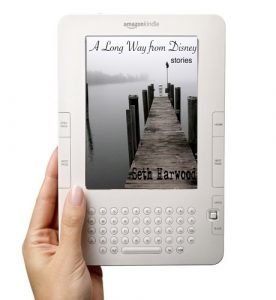
About a week ago, I posted here about my Publishing Experiment Take 1. I spoke of the need for authors (Yes, Authors!) to make experiments in new media and publishing. Well, now’s the time to put my fiction where my mouth is. Today I’m launching my collection of short stories, A Long Way from Disney, on Amazon’s Kindle platform at the price of $.99.
Those who read this blog regularly may remember my past posts (here, here and here) about the Amazon Kindle and recall that I have mixed feelings about it. You’ll also know that I’ve been interested in what authors such as J.A. Konrath have accomplished by releasing books on the Kindle itself. (Heck, some of you even knew about Konrath’s successes before I did.—Thanks Kurt.) And now, since recently becoming a happy Kindle owner myself, I’ve decided it’s time to make an experiment in this new fold. So let me tell you about it.
Publishing Experiment 1: If we know anything for sure about publishing right now, it’s that it is changing. Authors, I believe, must become the scientists running experiments with new technology, new publicity strategies, marketing, you name it. There’s just too much money involved for the big (and some small) presses to carry out the kind of testing and idea-trying that needs to be done. That leaves us independent authors to try things out on our own.
In that spirit, I’m releasing a collection of short stories in the Kindle format just after Christmas. A Long Way from Disney is officially out now, but I’m “releasing it” on Sunday Dec. 27th, a day I’m calling Disney Commando Sunday! The thinking here is that by asking people to all buy the book on a single day, I can go after the top of Amazon’s Kindle bestseller chart and garner more attention (sales) there, especially with the after-Xmas new Kindle owners.
I’ve priced the collection low ($.99) because I’m more interested in how many copies of the book I can get out there than in how much money I can make off of sales. For those who’ll be counting, the $.99 price point will give me 35 cents and Amazon a hefty 64 cents per book sold. They’ll win out regardless, but it’s their sandbox and I want to play.
You can buy this Kindle book on any computer once you’ve established a Kindle reader preference/Kindle account. You have three choices here. You can do this with:
You cannot buy the Kindle book for anyone else, and no one can buy more than one copy. It’s certainly an interesting set of rules, isn’t it? Well, this is what Amazon has set up. If you’d like to aid this experiment, please forward this blog post to other authors, readers, Kindle owners, and experimenters in the publishing field. It should be interesting to see what this can generate with a minimum of publicity and zero budget.
If you’d like to sample any of the short stories from this collection, you can hear any/all of them free online at my website and find out more about the Kindle experiment here. I hope you’ll choose to come along and help make some waves with this idea. I do think that the more successes independent authors have with this new means of getting things done, the better it will be for all of publishing. Perhaps that’ll be our next debate.
I’ll be back later this week with a few stories from the collection and then again next Sunday for the big sales kickoff! See you…
We're hoping to rely on loyal readers, rather than erratic ads. Please click the Donate button and support Open Culture. You can use Paypal, Venmo, Patreon, even Crypto! We thank you!
Open Culture scours the web for the best educational media. We find the free courses and audio books you need, the language lessons & educational videos you want, and plenty of enlightenment in between.
 Today’s free story:
  Those who read this blog regularly may remember my past posts (


