In the past, I have written about Yale’s best-of-breed Open Course initiative, which makes available 15 free courses. They’re all recorded in high quality video and can be downloaded in multiple formats. You can access the full list here. Somewhere along the line (I’m not sure exactly when), Yale made these courses available on a dedicated YouTube channel, which means that you have another way to access these fine offerings. Above, I’ve featured a lecture on Jack Kerouac’s On the Road from a course called “The American Novel Since 1945.” You can find all of these Yale courses in our Free University Course collection. And, I’ve added the Yale YouTube channel to our list called Intelligent YouTube Collections.
It’s not often than a song gets written for an economics professor. It’s so bad that it’s actually good. Add that to the soundtrack for the Collapse.
At Stanford, students have found a way to get mobile phones to make music. As you’ll see, the iPhone can now reproduce the sounds of the ocarina, a twelve thousand year old flute-like instrument. That’s the hi-tech way of doing it. There’s also the low-tech way of getting the same result. In this classic bit of YouTube goodness, you’ll see a big piece of broccoli doubling as an ocarina. Never can get enough of this one.
Woody Allen has a new comic piece in The New Yorker that weaves together lobsters, existentialism and Bernie Madoff. It starts:
Two weeks ago, Abe Moscowitz dropped dead of a heart attack and was reincarnated as a lobster. Trapped off the coast of Maine, he was shipped to Manhattan and dumped into a tank at a posh Upper East Side seafood restaurant. In the tank there were several other lobsters, one of whom recognized him. “Abe, is that you?” the creature asked, his antennae perking up “Who’s that? Who’s talking to me?” Moscowitz said, still dazed by the mystical slam-bang postmortem that had transmogrified him into a crustacean. “It’s me, Moe Silverman,” the other lobster said. “O.M.G.!” Moscowitz piped, recognizing the voice of an old gin-rummy colleague. “What’s going on?” “We’re reborn,” Moe explained. “As a couple of two-pounders.”.
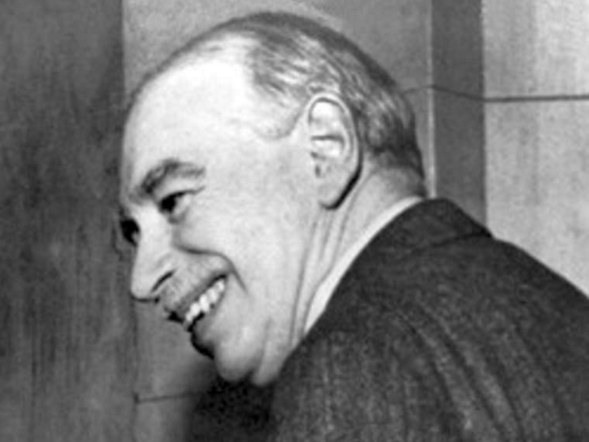
Once the Fed’s toolbox proved unable to stop the cascading global financial meltdown, the US government turned to the one strategy that it had left. It dusted off the old economic playbook of John Maynard Keynes and began introducing massive stimulus plans and other forms of government intervention. Since our collective fate now depends on Keynesian theory holding water, it seems worth bringing you a primer on Keynes and his style of economic thinking. And that’s what you get with this segment from This American Life. The segment (get the full episode here and then move to the 38th minute) tells you a little about his complex personality. (As they put it, you could make two movies about him — one that features “Keynes the statesman, advising presidents and prime ministers, furiously writing up papers that changed the direction of modern intellectual thought. Another movie would pretty much be a gay porno …” He was sexually too “out there” for even the envelope-pushing Bloomsbury Group.) Through interviews with various economists, the program then overviews the central tenets of Keynesian economics, and discusses Keynes’ influence over later generations of economists. During the 1940s, 50s and 60s, Keynesianism was all the rage, then it declined and almost disappeared during the 70s. Now it’s back, perhaps stronger than ever. My completely intuitive guess is that Keynesianism will alleviate some of the financial strains — it will keep more people working, which is good — but it will also lengthen the recession, bring about new problems (inflation and new bubbles), and prevent us from seriously addressing the problems that got us into this mess. Keynesianism may be the humane and necessary way to go, but don’t expect perfection, or anything close. In the meantime, if you want more blogs and podcasts that track the financial crisis, then please see our handy list.
This is Part 1 of a funny but also substantive talk about primate sexuality given by Robert Sapolsky to his Human Behavioral Biology class at Stanford University. As Cory Doctorow noted when featuring this video over at Boing Boing, Sapolsky (author of Why Zebras Don’t Get Ulcers) does a great job of lecturing on biology, and this talk is “filled with aha moments that’ll have you rethinking your relationship to your naughty parts.”
It’s time to put a human face on the disheartening economic statistics that we’re hearing almost daily. This video features students from a Southern California high school talking candidly (and without scripts) about how the economic collapse has affected their day-to-day lives. Unemployment, parents leaving the family, homelessness, scarce food — it’s all part of the reality they’re now living. Fittingly, this video project grew out of an AP lit class (more on the backstory here) that happened to be reading F. Scott Fitzgerald’s The Great Gatsby. There’s nothing like a good tale of materialism and decadent morality to get struggling kids talking.
There’s something of a happy ending to this story. This video made its way to Washington, and it resulted in President Obama visiting the school last week during his trip to California. So, yes, someone is listening. But how much will it really change the lot of these kids?
Lastly, you may want to check out this photo gallery called Scenes from Recession. It offers “some glimpses of the places and lives affected by what some are calling the Great Recession.” Stunning and depressing stuff, to be sure. But that’s our world.
If you’re late to Twitter, then this video creatively explains what the recent buzz is all about. In a quick two minutes, you’ll figure out the general idea behind Twitter and how to use it. And once you do, you can start to follow our Twitter stream right here. We also have a list of other cultural organizations on Twitter here. Worth a look perhaps.
The producer of this video, CommonCraft, hosts other videos along these lines on YouTube. Here are the most popular ones.
The GWB debate brings together a pretty solid panel. Arguing against the Bush legacy: Jacob Weisberg (Editor in Chief of Slate) and Simon Jenkins (columnist for the Guardian and the Sunday Times). Then, for the Bush legacy: Karl Rove (the all important Bush strategist) and Bill Kristol (editor of The Weekly Standard and former columnist for The New York Times). As you’ll see, it’s a pretty spirited conversation. Have a listen and let us know where you come down: iTunes — Feed — Stream.
We're hoping to rely on loyal readers, rather than erratic ads. Please click the Donate button and support Open Culture. You can use Paypal, Venmo, Patreon, even Crypto! We thank you!
Open Culture scours the web for the best educational media. We find the free courses and audio books you need, the language lessons & educational videos you want, and plenty of enlightenment in between.