We should all learn from the best, and in the domain of cinema, that means studying under masters like Akira Kurosawa. Though now nearly twenty years gone, the Japanese filmmaker known as “the Emperor” left behind not just one of the most impressive bodies of directorial work in existence — Rashomon, Seven Samurai, Throne of Blood, Ran, and much else besides— but a generous quantity of words. In addition to the voluminous materials related to the films themselves, he wrote the book Something Like an Autobiography, gave in-depth interviews, and offered filmmaking advice to established colleagues and young aspirants alike.
“If you genuinely want to make films,” Kurosawa tells the next generation of directors in the clip above, “then write screenplays. All you need to write a script is paper and a pencil. It’s only through writing scripts that you learn specifics about the structure of film and what cinema is.”
This brings to mind the story of how, long unable to find funding for Kagemusha, he wrote and re-wrote its screenplay, then, still unable to go into production, painted the entire film, shot by shot. Such persistence requires no little strength of patience and discipline, the very kind one builds through rigorous writing practice. Kurosawa quotes Balzac: “The most essential and necessary thing is the forbearance to face the dull task of writing one word at a time.”
Take it one word at a time: apparently creators as ostensibly different as Balzac, Kurosawa, and Stephen King agree on how to handle the writing process. And to write, Kurosawa adds, you must read. “Young people today don’t read books,” he says, echoing an oft-heard complaint. “It’s important that they at least do a certain amount of reading. Unless you have a rich reserve within, you can’t create anything. Memory is the source of your creation. Whether it’s from reading or from your own real-life experience, you can’t create unless you have something inside yourself.” Or, as Werner Herzog more recently put it: “Read, read, read, read, read, read, read, read, read… read, read… read.” But per Kurosawa, don’t forget to write — and when the writing gets tough, do anything but give up.
If you would like to support the mission of Open Culture, consider making a donation to our site. It’s hard to rely 100% on ads, and your contributions will help us continue providing the best free cultural and educational materials to learners everywhere. You can contribute through PayPal, Patreon, and Venmo (@openculture). Thanks!
Reports of traditional books’ death are greatly exaggerated, thanks in part to the success of print-on-demand publishing and other digital innovations.
As thrilled as we are about the survival of the printed page—it’s a relief to have something to read after Wi-Fi fails during the zombie invasion—the craftsmanship that goes into hand-printed, hand-bound volumes is an almost-lost art.
A well-deployed tune could elevate these lovely visuals to the realms of the advanced elegy.
YouTube user, Kraftsman Sheng, attempts to remedy the situation by reproducing the video (sans attribution) with a soundtrack of his own choosing—pianist Roger Williams’ syrupy 1965 rendition of “Softly As I Leave You,” below.
An unconventional choice, to be sure. I should think something baroque would go better with all of this meticulous folding, cutting, and binding.
Though perhaps something a little more robust could highlight the hardcore heroism of the artisans toiling to keep this ancient art alive. Electric Lit has a round up of great book-inspired punk songs, of which “Time” by Richard Hell and the Voidoids seems particularly apt.
Ayun Halliday is an author, illustrator, theater maker and Chief Primatologist of the East Village Inky zine. Her play Zamboni Godot is opening in New York City in March 2017. Follow her @AyunHalliday.
Unless you’re a policy geek or an educator, you may never have heard of the “STEM vs. STEAM” debate. STEM, of course, stands for the formula of “science, technology, engineering, and mathematics” as a baseline for educational curriculum. STEAM argues for the necessity of the arts, which in primary and secondary education have waxed and waned depending on prevailing theory and, perhaps more importantly, political will. Andrew Carnegie may have donated handsomely to higher education, but he frowned on the study of “dead languages” and other useless pursuits. Industrialist Richard Teller Crane opined in 1911 that no one with “a taste for literature has the right to be happy” because “the only men entitled to happiness… are those who are useful.”
It’s a long way from thinking of poets as “the unacknowledged legislators of the world,” as Percy Shelley wrote in his “Defence of Poetry” 90 years earlier, but Shelley’s essay shows that even then the arts needed defending. By the time we get to STEM thinking, the arts have disappeared entirely from the conversation, become an afterthought, as venture capitalists, rather than wealthy industrialists, decide to trim them away from public policy and private investment. The situation may be improving, as more educators embrace STEAM, but “there’s tension,” as Neil DeGrasse Tyson says in the excerpt above from his StarTalk interview show on Nat Geo. In the kinds of funding crises most school districts find themselves in, “school boards are wondering, do we cut the art, do we keep the science?”
The choice is a false one, argues former Talking Heads frontman and sometimes Cassandra-like cultural theorist David Byrne. “In order to really succeed in whatever… math and the sciences and engineering and things like that,” Byrne tells Tyson above, “you have to be able to think outside the box, and do creative problem solving… the creative thinking is in the arts. A certain amount of arts education…” will help you “succeed more and bring more to the world… bringing different worlds together has definite tangible benefits. To kind of cut one, or separate them, is to injure them and cripple them.”
The idea goes back to Aristotle, and to the creation of universities, when medieval thinkers touted the Liberal Arts—the Trivium (grammar, rhetoric, and logic) and Quadrivium (arithmetic, geometry, music, and astronomy)—as models for a balanced education. Tyson agrees that the arts and sciences should not be severed: “Suppose they did that back in Renaissance Europe? What would Europe be without the support and interest in art?” He goes even further, saying, “We measure the success of a civilization by how well they treat their creative people.”
It’s a bold statement that emerges from a longer conversation Tyson has with Byrne, which you can hear in the StarTalk Radio podcast above. Tyson is joined by co-host Maeve Higgins and neuroscientist and concert pianist Dr. Mónica López-González—and later by Professor David Cope, who taught a computer to write music, and Bill Nye. Byrne makes his case for the equal value of the arts and sciences with personal examples from his early years in grade school and art college, and by building conceptual bridges between the two ways of thinking. One theme he returns to is the interrelationship between architecture and music as an example of how art and engineering co-evolve (a subject on which he previously delivered a fascinating TED talk).
You won’t find much debate here among the participants. Everyone seems to readily agree with each other, and I can’t say I’m surprised. Speaking anecdotally, all of the scientists I know affirm the value of the arts, and a high percentage have a creative avocation. Likewise, I’ve rarely met an artist who doesn’t value science and technology. We find example after example of scientist-artists—from Albert Einstein to astrophysicist Stephon Alexander, who sees physics in Coltrane. The central question may not be whether artists and scientists can mutually appreciate each other—they generally already do—but whether school boards, politicians, voters, and investors can see things their way.
Bruce Springsteen turns 67 today. And next week his long-awaited memoir, Born to Run, will finally get into readers’ hands. In advance of that literary event, we’re looking back at a 2014 interview with The New York Times, printed shortly before Springsteen published his children’s book, Outlaw Pete.
The interview takes you inside Springsteen’s literary world, revealing what books he reads, which books he loves, and what authors have shaped his songwriting (and likely his own literary style): The Times asks: “Who is your favorite novelist of all time, and your favorite novelist writing today?;” “Who are your favorite New Jersey writers?;” “What’s your favorite memoir by a musician?;” “What book, if any, most influenced your decision to become a songwriter and musician or contributed to your artistic development?” The books he namechecks along the way include the following:
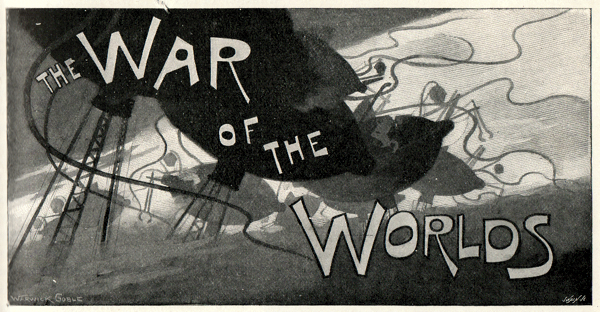
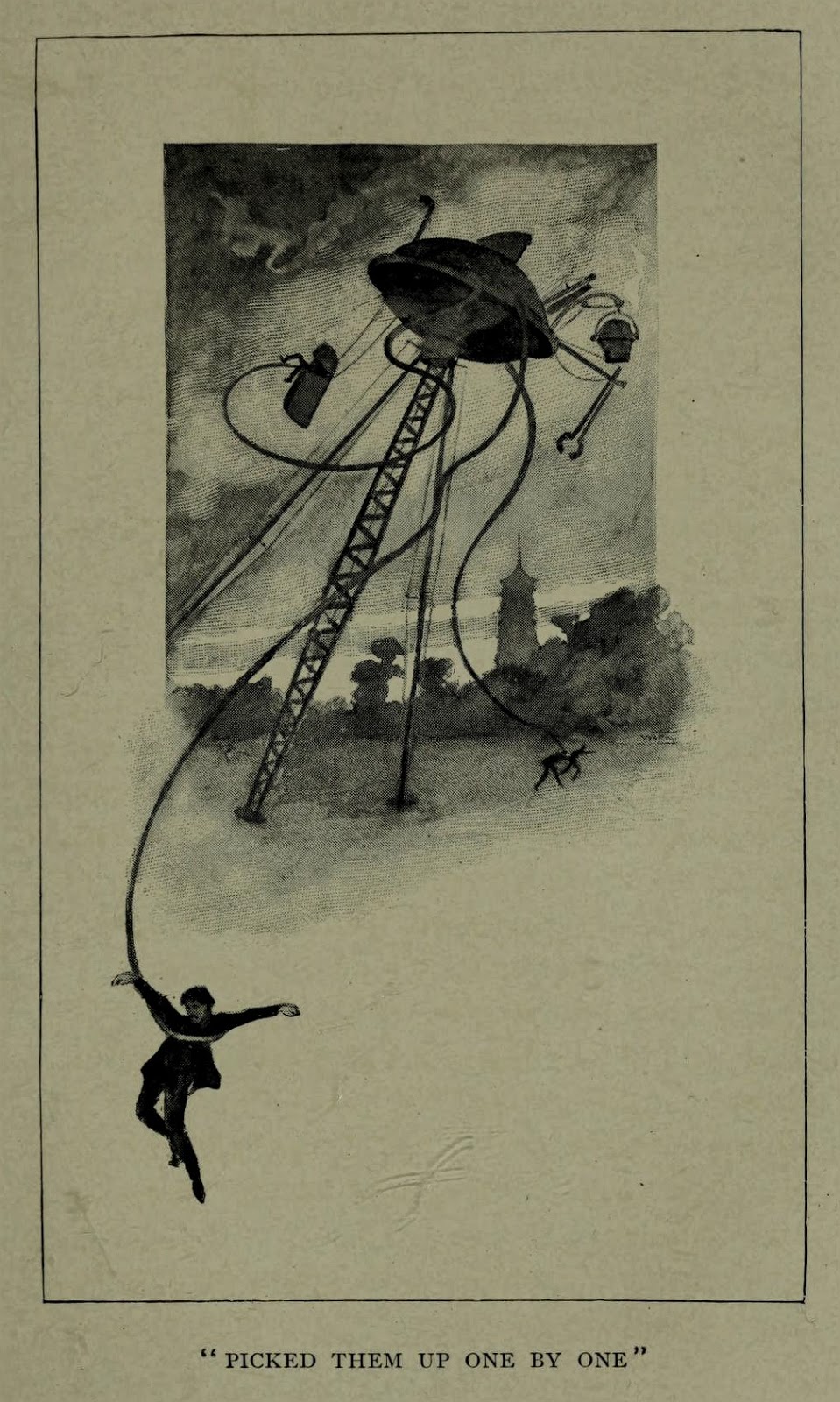
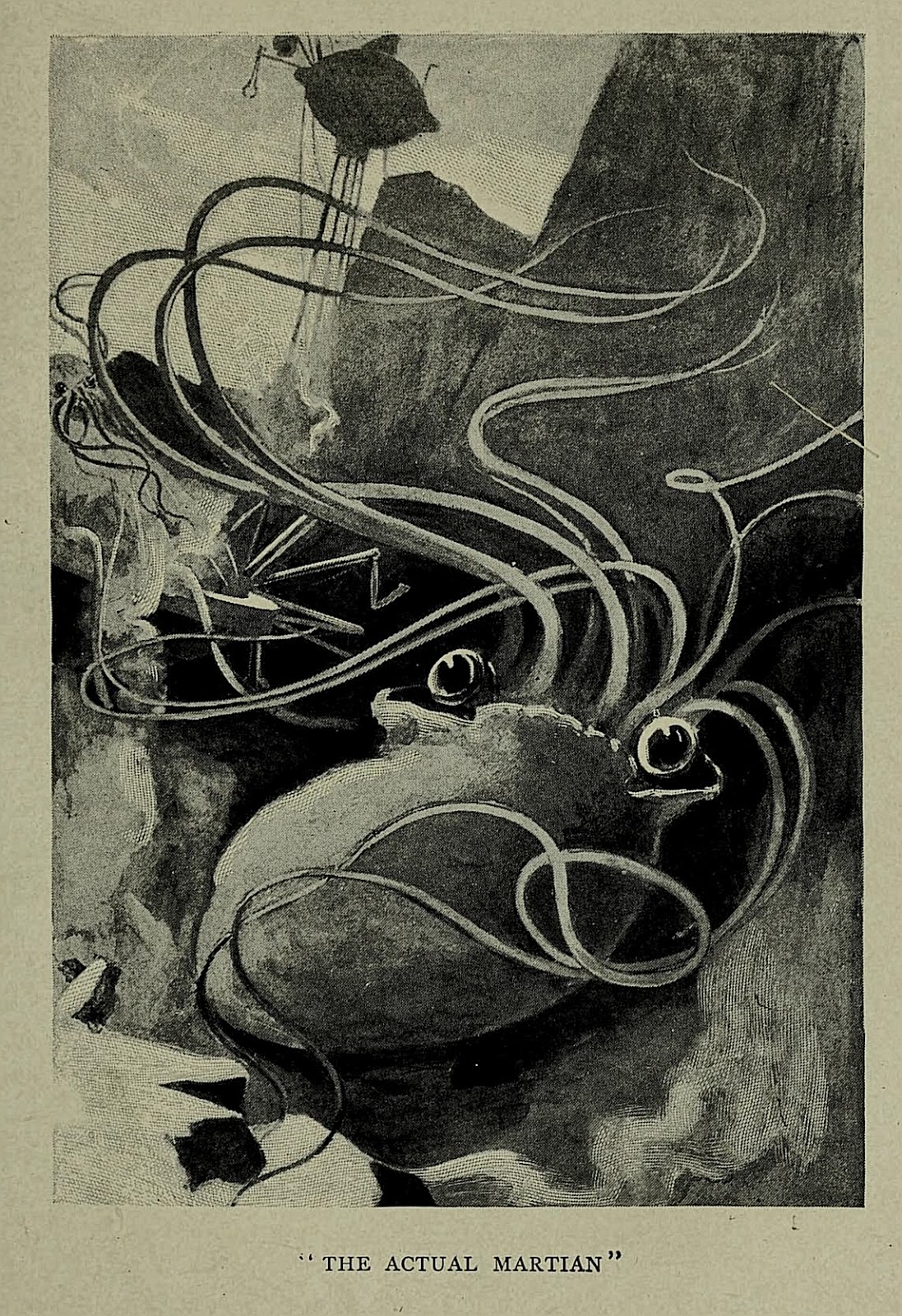
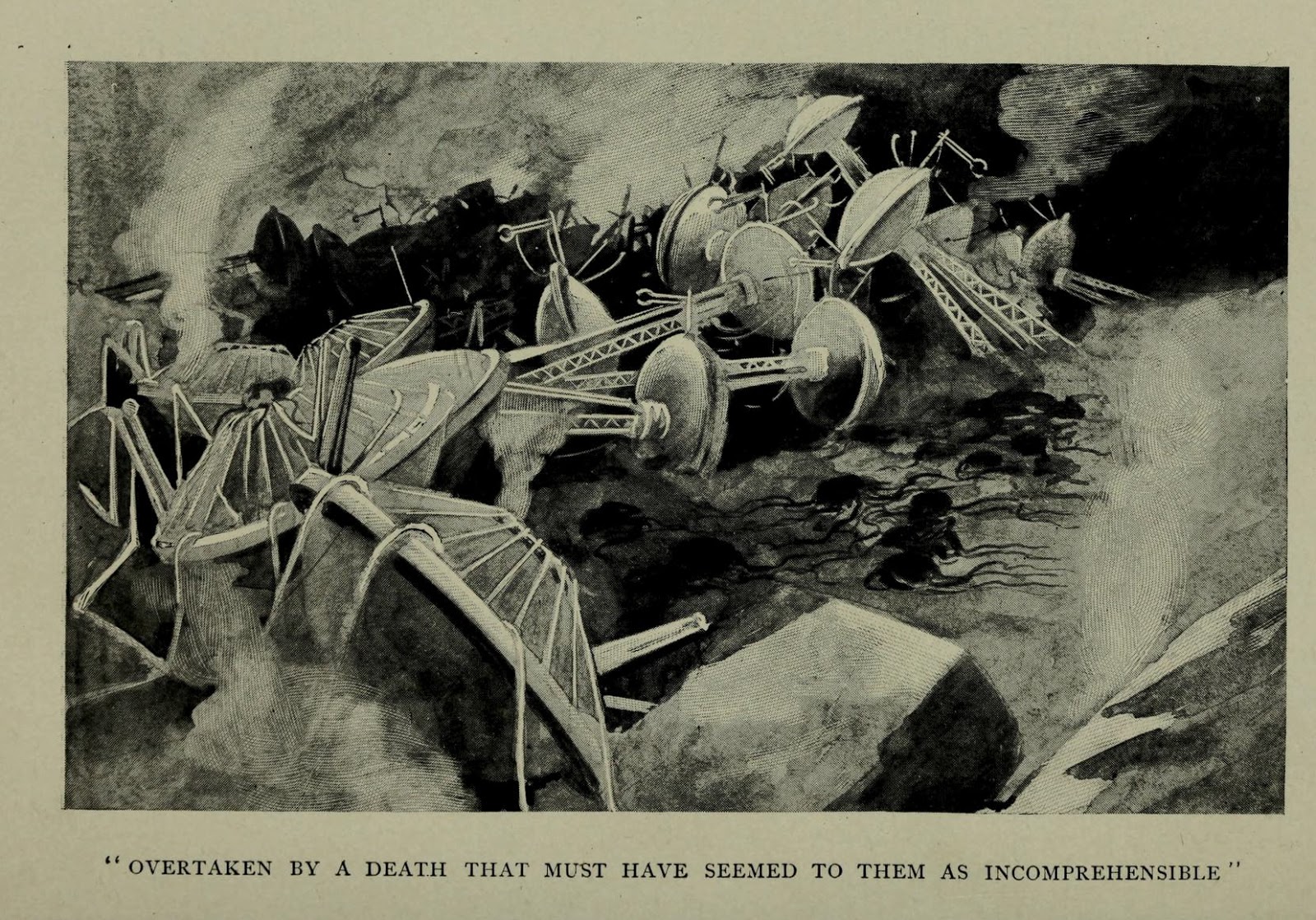
H.G. Wells’ tales of fantastical inventions, never-before-seen beings, time travel, and alien invasion practically cry out for visual and sonic accompaniment. Of all the other artists’ interpretations of his 1898 novel The War of the Worlds, Orson Welles’ infamous Halloween 1938 radio broadcast remains best known, but various illustrators have also brought the story of mercilessly destructive Martians’ arrival on Earth to equally vivid life. Last year, we featured Brazilian illustrator Henrique Alvim Corrêa’s horrifying work for the 1906 edition; today, we go back before TheWar of the Worlds’ first edition to behold the aliens as rendered by Warwick Goble.
“I’m doing the dearest little serial for Pearson’s new magazine,” Wells wrote to a friend, “in which I completely wreck and sack Woking — killing my neighbours in painful and eccentric ways — then proceed via Kingston and Richmond to London, which I sack, selecting South Kensington for feats of peculiar atrocity.” That dearest little serial, after its 1897 run in Pearson’s Magazine in the U.K. and Cosmopolitan in the U.S., appeared the next year in book form as The War of the Worlds, a common publication procedure for popular English-language novels in the 19th and early 20th century.
“The story is still a bit rough round the edges,” writes sci-fi author John Guy Collick, but “what makes the magazine special are the fantastic illustrations by Warwick Goble. These are the first pictures of the Martians and their tripods and, I think, the best.” He praises their low-tech style and their faithfulness to the text: “in the novel Wells is at pains to point out that the Martian legs are rigid,” not articulated as the films and other illustrations have tended to portray them.” The Martians themselves he considers a “bit too cute, though they are the first attempt to visualise beings from another world,” and these depictions of terror from another planet (more of which you can see here) certainly marked a departure in Goble’s children’s book-oriented career. Even an artist of whimsy has to cause a few nightmares once in a while.
Aspiring artists, take note. New Masters Academy has put online a video demonstrating how to draw the human face and head. And it’s no short demo. It runs a full three hours.
Describing the scope and content of the video, the Academy writes:
In this in-depth drawing series, instructor Steve Huston shows you a step-by-step construction of the human head. He covers the basic forms and more detailed intermediate constructs of the head as well as the eyes, nose, mouth and ears.
In this lesson, you will learn how to use basic shapes (boxes, cylinders, spheres) to form the basic structure of the head. This lesson is a fundamental step in learning how to create a solid foundation to place the features of the face on. He will also show you how to construct the basic head in different perspectives…
This video will give you a big taste of what’s inside New Masters Academy’s library of subscription videos. You can learn more about their service here.
If you would like to support the mission of Open Culture, consider making a donation to our site. It’s hard to rely 100% on ads, and your contributions will help us continue providing the best free cultural and educational materials to learners everywhere. You can contribute through PayPal, Patreon, and Venmo (@openculture). Thanks!
In early October, The New York Public Library will unveil a new book delivery system that features 24 cars, running on 950-feet of vertical and horizontal track, moving millions of books through 11 different levels of the library, at a rate of 75 feet per minute. This new $2.6 million book transport system replaces a clunkier old one where “boxes of research materials were placed on a series of conveyor belts.”
Image by Jonathan Blanc/NYPL
Says Matt Knutzen, director of the Humanities and Social Sciences Research Divisions within the Stephen A. Schwarzman Building, “This new dependable and efficient system will ensure a seamless delivery of research items from our storage facility to the researchers who need them.” “Our priorities include preserving our materials and making them increasingly accessible to the public in an inspiring space for research – our recent storage expansion, our restoration of the Reading Room, and the installation of this system are all elements of that work.”
Above, you can watch the new system at work, chugging away, climbing to new heights, and delivering books to happy readers.
“Where do you get your ideas?” Every artist dreads having to answer that most common of all questions. Well, every artist with the exception of David Lynch. The director of such modern cinematic quasi-nightmares as Eraserhead, Blue Velvet, and Mulholland Drive will gladly explain exactly where he gets his ideas: from his own consciousness, “the TV in your mind.”
He’ll also gladly explain how he gets them by, not to mix the metaphor too much, using the folksy terms of fishing: “Ideas are like fish. If you want to catch little fish, you can stay in the shallow water. But if you want to catch the big fish, you’ve got to go deeper.” And to bait the hook with? Why, bits of other ideas. Those words come from his 2006 book Catching the Big Fish: Meditation, Consciousness, and Creativity, a slim volume on this and that which gets into some detail about his use of Transcendental Meditation as a kind of fishing pole to reel those especially compelling ideas in from one’s consciousness.
A couple of years after that, Lynch sat down with TheAtlantic to talk about his special brand of creativity (as distinct from his special brand of coffee, no doubt also a fuel for thought). They’ve just recently animated his remarks to make the short video above, a visualization of his idea-getting processes, including daydreaming, traveling, and looking into a puddle in the gutter.
“I always say it’s like there’s a man in another room with the whole film together, but they’re in puzzle parts,” says Lynch as hands chop a fish into frames of celluloid. “He’s flipping one piece at a time into me. At first it’s very abstract; I don’t have a clue. More pieces come, more ideas are caught. It starts forming a thing. And then one day, there it is. In a way, there’s no original ideas. It’s just the ideas that you caught.”
The ideas Lynch has caught have become, among other things, some of the most memorable films of the late 20th century — and, according to last month’s BBC poll, the best film of the 21st century so far. What’s more, he claims not to have suffered for them, illustrating his argument of suffering as antithetical to creativity with an imaginary scenario of a diarrhea-afflicted Van Gogh. As for what part of his consciousness he fished that image out of, perhaps we’d rather not know.
In the Shintoism from which Hayao Miyazaki’s films liberally draw, the worlds of nature and spirit are not mutually exclusive. “Shrine Shinto,” write James Boyd and Tetsuya Nishimura at The Journal of Religion and Film, “understands the whole of life, including both humans and nature, as creative and life giving. A generative, immanent force harmoniously pervades the whole phenomenal world.” But to experience this power “requires an aesthetically pure and cheerful heart/mind, an emotional, mental and volitional condition that is not easily attained.” In My Neighbor Totoro, for example, Miyazaki helps to induce this state in us with long slice-of-life passages that move like gentle breezes through tall grasses and trees. In the apocalyptic sci-fi Nausicaäof the Valley of the Wind, the title character herself takes on the task of harmoniously reconciling man, nature, and mutant insect.
I would argue that Miyazaki’s films are not solely entertainments, but means by which we can experience “an aesthetically pure and cheerful” heart and mind. And although he has retired, we can relive those films “over and over again,” as The Creator’s Project writes, not only by watching them, but by building miniature sets from them, as you see represented here. See My Neighbor Totoro’s old, rustic house in the forest—where Satsuki and Mei come to terms with their mother’s illness while befriending the local nature spirits—get assembled at the top of the post. And just above, see the town of Koriko from Kiki’s Delivery Service take shape, a place that becomes transformed by magic, just as Kiki does by her sorties into the forest.
These kits, made by the Japanese paper craft company Sankei, are “ready to be assembled and glued together, creating your own mini movie set,” The Creator’s Project notes. Previous models include Totoro and his two small companions, above, and the bakery from Kiki; another kit recreates the deserted magical town Chihiro and her parents stumble upon in Spirited Away. The kits don’t come cheap—each one costs around $100—and they take time and skill to assemble, as you see in these videos. But like so many of the important acts in Miyazaki’s films—and like the act of watching those films themselves—we might think of assembling these models as rituals of patience and devotion to aesthetic habits of mind that slow us down and gently nudge us to seek harmony and connection.
Last week, Josh Jones highlighted for you a free five-hour playlist featuring Ennio Morricone’s Scores for Classic Western Films. Even if you’re not deeply familiar with Morricone’s body of work, you’ve almost certainly heard the theme to The Good, the Bad & the Ugly–the iconic 1966 Spaghetti western directed by Sergio Leone. Opening with the immediately recognizable two-note melody that sounds like “the howl of a coyote,” the theme was originally recorded with the help of the Unione Musicisti di Roma orchestra.
If you would like to support the mission of Open Culture, consider making a donation to our site. It’s hard to rely 100% on ads, and your contributions will help us continue providing the best free cultural and educational materials to learners everywhere. You can contribute through PayPal, Patreon, and Venmo (@openculture). Thanks!
Few people have done more to accurately foresee and help shape the century ahead of them as W.E.B. Du Bois. And perhaps few intellectuals from the early twentieth century still have as much critical relevance to our contemporary global crises. Du Bois’ incisive sociology of racism in The Souls of Black Folk, Black Reconstruction in America, and his articles for the NAACP’s journal, The Crisis, remained rooted in a transcontinental awareness that anticipated globalism as it critiqued tribalism. Du Bois, who studied in Berlin and traveled widely in Europe, Africa, and Latin America, also became one of the most influential of Pan-Africanist thinkers, uniting the anti-colonial concerns of African and Caribbean nations with the post-Reconstruction issues of Black Americans.
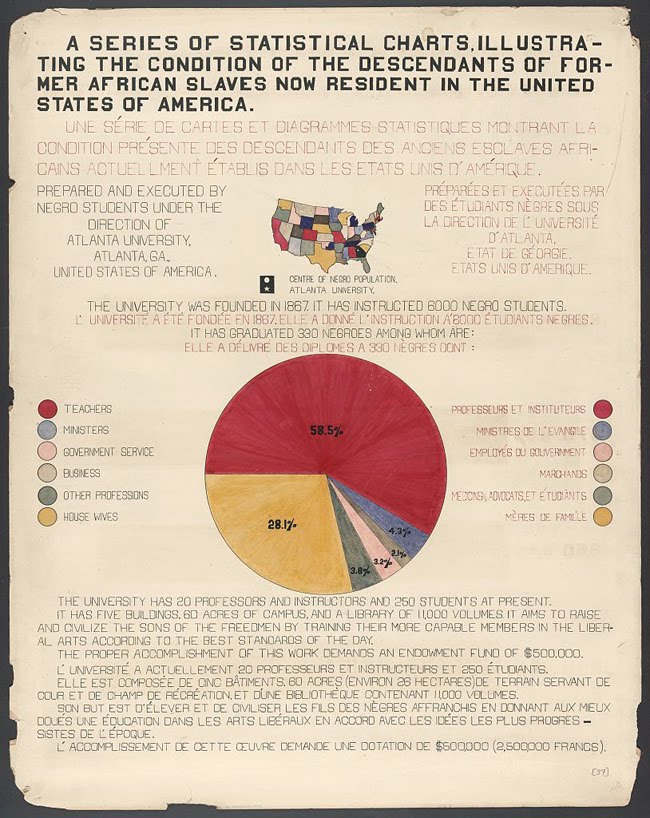
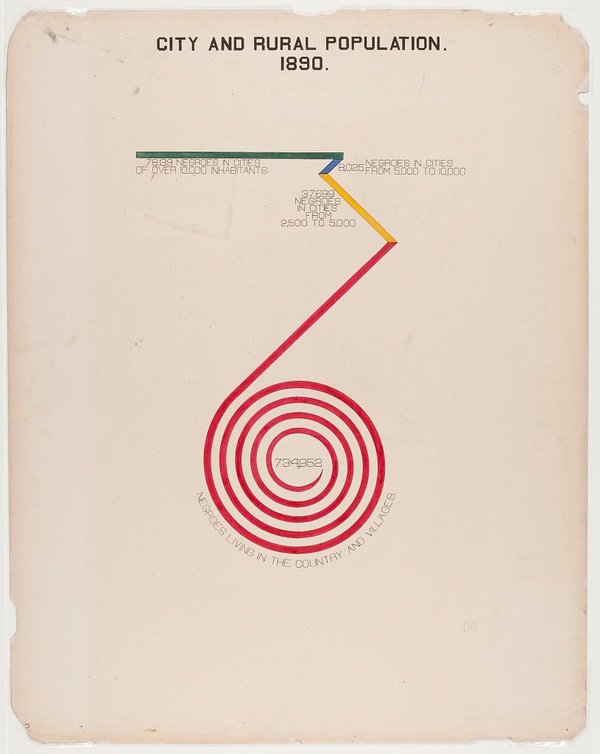
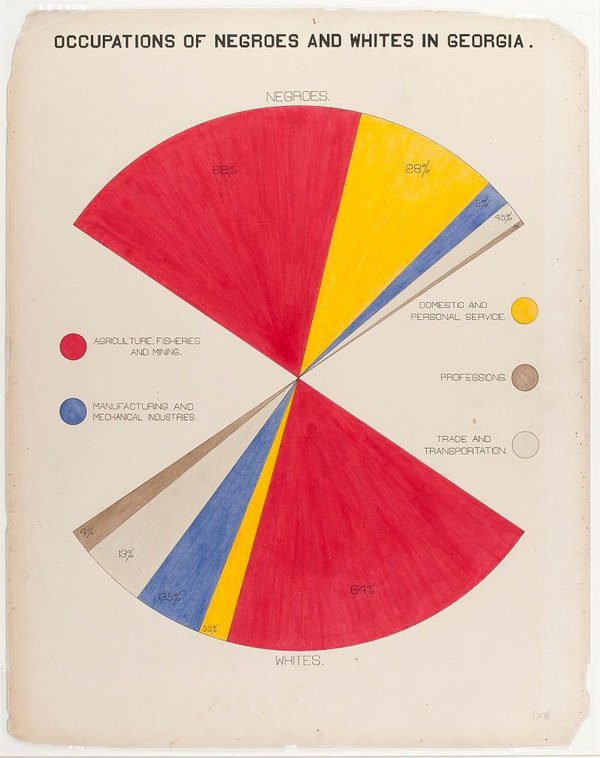
In 1900, Du Bois attended the First Pan-African Conference, held in London at Westminster Hall just prior to the Paris Exhibition. Attendees presented papers on “the African origins of human civilization,” writes Ramla Bandele at Northwestern’s Global Mappings, on African self-government, and on the imperial aggression of European countries (including the host country). Du Bois arrived armed with what might have seemed like a dull offering to some: a collection of statistics. But not just any collection of statistics. Though they’re now an often banal staple of our everyday working lives, his presentation used then-innovative charts and graphs to condense his data into a powerful set of images.
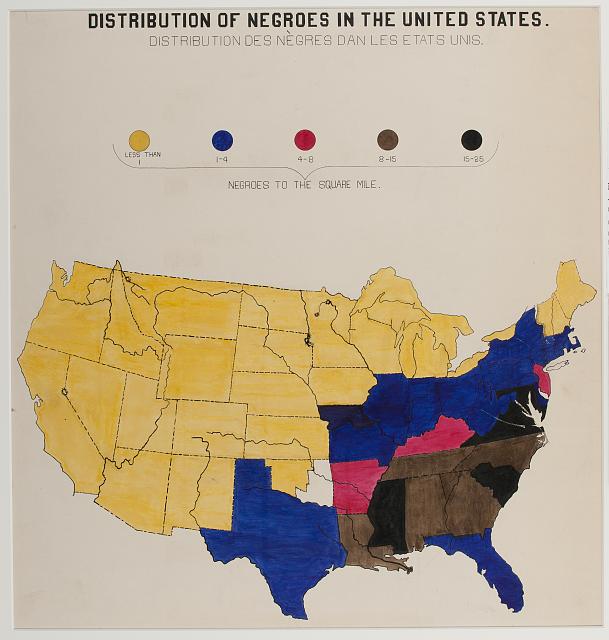
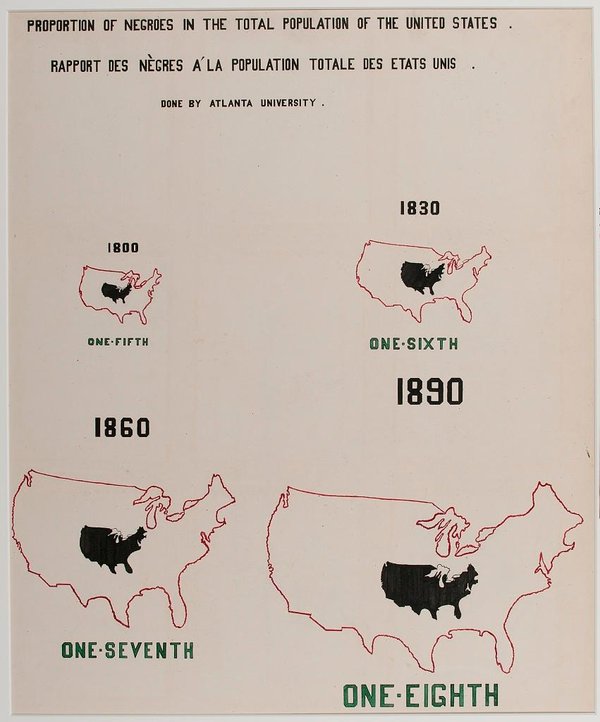
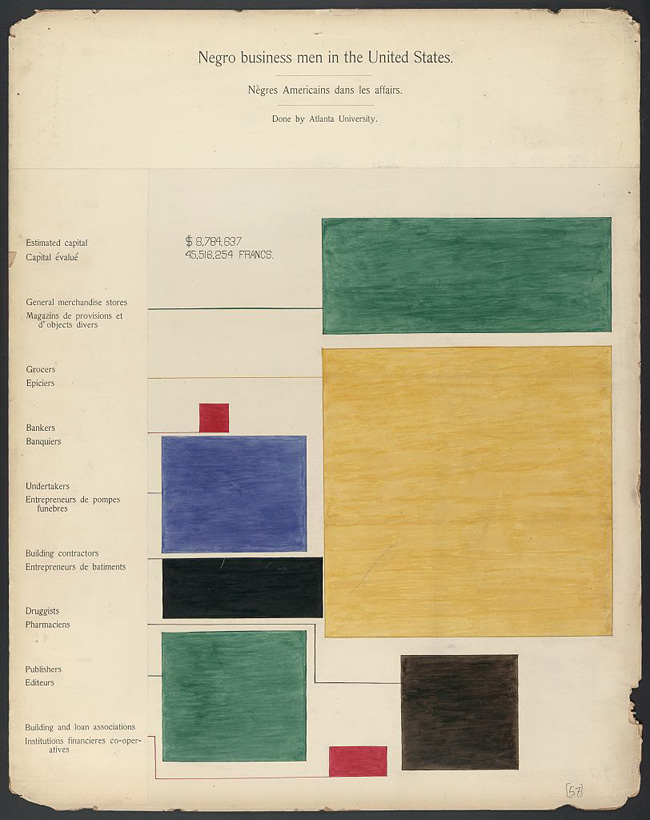
Once again anticipating global trends of over a century hence, the activist and sociology professor at Atlanta University created around 60 eye-catching data visualizations, “charts and maps,” writes the blog All My Eyes, “hand drawn and colored at the turn of the 19th century” by Du Bois and his students.
For audiences at the time, these must have packed the evidentiary punch that Michelle Alexander’s The New Jim Crow or Ta-Nehisi Coates’ “The Case for Reparations” have recently. Du Bois and his students’ charts show us—as the first “slide” at the top of the post notes—“the condition of the descendants of former African slaves now resident in the United States of America.”
The collection of infographics, Danny Lewis argues at The Smithsonian, “is just as revolutionary now as it was when it was first created,” for an exhibit Du Bois organized with a lawyer named Thomas J. Calloway and his occasional rival Booker T. Washington. “This was less than half a century after the end of American slavery,” writes Allison Meier at Hyperallergic, “and at a time when human zoos displaying people from colonized countries in replicas of their homes were still common.” In the U.S., the grotesque stereotypes of blackface minstrels provided the primary depiction of African-American life.
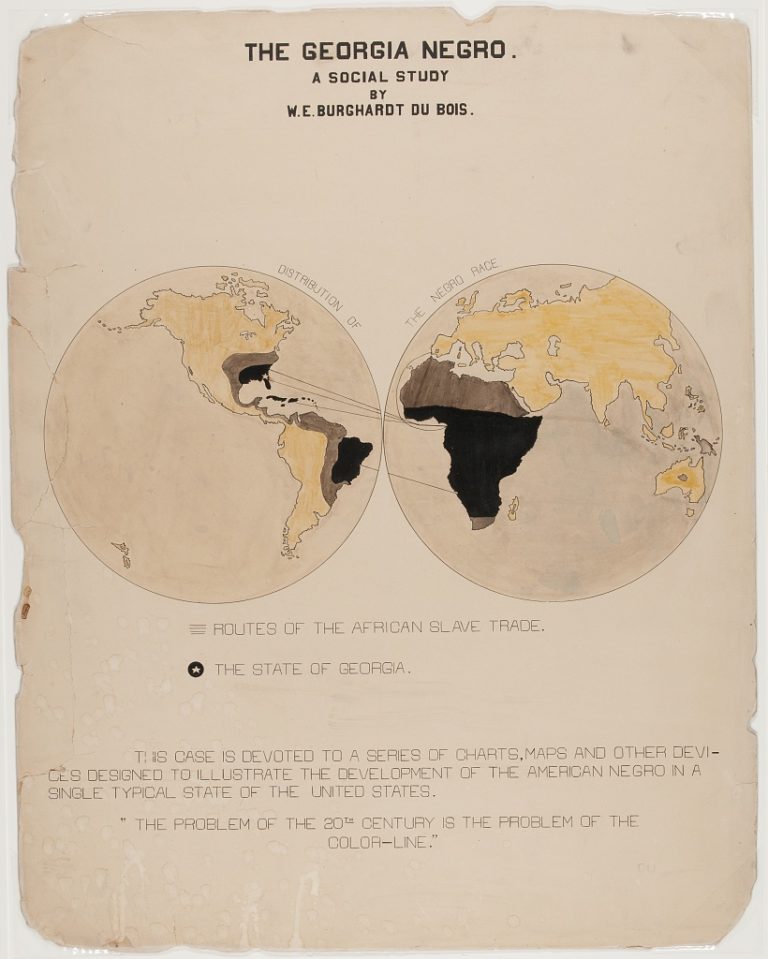
“Du Bois’ students,” writes data blog Seeing Complexity, “made a radical decision when they visualized the economic plight of a group explicitly excluded from statistical analysis and thus hidden from international attention.” The level of detail—for Du Bois’ time and ours—is overwhelming, reminding us that “the simple act of disseminating information can, in itself, be a radically and potentially transformative act.” In one of Du Bois’ graphic studies, “The Georgia Negro,” he quotes his key line from The Souls of Black Folk, “The problem of the 20th century is the problem of the color-line.” Far too much current data demonstrates that the statement still holds true in the 21st century, as gross disparities in wealth and in the criminal justice system grimly persist, or worsen, along racial lines.
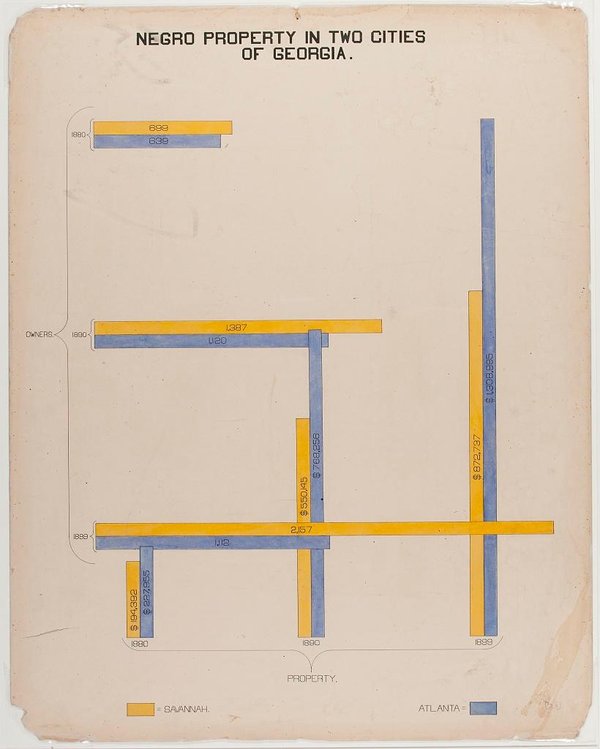
Data may not be as transformative as Du Bois had hoped, but it forces us to confront the reality of the situation—and either rationalize the status quo or seek to change it. One of three parts of the exhibit, The Georgia Negro study was Du Bois’ “most important contribution to the project,” writes Professor Eugene Provenzo in his book on the subject. The charts are truly impressive for their distillation of “an enormous amount of statistical data,” drawn from “sources such as the United States Census, the Atlanta University Reports, and various governmental reports that had been compiled by Du Bois for groups such as the United States Bureau of Labor.” (Much of the data would have gone uncollected were it not for Du Bois’ tireless efforts.)
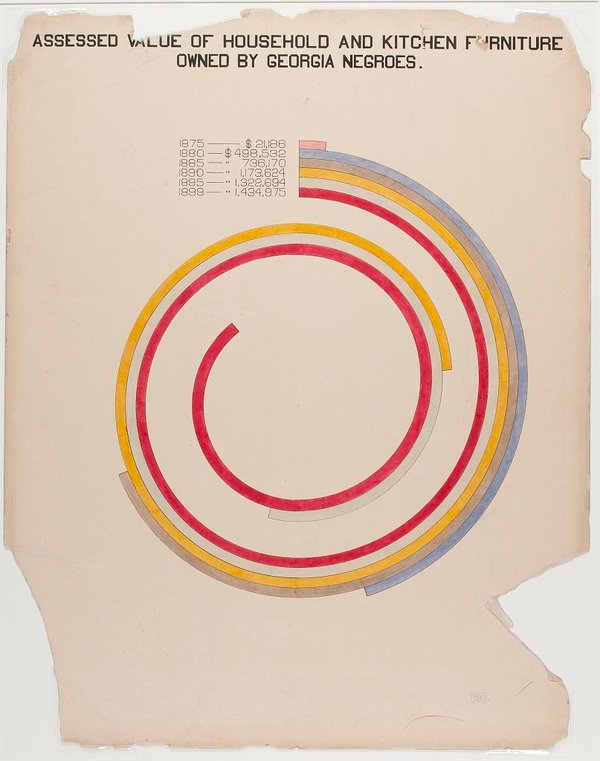
The charts are also, Provenzo notes, “remarkable in terms of their design,” as you can see for yourself. Du Bois and his students committed to “examining everything,” Meier writes, quoting Slate’s Rebecca Onion, “from the value of household and kitchen furniture to the ‘rise of the negroes from slavery to freedom in one generation.’” And they did so in a way that still looks “strikingly vibrant and modern, almost anticipating the crossing lines of Piet Mondrian or the intersecting shapes of Wassily Kandinsky.” However much their creators had explicitly modernist intentions, these designs also draw from historical techniques in data visualization—from 17th century scientific texts to Florence Nightingale’s revolutionary 19th century epidemiological maps.
You can view and download scans of all the hand-drawn Du Bois’ Pan-African Conference charts and graphs at the Library of Congress. There, you’ll also find other features of the Du Bois/Calloway/Washington Exhibit, including photographs of several African-American men who had “received appointment as clerks in civil service departments… through competitive examinations” and a “hand-lettered description of Hampton Normal and Agricultural Institute” in Virginia. Du Bois’ description of his project says as much about his sense of Black Nationalism as it does about pride in the progress made a generation after slavery: “an honest straightforward exhibit of a small nation of people, picturing their life and development without apology or gloss, and above all made by themselves.”
We're hoping to rely on loyal readers, rather than erratic ads. Please click the Donate button and support Open Culture. You can use Paypal, Venmo, Patreon, even Crypto! We thank you!
Open Culture scours the web for the best educational media. We find the free courses and audio books you need, the language lessons & educational videos you want, and plenty of enlightenment in between.