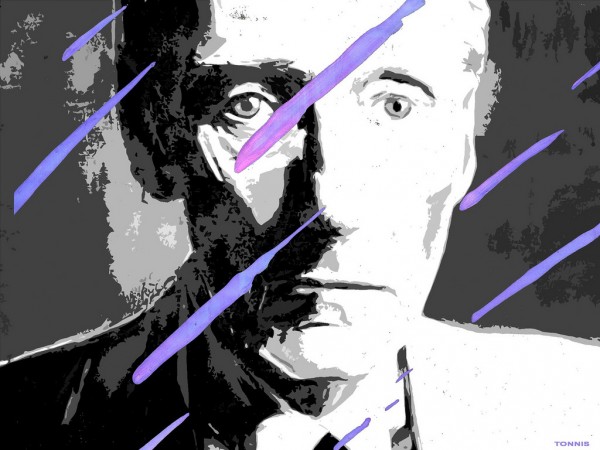
If you were American and in school during the late ‘80s and through the ‘90s, you would have seen the American Library Association’s series of promotional posters that paired a celebrity with his/her favorite book, and a simple command: READ. Need it be pointed out that the coolest of the batch, and one of the first to be shot for the series, was the one featuring David Bowie? (This also probably meant your librarian was cool too.)
Ted Mills is a freelance writer on the arts who currently hosts the artist interview-based FunkZone Podcast. You can also follow him on Twitter at @tedmills, read his other arts writing at tedmills.com and/or watch his films here.
Tom Waits is that rare breed of artist who has equal amounts of credibility in the art house theaters and on the punk rock street. His depression-era everyman blues and drunken skid row laments ring just as true as his high-concept vaudeville theater act and cocktail lounge performance art. Having the ability to convincingly set his brow high or low makes Waits an excellent ambassador for film, a medium sadly riven by brow height. While cable TV and Netflix may be the art houses of the 21st century, let’s not give up on the cultural reach of legacy archives like the Criterion Collection just yet. Not before we hear Waits weigh in on his favorite art films.
Waits’ filmography as an actor is itself a testament to his brow-spanning abilities—from such wide-release fare as Dracula and Seven Psychopaths to the scrappy, intimate films of Jim Jarmusch, and more or less everything in-between. The threads that run through all of his film choices as an actor are a certain surreal sense of humor and the off-kilter humanity and formal anarchy we know so well from his musical choices.
We see similar proclivities in Waits’ film favorites, as compiled by Chris Ambrosio at Criterion. Most of the choices are of the, “Ah, of course” variety in that these films so perfectly explain, or illustrate, the Tom Waits universe. We might imagine many of them with alternate soundtracks of songs from Real Gone, Swordfishtrombones, Bone Machine, etc.
First, up, of course, Fellini’s neorealist La Strada, a film about the saddest, sweetest, gruffest traveling circus act ever. Waits also confesses a passion for all of the beautifully overwrought films of Carl Theodor Dreyer, including the profound and disturbing 1928 The Passion of Joan of Arc and 1932 horror classic Vampyr (both above). You can see the full list of Waits’ favs below. Let your passion for art film be rekindled, and when watching the silent films, consider putting on some Mule Variations or Blood Money. You’ll probably find it fits perfectly.
First published in three volumes in 1914, only 24 years after his death, the letters of Vincent Van Gogh have captivated lovers of his painting for over a century for the insights they offer into his creative bliss and anguish. They have also long been accorded the status of literature. “There is scarcely one letter by Van Gogh,” wrote W.H. Auden, “which I do not find fascinating.”
That first published collection consisted only of the painter’s 651 letters to his younger brother, Theo, who died six months after Vincent. Compiled and published by Theo’s wife, Johanna, Van Gogh’s correspondence became instrumental in spreading his fame as both an artist and as a chronicler of deep emotional experiences and religious and philosophical convictions.
Now available in a six-volume scholarly collection of 819 letters Vincent wrote to Theo and various family members and friends—as well as 83 letters he received—the full correspondence shows us a man who “could write very expressively and had a powerful ability to evoke a scene or landscape with well-chosen words.” So write the Van Gogh Museum, who also host all of those letters online, with thoroughly annotated English translations, manuscript facsimiles, and more. The collection dates from 1872—with a few mundane notes written to Theo—to Van Gogh’s last letter to his brother in July of 1890. “I’d really like to write to you about many things,” Vincent begins in that final communication, “but sense the pointlessness of it.” He ends the letter with an equally ominous sentiment: “Ah well, I risk my life for my own work and my reason has half foundered in it.”
In-between these very personal windows onto Van Gogh’s state of mind, we see the progression of his career. Early letters contain much discussion between him and Theo about the business of art (Vincent worked as an art dealer between 1869 and 1876). Endless money worries preoccupy the bulk of Vincent’s letters to his family. And there are later letters between Vincent and Paul Gaugin and painter Emile Bernard, almost exclusively about technique. Since he was “not in a dependent position” with artist friends as he was with family, in the few letters he exchanged with his peers, points out the Van Gogh Museum, “the sole focus was on art.”
And as you can see here, Van Gogh would not only “evoke a scene or landscape” with words, but also with many dozens of illustrations. Many are sketches for paintings in progress, some quick observations and rapid portraits, and some fully-composed scenes. Van Gogh’s sketches “basically served one purpose, which was to give the recipient an idea of something that he was working on or had finished.” (See the sketch of his room in an 1888 letter to Gauguin at the top of the post.) In early letters to Theo, the sketches—which Vincent called “scratches”—also served to convince his younger brother and patron of his commitment and to demonstrate his progress. You can peruse all of the letters at your leisure here. Click on “With Sketches” to see the letters featuring illustrations.
Since 1999, NASA has used ASTER (Japan’s Advanced Spaceborne Thermal Emission and Reflection Radiometer) to gather images of the Earth’s surface, providing a way to “map and monitor the changing surface of our planet.” They’ve mapped 99% of the planet’s surface over the years, generating nearly three million images, showing all kinds of things — “from massive scars across the Oklahoma landscape from an EF‑5 tornado and the devastating aftermath of flooding in Pakistan, to volcanic eruptions in Iceland and wildfires in California.”
And now, NASA is letting the public download and use those images at no cost. (Read the NASA announcement here.) You can access most of the images through a NASA database, and a smaller subset via an ASTER website.
To be completely honest, you’ll need some patience and technical chops to figure out how to download these images. The method wasn’t obvious to me. If anyone has some clarity on that, please let us know in the comments, and we’ll update the post to include your insights.
Up top, see an aerial shot of The Andes Mountains in Chile/Bolivia. Further down a shot of the Lena River in Russia.
If you would like to sign up for Open Culture’s free email newsletter, please find it here. It’s a great way to see our new posts, all bundled in one email, each day.
If you would like to support the mission of Open Culture, consider making a donation to our site. It’s hard to rely 100% on ads, and your contributions will help us continue providing the best free cultural and educational materials to learners everywhere. You can contribute through PayPal, Patreon, and Venmo (@openculture). Thanks!
All of us who saw Jurassic Park as kids, no matter how much skepticism we’d precociously developed, surely spent at least a moment wondering if science could actually bring dinosaurs back to life by pulling the DNA out of their blood trapped in amber-preserved mosquitoes. It turns out that it can’t — at least not yet! — but even so, we had to admit that Steven Spielberg and his CGI-savvy collaborators (not to mention their huge budget) achieved, on screen, the next best thing. Even so, people have long disagreed about whether to call the visual resurrection of dinosaurs in the service of a blockbuster adventure movie a work of art.
But what if we used the even more powerful data analysis and computer graphics technology now at our disposal specifically for the purpose of generating a masterpiece, or at least a piece by a master — by Rembrandt, say? A project called The Next Rembrandt has aimed to do just that with its attempt “to distill the artistic DNA of Rembrandt” using everything from building and analyzing “an extensive analysis of his paintings [ … ] pixel by pixel,” to performing a demographic study determining his conclusive portrait subject (“a Caucasian male with facial hair, between the ages of thirty and forty, wearing black clothes with a white collar and a hat, facing to the right”), to creating a height map to mimic his physical brush strokes.
“You could say that we use technology and data like Rembrandt used his paints and his brushes to create something new.” Those bold words come from Ron Augustus, Microsoft’s director of small- and medium-sized business markets, in the promotional video at the top of the post. His employer acts as one of two partners involved in The Next Rembrandt, the other being the Dutch bank ING — hence, presumably, the choice of painter to resurrect. Their combined resources have produced a wholly theoretical, but in a physical sense very real, new “Rembrandt” portrait, meticulously 3D-printed at 148 megapixels in thirteen layers of paint-based UV ink.
Despite its impressive plausibility, nobody expects the fruit of the Next Rembrandt project’s considerable labors, unveiled yesterday in Amsterdam, to hang in the Rijksmuseum next to The Night Watch. But it can, properly considered, teach us all a great deal about what, in the words of ING executive creative director Bas Korsten, “made Rembrandt Rembrandt.” And like any cutting-edge stunt, it also gives us a glimpse into what technology will sooner or later make possible for us all. How long could we possibly have to wait before we can 3D-print, on canvas with oil paint, portraits of ourselves as Rembrandt almost certainly would have painted us — or our very own Night Watch, indistinguishable from the original? Truly, we stand on the cusp of a golden age of forgery.
Last year, we highlighted the Harvard Grant Study and The Glueck Study, two 75-year studies that have traced the lives and development of hundreds of men, trying to get answers to one big question: How can you live a long and happy life? For answers, watch Robert Waldinger above. He’s the director of what’s now called the Harvard Study of Adult Development and also an associate professor of psychiatry at Harvard Medical School.
According to the decades-long study, you won’t get health and happiness from wealth and fame (nor hard work), the mirages that many Americans chase after. Instead they come from something a little more obtainable, if you work at it—good, strong relationships with family, friends, colleagues, and folks in your community. These relationships, the study finds, protect us mentally and physically. They increase our happiness and extend our lives, whereas, conversely, loneliness and corrosive relationships put us into decline sooner than we’d like. The key takeaway here: good relationships are the foundation on which we build the good life. Start putting that into practice today.
If you would like to sign up for Open Culture’s free email newsletter, please find it here. It’s a great way to see our new posts, all bundled in one email, each day.
If you would like to support the mission of Open Culture, consider making a donation to our site. It’s hard to rely 100% on ads, and your contributions will help us continue providing the best free cultural and educational materials to learners everywhere. You can contribute through PayPal, Patreon, and Venmo (@openculture). Thanks!
Abstract art, spurred into being by the emergence of photography, had by 1912 begun to face an even more technically adroit competitor for the public’s eye: film. Marcel Duchamp responded by superimposing all of the discrete moments that make up a film reel into one astonishing image that is both static and always in motion. Over one hundred years after its composition, Marcel Duchamp’s Nude Descending a Staircase, No. 2 (below) still amazes viewers with its absolute novelty. He was asked to withdraw the painting from a cubist exhibition when the committee pronounced it “ridiculous.”
Five years later, feeling with his fellow Dadaists that the avant-garde had grown too cozy with the establishment, and too precious in its approach and reception, Duchamp submitted a signed urinal for an exhibition, the first of many replicas to occupy galleries for the past one-hundred years—and a provocation once voted the most influential modern art work ever. Like some sort of trickster god, Marcel Duchamp possessed transformative powers, which also had the effect of driving everyone around him crazy. There seem to be no two ways about it: people either think Duchamp is a genius, or they consider him a fraud.
Like most of his Dada contemporaries, Duchamp left no medium untouched, from painting, to sculpture, to film. And when it came to music, Ubuweb informs us, he enthusiastically applied himself, between the years 1912 and 1915, to “two works of music and a conceptual piece—a note suggesting a musical happening.” Like all of his creative work—love it or hate it—his compositions “represent a radical departure from anything done up until that time.” Also like his other works, his music gleefully trespassed formal boundaries, anticipating “something that then became apparent in the visual arts,” amateur experimentation. Duchamp respected no school and no canon of taste, and his “lack of musical training could have only enhanced his exploration.”
The methods employed were, of course, conceptual, and seriously playful. In “Erratum Musical,” written for three voices, “Duchamp made three sets of 25 cards, one for each voice, with a single note per card. Each set of cards was mixed in a hat; he then drew out the cards from the hat one at a time and wrote down the series of notes indicated by the order in which they were drawn.” The second piece, directly above, “La Mariée mise à nu par ses célibataires même. Erratum Musical (The Bride Stripped Bare by Her Bachelors Even. Erratum Musical),” contains instructions for a “mechanical instrument.” It is also “unfinished and is written using numbers instead of notes.”
Finally, “Sculpture Musicale (Musical Sculpture)”—vocalized by John Cage above, and recreated with music boxes below—consists of “a note on a small piece of paper” and anticipates the “Fluxus pieces of the early 1960s.” While Dada artists nearly all experimented with music, mostly in the form of a kind of confrontational musical theater, Duchamp’s cerebral compositions push into the territory of purely conceptual exercises created through chance operation. In “Erratum Musical,” for example, “the three voices are written out separately, and there is no indication by the author, whether they should be performed separately or together as a trio.” The arrangement depends entirely on the time and place of performance and the intuitions of the interpreters.
The Rube Goldberg machine described by Duchamp’s second piece, along with the notation system of his own devising, makes it seem impossible to perform; likewise the entirely non-musical “Sculpture Musicale.” The recordings we have here represent only possible versions. Hear others at Ubuweb, along with several interviews with Duchamp in French and English.
Growing up in the Washington, DC suburbs in the 80s and 90s among a certain subculture of disaffected youth meant that the short cult documentary Heavy Metal Parking Lot had an especially legendary status. Everybody seemed to know a friend of a friend’s older brother or sister who had been caught on camera by filmmakers John Heyn and Jeff Krulik outside that 1986 Judas Priest concert at Largo, Maryland’s Capital Centre (RIP). But geographical proximity alone to the titular parking lot does not explain the 17-minute video’s popularity.
Since its first screening at a club called DC Space, Heavy Metal Parking Lot has become one of the most beloved of rock films worldwide, a “sociological study of headbangers,” writes Rolling Stone, who rank the short at number 33 in their list of the 40 Greatest Rock Documentaries. “Decades before the internet made sharing video clips as simple as posting to Twitter or Facebook,” writes The Verge, “Heavy Metal Parking Lot caught on, not through official distribution channels, but through an underground network of fans that would dub VHS copies and pass them along.” (The movie got a big boost when the filmmakers gave a copy to DC-area native Dave Grohl, who kept it on regular rotation on the Nirvana tour bus.)
What makes this exposé of metal fans so special? Although there’s undoubtedly a segment of its viewers who laugh at the film’s collection of mostly anonymous mid-eighties metal fans, for the most part, Heavy Metal Parking Lot’s appeal has not been that of so much viral internet content—mean-spirited comedy at the expense of naïve amateurs. Thought it’s tempting, as Rolling Stone remarks, “to mock these mullet-afflicted metalheads… there’s an undeniable sweetness that permeates” the mini-doc and its subjects’ “innocent quest for rock & roll kicks.”
The sheer goofiness and joyous abandon that is 80s heavy metal contributes to the film’s character. And much of the love of Heavy Metal Parking Lot comes from the same nostalgic place as that for Dazed and Confused except that its characters are the real deal. The documentary presents an authentic record of mid-80s suburban youth in America. It’s likely costume designers of Richard Linklater’s follow-up period piece Everybody Wants Some!! studied Heavy Metal Parking Lot in detail.
Like Linklater’s testosterone-heavy films, Heavy Metal Parking Lot is largely dominated by dudes—metal bros who “may occasionally be inarticulate, sexist and obnoxious.” And yet, even fans of the film who grew up in more enlightened times and places—and who may not have had friends who looked just like these guys—have found much to love in the movie. The slice-of-life character studies and interviews create “a time capsule,” Krulik told the Verge on the documentary’s 30th anniversary screening, one surprisingly still “a little bit shocking.”
On the other hand, Heavy Metal Parking Lot remains a vital, timeless record of fandom—of the unvarnished, uncritical devotion young lovers of any pop culture phenomenon bestow upon their object. And like certain other documentaries about fandom—such as 1997’s Trekkies—Heavy Metal Parking Lot allows its subjects to fully be themselves, without judgment or condescension. Even as ordinary, mostly nameless, mostly stoned and shirtless kids in the suburbs, those selves prove to be as at least as entertaining as the flamboyant band they came to see.
Last year, we let you know that the first season of The Joy of Painting, the public-television paint-along show hosted by the neatly permed and persistently reassuring Bob Ross, had appeared free to watch online.
Produced by WNVC in Falls Church, Virginia, that season aired in 1983, and had some rough edges — the audible movements and murmurs of the crew in the background, the naturally improvisational Ross’ occasional stumble over one of his scripted lines — that would get thoroughly smoothed away as the program rapidly became an international TV institution, a process you can witness again for yourself now that Bob Ross’ Youtube channel has made available all 31 seasons free online.
Season Two
“Bob Ross died in 1995 at 52 after a battle with lymphoma,” writes the New York Times’ Foster Kamer, “but his cultural legacy has grown in his absence. He was around to witness the beginnings of his own cult status. In the early ’90s, he was big in Japan. And MTV, catering to the Gen X penchant for irony, ran a series of promotionaladvertisements that featured him.”
Gen Xers across America would surely all have caught glimpses of Ross — and more importantly, heard a few of his mesmerizingly delivered words — during late-night or midday channel-surfing sessions, but now, thanks to the increasing availability of The Joy of Painting’s archives on-demand and online, it’s made new fans even of those born after Ross had already departed.
Season Three
The show always made it easy for its viewers to paint as they watched, with Ross always taking the time to run down the short list of required tools, making tirelessly sure to emphasize that under no circumstances should they buy nylon brushes or clean those brushes with turpentine. As the production values increased, so did the number of colors on the palette, though they never expanded too far beyond the core set, which The Joy of Painting die-hards can rattle off like a mantra, of Bright Red, Phthalo Blue, Midnight Black, Alizarin Crimson, Cadmium Yellow, Van Dyke Brown, Titanium White, Sap Green — and, as Ross himself might say, the “almighty” canvas-covering Magic White, the foundation of the “wet-on-wet” technique he learned from mentor, and later bitter rival, Bill Alexander.
Season Four
The New York Times article quotes Annette Kowalski, a onetime student of Ross who now helps run the Bob Ross, Inc. empire, on the host’s enduring appeal as a teacher: “If you listen closely to Bob’s programs, he never says ‘I’m going to teach you this. He never assumes that he knows more than you do. He says: ‘We’ll learn this together.’ And I think — even though people don’t realize it — I think that’s what his big turn-on is.” But it almost goes without saying that not everyone fascinated by the show, and maybe not even most people fascinated by the show, actually have any desire to paint themselves.
Season Five
So why do they still tune in, on whatever platform they might tune in on, and in such large numbers? The key must have something to do with Ross’ oft-repeated reminders to his viewers that, when it comes to the landscapes on their own canvases, “this is your world, your creation,” and in your world, “there are no set, firm rules — you find what works for you, and that’s what you do.” On The Joy of Painting, Ross created a world, or perhaps a reality, of his own, one where “anybody can paint; all you need is a dream in your heart and a little practice,” where “there are no mistakes, just happy accidents” (plentifully inhabited, of course, by “happy little trees”), and one which many found they enjoyed living in, brush in hand or not, even if only for 26 minutes at a time.
Season Six
We will continuing adding seasons to this list as they become available.
David Bowie’s 1974 album Diamond Dogs introduced a new hodgepodge of musical styles: “The music,” writes Nicholas Pegg, “was a four-way tussle between the receding sounds of glam, the rising influence of black soul, the synthesized nightmares of The Man Who Sold the World, and the ubiquitous rock’n’roll swagger of Jagger.” With its echoes of A Clockwork Orange and William S. Burroughs’ The Wild Boys, Bowie called the songs on the album part of a “glitter apocalypse” and described its conceptual scenario as “the breakdown of a city… a disaffected youth that no longer had home-unit situations, but lived as gangs on roofs and really had the city to themselves.” His “fragmented lyrics and the portrait of urban America’s sordid meltdown,” writes Pegg, “were clearly indebted to Burroughs.”
This was a mode in step with the late sixties/early 70s decadent ethos (and a concept anticipating later cult films like The Warriors and Escape from New York.) And yet, far from societal decay, one of Bowie’s original visions for the project was an adaptation of George Orwell’s novel of totalitarian social control, 1984. Diamond Dogs may work as a concept album in an oblique sort of way, but it came together, writes Bowie blog Pushing Ahead of the Dame, as “a salvage job, a compilation of scraps from stillborn Bowie projects.” In addition to the “urban meltdown” story, an aborted Ziggy Stardust musical produced two of Diamond Dogs’ songs, “Rebel Rebel” and “Rock’n’Roll With Me.” And Bowie’s foray into Orwell gave us “We Are the Dead,” “Big Brother,” and, of course, the Isaac Hayes-cribbing “1984.” (Hear the album version below and an earlier version at the top of the post, with a few more Orwellian lyrics and joined with an earlier song, “Dodo.”)
Perhaps his first public mention of the project came as “almost an aside,” notes Pegg, when he casually mentioned in a Rolling Stone interview with Burroughs, “I’m doing Orwell’s Nineteen Eighty-Four on television.” At first, the project had a much more ambitious scope. Chrisopher Sandford describes Bowie’s planned adaptation as “a West End musical, with an accompanying album and film, little of which ever happened.” Orwell’s widow and executor of his estate, Sonia Brownell considered the project in poor taste and refused him the rights to the novel. (Her death in 1980 allowed director Michael Radford to make his film version, and the Eurythmics to record their contested soundtrack album.)
What survives are the songs—as well as the visions of Orwell and Burroughs that continued to resonate in Bowie’s work. The mash-up of musical styles and political concepts in Diamond Dogs signals a kind of confusion of Bowie’s own politics—or those of his competing personae—which his later albums doggedly pursue.
On the one hand, Diamond Dogs sees Bowie hanging on to the role of alien dandy Ziggy Stardust. He had also embraced the avant-garde paranoia of Burroughs’ magical belief system and Orwell’s nightmare of institutional control and surveillance. Oddly pulling these tendencies together was the soul music that emerged fully-fledged on Young Americans. When it came to Orwell, “what fascinated Bowie,” writes Pushing Ahead of the Dame, “what was arguably the only thing that truly interested him in the mid-‘70s, was power, and the schizophrenic manner of thinking—double-thought, basically—that allows, even encourages its abuses.”
For a time, as Bowie moved into his Berlin phase, the fascination with power dominated his aesthetic, such that he got a little too carried away with his Thin White Duke character’s flirtations with fascism. (“By 1979,” writes Stereo Williams, “Bowie had dropped the Duke image and referred to it as ‘a nasty character for me.’”) But the theme of “double-thought,” the fascination with Orwellian dystopias, and the influence of Burroughs’ paranoia and cut-up technique survived the death of both the Thin White Duke and of Ziggy, the interstellar flâneur.
Twenty years after Diamond Dogs, strains of Orwell and Burroughs came together in Bowie’s dystopian epic Outside, whose lyrics, writes Sandford, “were subjected to a spin in his computer, industrializing the technique once limited to scissors and paste.” Orwellian themes crop up again in other later Bowie concept albums, and in a way, he continued to adapt the novel long after the literary experiments on Diamond Dogs, only in cut-up fashion rather than as glam musical theater.
Henrietta Louisa Koenen was born a century before the Guerrilla Girls, but her collecting habits are a strong argument for honorary, posthumous membership in the activist group.
The wife of the Rijksmuseum’s Print Room’s first director, Koenen spent over three decades acquiring prints by female artists, though discouragingly few of the 827 women in her collection achieved much in the way of recognition for their work.
(And it would be unseemly not to credit American art dealer Samuel Putnam Avery, for donating Koenen’s collection to the library at the turn of the last century, twenty years after her death.)
And Maria Cosway’s Music Has Charms, at the top of this post, was a family affair, with Cosway printing husband Richard’s celestial rendering of daughter Louisa Paolina Angelica. (Mrs. Cosway was also an accomplished composer and painter of miniatures and mythological scenes, though history has decreed her most enduring claim to fame should be her hold over a besotted Thomas Jefferson.)
I believe that the domestic objects with which we spend our lives retain traces of our histories and tell stories about our pasts. These prints are part of an ongoing series of portraits of chairs drawn in the way we imagine them to be. Two of the chairs in this series were drawn from existing objects with a rich history, while the rest are imagined character studies.
Her thoughts seem particularly germane, when the “lesser genres” of ornament, still-life, and landscape were by default frequent subjects for the female artists in Koenen’s collection. Propriety deemed the fairer sex should not be party to the nude figure studies that significant religious and historical scenes so often demanded.
(Channel your inner Guerrilla Girl by performing an image search on Rape of the Sabine Women, and imagining the models as aspirant artists themselves, confined to such subject matter as violets and laundry day.)
That’s not to say domestic subjects can’t prove divine.
View the online brochure for New York Public Library’s Printing Women: Three Centuries of Female Printmakers, 1570–1900 exhibition here. The exhibition at The New York Public Library ends May 27th, 2016.
We're hoping to rely on loyal readers, rather than erratic ads. Please click the Donate button and support Open Culture. You can use Paypal, Venmo, Patreon, even Crypto! We thank you!
Open Culture scours the web for the best educational media. We find the free courses and audio books you need, the language lessons & educational videos you want, and plenty of enlightenment in between.