
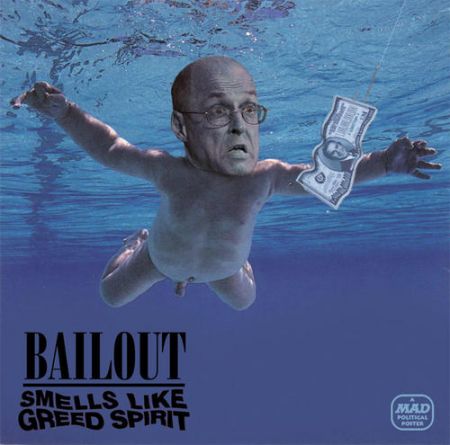
MAD Parodies the Bailout: “Smells Like Greed Spirit”
Straight from BoingBoing: The new MAD Magazine artwork below. Glad someone can find a little humor in this…
(PS Also see BoingBoing’s piece on the changing WaMu web site.)
The Financial Crisis Explained
NPR’s Fresh Air has been doing a very good job of demystifying the financial crisis. Here, we have an interview with the Pulitzer Prize-winning financial journalist, Gretchen Morgenson. As you’ll see, the program (iTunes — RSS Feed — Stream Here) does an excellent job of connecting many small dots, explaining precisely how the recklessness of Wall Street threatens to spill over into Main Street and beyond, harming our individual and collective financial future. Even if you live outside the US, this all probably applies to you. Definitely worth a listen.
Related Content:
Ten Days That Shook The Financial World
This American Life Demystifies The Credit Crisis
The 2008 Bailouts V. The Great Depression Bailouts

The Life of “W” According to Oliver Stone
Rather slick trailer. (And got to wonder how filming the pretzel scene didn’t hurt.) “W,” Oliver Stone’s new biopic, hits the theaters this fall.
Music for Our Economic Times, Or a Creative R.E.M. Remix

The Top Five Collections of Free University Courses
Last week, the launch of Stanford Engineering Everywhere, featuring 10 free computer science and engineering courses, got no shortage of buzz on the net. This led me to think, why not highlight other major collections of free university courses/resources. As you’ll see, each collection offers countless hours of free, high quality content. Download the audio and video to your iPod or computer, and you can get lost here for days, weeks, even months. A perfect way to distract yourself on the cheap during the recession. For many more free courses, be sure to see our larger collection of Free Courses, which now includes over 250 free classes from leading universities.
1. UC Berkeley — Stanford’s neighbor to the north makes available a large number of courses online. The collection features lectures taken directly from the undergraduate classroom. And they can be accessed through multiple means — that is, through the web/rss feed, through Berkeley’s iTunesU site, and via YouTube. Overall, this is probably the deepest collection of free academic content out there. And here you’ll find one of the most popular undergraduate courses at UC Berkeley: Physics for Future Presidents, taught by Richard Muller. You can download the course in audio (iTunes — Feed — MP3s) or watch it in video here.
2. Yale — Last fall, Yale launched an open course initiative known as Open Yale Courses. The university initially came out of the gate with seven courses, and it plans to release another eight this fall. As you will see, Yale’s project is high-touch. Each course features a syllabus, reading assignments, class notes, and polished lectures, which, when taken together, contribute to a well-rounded learning experience. The lectures can be downloaded in one of five formats (text, audio, flash video, low bandwidth quicktime video, and high bandwidth quicktime video). And quite notably, Yale has designed the courses to be downloaded fairly easily, which means that you can put the lectures onto an mp3 player, even if you’re only a little tech savvy. Here’s a list of the course titles that you will find: Frontiers and Controversies in Astrophysics, Modern Poetry, Death, Fundamentals of Physics, Introduction to Political Philosophy, Introduction to Psychology, and Introduction to the Old Testament.
3. MIT — By now, MIT’s OpenCourseWare project is no secret. Leading the open course charge, MIT has put online materials from 1,800 courses, including syllabi, reading lists, course notes, assignments, etc. If there was a downside to the MIT initiative, it was that it originally lacked audio and video lectures. These days, however, MIT has started to fill that gap by adding audio and video components to a number of courses, including Walter Lewin’s very popular and publicized course, Classical Mechanics. Download the course lectures in video via iTunes or in various formats here.
4. Indian Institutes of Technology — In India, there are seven institutes dedicated to training some of the world’s top scientists and engineers, making the country an up and coming world power. They are collectively known as the IITs, or the Indian Institutes of Technology. And now more than 50 IIT courses are being made available in English on YouTube for free. (The main page is here; the courses are actually here.) Some of the titles featured here include: Introduction to Computer Graphics, Core Science Mathematics, Computer Networks, and Introduction To Problem Solving & Programming.
5. Stanford - Yes, last week we mentioned the 10 free courses coming out of the Engineering School. But we should also mention the open course collection maintained by the larger university. Stanford’s iTunes site gives you access to dozens of lectures and lets you download close to 30 courses in their entirety. Clearly, the thinking public loves physics (witness above), and among the Stanford courses you’ll find a multi-course overview of modern physics by Leonard Susskind, who has waged a long-running “Black Hole War” with Stephen Hawking (see his new book on that subject here). The lover of the liberal arts will also find some gems, including: The Historical Jesus, History of the International System, Geography of World Cultures, and African American History: The Modern Freedom Struggle. Lastly, I’ll mention that many courses can also be found on Stanford’s YouTube collection in video. Visit here.
We’ve integrated all of these courses into our own meta list of Free Courses from leading universities. It now includes roughly 250 courses, and we’d encourage you to bookmark the page and use it often. Enjoy.

2008 MacArthur “Genius” Grants Awarded
The 2008 MacArthurs were just announced. And one goes to Alex Ross, the New Yorker music critic who recently published The Rest is Noise, a widely praised work that makes sense of 20th century classical music. Below we have Ross talking about his musical background, the New York music scene and the general gist of his book.

via Kottke.org
Michael Moore’s New Film (Slacker) Now Free Online
Just a quick reminder. Starting today (September 23), you can download Michael Moore’s new feature film — Slacker Uprising — via the web for free. This is unfortunately only available to US and Canadian residents, and it will remain free for three weeks. You can get more info and download the film here.

The New York Times Picks Five Online Lectures
In case this got lost over the weekend I am bumping it back up: The New York Times has a piece running this weekend that surveys the landscape of online university lectures. (Get a jumbo list of free courses here.) Along the way, they focus on five lectures that “no one should miss.” They are as follows:
1.) Walter H. G. Lewin, Powers of 10 (M.I.T.)
2.) Randy Pausch, Really Achieving Your Childhood Dreams (Carnegie Mellon)
3.) Dan Ariely, Predictably Irrational (Duke and M.I.T.)
We posted this one below.
4.) Langdon Hammer, Modern Poetry (Yale)
5.) Christine Hayes, Introduction to the Old Testament (Yale)


Live Performances at AOL Sessions
Courtesy of Metafilter:
“AOL Sessions has live videos from more than 150 different artists specially recorded for the series. Here are just a few of the artists on offer: Paul McCartney, Brian Wilson, Modest Mouse, Tom Petty, Red Hot Chili Peppers, Weezer, Sarah McLachlan, Bonnie Raitt, Iggy Pop, and more. To the left of the videos there’s a Q&A link that has short interview videos with the artists as well as behind the scenes footage and longer interviews.”
Support Us
We're hoping to rely on loyal readers, rather than erratic ads. Please click the Donate button and support Open Culture. You can use Paypal, Venmo, Patreon, even Crypto! We thank you!

Receive our Daily Email
About Us

Open Culture scours the web for the best educational media. We find the free courses and audio books you need, the language lessons & educational videos you want, and plenty of enlightenment in between.
Advertise With Us

