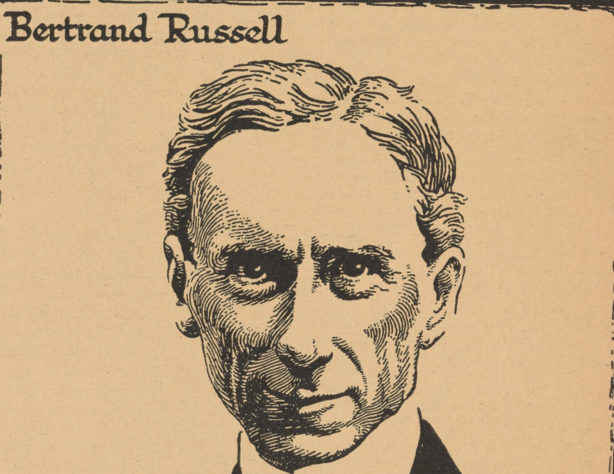
Image by J. F. Horrabin, via Wikimedia Commons
Bertrand Russell saw the history of civilization as being shaped by an unfortunate oscillation between two opposing evils: tyranny and anarchy, each of which contains the seed of the other. The best course for steering clear of either one, Russell maintained, is liberalism.
“The doctrine of liberalism is an attempt to escape from this endless oscillation,” writes Russell in A History of Western Philosophy. “The essence of liberalism is an attempt to secure a social order not based on irrational dogma [a feature of tyranny], and insuring stability [which anarchy undermines] without involving more restraints than are necessary for the preservation of the community.”
In 1951 Russell published an article in The New York Times Magazine, “The Best Answer to Fanaticism–Liberalism,” with the subtitle: “Its calm search for truth, viewed as dangerous in many places, remains the hope of humanity.” In the article, Russell writes that “Liberalism is not so much a creed as a disposition. It is, indeed, opposed to creeds.” He continues:
But the liberal attitude does not say that you should oppose authority. It says only that you should be free to oppose authority, which is quite a different thing. The essence of the liberal outlook in the intellectual sphere is a belief that unbiased discussion is a useful thing and that men should be free to question anything if they can support their questioning by solid arguments. The opposite view, which is maintained by those who cannot be called liberals, is that the truth is already known, and that to question it is necessarily subversive.
Russell criticizes the radical who would advocate change at any cost. Echoing the philosopher John Locke, who had a profound influence on the authors of the Declaration of Independence and the U.S. Constitution, Russell writes:
The teacher who urges doctrines subversive to existing authority does not, if he is a liberal, advocate the establishment of a new authority even more tyrannical than the old. He advocates certain limits to the exercise of authority, and he wishes these limits to be observed not only when the authority would support a creed with which he disagrees but also when it would support one with which he is in complete agreement. I am, for my part, a believer in democracy, but I do not like a regime which makes belief in democracy compulsory.
Russell concludes the New York Times piece by offering a “new decalogue” with advice on how to live one’s life in the spirit of liberalism. “The Ten Commandments that, as a teacher, I should wish to promulgate, might be set forth as follows,” he says:
1: Do not feel absolutely certain of anything.
2: Do not think it worthwhile to produce belief by concealing evidence, for the evidence is sure to come to light.
3: Never try to discourage thinking, for you are sure to succeed.
4: When you meet with opposition, even if it should be from your husband or your children, endeavor to overcome it by argument and not by authority, for a victory dependent upon authority is unreal and illusory.
5: Have no respect for the authority of others, for there are always contrary authorities to be found.
6: Do not use power to suppress opinions you think pernicious, for if you do the opinions will suppress you.
7: Do not fear to be eccentric in opinion, for every opinion now accepted was once eccentric.
8: Find more pleasure in intelligent dissent than in passive agreement, for, if you value intelligence as you should, the former implies a deeper agreement than the latter.
9: Be scrupulously truthful, even when truth is inconvenient, for it is more inconvenient when you try to conceal it.
10. Do not feel envious of the happiness of those who live in a fool’s paradise, for only a fool will think that it is happiness.
Wise words then. Wise words now.
Note: An earlier version of this post appeared on our site in March, 2013.
If you would like to support the mission of Open Culture, consider making a donation to our site. It’s hard to rely 100% on ads, and your contributions will help us continue providing the best free cultural and educational materials to learners everywhere. You can contribute through PayPal, Patreon, and Venmo (@openculture). Thanks!
Related Content:
Bertrand Russell & Buckminster Fuller on Why We Should Work Less, and Live and Learn More
Philosopher Bertrand Russell Talks About the Time When His Grandfather Met Napoleon





Having gone through the list for maybe the twentieth time in my life, I think I now understand why the ILliberals hate us so deeply. Those commandments reflect what any ‘liberally’ educated person should be.
“Have no respect for the authority of others.” This can begin with an authority like Bertrand Russell and his “new decalogue.”
“Do not feel absolutely certain of anything.” Let’s not feel absolutely certain that there is nothing we can be absolutely certain of.
“Do not use power to suppress opinions you think pernicious.” This should be posted on woke college campuses and above the desks of those censoring social media and YouTube, including those who went after Alex Jones and those at the erstwhile Twitter who banned Donald Trump.
“Do not feel envious of the happiness of those who live in a fool’s paradise…” Do not feel envious, period. Appeals to envy (aka “social justice”) and rights (often “human” rights) are the motivational tools in activists’ political tool kits. Let’s blunt the usefulness of those tools.
“Do not fear to be eccentric in opinion.” Amen. Leftwing social pressure–exerted through media, universities, and “entertainment”–is pernicious. If we want democracy, there is no room for manipulocracy or technocracy or any other form of elite oligarchy.
“Never try to discourage thinking.” Encourage questioning of whatever goes by the name of democracy, humanism, secularism, and liberalism. This is the route to becoming free.
“I woke up this morning and I got myself a beer!”
D Schultz, written like someone with an enormous chip on their shoulder. But hold onto those thoughts, you will need to reapply them shortly.
Fear of intellectuals grossly overstates their influence in our society. We saw that last week, once again proving H.L. Mencken correct. Better to worry about the economic elite, they are the ones who are wrecking everything.
“We saw that last week…”
The urge to delegitimize any conservative running for the White House is perhaps the greatest of contemporary psychological abnormalities. Conservatism is the future now… and those accustomed to feeling superior will just have to adjust.
Yes, we should worry about the economic elite… e.g., Target using its economic might to impose Pride on the rest of us… while small business owners, florists and bakers, aren’t allowed to use their businesses to further their political interests.
I worry about the information elite too, those with ready access to tens of thousands of listeners. Just listened to a CBS report on President Trump’s plan to fire generals responsible for promoting wokeness over preparedness to fight a war. The “journalists” indulged in hypothesizing and vague references to “unconstitutionality.” They acted as though they had no idea what Mr. Trump could possibly mean by the term “woke.” What happened to journalists who ask questions, find out answers, deal in facts?
Amazing reading this list, — I read this list I see the spirit of liberalism dead in the mainstream media and democratic party elite.
The first 3 were ignored and our government did the exact opposite during the last 4 years.
________________________________
1: Do not feel absolutely certain of anything. (99% Safe and Effective, Stops Transmission, You won’t die)
2: Do not think it worthwhile to produce belief by concealing evidence, for the evidence is sure to come to light. (Let’s keep the clinical trial data secret for 75 years),
3: Never try to discourage thinking, for you are sure to succeed. — Don’t think for yourself.
With due respect,I want to ask a question here. If, as per the first advice or statement of Bertrand Russell, I must not or don’t have to consider anything certain in life then why should I consider this first statement of Russell itself as something absolutely certain, let alone to consider other 9 advises or rest of his philosophy.
The answer is built into the narrative. It essentially says “Never do this…” and “never say never.” Fortunately it’s not arbitrary. Nobody is forcing this on you. It’s just really good food for thought.
Now I’ve seen proof that Al Gore plagiarised the term “An Inconvenient Truth”