Here’s a quick video that serves as an addendum to last week’s post, “Don’t Try”: Charles Bukowski’s Concise Philosophy of Art and Life. As you’ll recall, Bukowski’s headstone is engraved with the simple saying, “Don’t Try,” and, if you look back at his letters, the cryptic expression could be interpreted in any number of ways. (See our summary.) But, thanks to Andrew Sullivan, we can take another good whack at making sense of Bukowski’s immortal words. Released in a posthumously published collection in 2003, the Bukowski poem “So You Want to be a Writer?” (above) warns the reader:
if you have to sit for hours
staring at your computer screen
or hunched over your
typewriter
searching for words,
don’t do it.
if you’re doing it for money or
fame,
don’t do it.
if you’re doing it because you want
women in your bed,
don’t do it.
Later, the poem continues:
when it is truly time,
and if you have been chosen,
it will do it by
itself and it will keep on doing it
until you die
or it dies in you.
So here’s another way to interpret, “Don’t try.” Either you’ve got it, or you don’t. And you’ll know it if you do.
The video above comes from the Spoken Verses YouTube collection. Tom O’Bedlam always does a nice job with the readings. In this case, I’m not so sure about the visual selections in the clip. But it’s not a perfect world.
From 18bis, a Brazilian design & motion graphics studio, comes this: a free interpretation of “The Me Bird,” a poem by the Nobel Prize-winning poet Pablo Neruda. Writes 18bis, “The inspiration in the strata stencil technique helps conceptualize the repetition of layers as the past of our movements and actions. The frames depicted as jail and the past as a burden serve as the background for the story of a ballerina on a journey towards freedom. A diversified artistic experimentation recreates the tempest that connects bird and dancer.” It’s all pretty wonderful.
When Leonard Cohen wrote “Hallelujah” back in 1984, the world didn’t take immediate notice. And the song only began its journey toward becoming a classic when it was later recorded by John Cale and Jeff Buckley. Now, it’s one of the more widely covered songs out there. Rufus Wainwright, k.d. lang, Bono, Willie Nelson, Alexandra Burke — they’ve all paid homage to the song. So have lesser-known musicians too, like this street musician, Petr Spatina, who recorded a version with crystal glass. Be sure to watch it all the way through.
If you would like to support the mission of Open Culture, consider making a donation to our site. It’s hard to rely 100% on ads, and your contributions will help us continue providing the best free cultural and educational materials to learners everywhere. You can contribute through PayPal, Patreon, and Venmo (@openculture). Thanks!
If you’re applying to Stanford, this is what you’re up against. Undergrads like Ravi Fernando (Class of 2014) who can solve a Rubik’s Cube … while juggling. You might want to have a safety school!
It should surprise few to learn that Abraham Lincoln wrote poetry. But this fact about his life is dwarfed by those events that defined his political legacy, and this is also no surprise. Nevertheless, in the midst of the current Lincoln revival, the man and the statesman, I think it’s fitting to attend to Abraham Lincoln the poet. Certainly scholars have read his poetry in relation to his skillful prose and oratory. But, on its own, this writing gives us insight into the sensitivity of Lincoln’s less public modes of expression.
Was he a great poet? Well, it appears that he had at least three phases—the first, a youthful one in his teens and early twenties when he produced some silly juvenelia, “a number of crude and satirical verses.” The most popular of these is called “Chronicles of Reuben,” a local satire Lincoln scholar Robert Bray describes as “a series of pseudo-biblical prose and verse pieces that are, out of their local Indiana context, so topical as to be neither funny nor comprehensible.” The piece, written in 1828 to avenge himself upon a rival Indiana family, apparently had great effect on the neighbors, however. One of them, Joseph C. Richardson, claimed that the poem was “remembered here in Indiana in scraps better than the Bible.”
We have to credit frontier oral tradition for our knowledge of some of Lincoln’s more serious poems in his second phase, after he joined “a Kind of Poetical Society” in Illinois sometime between 1837–39. One neighbor, James Matheny, remembered the following worldly lines from a Lincoln poem called “On Seduction”:
Whatever Spiteful fools may Say—
Each jealous, ranting yelper—
No woman ever played the whore
Unless She had a man to help her.
If this is truly a stanza from Lincoln’s pen, the satirist is still very much in evidence—Swift could have written these lines—but the self-described “prairie lawyer” has grown philosophical and left the adolescent boundaries of local feuds and pranks.
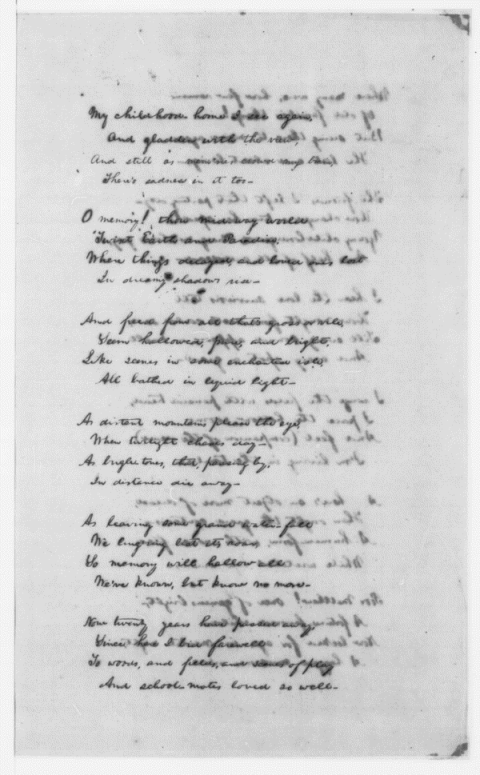
His third, most serious phase begins when Lincoln returned to Indiana, after leaving Illinois briefly in an attempt to help Henry Clay’s failed presidential bid against James Polk. Lincoln called Indiana “as unpoetical as any spot of the earth,” and yet it serves as a subject for a poem completed in 1846 called “My Childhood Home I See Again.” (The image above is of the first six stanzas of this long poem in Lincoln’s handwriting. Click here to see the remaining pages). Here in the first two stanzas (below), you can see the cutting wit of the younger, more confident man give way to a kind of wistful nostalgia worthy of Wordsworth:
Lincoln-as-poet continued in this thoughtful, mature voice in the remaining years of his life, though never equaling the poetic output of 1846. Somewhat out of character, the final documented piece of poetry from Lincoln comes from July 19, 1863. Written in response to the North’s victory in Gettysburg, “Verse on Lee’s Invasion of the North” is a short piece of doggerel that sees him returning to satire, writing in the voice of “Gen. Lee”:
Gen. Lee’s invasion of the North written by himself—
In eighteen sixty three, with pomp,
and mighty swell,
Me and Jeff’s Confederacy, went
forth to sack Phil-del,
The Yankees they got arter us, and
giv us particular hell,
And we skedaddled back again,
And didn’t sack Phil-del.
Surely the poem was written in a hurry, and with jubilant, triumphal glee, but if this is the last we heard from Lincoln the poet, it might be a shame, though it would not blot out the literary skill of poems like “My Childhood Home I See Again” and others like “The Bear Hunt” and “To Rosa,” which you can read here.
But there’s more to this story; in 2004, a historian discovered an unsigned poem called “The Suicide’s Soliloquy”—published in the August 25, 1838 issue of the Sangamo Journal, a Springfield newspaper—and believed the former president to be the poet. In the video above, listen to a moody, dramatic reading of the poem:
It is not known with certainty if Lincoln wrote this poem, but scholarly consensus inclines heavily in that direction, given its stylistic similarity to his other work from this period. “The Suicide’s Soliloquy” is as passionate and morbid as any of Edgar Allen Poe’s verse, and betrays Lincoln’s characteristic melancholy in its stormiest and most Romantic guise. NPR has the full poem and the story of its discovery.
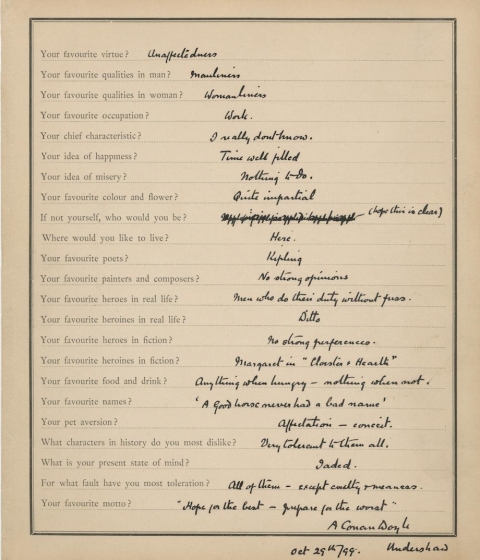
Ah, the Proust Questionnaire: does it reveal everything about one’s personality, or nothing at all? Presumably Marcel Proust, who gave the questionnaire its name by filling it out so wholeheartedly, wouldn’t have cared either way. French interviewer Bernard Pivot must have seen some usefulness in it, since he applied its questions so regularly to guests on his literary television program Apostrophesthat it gained the second name of “Pivot Questionnaire.” Open Culture readers know James Lipton also adapted a version on Inside the Actors Studio. (See our previous post here.)And now, thanks to archivists at the University of Texas at Austin’s Harry Ransom Center, we have Proust Questionnaire answers from one more luminary: Sir Arthur Conan Doyle, creator of Sherlock Holmes.
Not that Conan Doyle responds with quite so much style as does Proust. His favorite qualities in a man? Manliness. In a woman? Why, womanliness. His favorite food and drink? Anything when hungry or thirsty — nothing when not. Favorite activity? Work. This all has a certain utilitarian charm, but if you read the questionnaire itself, you also find the particular flavor of half-hidden wit that Conan Doyle’s readers would expect. But we care about his responses, as we care about Proust’s, because of all the other words they wrote. And lest we get caught up in questionnaires, let us not forget that Swann’s Way, the first volume of Proust’s In Search of Lost Time, turns one hundred this year.
Colin Marshall hosts and produces Notebook on Cities and Culture and writes essays on literature, film, cities, Asia, and aesthetics. He’s at work on a book about Los Angeles, A Los Angeles Primer. Follow him on Twitter at @colinmarshall.
This eighteen minute documentary takes you inside the work of David A. Smith, an English artist who specializes in “high-quality ornamental hand-crafted reverse glass signs and decorative silvered and gilded mirrors.” (Got that? You may want to read that last part again.) In something of a departure from earlier projects, Smith designed an ornate “turn-of-the-century, trade-card styled album cover” for John Mayer’s album Born &Raised. His work is meticulous and exacting. And this “Behind The Scenes” film, complete with commentary from Mayer and Smith, captures the artist’s process in loving detail. Now please sit back and enjoy.
Find us on Facebook, Twitter and Google Plus and we’ll make it easy to share intelligent media with your friends!
Although he died in 1950, George Orwell seemingly escaped the reach of modern media. Orwell’s voice was never captured on audio. And his image never appeared on film. Historians and literature scholars lamented this for decades.
But then, in 2003, on the hundredth anniversary of Orwell’s birth, two researchers stumbled upon a tantalizing piece of footage in the The Pathay Film Library in London. The very brief footage — watch in full here, or at the 50 second mark in the video above — shows an 18-year-old Orwell, then named Eric Blair, marching across a sports field at Eton College, where he spent his formative years and studied French with Aldous Huxley. In the line of marching students, Orwell is the fourth student from the left.
Note: the video above comes from a British Pathe clip that features celebrities before they became famous. If you’re curious who appears in the film, see the list below the jump.
We're hoping to rely on loyal readers, rather than erratic ads. Please click the Donate button and support Open Culture. You can use Paypal, Venmo, Patreon, even Crypto! We thank you!
Open Culture scours the web for the best educational media. We find the free courses and audio books you need, the language lessons & educational videos you want, and plenty of enlightenment in between.