Tina Seelig serves as the Executive Director of the Stanford Technology Ventures Program, a center that teaches students entrepreneurial skills needed to solve major world problems. She is also the author of the 2012 book, inGenius: A Crash Course on Creativity, that operates on the assumption that we’re not born being creative and knowing how to solve difficult problems. It’s something that we can cultivate and learn (as John Cleese has also told us before). If you’re intrigued by this idea, and if you want to rev up your own “Innovation Engine,” you can take Seelig’s new course, also called A Crash Course on Creativity, starting on April 22. It’s one of five Stanford MOOCs (Massive Open Online Courses) that will launch in April on the Venture Lab platform. Other courses now open for enrollment include:
We recently featured a Vanity Fair article on the making of Quentin Tarantino’s Pulp Fiction, marking the only semi-believable fact that its making happened 20 years ago. But can you accept that the making of Tarantino himself happened 50 years ago? We think of the motormouthed, grammatically unconcerned, pop-cultural blender of a filmmaker as an eternal genius adolescent, consummately skilled and passionate but never well served by the rigid structures of traditional education and craft. His recent releases like Inglourious Basterds and Django Unchained don’t even hint at a cooling of the fire within. As the man who (for better or for worse) represents the past two decades of creativity in American cinema crosses the middle-age rubicon, seemingly untroubled, we ask this: how does Quentin Tarantino do it? To help you find the answer yourself, we’ve rounded up all of our choicest pieces of Tarantino-related material.
As a born storyteller, Tarantino knows that every journey, no matter how ultimately victorious, begins somewhere. Preferably, it begins somewhere humble, which brings us to My Best Friend’s Birthday(below), the very first movie Tarantino attempted to make back in 1987, five years before his “real” feature debut Reservoir Dogs. In it, the filmmaker plays a hapless young rockabilly desperately looking for a way to enliven his buddy’s birthday. Because a fire claimed all but 36 minutes of the picture, we’ll never see whether he succeeds. But Tarantino himself, an aggressive collector of film prints who owns both a reputedly astonishing home theater and Los Angeles’ respected revival house the New Beverly Cinema, should have no trouble living it up for the big 5–0. He’s no doubt planned an ambitious birthday screening: I’m thinking a quintuple-bill, all genre.
This week, the Supreme Court is hearing arguments about gay rights in America. And, no matter how the court decides, these cases will enter the history books. Will the court lead the nation in making equality available for all, as it did during the civil rights era? Or will the nation be forced to lead the court into modernity during the years ahead? That we will soon find out.
Usually the court delays the release of audio recordings of oral arguments. But, acknowledging the importance of these particular cases, SCOTUS is making this week’s arguments immediately available. You can listen to the debates over Prop. 8 here or below. DOMA arguments will appear here. And it’s also now below.
For almost a century, writers and other creative people have found inspiration and a profound sense of validation in the Bohemian-Austrian poet Rainer Maria Rilke’s posthumously published Letters to a Young Poet. Many a sensitive soul has felt as if Rilke’s letters, written to a young man who had asked him for advice on whether to become a poet, were addressed directly to him or her. One of those people was the actor Dennis Hopper.
“Rilke’s Letters to a Young Poet is a great book,” Hopper says in this short film from 2007. “For me the letters are a credo of creativity and a source of inspiration. After reading Rilke it became clear to me that I had no choice in the matter. I had to create.” The ten-minute film, Must I Write?, was directed by Hermann Vaske and photographed by Rain Li. Hopper reads the first of the book’s ten letters, in which Rilke tells the young man to stop seeking approval from others:
You are looking outward, and that above all you should not do now. Nobody can help and counsel you, nobody. There is only one single way. Go into yourself. Search for the reason that bids you write; find out whether it is spreading out its roots in the deepest places in your heart, acknowledge to yourself whether you would have to die if it were denied you to write. This above all–ask yourself in the stillest hour of your night: must I write? Delve into yourself for a deep answer. And if this should be affirmative, if you may meet this earnest question with a strong and simple “I must,” then build your life according to this necessity; your life even into its most indifferent and slightest hour must be a sign of this urge and a testimony to it.
Hopper is reading from the 1934 translation by M.D. Herter Norton. There are a few minor slips, in which Hopper deviates slightly from the text. Most seriously, he inverts the meaning of a passage near the end by adding (at the 7:23 mark) the word “not” to Rilke’s phrase, “Perhaps it will turn out that you are called to be an artist.” That passage, one of the most memorable in the book, reads:
A work of art is good if it has sprung from necessity. In this nature of its origin lies the judgement of it: there is no other. Therefore, my dear sir, I know no other advice for you save this: to go into yourself and test the deeps in which your life takes rise; at its source you will find the answer to the question whether you must create. Accept it, just as it sounds, without inquiring into it. Perhaps it will turn out that you are called to be an artist. Then take that destiny upon yourself and bear it, its burden and its greatness, without ever asking what recompense might come from outside. For the creator must be a world for himself and find everything in himself and in Nature to whom he has attached himself.
“Why waste my time slumped in front of a television screen watching young men at play?” writes one man. “I have an experience (a secondhand experience), but it does me no good that I can detect. I learn nothing. I come away with nothing.” From the other man comes a reply: “I agree with you that it is a useless activity, an utter waste of time. And yet how many hours of my life have I wasted in precisely this way, how many afternoons have I squandered just as you did?” This epistolary conversation about sports continues, touching on the power of familiarity to endure boredom, performance art, heroism, ethics versus aesthetics, activity versus passivity, the “big business” of the NFL against the subsidization of ballet, childhood sexual identification, the visiblity of the human ideal, chess mania, the pleasure of maximum effort, and genre literature versus “the kinds of books you and I try to write.” What kind of books do these men try to write? Being the novelists Paul Auster and J.M. Coetzee, they write books, we can safely say, in their very own genres.
We now have a new volume from both Auster and Coetzee called Here and Now: Letters (2008–2011), from which a substantial sports-related excerpt appears on the New Yorker. Though not sui generis like the contributors’ own novels, the book does its part for the current mini-revival of collections of letters between men of letters. (2011 saw a similar French project from Michel Houellebecq and Bernard-Henri Lévy. “Who would we end up with?” asked the Observer’s Tim Adams, imagining a British equivalent. “Irvine Welsh and Alain de Botton?”) Fans of the lauded, private Auster and the highly lauded, intensely private Coetzee surely feel grateful for these new pieces of direct insight into the authors’ personalities, and they can get a little more by watching the reading of Here and Now at the New York State Writers Institute at the top of the post. Do see also Auster’s Big Think clips on what keeps him up at night, the fate of the novel, and how he stares down the challenges of writing (above). As for a solo performance from Coetzee, could we do any better than his Nobel lecture?
Unlike the typewriter, the lowly fax machine never pulled itself out of the hive-like existence of utilitarian office machines and into literary celebrity. With their bland, functional styling, fax machines will not have their impending obsolescence capped with museum exhibitions. And as little more than conduits for wonky, unglamorous communiqués, fax machines rarely conduct a piece of text that inspires people to savor, and want to save, the words, as with personal letters. While we often feature historic correspondence of a time before email from one of our favorite sites, Letters of Note, the risible, profound, and shocking sentiments expressed by famous figures when they think that no one’s looking rarely make it into office memoranda.
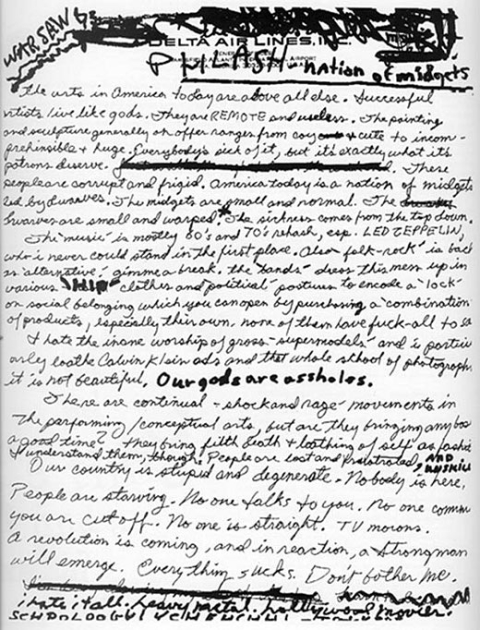
However, inspired by our recent post on Mark Twain’s typewriter, a reader alerted us to a Letters of Note subgenre of sorts, “faxes of note.” These oddball messages defy the workaday conventions of the fax. Take, for example, the fax above sent by Iggy Pop to Plazm magazine writer Joshua Berger as an addendum to a 1995 interview. Scrawled with his fevered thoughts, on Delta Airlines stationary, Pop’s fax amounts to what Letters of Note calls “a rant so rich with quotable lines, it’s amazing he was able to contain it all on a single sheet.”
You can click here for a full transcript of Iggy’s take on American cultural decadence, but here are just a few highlights from his faxed get-off-my-lawn moment: Pop—on tour in Europe at the time—calls his home country “a nation of midgets,” and decries the ‘90s rehash of ‘60s and ’70s music (“none of them have fuck-all to say”); he rails against the Calvin Klein aesthetic, adding “our gods are assholes” (maybe some professional jealousy here—Pop more or less invented heroin chic). Finally, he signs off with some cranky onomatopoeia: “i hate it all. heavy metal. hollywood movies. SCHPOLOOGY! YeHEHCHH!” This is archival-worthy vitriol, for sure.
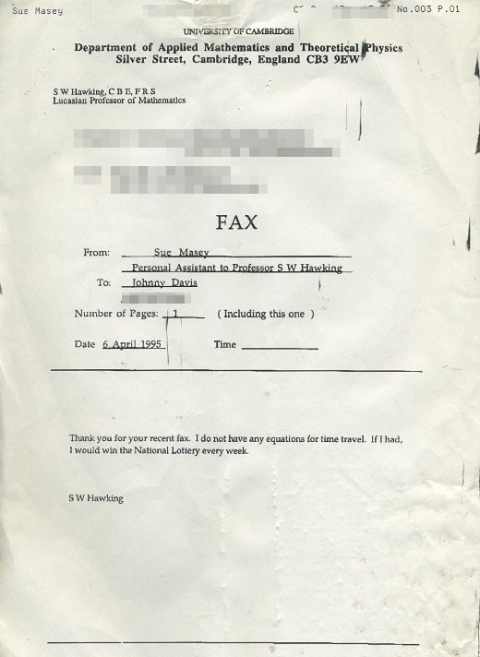
Another fax of note uses the medium to opposite effect; Stephen Hawking’s fax (above), also from 1995, responds to a request from erstwhile British music and fashion magazine The Face for the formula for time travel. Hawking replies, via his personal assistant, “Thank you for your recent fax. I do not have any equations for time travel. If I had, I would win the National Lottery every week.” Unlike Iggy’s explosion of handwritten bile, Hawking’s missive retains all the formal properties of the fax—appropriate institutional letterhead, “from” and “to” lines, etc—which makes his pithy retort all the more incongruous.
While the 1980s and ’90s were boom times for fax transmissions, the machine actually dates back to 1843, when it was patented by Scottish inventor Alexander Bain. As early as 1902, fax technology allowed photographs to be sent over telephone lines. And yes, as every frustrated administrative assistant knows too well, the humble fax machine is still in use in offices around the world, transmitting blearingly boring messages, as well as the occasional flash of individuality. For more on famous faxes, see this helpful infographic from our reader.
Charles Bamforth is the Anheuser-Busch Endowed Professor of Malting and Brewing Sciences at UC Davis, which means he knows a few things about making beer. He can get into some nitty-gritty topics, like the enzymology of the brewing process, foam stability, and the psychophysics of beer perception. But that’s not what he’s doing here. In the clip above, the “Pope of Foam,” as Bamforth is otherwise known, gives you a quick overview of the beer-making process, describing everything from grinding the malt, to boiling the wort, to bottling with glass versus cans. Finally, the Pope gives you a hot tip: how to pick the freshest pint when you’re at a pub.
Musically, Tom Waits has come a long way since the 1970s. Absorbing a range of influences, Waits has reinvented himself several times over to become one of the most influential writers and performers of our time.
Along the way he has also made his mark as a character actor. But “parallel career” would be the wrong phrase to describe Waits’s film and television work, for his music and acting have always intersected. Never was this more apparent than in the 1970s, when Waits cultivated the persona of a down-and-out barfly with the soul of a Beat poet.
That early phase of Waits’s career is preserved in this highly theatrical 54-minute television performance. It was recorded on December 5, 1978 at the University of Texas for a March 24, 1979 broadcast of Austin City Limits. The program was later released onDVD as Burma Shave. Waits is joined by Herbert Hardesty on trumpet and tenor saxophone, Arthur Richards on guitar, Greg Cohen on bass, and Big John Thomassie on drums. Here’s the set list:
We're hoping to rely on loyal readers, rather than erratic ads. Please click the Donate button and support Open Culture. You can use Paypal, Venmo, Patreon, even Crypto! We thank you!
Open Culture scours the web for the best educational media. We find the free courses and audio books you need, the language lessons & educational videos you want, and plenty of enlightenment in between.