Back in August, Colin Marshall remarked that drones “have drawn bad press in recent years: as the intrusive tools of the coming surveillance state, as deliverers of death from above in a host of war zones, as the purchase-delivering harbingers of world domination by Amazon.com.” “But as with any technology,” Colin went on to note, “you can also use drones for the good, or at least for the interesting.” Like capturing mesmerizing aerial footage of major cities around the world, cities such as Los Angeles, New York, London, Bangkok & Mexico City. Now let’s add Chernobyl to the list.
While working on a recent 60 Minutes episode, filmmaker Danny Cooke visited Chernobyl, and, using a drone (a DJI Phantom 2 and GoPro 3+, to be precise), he captured haunting footage of the city devastated by the nuclear meltdown of April 26, 1986. Chernobyl has cooled off enough that journalists and scientists can now visit the area for short periods of time. (Biologists, for example, are actively studying the crippling effects radiation has had on Chernobyl’s animal life, and producing disturbing videos showing howbirds are developing tumors, and spiders are spinning asymmetrical webs.) As for when Chernobyl will be truly habitable again, the best guess is another 20,000 years. By that time, the detritus will have fully given way to nature, and, if people still roam the earth, they’ll get something close to a fresh start.
If you would like to sign up for Open Culture’s free email newsletter, please find it here. It’s a great way to see our new posts, all bundled in one email, each day.
If you would like to support the mission of Open Culture, consider making a donation to our site. It’s hard to rely 100% on ads, and your contributions will help us continue providing the best free cultural and educational materials to learners everywhere. You can contribute through PayPal, Patreon, and Venmo (@openculture). Thanks!
Earlier this month, when Lionel Messi scored a hat-trick against Sevilla, he reached a milestone. He had scored his 253rd goal in La Liga, making him the all-time top scorer in the elite Spanish soccer league. His first goal came on May 1, 2005, and it took him just 289 matches to break the record previously held by Telmo Zarra. If you’re late to appreciating the artistry of Messi, not to worry. Above, we have a video that runs 31 minutes and brings together footage of every Messi goal in La Liga — all 253 in a row. To see the goals presented in another fashion, check out this infographic.
(Yes, we know, MOOCs are free. This will be too, if you add it to your holiday wish list, or insist that your local library orders a copy.)
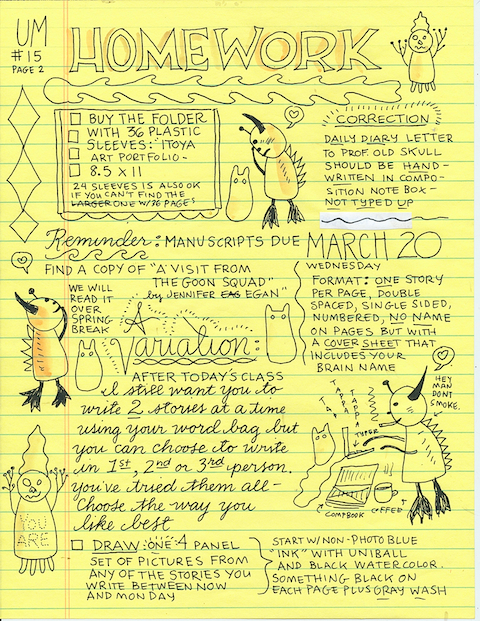
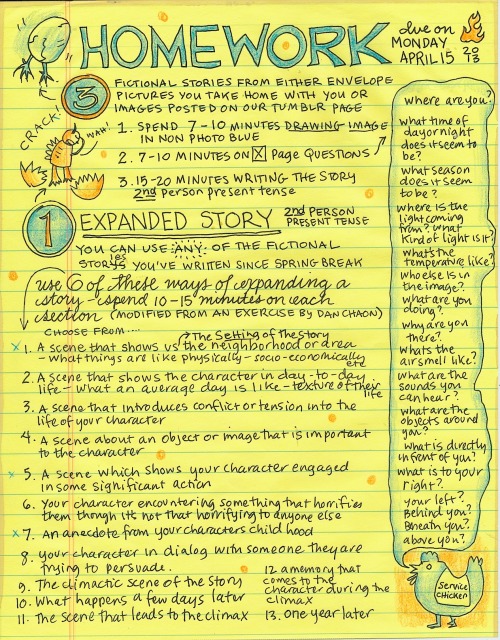
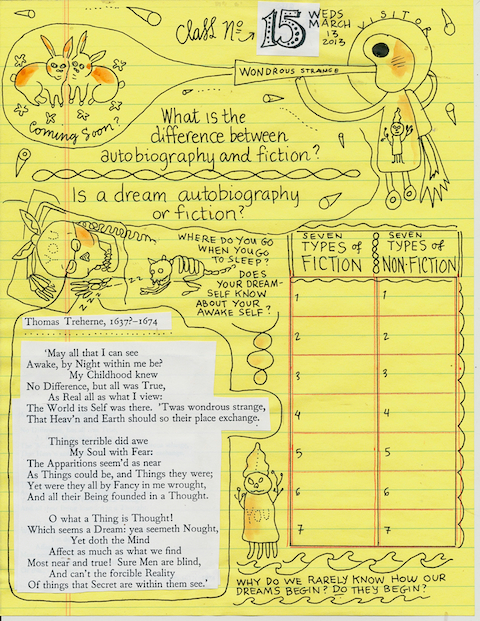
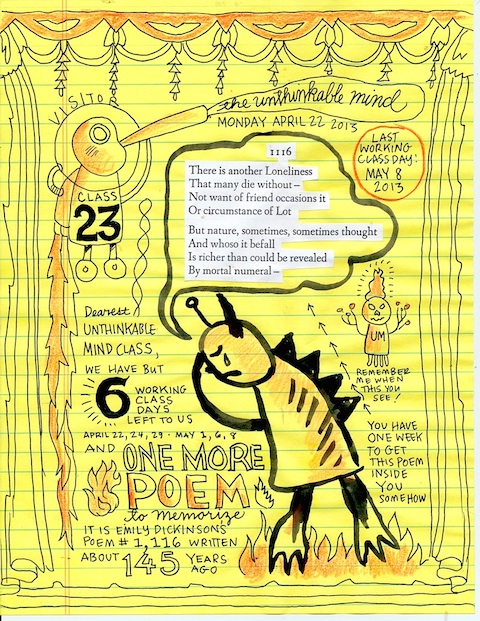
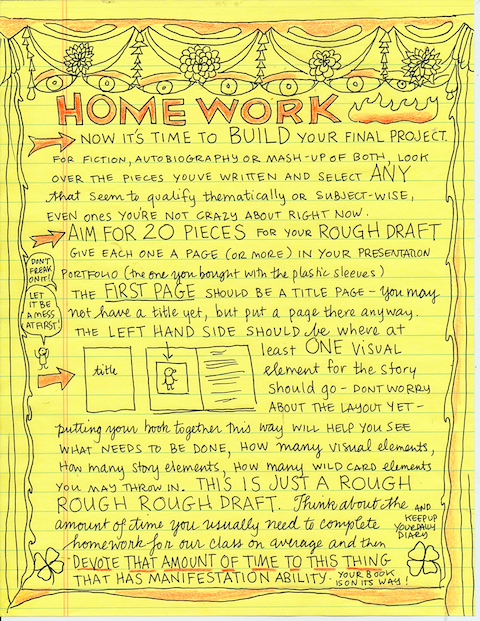
Barry’s marching orders are always to be executed on paper, even when they have been retrieved on smartphones, tablets, and a variety of other screens. They are the antithesis of dry. A less accidental professor might have dispensed with the doodle encrusted, lined yellow legal paper, after privately outlining her game plan. Barry’s choice to preserve and share the method behind her madness is a gift to students, and to herself.
The decontextualization of cheap, common, or utilitarian paper (which also harkens back to the historical avant-garde) may be understood as a transvaluation of the idea of working on “waste” –a knowing, ironic acknowledgment on Barry’s part that her life narrative, itself perhaps considered insignificant, is visualized in an accessible popular medium, comics, that is still largely viewed as “garbage.”
I got screamed at a lot for using up paper. The only blank paper in the house was hers, and if she found out I touched it she’d go crazy. I sometimes stole paper from school and even that made her mad. I think it’s why I hoard paper to this day. I have so much blank paper everywhere, in every drawer, on every shelf, and still when I need a sheet I look in the garbage first. I agonize over using a “good” sheet of paper for anything. I have good drawing paper I’ve been dragging around for twenty years because I’m not good enough to use it yet. Yes, I know this is insane.
Sample assignments from “The Unthinkable Mind” are above and below, and you will find many more in Syllabus: Notes from an Accidental Professor. Let us know if Professor Chewbacca’s neurological assumptions are correct. Does drawing and writing by hand release the monsters from the id and squelch the internal editor who is the enemy of art?
The American Public Media show, “Wits,” asked its listeners to write their “poorest imitations of Neil Gaiman’s writing.” And then they got Gaiman himself to read the best/worst submissions. You can watch the results above, and hear the complete radio show here.
To watch/listen to Gaiman reading stories that he actually wrote, see this collection where Neil reads eight works, including the entirety of The Graveyard Book.
If you would like to sign up for Open Culture’s free email newsletter, please find it here. It’s a great way to see our new posts, all bundled in one email, each day.
If you would like to support the mission of Open Culture, consider making a donation to our site. It’s hard to rely 100% on ads, and your contributions will help us continue providing the best free cultural and educational materials to learners everywhere. You can contribute through PayPal, Patreon, and Venmo (@openculture). Thanks!
If you don’t understand big history, you’ll never understand small history. That idea hasn’t yet attained aphorism status, but maybe we can get it there. Last month, we featured a free, Bill Gates-funded short course on 13.8 billion years of “Big History”. Back in 2012, we featured well-known online educator (and now even better-known young adult novelist) John Green’s Crash Course on World History. Now these worlds, or rather these histories of the world, have collided in the form of Crash Course Big History, a web series “in which John Green, Hank Green, and Emily Graslie teach you about, well, everything.” In true fashion of the biggest possible history, the Crash Course crew begins at the beginning — the real beginning, the Big Bang, which the first fifteen-minute episode gets into above.
“Mr. Green! Mr. Green!” exclaims Green at himself, momentarily taking on his signature secondary pushy-student persona. “That’s not history, that’s science.” Returning to his cool-professor persona, Green lays it out for himself: “Academics often describe history as, like, all stuff that’s happened since we started writing things down, but they only start there because that’s where we have the best information. The advent of writing was a huge deal, obviously, but as a start date for history, it’s totally arbitrary. It’s just a line we drew in the sand and said, ‘Okay, history begins now!’ ” In order to push that line as far back as possible, history must fuse with science, allowing the study of the past to best incorporate and contextualize all it can about (and students of Green had to know he would quote Douglas Adams on this) “Life, the Universe, and Everything.”
Seven episodes in and underway right now, Crash Course Big History has gone on to cover not just the universe, but the sun and the Earth, the emergence of life, the epic of evolution, and how that process produced humans. Having arrived at the appearance of Homo sapiens, Green and company cover, in the freshly released seventh episode, the process of “humanity conquering the Earth. Or at least moving from Africa into the rest of the Earth,” going on to reach “a critical mass of innovators” and develop “collective learning.” And amid the grand sweep of planetary movement, evolution, and mass migration, we continue to find new ways to collectively learn all the time — of which the Crash Courses represent only one particularly entertaining variety.
A quick heads up for Thomas Pynchon fans. Four decades after its publication, you can finally get Gravity’s Rainbow as an audio book — possibly even as a free audio book.
According to The New York Times, “Since the mid-1980s, a George Guidall recording [of the 1973 novel] has been floating around, like some mythical lost rocket part — no one had heard it, but all Pynchon fans knew someone who knew someone who had — but in October a new version, authorized and rerecorded… — hit the stands.”
The new release, which runs 40 hours and 1 minute, is also narrated by Guidall. It’s available on Audible.com. (Hear an audio sample below.) And there’s a way to get it for free. As we’ve mentioned before, Audible lets you download an audio book for free if you sign up for their 30-Day Free Trial. And even if you decide to cancel the trial, you can still keep the audio book and pay no money. That said, I dig Audible’s subscription service, as I’ve spelled out before, precisely because you can get big long audio books for a really reasonable price.
Learn more about the Free Trial program here, and to get Gravity’s Rainbow, simply click here and then click the “Try Audible Free” link on the right side of the page. NB: Audible is an Amazon.com subsidiary, and we’re a member of their affiliate program.
Some of us get our education at film school. More of us get it from The Criterion Collection, that formidably cinephilic restorer, curator, and packager of classic motion pictures from every era. In addition to their elegant, supplementary material-rich home video releases — they’ve put them out on Laserdisc, on DVD, on Blu-ray, streaming over the internet, and will presumably continue to do so on whichever formats come next — they also do intriguing collaborations with the various cultural figures with whom they’ve worked, such as asking them to name their ten favorite Criterion releases. You may recall that, back in June, we featured actor, director, and 1990s “Indiewood” icon Steve Buscemi’s Criterion top ten list, which included such choice pieces of film history as Gus Van Sant’s My Own Private Idaho, Franco-Dutch horror classic The Vanishing, and long-unreleased “faux-documentary” Symbiopsychotaxiplasm.
Jeanne Dielman, 23, quai du Commerce, 1080 Bruxelles (Chantal Akerman)
Ali: Fear Eats the Soul (Rainier Werner Fassbinder)
Masculin féminin (Jean-Luc Godard)
Double Suicide (Masahiro Shinoda)
The Vanishing (George Sluizer)
Mamma Roma (Pier Paolo Pasolini)
Black Orpheus (Marcel Camus)
Ace in the Hole (Billy Wilder)
Night on Earth (Jim Jarmusch)
Fat Girl (Catherine Breillat)
Days of Heaven (Terrence Malick)
Or lists from vital creators who have more recently arrived on the scene, such as this one from Tiny Furniture director and Girls creator Lena Dunham, an inveterate fan of Agnès Varda (who “manages to be both deeply emotional and utterly in control of the technical elements of filmmaking [ … ] that had seemed to me to be an impossible line to straddle, and she does it so beautifully”). She also makes room for Malick’s Days of Heaven, (also a pick of Sonic Youth’s Kim Gordon), two from Fassbinder (also a director of choice for Sonic Youth’s Lee Ranaldo), and one from Bergman (who should make everyone’s favorite-films lists, but also made Linklater’s):
Fish Tank (Andrea Arnold)
Days of Heaven (Terrence Malick)
Broadcast News (James L. Brooks)
Weekend (Andrew Haigh)
La Pointe Courte, Cléo from 5 to 7, Le bonheur, and Vagabond (Agnès Varda)
The Marriage of Maria Braun and Ali: Fear Eats the Soul (Rainier Werner Fassbinder)
Picnic at Hanging Rock (Peter Weir)
Straw Dogs (Sam Peckinpah) and Dead Ringers (David Cronenberg)
Through a Glass Darkly (Ingmar Bergman)
The War Room (Chris Hegedus and D. A. Pennebaker)
D.A. Pennebaker, by the way, has his own Criterion top ten list, as do other filmmakers named here, like Andrew Haigh and Martin Scorsese. But this leaves me with one burning question: if directors like Ozu and Fassbinder had lived to see The Criterion Collection, which volumes would they have put on their own DVD shelves?
Digital photography has bestowed many gifts, and some few horrors: selfies, naturally, as well as even less dignified self-portraits, of the sort certain politicians send out; mass surveillance, as well as the ability of average citizens to produce important pieces of evidence and to document history; hard times for professional photographers, as well as the full democratization of the medium. What it has almost rendered obsolete is the mechanism that enabled photographic images in the first place. In place of cameras, we have smartphones, the hated Glass… maybe sometime in the future no external device at all. Given this trajectory, it’s entirely understandable that all sorts of people—steampunks, antiquarians, Luddites, analog fetishists, middle-age hipsters, etc.—would grow nostalgic not only for the cracked, striated monochrome patina of vintage photographs, but also for the boxes—large and small, simple and highly complicated—that produced them.
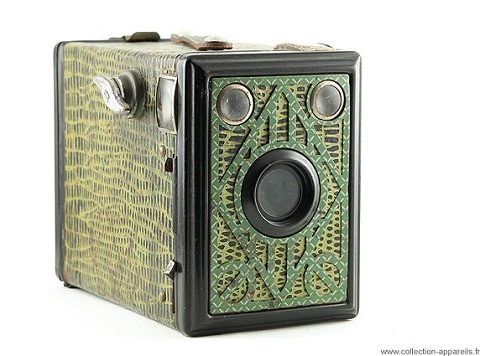
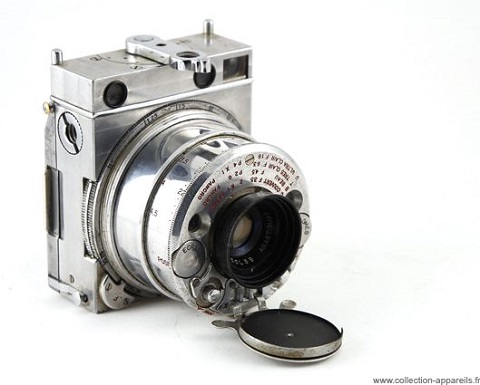
And what wonderful boxes they were! Before the onslaught of identical, cheap consumer point-and-shoots and (gasp!) disposables, or the utilitarian bricks of professional gear, the camera was very often a work of art in its own right. Today, we bring you a sampling of these objets—elegant, intricate, streamlined, and downright adorable. These are but a tiny fraction of the vintage camera treasures you’ll find represented at Collection Appareils, an online reference of 10,000 analog cameras run by Sylvain Halgand, a Frenchman sorely afflicted with the “insidious disease” of collecting.
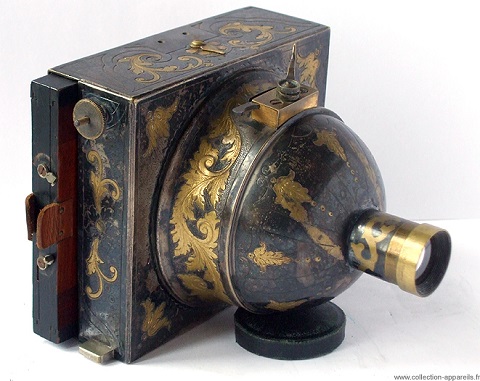
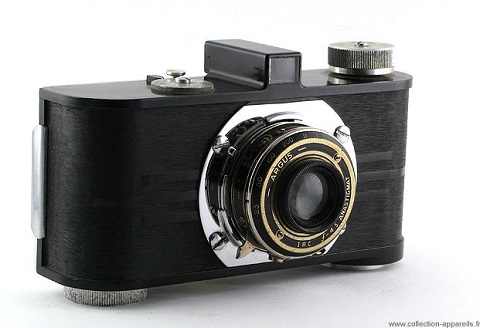
Witness at the top the Photosphere No. 1, manufactured by the Compagnie Francaise de Photographie in 1899—a truly beautiful artifact. No less stylish, but far more camera-like to our eyes, see the Argus A above. Made in the U.S. between 1936 and 1941, this may have been the most popular 35mm of all time. Though not as well known as the Leica A, “it’s a safe bet that Argus sold more cameras in their first twenty years than Leica has sold in their first 70 years.”
Above, we have the first “point and shoot,” the Gap Box 6x9, a curiously attractive device made in France in 1950. This camera “played a very important role by making photography accessible to the general public,” allowing “anyone to take pictures at the lowest price and in the most simple way.”
Then there are the stylized and the streamlined. Just above, see a very fine machine called The Compass, manufactured by Swiss watchmaker Le Coultre between 1937 and 1940. And below, gaze upon the graceful Haneel Tri-Vision, made in Los Angeles in 1946.
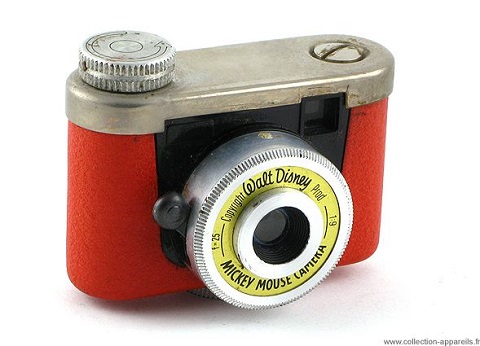
Almost equally appealing in their design simplicity are the irresistibly cute miniature cameras, such as the “Mickey Mouse” below. Manufactured in Germany in 1958, these tiny things—despite the “copyright” notice on the lens—may have disappeared quickly “due to them not actually being sanctioned by the Disney Corporation.” They were, however, sold with a “large cardboard Mickey Mouse that ‘held’ the camera.”
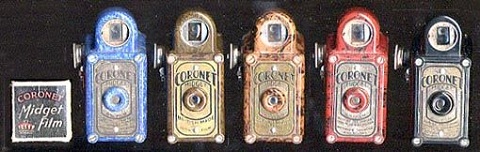
See also the Coronet Midget. Made in England in 1934, this 5‑shilling camera “must be one of the most popular of all small cameras to collect.” The company marketed its own 6‑exposure film for the Midget, which came in a choice of five colors.
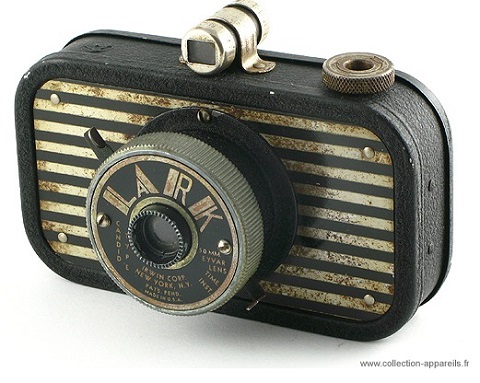
From the couture to the high-tech to the quirky and inventive (like the Lark “Sardine Can” below), the French vintage camera archive makes available a visual history of the camera that may exist nowhere else. It is the history of an object that defined the 20th century, and that may fully disappear sometime soon in the 21st. And while we can spend several hours a day marveling over the products of these fine devices, it’s a rare treat to see the things themselves in such an astonishing variety of shapes, sizes, colors, and degrees of design ingenuity. Take some time to get acquainted with the evolution of the handheld camera before digital technology finally renders it extinct.
We're hoping to rely on loyal readers, rather than erratic ads. Please click the Donate button and support Open Culture. You can use Paypal, Venmo, Patreon, even Crypto! We thank you!
Open Culture scours the web for the best educational media. We find the free courses and audio books you need, the language lessons & educational videos you want, and plenty of enlightenment in between.