Read 10 Short Stories by Gabriel García Márquez Free Online (Plus More Essays & Interviews)

Image by Fes­ti­val Inter­na­cional de Cine en Guadala­jara via Wiki­me­dia Com­mons

“Our inde­pen­dence from Span­ish dom­i­na­tion did not put us beyond the reach of mad­ness,” said Gabriel Gar­cía Márquez in his 1982 Nobel Prize accep­tance speech. Gar­cía Márquez, who died yes­ter­day at the age of 87, refers of course to all of Spain’s for­mer colonies in Latin Amer­i­ca and the Caribbean, from his own Colom­bia to Cuba, the island nation whose artis­tic strug­gle to come to terms with its his­to­ry con­tributed so much to that art form gen­er­al­ly known as “mag­i­cal real­ism,” a syn­cretism of Euro­pean mod­ernism and indige­nous art and folk­lore, Catholi­cism and the rem­nants of Amerindi­an and African reli­gions.

While the term has per­haps been overused to the point of banal­i­ty in crit­i­cal and pop­u­lar appraisals of Latin-Amer­i­can writ­ers (some pre­fer Cuban nov­el­ist Ale­jo Carpentier’s lo real mar­avil­loso, “the mar­velous real”), in Marquez’s case, it’s hard to think of a bet­ter way to describe the dense inter­weav­ing of fact and fic­tion in his life’s work as a writer of both fan­tas­tic sto­ries and unflinch­ing jour­nal­is­tic accounts, both of which grap­pled with the gross hor­rors of colo­nial plun­der and exploita­tion and the sub­se­quent rule of blood­thirsty dic­ta­tors, incom­pe­tent patri­archs, venal oli­garchs, and cor­po­rate gang­sters in much of the South­ern Hemi­sphere.

Nev­er­the­less, it’s a descrip­tion that some­times seems to obscure Gar­cía Mar­quez’s great pur­pose, mar­gin­al­iz­ing his lit­er­ary vision as trendy exot­i­ca or a “post­colo­nial hang­over.” Once asked in a Paris Review inter­view the year before his Nobel win about the dif­fer­ence between the nov­el and jour­nal­ism, Gar­cía Márquez replied, “Noth­ing. I don’t think there is any dif­fer­ence. The sources are the same, the mate­r­i­al is the same, the resources and the lan­guage are the same.”

In jour­nal­ism just one fact that is false prej­u­dices the entire work. In con­trast, in fic­tion one sin­gle fact that is true gives legit­i­ma­cy to the entire work. That’s the only dif­fer­ence, and it lies in the com­mit­ment of the writer. A nov­el­ist can do any­thing he wants so long as he makes peo­ple believe in it.

Gar­cía Márquez made us believe. One would be hard-pressed to find a 20th cen­tu­ry writer more com­mit­ted to the truth, whether expressed in dense mythol­o­gy and baroque metaphor or in the dry ratio­nal­ist dis­course of the West­ern epis­teme. For its mul­ti­tude of incred­i­ble ele­ments, the 1967 nov­el for which Gar­cía Márquez is best known—One Hun­dred Years of Soli­tude—cap­tures the almost unbe­liev­able human his­to­ry of the region with more emo­tion­al and moral fideli­ty than any strict­ly fac­tu­al account: “How­ev­er bizarre or grotesque some par­tic­u­lars may be,” wrote a New York Times review­er in 1970, “Macon­do is no nev­er-nev­er land.” In fact, Gar­cía Márquez’s nov­el helped dis­man­tle the very real and bru­tal South Amer­i­can empire of banana com­pa­ny Unit­ed Fruit, a “great irony,” writes Rich Cohen, of one mythol­o­gy lay­ing bare anoth­er: “In col­lege, they call it ‘mag­i­cal real­ism,’ but, if you know his­to­ry, you under­stand it’s less mag­i­cal than just plain real, the stuff of news­pa­pers returned as lived expe­ri­ence.”

Edith Gross­man, trans­la­tor of sev­er­al of Gar­cía Márquez’s works—including Love in the Time of Cholera and his 2004 auto­bi­og­ra­phy Liv­ing to Tell the Tale (Vivir para Cotar­la)—agrees. “He doesn’t use that term at all, as far as I know,” she said in a 2005 inter­view with Guer­ni­ca’s Joel Whit­ney: “It’s always struck me as an easy, emp­ty kind of remark.” Instead, Gar­cía Márquez’s style, says Gross­man, “seemed like a way of writ­ing about the excep­tion­al­ness of so much of Latin Amer­i­ca.”

Today, in hon­or and with tremen­dous grat­i­tude for that inde­fati­ga­ble chron­i­cler of excep­tion­al lived expe­ri­ence, we offer sev­er­al online texts of Gabriel Gar­cía Márquez’s short works at the links below.

Harper­Collins’ online pre­view of Gar­cía Mar­quez’s Col­lect­ed Sto­ries includes the full text of “The Third Res­ig­na­tion,” “The Oth­er Side of Death,” “Eva Is Inside Her Cat,” “Bit­ter­ness for Three Sleep­walk­ers,” and “Dia­logue with the Mir­ror,” all from the author’s 1972 col­lec­tion Eyes of a Blue Dog (Ojos de per­ro azul).

At The New York­er, you can read Gar­cía Mar­quez’s sto­ry “The Autumn of the Patri­arch” (1976) and his 2003 auto­bi­o­graph­i­cal essay “The Chal­lenge.”

Fol­low the links below for more of Gar­cía Mar­quez’s short fic­tion from var­i­ous uni­ver­si­ty web­sites:

Death Con­stant Beyond Love” (1970)

The Hand­somest Drowned Man in the World” (1968)

A Very Old Man with Enor­mous Wings” (1955)

Vis­it The Mod­ern Word for an excel­lent bio­graph­i­cal sketch of the author.

See The New York Times for “A Talk with Gabriel Gar­cia Mar­quez” in the year of his Nobel win, an essay in which he recounts his 1957 meet­ing with Ernest Hem­ing­way, and many more reviews and essays.

Final­ly, we should also men­tion that you can down­load Love in the Time of Cholera or Hun­dred Years of Soli­tude for free (as audio books) if you join Audible.com’s 30-day pro­gram. We have details on it here.

As we say farewell to one of the world’s great­est writ­ers, we can remem­ber him not only as a writer of “mag­i­cal real­ism,” what­ev­er that phrase may mean, but as a teller of com­pli­cat­ed, won­drous, and some­times painful truths, in what­ev­er form he hap­pened to find them.

Relat­ed Con­tent:

Read 18 Short Sto­ries From Nobel Prize-Win­ning Writer Alice Munro Free Online

Read 12 Mas­ter­ful Essays by Joan Did­ion for Free Online, Span­ning Her Career From 1965 to 2013

10 Free Sto­ries by George Saun­ders, Author of Tenth of Decem­ber, “The Best Book You’ll Read This Year”

600 Free eBooks: Down­load Great Books for Free

Josh Jones is a writer and musi­cian based in Durham, NC. Fol­low him at @jdmagness

Free: British Pathé Puts Over 85,000 Historical Films on YouTube

British Pathé was one of the lead­ing pro­duc­ers of news­reels and doc­u­men­taries dur­ing the 20th Cen­tu­ry. This week, the com­pa­ny, now an archive, is turn­ing over its entire col­lec­tion — over 85,000 his­tor­i­cal films – to YouTube.

The archive — which spans from 1896 to 1976 – is a gold­mine of footage, con­tain­ing movies of some of the most impor­tant moments of the last 100 years. It’s a trea­sure trove for film buffs, cul­ture nerds and his­to­ry mavens every­where. In Pathé’s playlist “A Day That Shook the World,” which traces an Anglo-cen­tric his­to­ry of the 20th Cen­tu­ry, you will find clips of the Wright Broth­ers’ first flight, the bomb­ing of Hiroshi­ma and Neil Armstrong’s walk on the moon, along­side footage of Queen Victoria’s funer­al and Roger Bannister’s 4‑minute mile. There’s, of course, footage of the dra­mat­ic Hin­den­burg crash and Lind­bergh’s dar­ing cross-Atlantic flight. And then you can see King Edward VIII abdi­cat­ing the throne in 1936, and the even­tu­al Pearl Har­bor attack in Decem­ber 1941 (above).

But the real­ly intrigu­ing part of the archive is see­ing all the ephemera from the 20th Cen­tu­ry, the stuff that real­ly makes the past feel like a for­eign coun­try – the weird hair­styles, the way a city street looked, the breath­tak­ing­ly casu­al sex­ism and racism. There’s a rush in see­ing his­to­ry come alive. Case in point, this doc­u­men­tary from 1967 about the won­ders to be found in a sur­pris­ing­ly mono­chrome Vir­ginia.

Here’s a film about a tech­no­log­i­cal inno­va­tion that curi­ous­ly didn’t take off — an amphibi­ous scoot­er. The look of regal dig­ni­ty on the driver’s face as his vehi­cle moves down the Thames is price­less.

In an ear­ly exam­ple of a polit­i­cal bloop­er, there’s this footage from 1942 of Bess Tru­man try­ing valiant­ly to smash an unyield­ing bot­tle of cham­pagne against the fuse­lage of a brand new bomber.

And then there’s this news­reel from 1938 on the wed­ding between Bil­ly Cur­tis, a 3’7” night­club bounc­er and his 6’4” bur­lesque star bride. The jaun­ty, spec­tac­u­lar­ly un-PC voiceover should prob­a­bly be filed under “things were dif­fer­ent then.”

If you have sev­er­al weeks to kill, you can watch all of the videos here.

Relat­ed Con­tent:

Rare Film: Claude Mon­et at Work in His Famous Gar­den at Giverny, 1915

The Weird World of Vin­tage Sports

The World’s First Mobile Phone Shown on 1922 Vin­tage Film

Jonathan Crow is a Los Ange­les-based writer and film­mak­er whose work has appeared in Yahoo!, The Hol­ly­wood Reporter, and oth­er pub­li­ca­tions. You can fol­low him at @jonccrow.

“The Periodic Table of Storytelling” Reveals the Elements of Telling a Good Story

periodic table storytelling

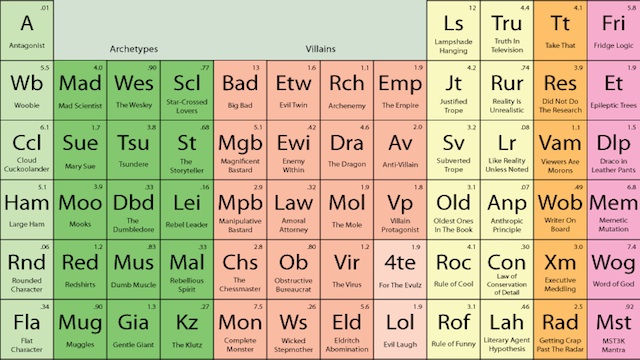
Dmitri Mendeleev might have designed the orig­i­nal peri­od­ic table – a graph­ic rep­re­sen­ta­tion of all the basic build­ing blocks of the uni­verse – but artist James Har­ris has done some­thing way cool with that tem­plate — the Peri­od­ic Table of Sto­ry­telling.

That’s right. Har­ris has tak­en all the tropes, arche­types and clichés found in movies (not to men­tion TV, com­ic books, lit­er­a­ture, video and even pro­fes­sion­al wrestling) and syn­the­sized them into an ele­gant­ly real­ized chart. Instead of group­ing the ele­ments by noble gas­es or met­als, Har­ris has orga­nized them by sto­ry ele­ments — struc­ture, plot devices, hero arche­types. Each ele­ment is linked to a vast wiki that gives def­i­n­i­tions and exam­ples. For instance, if you click on the ele­ment Chk, you’ll go to a page explain­ing the trope of Chekhov’s Gun. And if you click on Neo, you’ll go to the page for, of course, the Cho­sen One.

Below the chart, Har­ris has even cre­at­ed sto­ry mol­e­cules for a few spe­cif­ic movies. Ghost­busters, for exam­ple, is the com­bi­na­tion of an atom con­sist­ing of 5ma (Five Man Band) and Mad (Mad Sci­en­tist) and one con­sist­ing of Iac (Sealed Evil in a Can) and Hil (Hilar­i­ty Ensues).

So if you’re in film school or if you have a copy of Robert McKee’s Sto­ry on your book­shelf or if you’re one of the rough­ly three dozen peo­ple in the Los Ange­les cof­fee shop where I’m writ­ing this arti­cle who are bang­ing out screen­plays, you need to check this table out. But be warned: it will suck away a good chunk of your day.

via No Film School

Relat­ed Con­tent:

Pixar’s 22 Rules of Sto­ry­telling

Ira Glass, the Host of This Amer­i­can Life, Breaks Down the Fine Art of Sto­ry­telling

World’s Small­est Peri­od­ic Table on a Human Hair

“The Peri­od­ic Table Table” — All The Ele­ments in Hand-Carved Wood

Free Online Chem­istry Cours­es

Jonathan Crow is a Los Ange­les-based writer and film­mak­er whose work has appeared in Yahoo!, The Hol­ly­wood Reporter, and oth­er pub­li­ca­tions. You can fol­low him at @jonccrow.

The Ultimate Warrior, Professional Wrestler & Philosopher, Created a Glossary of World Philosophies

the-ultimate-warrior

If you run a web site long enough, you end up cov­er­ing top­ics you nev­er thought you’d touch. Like pro­fes­sion­al wrestling. Come to think of it, we did show you once before Andy Warhol mak­ing an unex­pect­ed appear­ance on a 1985 World Wide Wrestling Fed­er­a­tion broad­cast. But today the sub­ject isn’t an artist with a pen­chant for wrestling. It’s a wrestler him­self. More specif­i­cal­ly its The Ulti­mate War­rior (born James Hell­wig) who had a pen­chant for phi­los­o­phy.

A star dur­ing the 1990s in the WWF,  The Ulti­mate War­rior died of heart dis­ease last week at the age of 54. After his retire­ment from wrestling, he became a moti­va­tion­al speak­er and life coach. And, as Dead­spin notes, he main­tained a curi­ous web site that fea­tured a glos­sary of world philoso­phies.

If you want seri­ous def­i­n­i­tions of phi­los­o­phy, I’d sug­gest you vis­it The Stan­ford Ency­clo­pe­dia of Phi­los­o­phy. For some­thing more abbre­vi­at­ed and kooky, you can’t go wrong with The Ulti­mate War­riors’ dic­tio­nary. Let me give you a few quick exam­ples:

Exis­ten­tial­ism
This is a real nasty phi­los­o­phy that asserts man has free will, but exists in an unknow­able, malev­o­lent uni­verse with no knowl­edge of what is right or wrong. The catch is that the indi­vid­ual is respon­si­ble (moral­ly account­able) for all his actions, but has no way of know­ing what actions are cor­rect. The effects on a per­son are dev­as­tat­ing. (See also Skep­ti­cism.)

Kan­tian­ism
This is the exact oppo­site of Objec­tivism. It’s [sic] epis­te­mol­o­gy is faith-eat­en and mys­tic-appeas­ing. It’s [sic] meta­physics is sub­jec­tive, it’s [sic] ethics are altru­is­tic and it’s [sic] pol­i­tics are col­lec­tivis­tic. Kant cre­at­ed the exact oppo­site of what con­sti­tutes a phi­los­o­phy based on rea­son. His “argu­ment” con­sists of equiv­o­ca­tions, elab­o­rate straw-men (the entire Cri­tique of Pure Rea­son for exam­ple), etc. He was quite an evil per­son.

Paci­fism
This asserts a moral absolute (with­out any con­text) that it is wrong to use force. Instead of rec­og­niz­ing the need for self-defense, the paci­fist equates all force with evil, equiv­o­cat­ing. A paci­fist soci­ety would per­ish absolute­ly when the first gang came along.

Tran­scen­den­tal­ism
This is the belief that intu­ition is supe­ri­or to sense-per­cep­tion and rea­son, and is filled with mys­tic gooble-dee-gook. Its epis­te­mol­o­gy is exclu­sive­ly sub­jec­tive. I think this is only pop­u­lar because it has an inter­est­ing sound­ing name. (See also Mys­ti­cism, Sub­jec­tivism, Zen.)

If you’re won­der­ing what phi­los­o­phy The War­rior sym­pa­thized with, it seems you need to look no fur­ther than Ayn Rand’s Objec­tivism (sur­prise, sur­prise), which he defined as fol­lows: “In essence, a con­cept where man is a hero­ic being, and his life is an end in itself, with his own hap­pi­ness as the moral pur­pose of his life, with pro­duc­tive achieve­ment as his noblest activ­i­ty, and rea­son as his only absolute.”

For more def­i­n­i­tions, you can dive into the glos­sary right here. This curi­ous item comes to us via Leit­er Reports.

Relat­ed Con­tent:

100 Free Phi­los­o­phy Cours­es Online

The Epis­te­mol­o­gy of Dr. Seuss & More Phi­los­o­phy Lessons from Great Children’s Sto­ries

The His­to­ry of Phi­los­o­phy, from 600 B.C.E. to 1935, Visu­al­ized in Two Mas­sive, 44-Foot High Dia­grams

Ayn Rand Adamant­ly Defends Her Athe­ism on The Phil Don­ahue Show (Cir­ca 1979)

by | Permalink | Make a Comment ( 2 ) |

A Brief Tour of British & Irish Accents: 14 Ways to Speak English in 84 Seconds

Amer­i­cans, com­ing from the enor­mous and rel­a­tive­ly recent­ly set­tled place we do, tend to have a hard time with accents, strug­gling to grasp the extent of the vari­ety of region­al ways of speech in small­er, old­er coun­tries, let alone to use them our­selves. Study­ing the Kore­an lan­guage, I’ve found that under­stand­ing a native speak­er from one city does­n’t mean I’ll under­stand any­thing said by anoth­er native speak­er from a city fifty miles away. (Though that holds true even for Kore­ans them­selves; hence the preva­lence of sub­ti­tles on their tele­vi­sion shows.) Vis­it­ing Lon­don a few months ago, eas­i­ly as I could make sense of every­body speak­ing my native tongue, I pre-emp­tive­ly gave up hope of pick­ing up on the nuances of all the accents peo­ple had brought to the city from their home­towns — much less the numer­ous and sub­tle dialects native of Lon­don itself. Every­one I met insist­ed that a Briton’s accent says more about their ori­gin, class, sta­tion in life, and degree of self-regard than any oth­er qual­i­ty, but not know­ing New­cas­tle from Southamp­ton when I first set foot on Eng­lish soil, I had to take them at their word (how­ev­er they hap­pened to pro­nounce it).

The video above, in which pro­fes­sion­al dialect coach Andrew Jack demon­strates four­teen British accents in 84 sec­onds, might help sort things out for my fel­low con­fused coun­try­men. “Received com­mu­ni­ca­tion is the great com­mu­ni­ca­tor,” Jack says, using the accent I assume he grew up with. “As soon as you devi­ate from that and you go into Lon­don speech, for exam­ple, you lose a lit­tle bit of the com­mu­ni­ca­tion.” By that point, Jack has seam­less­ly tran­si­tioned into Cock­ney, from which he then shifts into the accents of East Anglia, the West Coun­try, York­shire, Lan­cashire, Liv­er­pool, North­ern Ire­land, Dublin, the Scot­tish high­lands, Glas­gow, North Wales, and South Wales. The Youtube com­ment box below has, pre­dictably, filled with com­plains about all the accents — the com­menters’ own, dare I imag­ine? — that did­n’t make it into this brief lin­guis­tic tour. Though far from com­pre­hen­sive, the video does in any case put the lie to the notion so many non-Brits seem to have that they can “do a British accent.” If you encounter one of them, don’t ask them to demon­strate it; ask them which British accent they mean. Then you’ll real­ly hear how poor­ly they fare.

via Kot­tke

Relat­ed Con­tent:

Peter Sell­ers Gives a Quick Demon­stra­tion of British Accents

Peter Sell­ers Reads The Bea­t­les’ “She Loves You” in Four Dif­fer­ent Accents

Sir Patrick Stew­art Demon­strates How Cows Moo in Dif­fer­ent Eng­lish Accents

What Shake­speare Sound­ed Like to Shake­speare: Recon­struct­ing the Bard’s Orig­i­nal Pro­nun­ci­a­tion

Col­in Mar­shall hosts and pro­duces Note­book on Cities and Cul­ture and writes essays on cities, lan­guage, Asia, and men’s style. He’s at work on a book about Los Ange­les, A Los Ange­les Primer. Fol­low him on Twit­ter at @colinmarshall or on Face­book.

John Coltrane Plays the Only Live Performance of A Love Supreme (1965)

John Coltrane’s A Love Supreme came out in 1964, an “album-long hymn of praise,” writes Rolling Stone, “tran­scen­dent music per­fect for the high point of the civ­il rights move­ment” as well as Coltrane’s grow­ing spir­i­tu­al awak­en­ing after kick­ing his hero­in habit. The record amazed crit­ics and jazz fans alike and by 1970, it had sold over half-a-mil­lion copies. But lovers of Coltrane would only have only one chance to see him per­form the full four-part suite live, and not in any state­side clubs but in Antibes, France on July 26, 1965, where he played two nights with his quar­tet.

You can see twelve of those mirac­u­lous min­utes above, con­sist­ing of the first two move­ments of the suite, “Acknowl­edge­ment” and “Res­o­lu­tion.” This is a gor­geous per­for­mance, cap­tur­ing what sax­o­phon­ist David Lieb­man describes as “an end and a new musi­cal begin­ning” for Coltrane.

The sec­ond evening’s per­for­mance, below, begins with “Naima,” on which, Lieb­man says, “Trane solos com­bin­ing a strik­ing lyri­cal approach off­set by mul­ti-not­ed, dense­ly packed runs.” If you’ve ever won­dered what Ira Gitler meant in describ­ing Coltrane’s style as “sheets of sound,” these per­for­mances will clear up the mys­tery.

The mid-six­ties was a piv­otal time for jazz—before the elec­tron­ic fusion exper­i­ments to come, as hard bop and free jazz com­bined with the dis­so­nance of ear­ly 20th cen­tu­ry con­tem­po­rary clas­si­cal music, which had “per­me­at­ed jazz for at least a hand­ful of artists.”  Coltrane still spoke the “com­mon language”—the “stan­dard reper­toire stem­ming from the Amer­i­can song book and/or orig­i­nal com­po­si­tions with sim­i­lar and pre­dictable har­mon­ic move­ment,” yet in his case, he “added modal­i­ty to the mix,” a trick picked up from Miles Davis.

Coltrane sad­ly died from liv­er can­cer in 1967 at age 40 and did not live to see the strange, sur­pris­ing turns jazz would take in the decade to come. How his brash, yet enchant­i­ng play­ing would have trans­lat­ed in the 70s is anyone’s guess. Yet, like so many artists who die young and in their prime, he left us with a body of work almost mys­ti­cal in its inten­si­ty and beauty—so much so that his more reli­gious fol­low­ers made him a saint after his death. Watch­ing these too-brief record­ings above, it’s not hard to see why.

The sec­ond night’s per­for­mances from the Antibes Jazz Fes­ti­val were issued as a live album in 1988. The first night’s live show­case of A Love Supreme has seen sev­er­al releas­es, and if you’re one of those who pro­fess­es devo­tion to this amaz­ing piece of work, you’d do well to pick up a copy, if you don’t own one already. “The inten­si­ty if the Antibes live per­for­mance,” writes Lieb­man in his 2011 lin­er notes to the Jazz Icons/Mosaic release of the Coltrane Live at Antibes 1965 DVD, “far exceeds the stu­dio record­ing” of the album. And that’s say­ing some­thing.

Relat­ed Con­tent:

John Coltrane’s Hand­writ­ten Out­line for His Mas­ter­piece A Love Supreme

Watch John Coltrane and His Great Quin­tet Play ‘My Favorite Things’ (1961)

The World Accord­ing to John Coltrane: His Life & Music Revealed in Heart­felt 1990 Doc­u­men­tary

Josh Jones is a writer and musi­cian based in Durham, NC. Fol­low him at @jdmagness

The Secret of Life and Love, According to Ray Bradbury (1968)

“Jump off the cliff and build your wings on the way down.” This—writes Sam Weller in his intro­duc­tion to a 2010 inter­view with sci-fi and fan­ta­sy lumi­nary Ray Brad­bury—was the author’s “life­long cre­do.” Weller writes of dis­cov­er­ing an unpub­lished Paris Review inter­view from the 1970s in Bradbury’s garage, with a note from edi­tor George Plimp­ton that read “a bit infor­mal in places, maybe over­ly enthu­si­as­tic.” The irony of this judg­ment is that it is Bradbury’s enthu­si­asm, his lack of for­mal­i­ty, which make him so com­pelling and so copi­ous a writer and speak­er. Brad­bury didn’t self-edit or sec­ond guess much—his approach is best char­ac­ter­ized as fear­less and pas­sion­ate, just as he describes his writ­ing process:

I type my first draft quick­ly, impul­sive­ly even. A few days lat­er I retype the whole thing and my sub­con­scious, as I retype, gives me new words. Maybe it’ll take retyp­ing it many times until it is done. Some­times it takes very lit­tle revi­sion.

It’s that unfet­tered expres­sion of his sub­con­scious that Brad­bury dis­cuss­es in the short clip above, in which he re-invig­o­rates all the sort of carpe diem clichés one hears so often by fram­ing them not as self-help sug­ges­tions but as imper­a­tives for a full and healthy life. Respond­ing in the moment, says Brad­bury, refus­ing to “put off till tomor­row… what I must do, right now,” allows him to “find out what my secret self needs, wants, desires with all its heart.” For Brad­bury, writ­ing is much more than a for­mal exer­cise or a spe­cial­ized craft—it is a vital expres­sion of his full human­i­ty and a means of “cleans­ing the stream” of his mind: “We belong only by doing,” he says, “and we own only by doing, and we love only by doing…. If you want an inter­pre­ta­tion of life and love, that would be the clos­est thing I could come to.”

Brad­bury doesn’t lim­it his phi­los­o­phy to the writ­ing life; he advo­cates for every­one an unabashed emo­tion­al engage­ment with the world. For him, the man (and woman, we might pre­sume), who can­not “laugh freely,” cry, or “be violent”—which he defines in sub­li­mat­ing terms as any phys­i­cal or cre­ative activity—is a “sick man.” Bradbury’s “over­ly enthu­si­as­tic” explo­rations of cre­ative pas­sion were almost as much a part of his out­put as his fic­tion. His inter­views, tele­vised and in print, are inspir­ing for this rea­son: he is nev­er coy or pre­ten­tious but push­es oth­ers to aspire to the same kind of authen­tic joy he seemed to take in every­thing he did.

By the way, the first per­son we see above is leg­endary Warn­er Bros. ani­ma­tor Chuck Jones (as one Youtube com­menter says, we get in this clip “two vision­ar­ies for the price of one”). Bradbury’s “vital­i­ty,” says Jones, “rubs off on the peo­ple who work with him.” And, he might have added, all of the peo­ple who read and lis­ten to him, too.

Relat­ed Con­tent:

Ray Brad­bury: “The Things That You Love Should Be Things That You Do.” “Books Teach Us That”

Ray Brad­bury: Sto­ry of a Writer 1963 Film Cap­tures the Para­dox­i­cal Late Sci-Fi Author

Ray Brad­bury Gives 12 Pieces of Writ­ing Advice to Young Authors (2001)

Ray Brad­bury: Lit­er­a­ture is the Safe­ty Valve of Civ­i­liza­tion

Josh Jones is a writer and musi­cian based in Durham, NC. Fol­low him at @jdmagness

Two Artificial Intelligence Chatbots Talk to Each Other & Get Into a Deep Philosophical Conversation

The folks at the Cor­nell Cre­ative Machines Lab are “inter­est­ed in robots that cre­ate and are cre­ative.” Here’s one such exam­ple of robots get­ting cre­ative. Above, the lab lets two chat­bots (essen­tial­ly com­put­er pro­grams designed to sim­u­late an intel­li­gent con­ver­sa­tion) start chat­ting with one anoth­er. They start by exchang­ing pleas­antries. Then things get deeply philo­soph­i­cal, fair­ly quick­ly.  It’s fun to watch it play out.

via Giz­mo­do

Relat­ed Con­tent:

Down­load 100 Free Phi­los­o­phy Cours­es and Start Liv­ing the Exam­ined Life

Learn to Code with Harvard’s Intro to Com­put­er Sci­ence Course And Oth­er Free Tech Class­es

Noam Chom­sky Explains Where Arti­fi­cial Intel­li­gence Went Wrong


by | Permalink | Make a Comment ( 9 ) |

« Go BackMore in this category... »
Quantcast