By far the most enjoyable part of our recent family trip to London was the afternoon my young son and I spent in Shoreditch, groping our way to No Brow, a comics shop I had noticed on an early morning stroll with our hostess. Our route was evidence that I had forgotten the coordinates, the street name, the name of the shop… Eventually, I realized we were lost, and that is where the real fun began, as we retraced our steps using street art as bread crumbs.
After a while, a FedEx man took pity on us, ruining our fun by steering us toward the proper address..
I’m not sure I could ever duplicate our trail, but I enjoy trying with Google Street Art. Armchair travelers can use it to project themselves to the heart of ephemeral, possibly illegal exhibitions all over the globe,.
Bogotá... Paris... New York’s legendary 5 Pointz, before the landlord clutched and whitewashed the entire thing in the dead of night. Each up close photo bears a highly informational caption, much more than you’d find in the street itself. Think of it as an after-the-fact digital museum. It’s appropriate, given the ephemeral nature of the work. An online presence is its best shot at preservation.
Those of us with something to contribute can add to the record with a user gallery or by tagging our photos with #StreetArtist.
Living, as many do, in Los Angeles, and loving, as many do, the films of Stanley Kubrick, I managed to attend last year’s acclaimed Kubrick exhibit at the Los Angeles County Museum of Art more than once. The first time there, I marveled at all the artifacts they’d collected from the production of my favorite Kubrick films, the ones I’ve seen seven, eight, nine times: Dr. Strangelove, Barry Lyndon, 2001: A Space Odyssey, etc. But the second time, I focused on the rooms dedicated to the Kubrick films I’d never seen — the ones, in fact, that nobody has ever seen.
Several of his unfinished projects got far enough into pre-production to leave behind a considerable amount of intriguing research materials, script notes, shooting schedules, design sketches, and screen tests. The story of each project’s origin and demise reveals qualities of not just Kubrick’s much-examined working methods, but of his personality. “He was a man of such varied interests that he was always busy,” says former Warner Brothers executive John Calley in the short documentary above, Lost Kubrick. And if Kubrick had an interest, he instinctively threw himself into the making of a motion picture to do with it.
“Napoleon was one of the abiding interests of Stanley’s life,” says Anthony Frewin, Kubrick’s assistant on 2001, “along with extraterrestrial intelligence, the Holocaust, concentration camps, Julius Caesar, English place name etymology, and three thousand other things.” We’ve featured Kubrick’s Napoleon before, but Lost Kubrick also includes an examination of The Aryan Papers, his abandoned Holcaust project from the 1990s. I do wonder how it would have compared to Schindler’s List, Steven Spielberg’s completed Holocaust project from the 1990s, which itself had an influence on Kubrick’s dropping The Aryan Papers. But Jurassic Park, Spielberg’s dinosaur project from that same time, convinced Kubrick that special effects technology had come far enough for him to move forward on A.I., which he would later hand over to Spielberg himself. The younger director seems to have fallen into the role of executor of Kubrick’s many ideas; just last year, he even announced plans to turn Kubrick’s Napoleon script into a television series. Personally, it makes me wonder less what Spielberg will do with the story of Napoleon than what Kubrick could have accomplished in this age of the television-series auteur.
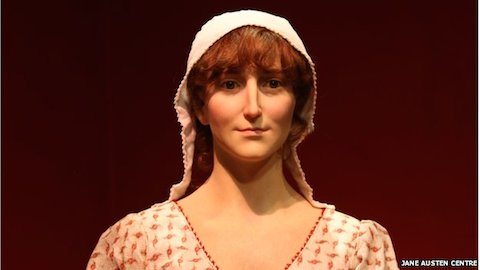
Last Wednesday, the Jane Austen Centre in Bath, England unveiled the wax sculpture above, which they say is the closest “anyone has come to the real Jane Austen in 200 years.” The figure, The Guardianreports, is the creation of forensic artist Melissa Dring, a “specialist team using forensic techniques which draw on contemporary eye-witness accounts,” and Emmy-winning costume designer Andrea Galer.
Austen often introduced her characters with broad descriptions—Emma Woodhouse is “handsome, clever, and rich,” Pride and Prejudice’s Mr. Bingley simply “a single man in possession of a good fortune.” But her talent consisted in undermining such stock descriptions, and the societal assumptions they entail. Instead of types, she gave readers complicated individuals squirming uncomfortably inside the bonds of propriety and decorum. But what of Austen herself? Readers initially knew nothing of the author, as her novels were first published anonymously.
Since her death in 1817, biographers have told and retold her personal history, and she has become an almost cult-like figure for fans of her work. Some of the author’s first biographers were family members, including her nephew James Edward Austen-Leigh, who published A Memoir of Jane Austen in 1872 (above). In it, Austen-Leigh describes his aunt as “very attractive”: “Her figure was rather tall and slender, her step light and firm, and her whole appearance expressive of health and animation. In complexion she was a clear brunette with a rich colour; she had full round cheeks, with mouth and nose small and well-formed, bright hazel eyes, and brown hair forming natural curls round her face.”
Based partly on that description and others from niece Caroline, the wax figure, Dring told the BBC, is “pretty much like her.” Austen “came from a large… family and they all seemed to share the long nose, the bright sparkly eyes and curly brown hair. And these characteristics come through the generations.” Dring used Austen’s sister Cassandra’s famous portrait as a starting point, but noted that the sketch “does make it look like she’s been sucking lemons […] We know from all accounts of her, she was very lively, very great fun to be with and a mischievous and witty person.” All descriptions with which her devoted readers would doubtless agree. See more photos of the Austen wax sculpture here.
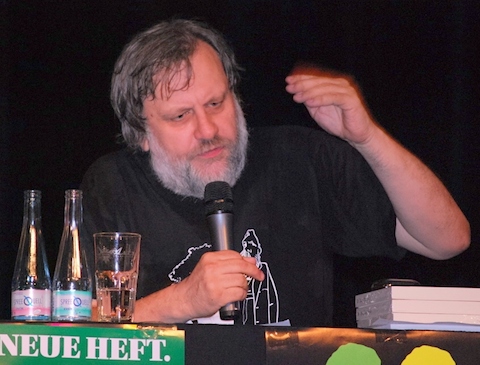
Anyone who does any sort of research-based writing knows how easy it is for an occasional close approximation of another’s prose to slip into a summary. Such instances rarely constitute plagiarism, but they can occupy an uncomfortable gray area. Recent allegations against Slovenian theorist Slavoj Žižek, however, charge the wholesale theft of entire passages of text, almost verbatim. It’s an unusual story, not least because of the source material Žižek allegedly lifted—an article in American Renaissance, identified by the Southern Poverty Law Center as a white supremacist publication.
In a July 11th article breaking the story, Newsweek wrote that it had contacted Deogolwulf and Sailer for comment, but neither responded by the time of publication. However, James Williams, senior managing editor for the journal Critical Inquiry, which published Žižek’s article, did, saying Žižek “absolutely” borrowed from Hornbeck. Had they known, said Williams, “we would have certainly asked him to remove the illegal passages.” Hornbeck also responded, calling the borrowing “contemptible.”
Did Žižek knowingly plagiarize American Renaissance (does Žižek even read American Renaissance)? According to Žižek himself, the answer is no. In an email to Critical Theory, he writes that the close resemblance between his article and Hornbeck’s review is the result of a summary of MacDonald’s work given to him by an unnamed “friend.” Here’s more from Žižek’s email. (Note: he uses the word “résumé” here in the sense of “summary”):
With regard to the recent accusations about my plagiarism, here is what happened. When I was writing the text on Derrida which contains the problematic passages, a friend told me about Kevin Macdonald’s theories, and I asked him to send me a brief resume. The friend send [sic] it to me, assuring me that I can use it freely since it merely resumes another’s line of thought. Consequently, I did just that – and I sincerely apologize for not knowing that my friend’s resume was largely borrowed from Stanley Hornbeck’s review of Macdonald’s book.
“The problematic passages,” Žižek continues in his defense, “are purely informative, a report on another’s theory for which I have no affinity whatsoever.” He adds at the end, “I nonetheless deeply regret the incident.”
It is true that unlike, say, Senator Rand Paul—who apparently passed off almost wholly plagiarized articles as his own original work—Žižek does not take any credit for MacDonald’s ideas and summarizes them only in an attempt to refute them. Nonetheless, as Newsweek notes (in an unfortunate choice of words), for conservative critics, Žižek is “a big scalp” and the matter a very serious one. Zizek’s “sloppy citations,” writes Critical Theory, have come under fire before—notably in his feud with Noam Chomsky, who caught Žižek misattributing a racist quote to him. (Žižek “admitted the mistake and apologized.”) This case seems much more severe for the length of the passages lifted as well as Žižek’s failure to check and cite his source. Charges of academic plagiarism frequently go to press. But with such a public figure (and film star) as the flamboyant Marxist Žižek, and such inflammatory far right source material, this particularly regrettable incident—unintentional as it may be—makes for some particularly sensationalist headlines.
Along with topplingdemocratically elected governments, funneling money illegally to dubious political groups and producing pornographic movies about heads of state, the Central Intelligence Agency has also been fiendishly good at manipulating language. After all, this is the organization that made “waterboarding” seem much more acceptable, at least to the Washington elite, by rebranding it as “enhanced interrogation techniques.” Another CIA turn of phrase, “extraordinary rendition,” sounds so much better to the ear than “illegal kidnapping and torture.”
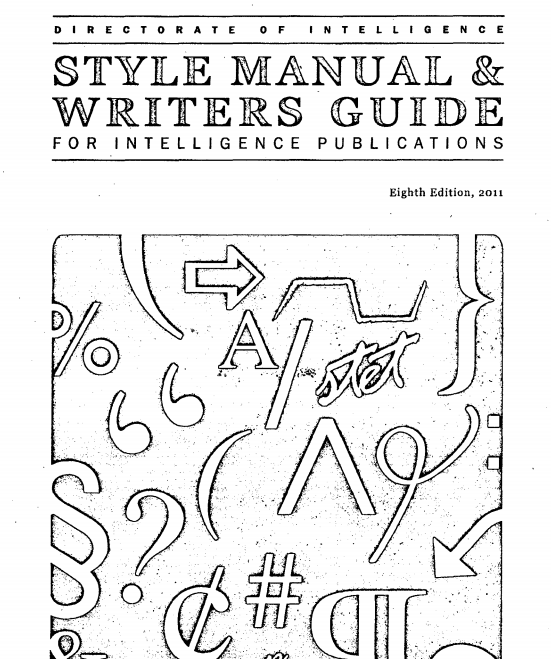
Not too long ago, the CIA’s style guide, called the Style Manual and Writers Guide for Intelligence Publications, was posted online. “Good intelligence depends in large measure on clear, concise writing,” writes Fran Moore, Director of Intelligence in the foreword. And considering the agency’s deftness with the written word, it shouldn’t come as a surprise that it’s remarkably good. Some highlights:
The guide likes the Oxford or serial comma. “Most authorities on English usage recommend [the serial comma], and it is the rule for CIA publications.”
It favors using adjectives and adverbs sparingly. “Let nouns and verbs show their power.”
In all cases, it favors American over British spellings, even proper names. Thus, “Labor Party” not “Labour Party.” And for that matter, the guide isn’t terribly keen on using phrases like “apropos” and “faux pas.” “Foreign expressions should be avoided because they sound hackneyed.”
It wisely discourages writers, or anyone really, from ever using the word “enthused.”
And they caution against using exclamation points. “Because intelligence reports are expected to be dispassionate, this punctuation mark should rarely, if ever, be used.”
And then there are some rules that will remind you this guide is the product of a particularly shadowy arm of the U.S. Government.
The guide makes a point of defining “disinformation” as opposed to “misinformation.” “Disinformation refers to the deliberate planting of false reports. Misinformation equates in meaning but does not carry the same devious connotation.” Now you know.
Undeclared wars, like Vietnam, should be spelled with an uncapitalized “w.” Same goes for the “Korean war” and the “Falklands war.” It goes on to argue that the writer should “avoid ‘Yom Kippur war’ which is slangy.” Presumably, the CIA prefers the term “The 1973 Arab-Israeli war.”
The confusing split between China and Taiwan – each refuses to recognize the other — is represented confusingly here too. “For what was once called Nationalist China or the Republic of China, use only Taiwan, both as noun and as adjective. … Avoid Taiwanese as an adjective referring to the island’s administration or its officials (and do not use the term Taiwanese government.)”
It’s unclear whether or not the guide is being used for the CIA’s queasily flip, profoundly unfunny Twitter account.
Jonathan Crow is a Los Angeles-based writer and filmmaker whose work has appeared in Yahoo!, The Hollywood Reporter, and other publications. You can follow him at @jonccrow.
Before he directed such mind-bending masterpieces as Time Bandits, Brazil and Fear and Loathing in Las Vegas, before he became short-hand for a filmmaker cursed with cosmically bad luck, before he became the sole American member of seminal British comedy group Monty Python, Terry Gilliam made a name for himself creating odd animated bits for the UK series Do Not Adjust Your Set. Gilliam preferred cut-out animation, which involved pushing bits of paper in front of a camera instead of photographing pre-drawn cels. The process allows for more spontaneity than traditional animation along with being comparatively cheaper and easier to do.
Gilliam also preferred to use old photographs and illustrations to create sketches that were surreal and hilarious. Think Max Ernst meets Mad Magazine. For Monty Python’s Flying Circus, he created some of the most memorable moments of a show chock full of memorable moments: A pram that devours old ladies, a massive cat that menaces London, and a mustached police officer who pulls open his shirt to reveal the chest of a shapely woman. He also created the show’s most iconic image, that giant foot during the title sequence.
On Bob Godfrey’s series Do It Yourself Film Animation Show, Gilliam delved into the nuts and bolts of his technique. You can watch it above. Along the way, he sums up his thoughts on the medium:
The whole point of animation to me is to tell a story, make a joke, express an idea. The technique itself doesn’t really matter. Whatever works is the thing to use. That’s why I use cut-out. It’s the easiest form of animation I know.
He also notes that the key to cut-out animation is to know its limitations. Graceful, elegant movement à la Walt Disney is damned near impossible. Swift, sudden movements, on the other hand, are much simpler. That’s why there are far more beheadings in his segments than ballroom dancing. Watch the whole clip. If you are a hardcore Python enthusiast, as I am, it is pleasure to watch him work. Below find one of his first animated movies, Storytime, which includes, among other things, the tale of Don the Cockroach. Also don’t miss, this video featuring All of Terry Gilliam’s Monty Python Animations in a Row.
Jonathan Crow is a Los Angeles-based writer and filmmaker whose work has appeared in Yahoo!, The Hollywood Reporter, and other publications. You can follow him at @jonccrow.
We're hoping to rely on loyal readers, rather than erratic ads. Please click the Donate button and support Open Culture. You can use Paypal, Venmo, Patreon, even Crypto! We thank you!
Open Culture scours the web for the best educational media. We find the free courses and audio books you need, the language lessons & educational videos you want, and plenty of enlightenment in between.