Humorist David Sedaris has become something of a local hero in his adopted home of West Sussex, England. And for fairly unexpected reasons. Repulsed by the litter problem in England, Sedaris began spending 3–8 hours each day picking up trash along the side of various roads. Day in, day out. Fast forward a few years, and the local community honored Sedaris by naming a garbage truck after him — “Pig Pen Sedaris.” And now we have him testifying before the MPs on the Communities and Local Government Committee. If you like C‑SPAN, you will love these 2+ hours of video.
Perhaps rather than trying to identify the source, we should work toward being open to inspiration in whatever guise it presents itself. It’s an approach that certainly seems to be working for Patti Smith and David Lynch, aka the Godmother of Punk and Jimmy Stewart from Mars, both a shockingly youthful 69.
One of the most exciting things about their recent segment for the BBC’s Newsnight “Encounters” series is watching how appreciative these veterans are of each other’s process.
“I want a copy of what you just said,” Smith gasps, after Lynch likens the beginnings of a creative process to being in possession of a single, intriguing puzzle piece, knowing that a completed version exists in the adjacent room.
As artists, they’re committed to peeking beneath the veneer. “What’s more horrifying than normalcy?” Smith asks.
It does seem important to note how both of these longtime practitioners mention jotting their ideas down immediately following the muse’s visit.
The Templeton Foundation asked some heavy-hitter thinkers to answer the question, “Does the Universe Have a Purpose”. Some said “Yes” and “Certainly.” Others concluded “Unlikely” and “No.” Neil deGrasse Tyson — astrophysicist, director of the Hayden Planetarium, and popularizer of science — gave an answer that falls technically in the “Not Certain” camp.
Above, you can watch a video where Tyson reads his answer aloud, and the makers of Minute Physics provide the rudimentary animation. One thing astrophysicists have is a knack for putting things into a deeper context, often making “big” human questions look remarkably small (if not somewhat absurd). Carl Sagan did it remarkably well in his famous ‘The Pale Blue Dot’ speech. And Tyson picks up right where Sagan left off.
We still live in a world where, despite Copernicus, we think the world revolves essentially around us. And, to the extent that that’s true, some will find Tyson’s data points disorienting. Others might wonder whether we should angst so much about the questions we perennially ask in the first place. I guess I am kind of there today.
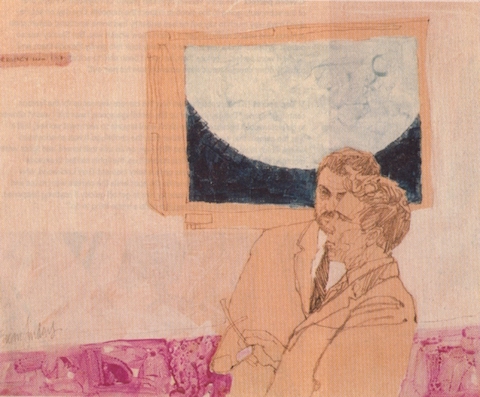
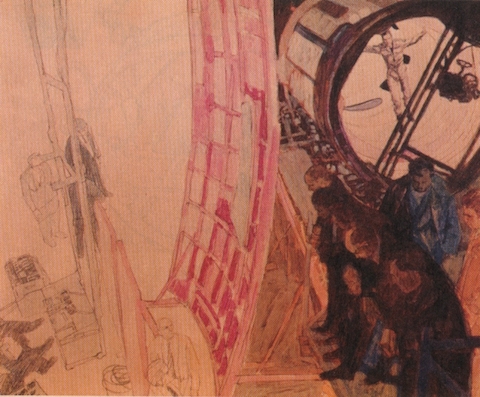
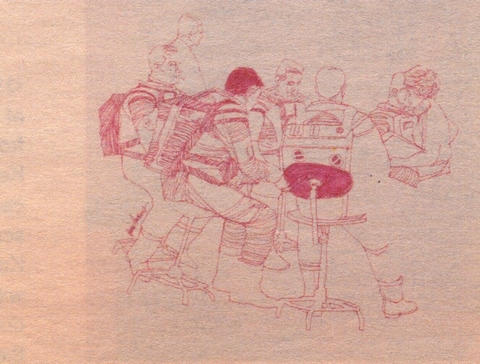
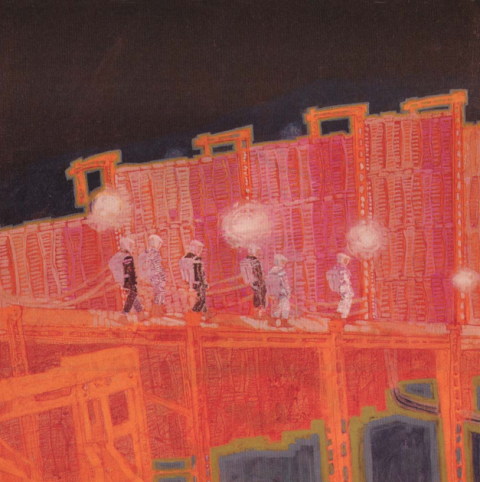
Remember courtroom sketch artists? The mere fact that they did what they did captured my imagination as a kid, representing as it seemed one of the few remaining vestiges of an older, more askew America, one bound by fewer yet stricter rules and all the more fascinating a component of history for it. These drawings of the shoot of Stanley Kubrick’s 2001: A Space Odyssey remind me of courtroom sketches, albeit on some stylistic levels more than others. And interestingly, just as court reporters once had to use sketch artists because of the supposed disturbance cameras would cause in the courtroom, these drawings result from the pursuit of something less troublesome to a set than a regular still photographer.
From 2001 onwards, Kubrick created illustrated production stills of what happened on his set, rather than having a photographer take noisy and distracting photographs. The illustrations, documenting for the media what happened in front of the camera as well as behind it, would then be sent out in press kits to publications and other media outlets that could promote the film.
Enter, in 1966, English magazine illustrator Brian Sanders (now perhaps best known for the pastiches of that decade he’s done for Mad Men), hired to turn up to the 2001 shoot and quietly draw what he saw. None of these images, however — or the rest of those featured at Kubrickonia — appeared anywhere until the actual year 2001, when TheIndependent’s magazine used them in an article. Cinephiles now and again wish for the return of illustrated movie posters, and sometimes we do occasionally see a new one, but looking at what Sanders came up with for 2001, I can’t help but ponder the still-unrealized potential of the illustrated production still. You can see more illustrations — once lost and now found — here.
A week ago, Charlie Hebdo was anything but a household name. On Wednesday, after the appalling terrorist attacks in Paris, all of that changed.
We all now have Charlie Hebdo on the tip of our tongues. We’ve seen samples of their satirical cartoons. And we’ve read about the news outlets too afraid to print them. But what do we still know about Charlie Hebdo — about the actual cartoonists who made the newspaper tick, their satirical ambitions and their creative process? Not very much.
The short documentary above, filmed at Charlie Hebdo in 2006 by Jerôme Lambert and Philippe Picard, helps fill in some of these blanks. The clip shows several of the cartoonists and editors murdered earlier this week — Jean Cabut (aka Cabu), Bernard Verlhac (aka Tignous) and Georges Wolinski — making a fateful decision: Would they put a satirical image of Muhammad on the cover of their newspaper?
The Charlie Hebdo cartoonists turned “provocation and bad taste” (to use Lambert and Picard’s words) into a particularly French form of political satire. As the French translator Arthur Goldhammerexplained it earlier this week, “There is an old Parisian tradition of cheeky humour that respects nothing and no one,” which goes back to the French Revolution. “It’s an anarchic populist form of obscenity that aims to cut down anything that would erect itself as venerable, sacred or powerful,” and it is directed against “authority in general, against hierarchy and against the presumption that any individual or group has exclusive possession of the truth.” That tradition will continue next week when Charlie Hebdo and its surviving staff plan to publish one million copies of their next edition.
Full disclosure: On my 7th grade report card, a sympathetic science teacher tempered a shockingly low grade with a handwritten note to my parents. Something to the effect of it being her opinion that my interest in theater would, ultimately, serve me far better than any information she was attempting to ram through my skull.
Thank you, Miss Cooper, for your compassion and exceptional foresight.
There are times, though, when I do wish I was just a teensy bit better informed about certain buzzy scientific theories. Hank Green’s information-packed science Crash Courses are helpful to a degree, but he talks so damn fast, I often have the sensation of stumbling stupidly behind…
As long as I don’t lose myself in non-scientific flourishes like the cat in a box anchoring some of Hawking’s equations or a sweet homage to ET, I may be able to keep hold of this tiger’s tail. Or at least nod with something resembling interest, the next time a science-obsessed teen is sharing his or her passion…
A joint operation of five participating countries and the European Space Agency, the International Space Station is an enormous achievement of human cooperation across ideological and national boundaries. Generations of people born in the nineties and beyond will have grown up with the ISS as a symbol of the triumph of STEM education and decades of space travel and research. What they will not have experienced is something that seems almost fundamental to the cultural and political landscape of the Boomers and Gen Xers—the Cold War space race. But it is worth noting that while Russia is one of the most prominent partners in ISS operations, current Communist republic China has virtually no presence on it at all.
But this does not mean that China has been absent from the space race—quite the contrary. While it seems to those of us who witnessed the exciting interstellar competition between superpowers that the only players were the big two, the Chinese entered the race in the 1960s and launched their first satellite in 1970. This craft, writes space history enthusiast Sven Grahn, “would lead to China being a major player in the commercial space field.”
Since its launch into orbit, the satellite has continuously broadcast a song called Dong Fang Hong, a eulogy for Mao Zedong (which “effectively replaced the National Anthem” during the Cultural Revolution—hear the broadcast here). The satellite, now referred to, after its song, as DFH‑1 (or CHINA‑1), marked a significant breakthrough for the Chinese space program, spearheaded by rocket engineer Qian Xuesen, who had been previously expelled from the Jet Propulsion Lab in Pasadena for suspected Communist sympathies.
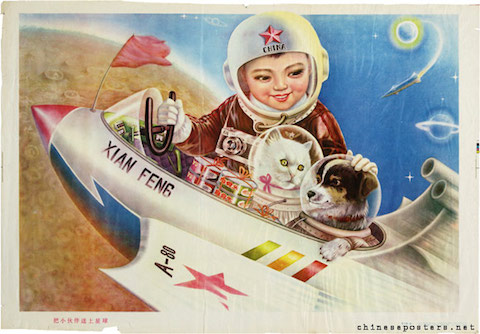
Before DFH‑1, the national imagination was primed for the prospect of Chinese space flight by images like the poster just above, titled “Roaming outer space in an airship,” and designed by Zhang Ruiheng in 1962. This striking piece of work comes to us from Chinese Posters, a compendium of images of “propaganda, politics, history, art.” Images like this one and that of a Chinese taikonaut at the top—“Bringing his playmates to the stars”—from 1980, appropriate imagery from the traditional nianhua, or New Years picture.
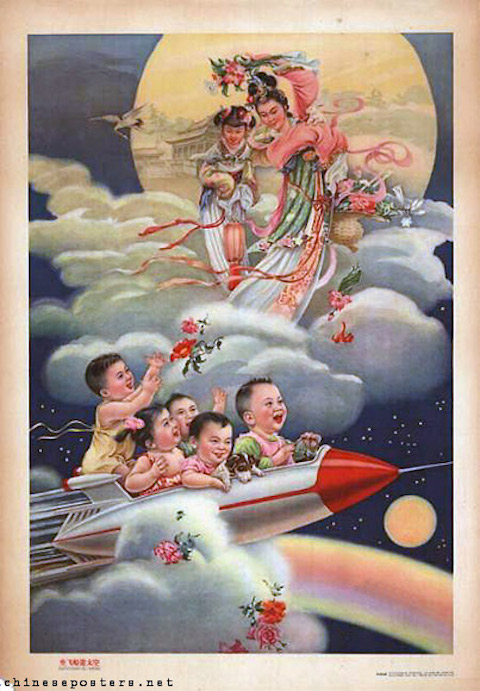
This fanciful style, which “catered to the tastes and beliefs in the countryside,” became the “most important influence on the propaganda posters produced by the Chinese Communist Party,” who began using it in the 1940s. The poster above, “Little guests in the Moon Palace,” dates from the early 1970s, after the launch of DFH‑1 and its sister satellite SJ‑I (CHINA‑2).
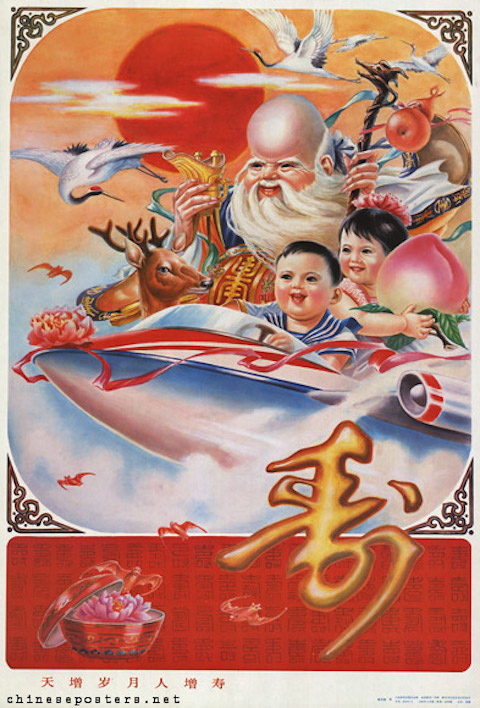
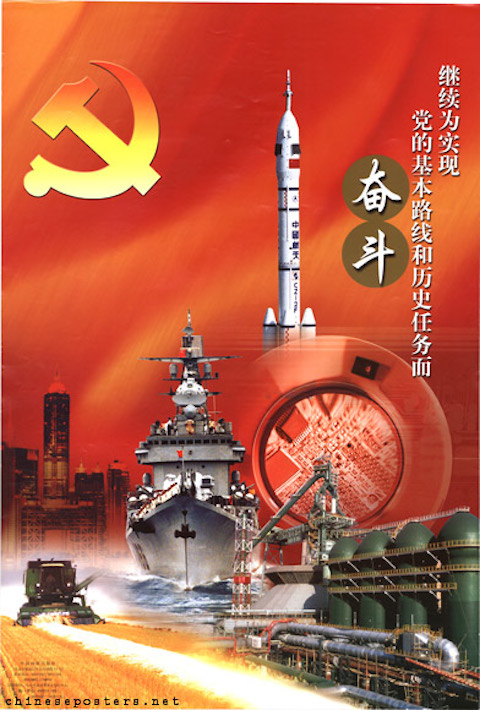
As you can see from the 1989 poster above—“Heaven increases the years, man gets older”—the CCP continued to use the nianhua style well into the eighties, but in the following decades, they began to move away from it and toward more militaristic imagery, like that in the image below from 2002. With different colors and symbols, it would look right at home on the wall of an armed forces recruiting station in any small town, U.S.A.
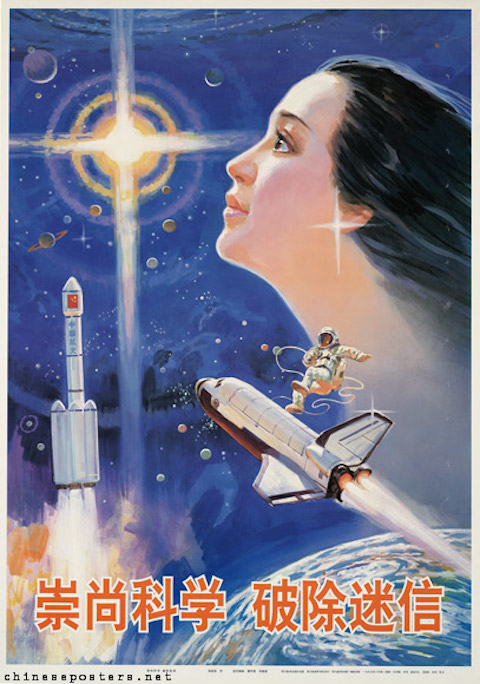
Like many U.S. advocates for space travel and exploration, such as the increasingly visible Neil deGrasse Tyson, the CCP has used space as a means of promoting scientific literacy. In the poster below, “Uphold science, eradicate superstition,” space imagery is used to bring much-persecuted Falon Gong adherents “back into the fold” and to oppose science to religious superstition.
Although some of the imagery may suggest otherwise, the Chinese space program has developed along similar lines as the U.S.’s, and has been put to similar uses. These include the use of space exploration as a means of unifying nationalist sentiment, driving support for science and technology funding and research, and pushing a vision of scientific progress as the national ethos. In 2012, the same year that Sally Ride—first American woman in space—passed away, China began selecting its first female taikonaut, making their space program a venue for increasing gender equality as well.
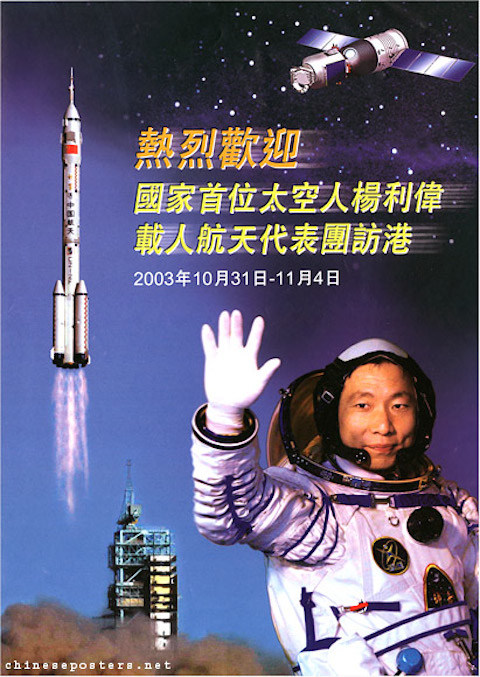
It was only very recently that the Chinese space program successfully completed its first manned mission, sending its first taikonaut, Yang Liewei, abord the Shenzhou 5 in a low earth orbit mission. Although the achievement—as you can see in the poster above commemorating a visit of the taikonaut to Hong Kong—marked a moment of significant national pride, there was one encouraging sign for the future of international cooperation: though you cannot see it in the photo, Yang wore the flag of the United Nations in addition to that of the People’s Republic of China.
See more of these fascinating works of propaganda at Chinese Posters
Nobody likes the way an entire human life can get reduced to a sound bite, but even if you know absolutely nothing else about Carl Sagan, you know that he said the words “billions and billions.” Or rather, you think you know it; in reality (and in accordance with the “Play it again, Sam” principle), the famous astronomer and science popularizer never actually said quite those words on television. A posthumous essay collection used them as its title, but the public only latched on to the catchphrase — or catch half-phrase, anyway — in 1980, when Johnny Carson used it in a Tonight Show parody of Sagan’s broadcast persona. But if you want to hear the real Sagan invoking very large numbers in his characteristic intonation, have we got the video for you.
At the top of the post, you’ll find a supercut of each and every one of his uses of “million,” “billion,” “trillion,” and even “quadrillion” during the entirety of his acclaimed television series Cosmos — to a beat. Alternatively, using similar source material to an entirely different aesthetic end, the sound clip above contains just one instance of Sagan saying “billion” — but stretched out to an hour in length, which turns it into a sort of dronelike ambient music. A not just outward- but forward-thinking scientific visionary like Sagan surely understood more about what lies ahead for humanity than the rest of us do, but could he possibly have foreseen us using our technology for stuff like this? Still, he probably would’ve dug it.
We're hoping to rely on loyal readers, rather than erratic ads. Please click the Donate button and support Open Culture. You can use Paypal, Venmo, Patreon, even Crypto! We thank you!
Open Culture scours the web for the best educational media. We find the free courses and audio books you need, the language lessons & educational videos you want, and plenty of enlightenment in between.