48 Animated Videos Explain the History of Ideas: From Aristotle to Sartre

This year we’ve been fea­tur­ing short ani­mat­ed videos from BBC Radio 4, all cov­er­ing the big ques­tions: How did every­thing begin? What makes us human? What is love? How can I know any­thing at all? They’ve all come script­ed by philoso­pher Nigel War­bur­ton (he of Phi­los­o­phy Bites pod­cast fame) and nar­rat­ed by a host of nota­bles from both sides of the pond like Stephen Fry, Gillian Ander­son, Aidan Turn­er, and Har­ry Shear­er. They’ve illus­trat­ed the philo­soph­i­cal con­cepts at hand not just with elab­o­rate and joke-filled draw­ings that come to life before your eyes, but with direct ref­er­ence to the ideas of his­to­ry’s best-known thinkers: Aris­to­tle, Descartes, Hume, Wittgen­stein, de Beau­voirSartre, Freud, Chom­sky — the list goes on.

Now you can expe­ri­ence all of them in the one big playlist embed­ded just above, which pro­vides a grand his­to­ry of ideas with a suc­ces­sion of bite-size videos. The intel­lec­tu­al jour­ney begins with Dio­ti­ma’s con­cept of desire as a form of beau­ty and ends, 47 one- to two-minute celebri­ty-nar­rat­ed and philo­soph­i­cal­ly scin­til­lat­ing pro­duc­tions lat­er, with Karl Pop­per’s con­cept of fal­si­fi­ca­tion, under which an idea only attains the des­ig­na­tion sci­en­tif­ic if it could, in prin­ci­ple, be proven false.

Once you’ve gone through all these videos, despite how much they them­selves will have taught you, you’ll sure­ly want to go even deep­er into all these big ideas. In the ser­vice of that goal, why not have a look through some of the oth­er philo­soph­i­cal resources we’ve fea­tured, includ­ing our archive of Free Phi­los­o­phy Cours­es, our col­lec­tion of Free Phi­los­o­phy eBooks, pod­casts like Oxford’s phi­los­o­phy lec­tures and The His­to­ry of Phi­los­o­phy With­out Any Gaps, Bryan Magee’s tele­vi­sion inter­views with philoso­phers, and of course, phi­los­o­phy explained with donuts.

If you would like to sign up for Open Culture’s free email newslet­ter, please find it here. It’s a great way to see our new posts, all bun­dled in one email, each day.

If you would like to sup­port the mis­sion of Open Cul­ture, con­sid­er mak­ing a dona­tion to our site. It’s hard to rely 100% on ads, and your con­tri­bu­tions will help us con­tin­ue pro­vid­ing the best free cul­tur­al and edu­ca­tion­al mate­ri­als to learn­ers every­where. You can con­tribute through Pay­Pal, Patre­on, and Ven­mo (@openculture). Thanks!

Relat­ed Con­tent:

How Can I Know Any­thing at All? BBC Ani­ma­tions Fea­ture the Phi­los­o­phy of Wittgen­stein, Hume, Pop­per & More

What is Love? BBC Phi­los­o­phy Ani­ma­tions Fea­ture Sartre, Freud, Aristo­phanes, Dawkins & More

What is the Self? Watch Phi­los­o­phy Ani­ma­tions Nar­rat­ed by Stephen Fry on Sartre, Descartes & More

How Did Every­thing Begin?: Ani­ma­tions on the Ori­gins of the Uni­verse Nar­rat­ed by X‑Files Star Gillian Ander­son

What Makes Us Human?: Chom­sky, Locke & Marx Intro­duced by New Ani­mat­ed Videos from the BBC

How to Live a Good Life? Watch Phi­los­o­phy Ani­ma­tions Nar­rat­ed by Stephen Fry on Aris­to­tle, Ayn Rand, Max Weber & More

How Can I Know Right From Wrong? Watch Phi­los­o­phy Ani­ma­tions on Ethics Nar­rat­ed by Har­ry Shear­er

Phi­los­o­phy Bites: Pod­cast­ing Ideas From Pla­to to Sin­gu­lar­i­ty Since 2007

Col­in Mar­shall writes else­where on cities, lan­guage, Asia, and men’s style. He’s at work on a book about Los Ange­les, A Los Ange­les Primer, the video series The City in Cin­e­maand the crowd­fund­ed jour­nal­ism project Where Is the City of the Future? Fol­low him on Twit­ter at @colinmarshall or on Face­book.

How Sybil Turned Multiple Personality Disorder into a Psychological Phenomenon in America

In 1973, the book Sybil about a young woman strug­gling with 16 dis­tinct per­son­al­i­ties — became a cul­tur­al sen­sa­tion, spawn­ing a huge­ly suc­cess­ful made-for-TV movie in 1976 and an utter­ly unnec­es­sary remake in 2007.

The con­di­tion of mul­ti­ple per­son­al­i­ty dis­or­der (MPD) was so exot­ic and strange that it soon became fod­der for day­time talk shows like Jer­ry Springer and campy sto­ry­lines in soap operas. But the case and the con­tro­ver­sial treat­ment pre­scribed by Sybil’s doc­tor Cor­nelia Wilbur had long-term and seri­ous impli­ca­tions for health­care in this coun­try. Above, you can watch a video by the New York Times that lays out much of the con­tro­ver­sy.

MPD was first diag­nosed in the ear­ly 1950s with a patient named Eve White (above) who seemed to have three per­son­al­i­ties. When Wilbur found that one of her own patients, a trou­bled grad­u­ate stu­dent named Shirley Mason (lat­er known to the world as “Sybil”) exhib­it­ed some of the same symp­toms as Eve, she start­ed an aggres­sive ther­a­py that includ­ed hyp­no­sis and the use of sodi­um thiopen­tal, truth serum. Wilbur sus­pect­ed that Mason’s prob­lems were the result of some child­hood trau­ma and her ther­a­py aimed at uncov­er­ing them.

Under Wilbur’s care, Mason revealed a host of dif­fer­ent per­son­al­i­ties from the assertive Peg­gy, to the emo­tion­al Mar­cia, to Mike, who was not only male but also a car­pen­ter. Through the voice of each per­son­al­i­ty, Wilbur also uncov­ered what she believed to be ter­ri­fy­ing accounts of child­hood rape and abuse.

But as Mason wrote in a 1958 let­ter to Wilbur, the abuse and the mul­ti­ple dis­or­ders were lies. “I am not going to tell you there isn’t any­thing wrong,” Mason writes. “But it is not what I have led you to believe.… I do not have any mul­ti­ple per­son­al­i­ties .… I do not even have a ‘dou­ble.’ … I am all of them. I have been essen­tial­ly lying.”

Wilbur dis­missed Mason’s claims as an excuse to avoid going deep­er in her treat­ment.

The pop­u­lar­i­ty of Sybil’s sto­ry soon turned what was pre­vi­ous­ly a very rare con­di­tion into a trendy psy­cho­log­i­cal dis­or­der. The video details the case of Jeanette Bartha who states, “I came in for depres­sion and I left with mul­ti­ple per­son­al­i­ties.” Under treat­ment with hyp­not­ic drugs, Bartha start­ed to believe not only that she had MPD but also her par­ents abused her as a part of a satan­ic cult. Years lat­er, Bartha real­ized to her grief and hor­ror that these mem­o­ries were false.

Sub­se­quent research has thor­ough­ly debunked the valid­i­ty of Wilbur’s meth­ods and even her diag­no­sis. MPD has been replaced with the broad­er, and less pulpy sound­ing, dis­so­cia­tive-iden­ti­ty dis­or­der.

“The prob­lem is frag­men­ta­tion of iden­ti­ty, not that you real­ly are 12 peo­ple,” says Dr. David Siegel, a crit­ic of Wilbur. “You have not more than one but less than one per­son­al­i­ty.”

via Men­tal Floss

Relat­ed Con­tent:

Free Online Psy­chol­o­gy Cours­es

The Pow­er of Empa­thy: A Quick Ani­mat­ed Les­son That Can Make You a Bet­ter Per­son

Carl Gus­tav Jung Explains His Ground­break­ing The­o­ries About Psy­chol­o­gy in Rare Inter­view (1957)

Jacques Lacan’s Con­fronta­tion with a Young Rebel: Clas­sic Moment, 1972

Jonathan Crow is a Los Ange­les-based writer and film­mak­er whose work has appeared in Yahoo!, The Hol­ly­wood Reporter, and oth­er pub­li­ca­tions. You can fol­low him at @jonccrow. And check out his blog Veep­to­pus, fea­tur­ing lots of pic­tures of bad­gers and even more pic­tures of vice pres­i­dents with octo­pus­es on their heads.  The Veep­to­pus store is here.

Hear Pablo Neruda Read His Poetry In English For the First Time, Days Before His Nobel Prize Acceptance (1971)

Pablo_Neruda_(1966)

Image by Library of Con­gress, via Wiki­me­dia Com­mons

“It is good,” wrote Chilean poet Pablo Neru­da, “at cer­tain hours of the day and night, to look close­ly at the world of objects at rest.” I find myself aston­ished Neru­da him­self ever found time to rest, and to com­pose the hun­dreds of sur­re­al­ist poems that made him a nation­al celebri­ty at 20 years of age and an inter­na­tion­al­ly renowned Nobel Prize win­ner at age 67. In 1927, Neru­da began his long career as a diplomat—“in the Latin Amer­i­can tra­di­tion,” writes the Amer­i­can Acad­e­my of Poets, “of hon­or­ing poets with diplo­mat­ic assign­ments.” Through­out his life, his polit­i­cal com­mit­ments were intense and unswerv­ing. His many diplo­mat­ic appoint­ments (in civ­il war-torn Spain and else­where), his term in the Chilean sen­ate, his exile, and then his return to diplo­mat­ic ser­vice in his native land might have con­sti­tut­ed a life’s work in its own right.

But Neruda’s loy­al­ty to poetry—“a poet­ry as impure as the cloth­ing we wear, or our bodies”—defines his life and lega­cy above all else. “Of all the over­lap­ping and com­pet­ing facets of his life,” writes Erin Beck­er, “amidst all the con­tra­dic­tions and the hypocrisies, Neru­da was always a poet first… his belief in the beau­ty of life and words always comes through, even in his most polit­i­cal work.” Neru­da him­self declared, “I have nev­er thought of my life as divid­ed between poet­ry and pol­i­tics.” Instead, he believed that his work spoke not for itself, but for the peo­ple. As the Nobel Com­mit­tee put it, Neruda’s poet­ry com­mu­ni­cat­ed “with the action of an ele­men­tal force” that “brings alive a continent’s des­tiny and dreams.”

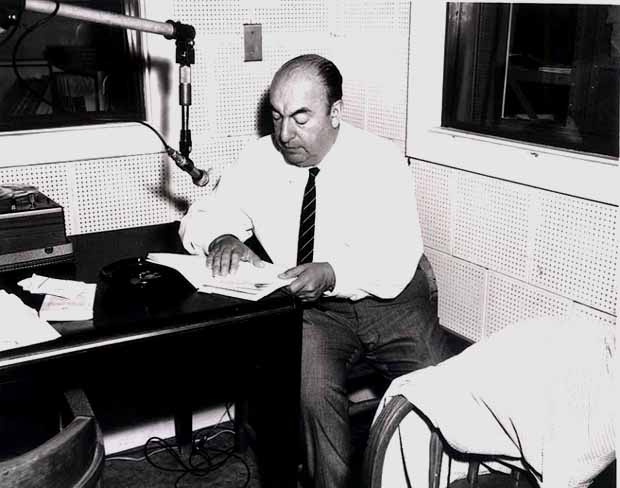
On Sep­tem­ber 5, 1971, just a few days before he accept­ed the Nobel, Neru­da gave his first pub­lic read­ing in Eng­lish, on the radio pro­gram Com­ment. You can hear him above intro­duce and read his very Whit­manesque poem, “Birth.” Neru­da had pre­vi­ous­ly addressed Eng­lish-speak­ing read­ers when, after a long­time ban, he vis­it­ed the states in 1966 and spoke to an audi­ence at New York’s 92nd St. Y. Then, he intro­duced him­self in Eng­lish but would only read his poet­ry in Span­ish. Here—“having entire­ly no con­fi­dence in my reading”—he nonethe­less reads trans­la­tions of his work by “some of my very best friends,” main­ly his pri­ma­ry trans­la­tor in Eng­lish, Ben Belitt. While Belitt has been “accused of tak­ing lib­er­ties” with Neruda’s verse, the poet him­self obvi­ous­ly endorsed his trans­la­tions.

Belitt’s ren­der­ings of Neru­da’s learned, yet earthy Span­ish have become the stan­dard way most of us encounter the poet in Eng­lish. The pub­li­ca­tion of the 1974 dual-lan­guage anthol­o­gy Five Decades: Poems 1925–1970, was to have been “fes­tive,” wrote Belitt in his pref­ace, in hon­or of the poet’s 70th birth­day. Sad­ly, instead, it was a posthu­mous cel­e­bra­tion of Neruda’s work. The poet died in Sep­tem­ber of 1973, two years after the read­ing above and just twelve days after the CIA helped over­throw Sal­vador Allende and install the bru­tal dic­ta­tor Augus­to Pinochet. As Oscar Guardi­o­la-Rivera writes col­or­ful­ly in The Guardian, the details of Neru­da’s polit­i­cal life are fod­der for activists, “Google-bombs wait­ing to be set off by a new gen­er­a­tion of net­worked free­dom fight­ers.” His poet­ic voice, how­ev­er, speaks to and for the mul­ti­tudes, with—as Neru­da wrote in “Toward an Impure Poet­ry”—“the man­dates of touch, smell, taste, sight, hear­ing, the pas­sion for jus­tice, sex­u­al desire… [and] the sump­tu­ous appeal of the tac­tile.”

Neru­da’s read­ing will be added to the Poet­ry sec­tion of our col­lec­tion, 1,000 Free Audio Books: Down­load Great Books for Free.

via Past Dai­ly

Relat­ed Con­tent:

Pablo Neruda’s His­toric First Read­ing in the US (1966)

“The Me Bird” by Pablo Neru­da: An Ani­mat­ed Inter­pre­ta­tion

Josh Jones is a writer and musi­cian based in Durham, NC. Fol­low him at @jdmagness

Everything is a Remix: A Video Series Exploring the Sources of Creativity

Our vet­er­an read­ers will per­haps remem­ber Kir­by Fer­gu­son’s four-part video series Every­thing is a Remix. Cre­at­ed between 2010 and 2014, the series explored the idea that (to quote from one of my ear­li­er posts) “great art doesn’t come out of nowhere. Artists inevitably bor­row from one anoth­er, draw­ing on past ideas and con­ven­tions, and then turn these mate­ri­als into some­thing beau­ti­ful and new.” That applies to musi­cians, film­mak­ers, tech­nol­o­gists, and real­ly any­one in a cre­ative space.

This week, to mark the 5th anniver­sary of the series’ launch, Fer­gu­son has remas­tered and re-released Every­thing is a Remix as a sin­gle video in HD. “For the first time now, the whole series is avail­able as a sin­gle video with prop­er tran­si­tions all the way through, uni­fied styling, and remixed and remas­tered audio.” Find it fea­tured above, and added to our col­lec­tion of Free Online Doc­u­men­taries, a sub­set of our col­lec­tion, 4,000+ Free Movies Online: Great Clas­sics, Indies, Noir, West­erns, Doc­u­men­taries & More.

If you would like to sign up for Open Culture’s free email newslet­ter, please find it here. It’s a great way to see our new posts, all bun­dled in one email, each day.

If you would like to sup­port the mis­sion of Open Cul­ture, con­sid­er mak­ing a dona­tion to our site. It’s hard to rely 100% on ads, and your con­tri­bu­tions will help us con­tin­ue pro­vid­ing the best free cul­tur­al and edu­ca­tion­al mate­ri­als to learn­ers every­where. You can con­tribute through Pay­Pal, Patre­on, and Ven­mo (@openculture). Thanks!

Relat­ed Con­tent:

Why Man Cre­ates: Saul Bass’ Oscar-Win­ning Ani­mat­ed Look at Cre­ativ­i­ty (1968)

Why You Do Your Best Think­ing In The Show­er: Cre­ativ­i­ty & the “Incu­ba­tion Peri­od”

Albert Ein­stein Tells His Son The Key to Learn­ing & Hap­pi­ness is Los­ing Your­self in Cre­ativ­i­ty (or “Find­ing Flow”)

by | Permalink | Make a Comment ( 1 ) |

Watch 1915 Video of Monet, Renoir, Rodin & Degas: The New Motion Picture Camera Captures the Innovative Artists

His­to­ry’s most respect­ed painters all gave their lives to their art. We can almost call that a require­ment of the artist who wish­es their work to attain immor­tal­i­ty, but as for the mor­tal artists them­selves — well, they’ve all got to get out of the house some­time or anoth­er. That rule held even for Edgar Degas, 19th- and ear­ly 20th-cen­tu­ry painter, sculp­tor, and reluc­tant impres­sion­ist whose body of work com­mands many ded­i­cat­ed exhi­bi­tions even in the 21st cen­tu­ry. In the clip above, you can see one of his excur­sions onto the streets of Paris, cap­tured in 1915 with the then-new inven­tion known as the motion pic­ture cam­era.

Degas, who would die in 1917, had by the time of this walk reached his eight­ies, hav­ing put his artis­tic work behind him at least three years before. With his long­time res­i­dence on rue Vic­tor-Massé just about to go under the wreck­ing ball, he moved over to Boule­vard de Clichy, where he lived out his days walk­ing the streets in the very man­ner we see in this snip­pet of film.

But even as Degas roamed Paris so rest­less­ly and aim­less­ly, oth­er French painters and sculp­tors did the work that would put their own names into the art-his­to­ry pan­theon. In the video just above, you can see a 74-year-old Claude Mon­et — also at quite an advanced age for the time — doing a bit of out­door paint­ing in his gar­den at Giverny in 1915, the very year we saw Degas strolling past us with his hat and umbrel­la.

Here, you can see sev­er­al shots of the sculp­tor Auguste Rodin in action, also in 1915, two years before his death, as Mike Springer pre­vi­ous­ly wrote here. The clip’s first sequence “shows the artist at the columned entrance to an uniden­ti­fied struc­ture, fol­lowed by a brief shot of him pos­ing in a gar­den some­where. The rest of the film, begin­ning at the 53-sec­ond mark, was clear­ly shot at the pala­tial, but dilap­i­dat­ed, Hôtel Biron, which Rodin was using as a stu­dio and sec­ond home.”

Mike also cov­ered the fourth French-artist film from 1915 we have here, three min­utes of footage of Auguste Renoir in which “we see the 74-year-old mas­ter seat­ed at his easel, apply­ing paint to a can­vas while his youngest son Claude, 14, stands by to arrange the palette and place the brush in his father’s per­ma­nent­ly clenched hand.” Though in sev­er­al ways debil­i­tat­ed by age, Renoir con­tin­ued to cre­ate, and you can read more about his strug­gle, as well as the project of the young film­mak­er who shot sev­er­al of these now-invalu­able pieces of film, at the orig­i­nal post. And if you want to see more of these artists you may know only as names from art-his­to­ry text­books brought to life, if only for a few moments, have a look at our roundup of icon­ic artists at work.

If you would like to sign up for Open Culture’s free email newslet­ter, please find it here. It’s a great way to see our new posts, all bun­dled in one email, each day.

If you would like to sup­port the mis­sion of Open Cul­ture, con­sid­er mak­ing a dona­tion to our site. It’s hard to rely 100% on ads, and your con­tri­bu­tions will help us con­tin­ue pro­vid­ing the best free cul­tur­al and edu­ca­tion­al mate­ri­als to learn­ers every­where. You can con­tribute through Pay­Pal, Patre­on, and Ven­mo (@openculture). Thanks!

Relat­ed Con­tent:

Watch Icon­ic Artists at Work: Rare Videos of Picas­so, Matisse, Kandin­sky, Renoir, Mon­et, Pol­lock & More

Rare Film of Sculp­tor Auguste Rodin Work­ing at His Stu­dio in Paris (1915)

Aston­ish­ing Film of Arthrit­ic Impres­sion­ist Painter, Pierre-Auguste Renoir (1915)

Claude Mon­et at Work in His Famous Gar­den at Giverny: Rare Film from 1915

Impres­sion­ist Painter Edgar Degas Takes a Stroll in Paris, 1915

Col­in Mar­shall writes else­where on cities, lan­guage, Asia, and men’s style. He’s at work on a book about Los Ange­les, A Los Ange­les Primer, the video series The City in Cin­e­maand the crowd­fund­ed jour­nal­ism project Where Is the City of the Future? Fol­low him on Twit­ter at @colinmarshall or on Face­book.

Support “Where Is the City of the Future?”: A Journey Across the Pacific Rim Using a Brand New Model of Journalism

Apart from from writ­ing here on Open Cul­ture, I write about cities. Hav­ing men­tioned my city-relat­ed projects here from time to time (the pod­cast Note­book on Cities and Cul­ture, the City in Cin­e­ma video essays), I’d like to sub­mit for your approval my newest and most ambi­tious one yet: Where Is the City of the Future?, an in-depth search across the Pacif­ic Rim for the best city to lead us into the urban cen­tu­ry ahead — using a brand new mod­el of jour­nal­ism.

Not long after the turn of the 21st cen­tu­ry, the world’s urban pop­u­la­tion sur­passed its non-urban pop­u­la­tion for the first time ever. And the deep­er human­i­ty gets into the this cen­tu­ry, the more urban­ized our world becomes: devel­op­ing cities devel­op, neglect­ed cities revi­tal­ize them­selves, and the long-stand­ing great cities of the world con­tin­ue to find (or strug­gle to find) new ways of accom­mo­dat­ing all those who’ve nev­er stopped com­ing to live in them. How can the ever-grow­ing urban world pre­pare itself for things to come?

colin cities

This series of reports, com­bin­ing both text and pho­tographs, and informed by both exten­sive on-the-ground explo­ration and in-depth con­ver­sa­tions with those who know these fas­ci­nat­ing urban places best, aims to find out by tak­ing as close as pos­si­ble a look at cities all across the Pacif­ic Rim. These include 20th-cen­tu­ry metrop­o­lis­es look­ing toward the future like Los Ange­les, Seat­tle and Van­cou­ver, com­pact city-states like Sin­ga­pore and Hong Kong, fast-devel­op­ing cap­i­tals like Jakar­ta and Bangkok, low­er-pro­file but nev­er­the­less inven­tive “sleep­er” cities like Welling­ton and San­ti­a­go, and east Asian megac­i­ties like Seoul, Tokyo, and Shang­hai.

I’ve launched “Where Is the City of the Future?” as one of the flag­ship projects on Byline, a new plat­form for crowd­fund­ed jour­nal­ism. For every $2000 raised there, I’ll go report on one Pacif­ic Rim city, seek­ing out the impor­tant lessons it has to teach every oth­er, from the urban­is­tic to the archi­tec­tur­al to the cul­tur­al and beyond. This will begin with reports on Los Ange­les and Seoul, and will con­tin­ue on indef­i­nite­ly to poten­tial cities of the future in an order vot­ed on the back­ers. (The­o­ret­i­cal­ly, you could keep me at this for quite a long time!) If you like, you can get involved at the project’s Byline page. Thanks very much indeed — and I look for­ward to find­ing the city of the future togeth­er.

Relat­ed con­tent:

The City in Cin­e­ma Mini-Doc­u­men­taries Reveal the Los Ange­les of Blade Run­ner, Her, Dri­ve, Repo Man, and More

Col­in Mar­shall writes else­where on cities, lan­guage, Asia, and men’s style. He’s at work on a book about Los Ange­les, A Los Ange­les Primer, the video series The City in Cin­e­ma, and the crowd­fund­ed jour­nal­ism project Where Is the City of the Future? Fol­low him on Twit­ter at @colinmarshall or on Face­book.

Beatles Tribute Band “The Fab Faux” Performs Live an Amazingly Exact Replica of the Original Abbey Road Medley

The Bea­t­les played their last sta­di­um gig in August, 1966 at Can­dle­stick Park, then stopped tour­ing alto­geth­er. At least pub­licly, they claimed that their new songs, com­ing off of intri­cate­ly-pro­duced albums like Revolver and Sgt. Pep­per, were just too hard to per­form live.

Enter The Fab Faux, the great­est of all Bea­t­les cov­er bands.

Fea­tur­ing Will Lee (bassist for the Late Show with David Let­ter­man), Jim­my Vivi­no (band­leader for Conan), Rich Pagano, Frank Agnel­lo, and Jack Petruzzel­li, The Fab Faux is all about one thing– per­form­ing live the most accu­rate repro­duc­tion of The Bea­t­les’ reper­toire. That includes songs that The Bea­t­les nev­er played live, and par­tic­u­lar­ly songs off of the intri­cate lat­er albums.

Above, you can watch them in action, play­ing the extend­ed med­ley (16 min­utes) that graces the sec­ond side of Abbey Road. Before you watch it, here are a cou­ple things you need to know:

This Fab Faux record­ing of most of side two of ‘Abbey Road’ is a live, in-the-stu­dio per­for­mance for a two-cam­era video shoot.… In the end, there were only three minor gui­tar fix­es and each sec­tion was record­ed in no more than three takes (most were two). There are NO added over­dubs with­in this per­for­mance. The audio is pure — and mixed by Joe Chin­ni­ci.

The video was orig­i­nal­ly record­ed for The Howard Stern Show. If you want to get a feel for how well The Fab Faux nailed it, watch their ver­sion played along­side the orig­i­nal below:

Relat­ed Con­tent

Audio: The Bea­t­les Play Their Final Con­cert at Can­dle­stick Park, 1966

Take a Vir­tu­al Tour of Abbey Road Stu­dios, Cour­tesy of the New Google Site “Inside Abbey Road”

A Short Film on the Famous Cross­walk From the Bea­t­les’ Abbey Road Album Cov­er

Hear the Iso­lat­ed Vocal Tracks for The Bea­t­les’ Cli­mac­tic 16-Minute Med­ley on Abbey Road

by | Permalink | Make a Comment ( 7 ) |

A Guided Tour of Guillermo del Toro’s Creativity-Inducing Man Cave, “Bleak House”

Many guys have man caves – a room, a base­ment, a shed where a dude can get away from the demands of domes­tic­i­ty and do dude things. Guiller­mo del Toro, the Oscar-nom­i­nat­ed direc­tor of such movies as Pan’s Labyrinth, Pacif­ic Rim and the upcom­ing Crim­son Peak, doesn’t just have a cave. He has an entire house. It’s called Bleak House and it’s pret­ty amaz­ing. In a fea­turette for Criterion’s release of Cronos (1993), Del Toro gives a guid­ed tour. You can watch it above.

As you can see, the place feels less like a frat house than an eccen­tric muse­um. One of his inspi­ra­tions was curios­i­ty cab­i­nets of old. Indeed, the walls are crammed with paint­ings, prints and curios and just about every cor­ner is teem­ing with skele­tons, skulls, ten­ta­cles and creepy things float­ing in bot­tles of formalde­hyde.

Anoth­er inspi­ra­tion was the orig­i­nal research library for Dis­ney Stu­dios, which fed the imag­i­na­tion of the studio’s artists with lots of art. So Del Toro has orig­i­nal frames from Ger­tie the Dinosaur by Win­sor McCay, the first ani­mat­ed movie ever, along with draw­ings by Moe­bius and pho­tographs of Alfred Hitch­cock. He also has piles of books, mag­a­zines and DVDs. “What­ev­er it is,” says Del Toro, “it’s here to pro­vide a shock to the sys­tem and get cir­cu­lat­ing the lifeblood of cre­ativ­i­ty, which I think is curios­i­ty. When we lose curios­i­ty, we lose entire­ly inven­tive­ness, and we start becom­ing old. So the man cave of Bleak house was designed to be sort of a com­pres­sion cham­ber where we can cre­ate a stim­u­lat­ing envi­ron­ment…” for artists.

Right above you even more about Bleak House in which Del Toro gives a tour to hor­ror direc­tor Tim Sul­li­van. Not only is the place filled with strange and macabre curiosi­ties but also memen­toes from Del Toro’s movies. Want to see Del Toro bran­dish the orig­i­nal Big Baby from Hell­boy II: The Gold­en Army? Check this video out.

Via @LaFa­mil­i­aFilm

Relat­ed Con­tent:

Sketch­es by Guiller­mo del Toro Take You Inside the Director’s Wild­ly Cre­ative Imag­i­na­tion

Geome­tria: Watch Guiller­mo del Toro’s Very Ear­ly, Ghoul­ish Short Film (1987)

Jonathan Crow is a Los Ange­les-based writer and film­mak­er whose work has appeared in Yahoo!, The Hol­ly­wood Reporter, and oth­er pub­li­ca­tions. You can fol­low him at @jonccrow. And check out his blog Veep­to­pus, fea­tur­ing lots of pic­tures of bad­gers and even more pic­tures of vice pres­i­dents with octo­pus­es on their heads.  The Veep­to­pus store is here.

« Go BackMore in this category... »
Quantcast