Man Ray’s Portraits of Ernest Hemingway, Ezra Pound, Marcel Duchamp & Many Other 1920s Icons

Hemingway Man Ray

When pho­tog­ra­phers spe­cial­ize in por­traits of famous peo­ple, they often speak of find­ing a visu­al way to reveal their oft-pho­tographed sub­jec­t’s rarely exposed nature; to bring their depths, in oth­er words, to the sur­face. Man Ray (1890–1976), the Sur­re­al­ist pho­tog­ra­ph­er and artist, had his own way of doing most every­thing, and he cer­tain­ly had his own approach to celebri­ty por­trai­ture. Take, for exam­ple, his 1923 shot of Ernest Hem­ing­way above, tak­en just a cou­ple years after both the writer and pho­tog­ra­ph­er joined the move­able feast of Paris, which Man Ray would call home for most of his career.

Pound Man Ray

That same year and in that same urban bohemia, Man Ray pho­tographed anoth­er famed man of let­ters, the mod­ernist poet Ezra Pound. You can see the some­what more con­ven­tion­al-look­ing result of that encounter just above. Below, we have a far less con­ven­tion­al-look­ing por­trait from 1922, which takes as its sub­ject the dancer Bro­nisla­va Nijin­s­ka, who per­haps only counts as famous to you if you know the his­to­ry of 20th-cen­tu­ry bal­let — but I say any­one will­ing to appear in a por­trait look­ing that fright­en­ing has earned all the fame they can get.

Nijinska

Mar­cel Duchamp, who appears below, sat for Man Ray in 1921 look­ing less scary than sil­ly, but as one of the wit­ti­est and most artis­ti­cal­ly for­ward-think­ing fig­ures of the era, he sure­ly got the joke. These appear in the book Man Ray: Paris — Hol­ly­wood — Paris, which col­lects 500 of the por­traits Man Ray left in his archives when he died in 1976, all of “mem­bers of Dadaist and Sur­re­al­ist cir­cles, of artists and painters, of writ­ers and US emi­grants of the Lost Gen­er­a­tion, of aris­to­crats, and paragons of the worlds of fash­ion and the­ater.”

Duchamp Man ray

You can sam­ple more such works, which cap­ture as only Man Ray would the natures of such icons as André Bre­ton, Sal­vador Dalí, and Lee Miller, at Mon­do Blo­go. You can also find many more works, in gen­er­al, by Man Ray on the MoMA’s web­site.

via Fla­vor­wire

Relat­ed Con­tent:

Three Essen­tial Dadaist Films: Ground­break­ing Works by Hans Richter, Man Ray & Mar­cel Duchamp

Andy Warhol’s 85 Polaroid Por­traits: Mick Jag­ger, Yoko Ono, O.J. Simp­son & Many Oth­ers (1970–1987)

Philoso­pher Por­traits: Famous Philoso­phers Paint­ed in the Style of Influ­en­tial Artists

Por­traits of Vir­ginia Woolf, James Joyce, Wal­ter Ben­jamin & Oth­er Lit­er­ary Leg­ends by Gisèle Fre­und

Cof­fee Por­traits of John Lennon, Albert Ein­stein, Mar­i­lyn Mon­roe & Oth­er Icons

Col­in Mar­shall writes else­where on cities, lan­guage, Asia, and men’s style. He’s at work on a book about Los Ange­les, A Los Ange­les Primer, the video series The City in Cin­e­maand the crowd­fund­ed jour­nal­ism project Where Is the City of the Future? Fol­low him on Twit­ter at @colinmarshall or on Face­book.

Read the Entire Comic Book Adaptation of T.S. Eliot’s “The Love Song of J. Alfred Prufrock”

prufrock23

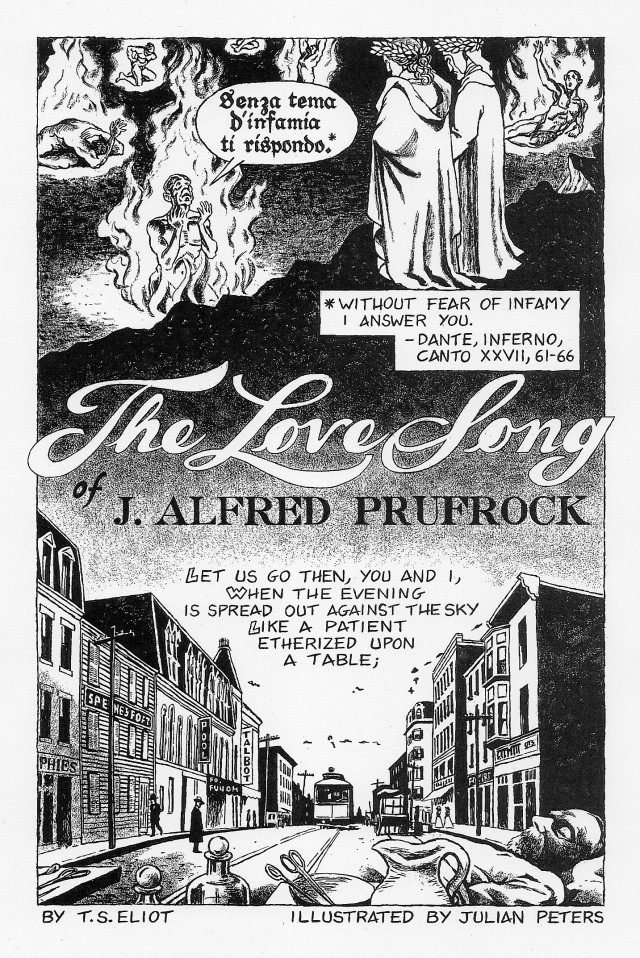
Two years ago, we high­light­ed for you the begin­ning of a promis­ing project — Julian Peters’ com­ic book adap­ta­tion of T.S. Eliot’s 1910 poem â€śThe Love Song of J. Alfred Prufrock.” At the time of our post, Peters had only com­plet­ed the first nine pages of his adap­ta­tion. And, about those first pages, our Josh Jones had this to say:

Dante is where “Prufrock” begins, with an epi­graph from the Infer­no. Peters’ first page illus­trates the ago­nized speak­er of Dante’s lines, Gui­do da Mon­te­fel­tro, a soul con­fined to the eighth cir­cle, whom you can see at the top of the title page shown above. Peters’ visu­al choic­es place us firm­ly in the hell­ish emo­tion­al realm of “Prufrock,” a seem­ing cat­a­logue of the mun­dane that har­bors a dark­er import. Peters gives us no hint of when we might expect new pages, but I for one am eager to see more.

Hap­pi­ly for Josh … and the rest of us … we can now find out where Peters took the rest of the project. The adap­ta­tion is now com­plete. 24 pages in total. All now on dis­play on Peters’ web­site here.

If you’re not famil­iar with â€śThe Love Song of J. Alfred Prufrock,” I’d strong­ly encour­age you to revis­it a post in our archive where you can hear “Prufrock” being read by T.S. Eliot him­self and also Sir Antho­ny Hop­kins. There you can learn more about Eliot’s mod­ernist mas­ter­piece.

Note: Julian is look­ing for a pub­lish­er to help put his com­ic book in print. If any pub­lish­ers want to chat with him, you can find his con­tact info on his web site.

Fol­low Open Cul­ture on Face­book and Twit­ter and share intel­li­gent media with your friends. Or bet­ter yet, sign up for our dai­ly email and get a dai­ly dose of Open Cul­ture in your inbox. And if you want to make sure that our posts def­i­nite­ly appear in your Face­book news­feed, just fol­low these sim­ple steps.

Relat­ed Con­tent:

T.S. Eliot’s Rad­i­cal Poem “The Love Song of J. Alfred Prufrock,” Read by Antho­ny Hop­kins and Eliot Him­self

Lis­ten to T.S. Eliot Recite His Late Mas­ter­piece, the Four Quar­tets

T.S. Eliot Reads Old Possum’s Book of Prac­ti­cal Cats & Oth­er Clas­sic Poems (75 Min­utes, 1955)

Bob Dylan Reads From T.S. Eliot’s Great Mod­ernist Poem The Waste Land

by | Permalink | Make a Comment ( 1 ) |

iTunes Terms & Conditions Adapted into a Graphic Novel: Read It Free Online

apple-terms-and-conditions-comic

In the past, we’ve brought you the cre­ative work of R. Siko­ryak. An illus­tra­tor who teach­es at the Par­sons School of Design in NYC, Siko­ryak has a pen­chant for cre­at­ing com­ic book adap­ta­tions of lit­er­ary clas­sics. Take for exam­ple Dos­toyevsky Comics where Bat­man stars in a com­ic book ver­sion of Crime & Pun­ish­ment. Or Wait­ing to Go, which mar­ries Wait­ing for Godot with Beav­is and Butt-Head. 

In his lat­est project, Siko­ryak veers sharply away from lit­er­a­ture toward lan­guage that is much more tech­ni­cal. Now, on his tum­blr, you can find iTunes Terms & Con­di­tions: The Graph­ic Nov­el.

Adding a new page every day, Siko­ryak is cre­at­ing an illus­trat­ed ver­sion of the “com­plete, unabridged legal agree­ment.” You can cur­rent­ly view the first 49 pages. Click here. Go to the bot­tom of the page. Then start scrolling up as you read.

Fol­low Open Cul­ture on Face­book and Twit­ter and share intel­li­gent media with your friends. Or bet­ter yet, sign up for our dai­ly email and get a dai­ly dose of Open Cul­ture in your inbox. And if you want to make sure that our posts def­i­nite­ly appear in your Face­book news­feed, just fol­low these sim­ple steps.

Relat­ed Con­tent:

Bat­man Stars in an Unusu­al Car­toon Adap­ta­tion of Dostoyevsky’s Crime and Pun­ish­ment

Down­load 15,000+ Free Gold­en Age Comics from the Dig­i­tal Com­ic Muse­um

Comics Inspired by Wait­ing For Godot, Fea­tur­ing Tintin, Roz Chast, and Beav­is & Butthead

New Video Game Inspired by 20 Haruki Murakami Stories Is Coming Your Way: Help Kickstart It

Back in grade school, I got into the genre of com­put­er games known as “graph­ic adven­tures,” nar­ra­tive expe­ri­ences — and often quite elab­o­rate ones — through which the play­er guides the pro­tag­o­nist with points and clicks: games like Mani­ac Man­sionSpace QuestMean StreetsZak McCrack­en and the Alien Mind­ben­ders. In col­lege I got into the writ­ing of Haru­ki Muraka­mi, the inter­na­tion­al super­star of Japan­ese lit­er­a­ture spe­cial­iz­ing in the kind of sto­ries that, in his words, have under­gone “a kind of mag­i­cal bap­tism to link the world on this side with the world on the oth­er side.” More recent­ly, I’ve cul­ti­vat­ed an inter­est in projects crowd­fund­ed on plat­forms like Kick­starter. At long last, some­one has come up with a cre­ation that unites all three: Mem­o­randa, a Muraka­mi-inspired graph­ic adven­ture now rais­ing its bud­get on Kick­starter.

memoranda 2

“Three years ago I sat down with a friend to brain­storm for mak­ing a game,” writes one of Mem­o­ran­da’s devel­op­ers. Murakami’s work “had inspired us pro­found­ly and we thought that the vague, sur­re­al­is­tic real­i­ty of his fic­tion­al world would have a great poten­tial for being turned into some­thing visu­al and could lead to the cre­ation of odd char­ac­ters, an essen­tial ele­ment in game design.” This led to a “script inspired by more than 20 sto­ries by Muraka­mi” involv­ing a lit­tle town (which has “Euro­pean-like archi­tec­ture but that does­n’t mean it belongs to some­where in Europe”) “where there are both lap­tops and bam­boo water clocks,” a cast of char­ac­ters from “a WWII sur­viv­ing sol­dier to an ele­phant tak­ing shel­ter in a man’s house hop­ing to become human,” and a pro­tag­o­nist “who lit­tle by lit­tle real­izes she is for­get­ting her own name.”

Kick­starter has proven a viable financ­ing medi­um for a new wave of graph­ic adven­ture games, some of them by the cre­ators of the old wave: Tim Schafer, known for Mani­ac Man­sion’s beloved sequel Day of the Ten­ta­cle, raised $3.3 mil­lion for what would become Bro­ken Age, and Space Quest mas­ter­minds Scott Mur­phy and Mark Crowe more recent­ly reunit­ed to raise over $500,000 for SpaceVen­tureMem­o­ran­da, by com­par­i­son, requires no more than a shoe­string, and, with ten days to go in its fund­ing dri­ve, it has already raised more than the $13,695 request­ed by Bit Byterz, its Van­cou­ver-based Iran­ian devel­op­ers (how’s that for a demon­stra­tion of Murakami’s glob­al appeal?). But you can still con­tribute at its Kick­starter page, and as a reward could get a copy of the game, its sound­track, a dig­i­tal art book, or even — enthu­si­asts of Muraka­mi tropes, take note — the inclu­sion of your own cat in the sto­ry. No game com­pa­ny ever offered me that in grade school.

You can watch a trail­er for Mem­o­ran­da above.

via Fla­vor­wire

Relat­ed Con­tent:

In Search of Haru­ki Muraka­mi: A Doc­u­men­tary Intro­duc­tion to Japan’s Great Post­mod­ernist Nov­el­ist

Haru­ki Murakami’s Advice Col­umn (“Mr. Murakami’s Place”) Is Now Online: Read Eng­lish Trans­la­tions

Haru­ki Muraka­mi Lists the Three Essen­tial Qual­i­ties For All Seri­ous Nov­el­ists (And Run­ners)

Haru­ki Murakami’s Pas­sion for Jazz: Dis­cov­er the Novelist’s Jazz Playlist, Jazz Essay & Jazz Bar

Dis­cov­er Haru­ki Murakami’s Adver­to­r­i­al Short Sto­ries: Rare Short-Short Fic­tion from the 1980s

A Pho­to­graph­ic Tour of Haru­ki Murakami’s Tokyo, Where Dream, Mem­o­ry, and Real­i­ty Meet

Col­in Mar­shall writes else­where on cities, lan­guage, Asia, and men’s style. He’s at work on a book about Los Ange­les, A Los Ange­les Primer, the video series The City in Cin­e­maand the crowd­fund­ed jour­nal­ism project Where Is the City of the Future? Fol­low him on Twit­ter at @colinmarshall or on Face­book.

The Night John Lennon & Yoko Ono Jammed with Frank Zappa at the Fillmore East (1971)

It’s unfor­tu­nate, I think, that legions of Bea­t­les fans turned on Yoko Ono with such fero­cious ani­mos­i­ty after the breakup of the band. Most fans still absolute­ly despise Yoko. (See the legion of often crude­ly misog­y­nist com­ments under every Youtube video in which she appears.) Sure, her voice and music is cer­tain­ly not to everyone’s taste, but with­out her artis­tic and con­cep­tu­al influ­ence on John Lennon post-Bea­t­les, it’s unlike­ly his amaz­ing solo albums John Lennon/Plastic Ono Band (1970) and Imag­ine (1971) would sound the way they do. Yoko, in fact, more or less gave Lennon the seeds of “Imag­ine,” the song, in her quirky 1964 self-pub­lished book, Grape­fruit: A Book of Instruc­tions and Draw­ings, though she nev­er took the cred­it for it.

Like it or not, if we love solo Lennon, we have no choice but to take the more tra­di­tion­al­ly great song­writ­ing with the messy, exper­i­men­tal, and some­times unlis­ten­able. They can­not be com­plete­ly untan­gled, to the dis­may of a great many peo­ple. As Dami­an Fanel­li at Gui­tar World com­ments on Lennon and the Plas­tic Ono Band’s impromp­tu performance/jam with Eric Clap­ton in Toron­to in 1969, “Yoko screams—very loudly—during the entire oth­er­wise-decent per­for­mance.” This is not an exag­ger­at­ed or espe­cial­ly biased char­ac­ter­i­za­tion. “Some­day,” Fanel­li then goes on, “I’ll vent about how ter­ri­ble and depress­ing this is.” Fine, but whether we think of her singing as chal­leng­ing per­for­mance art or “depress­ing” cat­er­waul­ing, we’re stuck with it. But do the dynam­ics of John and Yoko onstage change when we add anoth­er polar­iz­ing weirdo—Frank Zappa—to the mix? See for your­self in the videos here, from an onstage jam ses­sion the two did with Zap­pa and the Moth­ers of Inven­tion at the Fill­more East in 1971.

See Zap­pa, Lennon, et al. do Wal­ter Ward’s “Well (Baby Please Don’t Go),” which Fanel­li declares “the high­light of the jam, for sure.” Zap­pa announces to the band the key and “not stan­dard blues changes,” then Lennon intro­duces the tune as “a song I used to sing while I was in the Cav­ern in Liv­er­pool. I haven’t done it since.” Zap­pa rips out a fan­tas­tic solo and the band—though seem­ing­ly in the dark at first—lays down a right­eous groove. And Yoko? Well, it’s true, as Fanel­li notes, “all she did was scream her head off.” In this straight-ahead blues num­ber, I have to say, it’s pret­ty obnox­ious. But her vocal tics play much bet­ter in more freeform, odd­ball, Zap­pa-lead jams like “Jam­rag” and “King Kong,” and the shouty, repet­i­tive “Scum­bag,” which sounds almost like a Can out­take.

Zap­pa and band, as always, are in top form. Lennon at times looks out of place and uncer­tain in their impro­visato­ry envi­ron­ment, but he game­ly keeps up. Yoko… Yoko does her usu­al lot of scream­ing, howl­ing, yodel­ing, etc. But before you gin up to tear her to pieces in yet anoth­er nasty online com­ment, bear in mind, for what it’s worth, no Yoko, no “Imag­ine.”

As Fanel­li notes, “the per­for­mance was released as part of Lennon and Ono’s poor­ly received (and not very good at all) 1972 studio/live album, Some­time in New York City.” See Allmusic’s review for a much more thor­ough, fair-mind­ed assess­ment of that record­ing, which “found the Lennons in an explic­it­ly polit­i­cal phase.”

via Gui­tar World

Relat­ed Con­tent:  

The Night Frank Zap­pa Jammed With Pink Floyd … and Cap­tain Beef­heart Too (Bel­gium, 1969)

Down­load the John Lennon/Yoko Ono “War is Over (If You Want It)” Poster in 100+ Lan­guages

Hear John Lennon’s Final Inter­view, Taped on the Last Day of His Life (Decem­ber 8, 1980)

Josh Jones is a writer and musi­cian based in Durham, NC. Fol­low him at @jdmagness

Hand-Colored 1860s Photographs Reveal the Last Days of Samurai Japan

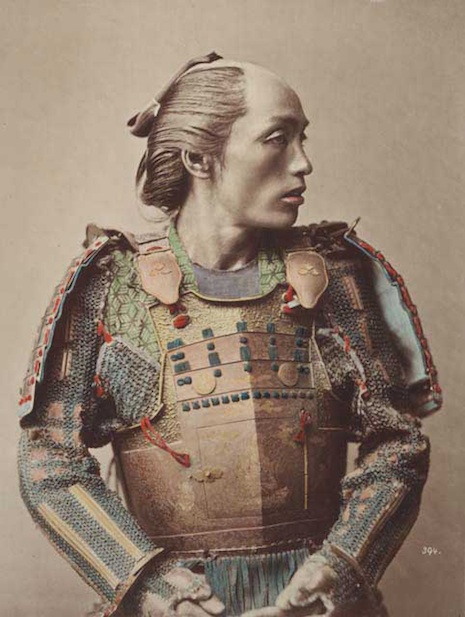
Samurai Japan 1

Any fan of samu­rai movies knows the elab­o­rate lengths some pro­duc­tions can go to in order to recre­ate the look and feel of old Japan, but glo­be­trot­ting Ital­ian-British pho­tog­ra­ph­er Felice Beato (1832 — 1909) actu­al­ly man­aged to cap­ture those days on cel­lu­loid first-hand. He arrived in Japan in 1863, at the very twi­light of the era of the samu­rai, a time he doc­u­ment­ed evoca­tive­ly with a series of hand-col­ored pho­tographs of sub­jects like “kimonos, para­sols, baby’s toys, bas­ket sell­ers, cour­te­sans at rest and a samu­rai gang ready for action,” as the Guardian lists them in their gallery of Beat­o’s Japan­ese work.

Samurai Japan 2

“After spend­ing over two hun­dred years in seclu­sion, Japan was being forced by the Amer­i­cans — under a mis­sion led by Com­modore Matthew C. Per­ry — to expand its trade with the west,” writes Dan­ger­ous Minds’ Paul Gal­lagher, describ­ing the unprece­dent­ed moment of Japan­ese his­to­ry in which Beato found him­self, one that pro­vid­ed the oppor­tu­ni­ty to pho­to­graph not just the last of the samu­rais but also the cour­te­sans they loved. But all this had its risks: “Trav­el was dan­ger­ous in Japan,” Gal­lagher adds, “with many of the Shogu­nate samu­rai war­riors killing west­ern­ers,” a fate Beato nar­row­ly avoid­ed at least once.

samurai in color

Hav­ing pho­tographed in Con­stan­tino­ple, India, and Chi­na before Japan, Beato moved on after it to oth­er parts of Asia, includ­ing Korea and Bur­ma, before return­ing to his native Italy at the very end of his life. But his pic­tures of Japan remain among the most strik­ing of his entire career, per­haps because of their artis­tic use of col­or, per­haps because of a his­tor­i­cal time and place that we think we’ve come to know through so many sword-and-sui­cide epics. Their char­ac­ters, from the hon­or-bound samu­rai to the sly cour­te­san to the sim­ple mer­chant, can seem to us a bit the­atri­cal as a result, but Beat­o’s pho­tographs remind us that they all began as very real peo­ple. Who might they inspire to make a film about their real lives?

Samurai Japan 4

Samurai Japan 5

Samurai Japan 6

via The Guardian/Dan­ger­ous Minds

Relat­ed Con­tent:

Hand-Col­ored Pho­tographs of 19th Cen­tu­ry Japan

Adver­tise­ments from Japan’s Gold­en Age of Art Deco

Glo­ri­ous Ear­ly 20th-Cen­tu­ry Japan­ese Ads for Beer, Smokes & Sake (1902–1954)

Ear­ly Japan­ese Ani­ma­tions: The Ori­gins of Ani­me (1917–1931)

A Pho­to­graph­ic Tour of Haru­ki Murakami’s Tokyo, Where Dream, Mem­o­ry, and Real­i­ty Meet

Col­in Mar­shall writes else­where on cities, lan­guage, Asia, and men’s style. He’s at work on a book about Los Ange­les, A Los Ange­les Primer, the video series The City in Cin­e­maand the crowd­fund­ed jour­nal­ism project Where Is the City of the Future? Fol­low him on Twit­ter at @colinmarshall or on Face­book.

This Is Your Brain on Exercise: Why Physical Exercise (Not Mental Games) Might Be the Best Way to Keep Your Mind Sharp

brain exercise

In the Unit­ed States and the UK, we’ve seen the emer­gence of a multi­bil­lion-dol­lar brain train­ing indus­try, premised on the idea that you can improve your mem­o­ry, atten­tion and pow­ers of rea­son­ing through the right men­tal exer­cis­es. You’ve like­ly seen soft­ware com­pa­nies and web sites that mar­ket games designed to increase your cog­ni­tive abil­i­ties. And if you’re part of an old­er demo­graph­ic, wor­ried about your aging brain, you’ve per­haps been inclined to give those brain train­ing pro­grams a try. Whether these pro­grams can deliv­er on their promis­es remains an open question–especially see­ing that a 2010 sci­en­tif­ic study from Cam­bridge Uni­ver­si­ty and the BBC con­clud­ed that there’s “no evi­dence to sup­port the wide­ly held belief that the reg­u­lar use of com­put­erised brain train­ers improves gen­er­al cog­ni­tive func­tion­ing in healthy par­tic­i­pants…”

And yet we should­n’t lose hope. A num­ber of oth­er sci­en­tif­ic stud­ies sug­gest that phys­i­cal exercise–as opposed to men­tal exercise–can mean­ing­ful­ly improve our cog­ni­tive abil­i­ties, from child­hood through old age. One study led by Charles Hill­man, a pro­fes­sor of kine­si­ol­o­gy and com­mu­ni­ty health at the Uni­ver­si­ty of Illi­nois, found that chil­dren who reg­u­lar­ly exer­cise, writes The New York Times:

dis­played sub­stan­tial improve­ments in … exec­u­tive func­tion. They were bet­ter at “atten­tion­al inhi­bi­tion,” which is the abil­i­ty to block out irrel­e­vant infor­ma­tion and con­cen­trate on the task at hand … and had height­ened abil­i­ties to tog­gle between cog­ni­tive tasks. Telling­ly, the chil­dren who had attend­ed the most exer­cise ses­sions showed the great­est improve­ments in their cog­ni­tive scores.

And, heart­en­ing­ly, exer­cise seems to con­fer ben­e­fits on adults too. A study focus­ing on old­er adults already expe­ri­enc­ing a mild degree of cog­ni­tive impair­ment found that resis­tance and aer­o­bic train­ing improved their spa­tial mem­o­ry and ver­bal mem­o­ry. Anoth­er study found that weight train­ing can decrease brain shrink­age, a process that occurs nat­u­ral­ly with age.

If you’re look­ing to get the gist of how exer­cise pro­motes brain health, it comes down to this:

Exer­cise trig­gers the pro­duc­tion of a pro­tein called brain-derived neu­rotroph­ic fac­tor, or BDNF, which helps sup­port the growth of exist­ing brain cells and the devel­op­ment of new ones.

With age, BDNF lev­els fall; this decline is one rea­son brain func­tion dete­ri­o­rates in the elder­ly. Cer­tain types of exer­cise, name­ly aer­o­bic, are thought to coun­ter­act these age-relat­ed drops in BDNF and can restore young lev­els of BDNF in the age brain.

That’s how The Chica­go Tri­bune sum­ma­rized the find­ings of a 1995 study con­duct­ed by researchers at the Uni­ver­si­ty of Cal­i­for­nia-Irvine. You can get more of the nuts and bolts by read­ing The Tri­bune’s recent arti­cle, The Best Brain Exer­cise May be Phys­i­cal. (Also see Can You Get Smarter?)

You’re per­haps left won­der­ing what’s the right dose of exer­cise for the brain? And guess what, Gretchen Reynolds, the phys ed colum­nist for The Times’ Well blog, wrote a col­umn on just that this sum­mer. Although the sci­ence is still far from con­clu­sive, a new study con­duct­ed by The Uni­ver­si­ty of Kansas Alzheimer’s Dis­ease Cen­ter found that small dos­es of exer­cise could lead to cog­ni­tive improve­ments. Writes Reynolds, “the encour­ag­ing take­away from the new study … is that briskly walk­ing for 20 or 25 min­utes sev­er­al times a week — a dose of exer­cise achiev­able by almost all of us — may help to keep our brains sharp as the years pass.”

If you would like to sign up for Open Culture’s free email newslet­ter, please find it here. It’s a great way to see our new posts, all bun­dled in one email, each day.

If you would like to sup­port the mis­sion of Open Cul­ture, con­sid­er mak­ing a dona­tion to our site. It’s hard to rely 100% on ads, and your con­tri­bu­tions will help us con­tin­ue pro­vid­ing the best free cul­tur­al and edu­ca­tion­al mate­ri­als to learn­ers every­where. You can con­tribute through Pay­Pal, Patre­on, and Ven­mo (@openculture). Thanks!

via New York Times

Relat­ed Con­tent:

This Is Your Brain on Jane Austen: The Neu­ro­science of Read­ing Great Lit­er­a­ture

New Research Shows How Music Lessons Dur­ing Child­hood Ben­e­fit the Brain for a Life­time

Free Online Psy­chol­o­gy & Neu­ro­science Cours­es

by | Permalink | Make a Comment ( 5 ) |

Listen to Ira Glass’ 10 Favorite Episodes of This American Life

American Life Titles

Even when one is a long­time, jad­ed denizen of a major city, celebri­ty sight­ings can still induce a thrill. Dur­ing my tenure in New York City, I ran across my share of famous names, though I’ve nev­er been one to both­er a stranger, world famous or no. This almost changed when I ran past Ira Glass one evening and found myself sore­ly tempt­ed to chat him up. I’m sure he’d be glad I resist­ed the urge, but hav­ing heard his voice on the radio every week for well over a decade… well, I felt like I knew him.

Since 1995, Glass has host­ed This Amer­i­can Life, per­haps the most pop­u­lar pub­lic radio show ever pro­duced and—before its huge­ly suc­cess­ful spin-off Ser­i­al—the most pop­u­lar pod­cast in the U.S. The show is quick­ly approach­ing its twen­ty-year anniver­sary (its first episode aired Novem­ber 17th; hear it here), and in hon­or of that mile­stone, we revis­it anoth­er: the show’s 500th episode, which aired in 2013. For that occa­sion, Buz­zfeed vis­it­ed with Glass for a reveal­ing inter­view.

Though he respond­ed to episode 500 with typ­i­cal understatement—saying it felt “more like an odome­ter rolling over than any­thing else”—many fans of the show, myself includ­ed, felt a great deal more enthu­si­asm, as did Los Ange­les’ KPCC, who brings us the list below of Glass’ top ten episodes (includ­ing one two-parter). Glass not­ed that his top picks also hap­pen to be fan favorites as well. You can hear all of his favorites at the links below:

  • Notes on Camp
  • Harp­er High School One and Two
  • The Giant Pool of Mon­ey
  • Some­where in the Ara­bi­an Sea â€” â€śI love how fun­ny and human-sized every­one is in this show. It’s a sur­pris­ing­ly fun­ny show about the war on ter­ror,” Glass writes.
  • Switched at Birth â€” Glass: “The struc­ture of this show — where the whole episode you won­der how a mom could know for decades she was rais­ing the wrong baby and final­ly, she answers it in the end — is per­fect.”
  • Break-Up â€” â€śThe stand­out sto­ry is Star­lee Kine’s essay on breakup songs, which includes an inter­view with Phil Collins that’s so men­schy and real, it changed how I saw him for­ev­er.”
  • Babysit­ting â€” â€śEspe­cial­ly the inter­view with Myron Jones, which is the best inter­view I’ve ever done, main­ly because he had so much grace and humor talk­ing about his past. Any ques­tion I could think of, he’d come back with an amaz­ing sto­ry, which is rare.”
  • My Big Break â€” â€śDavid Segal takes a turn in the mid­dle of this sto­ry that’s one of my favorite reveals in any radio sto­ry ever.”
  • Harold Wash­ing­ton â€” â€śHow can you go wrong when the cen­tral fig­ure in your sto­ry is fun­ny and can­tan­ker­ous and big­heart­ed and ide­al­is­tic and utter­ly prag­mat­ic and on top of all that, total­ly charis­mat­ic? If you don’t know who Harold is, be pre­pared for a treat.”
  • Heretics â€” â€śCarl­ton Pear­son, like Harold, is some­one they should make a movie about, for lots of the same rea­sons. An ide­al­is­tic preach­er whose ide­al­ism costs him pret­ty much every­thing: the church he runs, his rep­u­ta­tion, his for­tune, near­ly his fam­i­ly.”

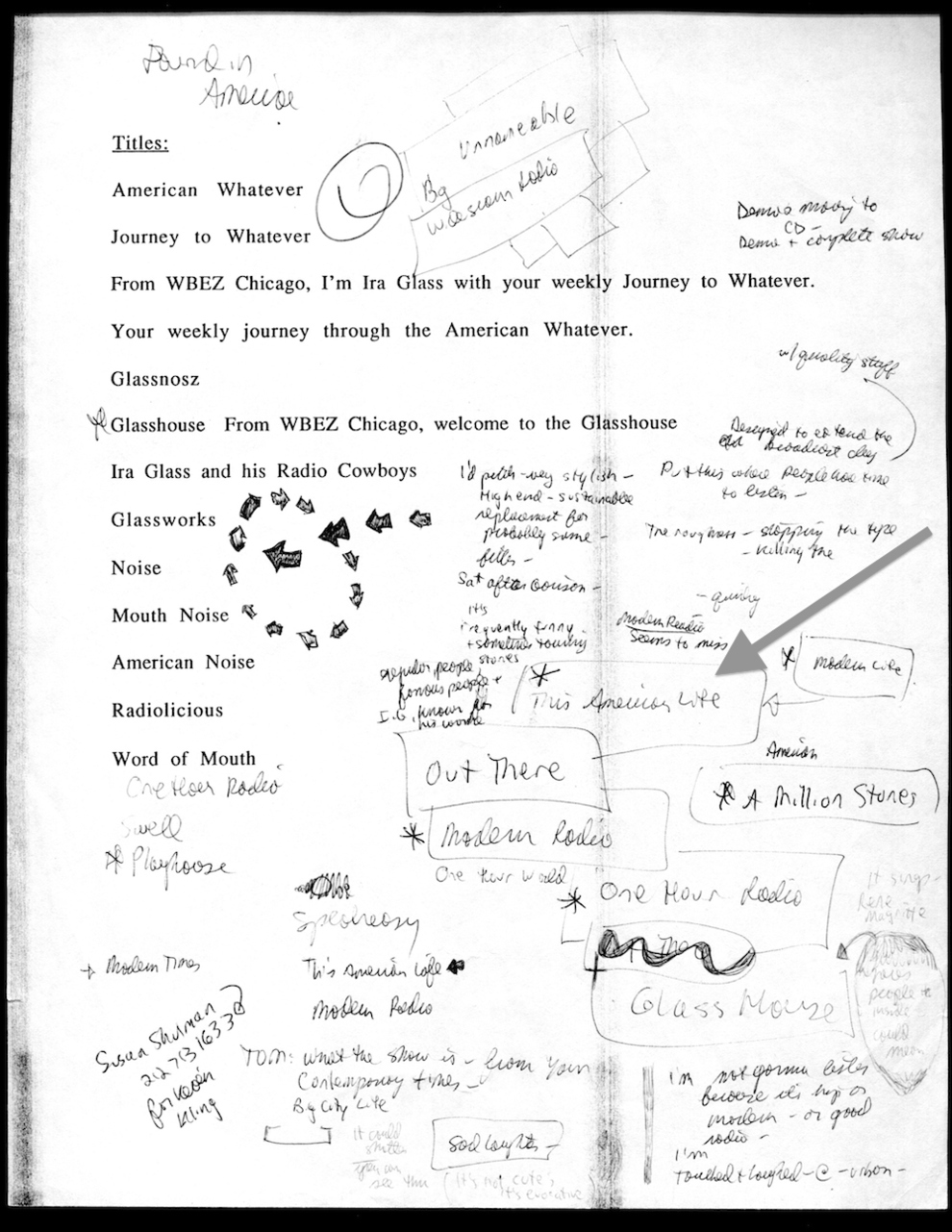
As a spe­cial treat, Glass also shared with Buz­zfeed the doc­u­ment at the top of the post, a page of ideas for alter­nate titles for the show orig­i­nal­ly called Your Radio Play­house. Before renam­ing the show in March of 1996, Glass and his crew con­sid­ered such titles as the unin­spir­ing “Amer­i­can What­ev­er,” weird “Mouth Noise,” and goofy “Ira Glass and his Radio Cow­boys.”

I kind of wish they’d gone with the lat­ter, but it’s hard to imag­ine the show we know as This Amer­i­can Life could ever have been called any­thing else. (See it pen­ciled in almost as an after­thought above.) The show’s title per­fect­ly sums up the breadth and scope of a pro­gram that tack­les every­thing from the triv­ial to the high­ly con­se­quen­tial, often back-to-back in the same themed hour. Though Glass would sure­ly balk at such high praise, I think his show has done more to help Amer­i­cans know and under­stand our­selves over the last twen­ty years than near­ly any­thing else on radio, TV, or the pod­cast­ing world.

via KPCC

Relat­ed Con­tent:

Ira Glass’ Advice on Achiev­ing Cre­ative Excel­lence Pre­sent­ed in Two Art­ful, Typo­graph­ic Videos

Ira Glass on the Art and Craft of Telling Great Radio Sto­ries

This Amer­i­can Life Demys­ti­fies the Amer­i­can Health­care Sys­tem

Josh Jones is a writer and musi­cian based in Durham, NC. Fol­low him at @jdmagness

« Go BackMore in this category... »
Quantcast