If you would like to support the mission of Open Culture, consider making a donation to our site. It’s hard to rely 100% on ads, and your contributions will help us continue providing the best free cultural and educational materials to learners everywhere. You can contribute through PayPal, Patreon, and Venmo (@openculture). Thanks!
On June 10th, at the Sheffield Doc/Fest in England, director Arwen Curry will premiere Worlds of Ursula K Le Guin, the first feature film about the groundbreaking science fiction writer. The film’s website notes that “Curry filmed with Le Guin for 10 years to produce the film, which unfolds an intimate journey of self-discovery as Le Guin comes into her own as a major feminist author, opening new doors for the imagination and inspiring generations of women and other marginalized writers along the way.” Starring Le Guin herself, who sadly passed away earlier this year, Worlds of Ursula K Le Guinfeatures appearances by Margaret Atwood, David Mitchell, Neil Gaiman, Samuel R. Delany, and Michael Chabon. You can watch the brand new trailer for the film above.
If you would like to support the mission of Open Culture, consider making a donation to our site. It’s hard to rely 100% on ads, and your contributions will help us continue providing the best free cultural and educational materials to learners everywhere. You can contribute through PayPal, Patreon, and Venmo (@openculture). Thanks!
In my childhood, I heard stories about Henrietta Lacks’ miraculous cells. I heard these stories because she happened to have been my grandmother’s cousin. But this was just oral lore, I thought at first, legendary and implausible. Cells don’t just keep growing indefinitely. Nothing is immortal. That’s a safe assumption in most every other case, but millions of people now know what only a relatively self-contained community of researchers, doctors, biology students, and, eventually, the Lacks family once did: Henrietta’s cervical cancer cells continued to grow and multiply after her death in 1951. They may, indeed, do so forever.
The once anonymous cell line, called HeLa, has provided researchers worldwide with invaluable medical data. Henrietta herself went unrecognized and unremembered until fairly recently. That all changed after Rebecca Skloot’s book The Immortal Life of Henrietta Lacks, based on an earlier series of articles, appeared in 2010 to great acclaim. Since the publication of Skloot’s bestseller, the story of Henrietta and the Lacks family has further achieved renown in a 2017 film version starring Oprah Winfrey.
Suffice it say, seeing Henrietta arrive on the pop cultural stage has been a strange experience. (One made even weirder by other media moments, like indie band Yeasayer and former Dead Kennedys singer Jello Biafra releasing songs about her and her cells.) The injustices of Henrietta’s story are now well-known. She was poor and received substandard medical treatment. Her cells were harvested without her knowledge, and after her death, no one notified the family about the worldwide use of her cells for biomedical research. That is, until doctors did research on her children in the 70s, publishing family medical records without consent and gathering more data because the HeLa cells had contaminated other cell lines.
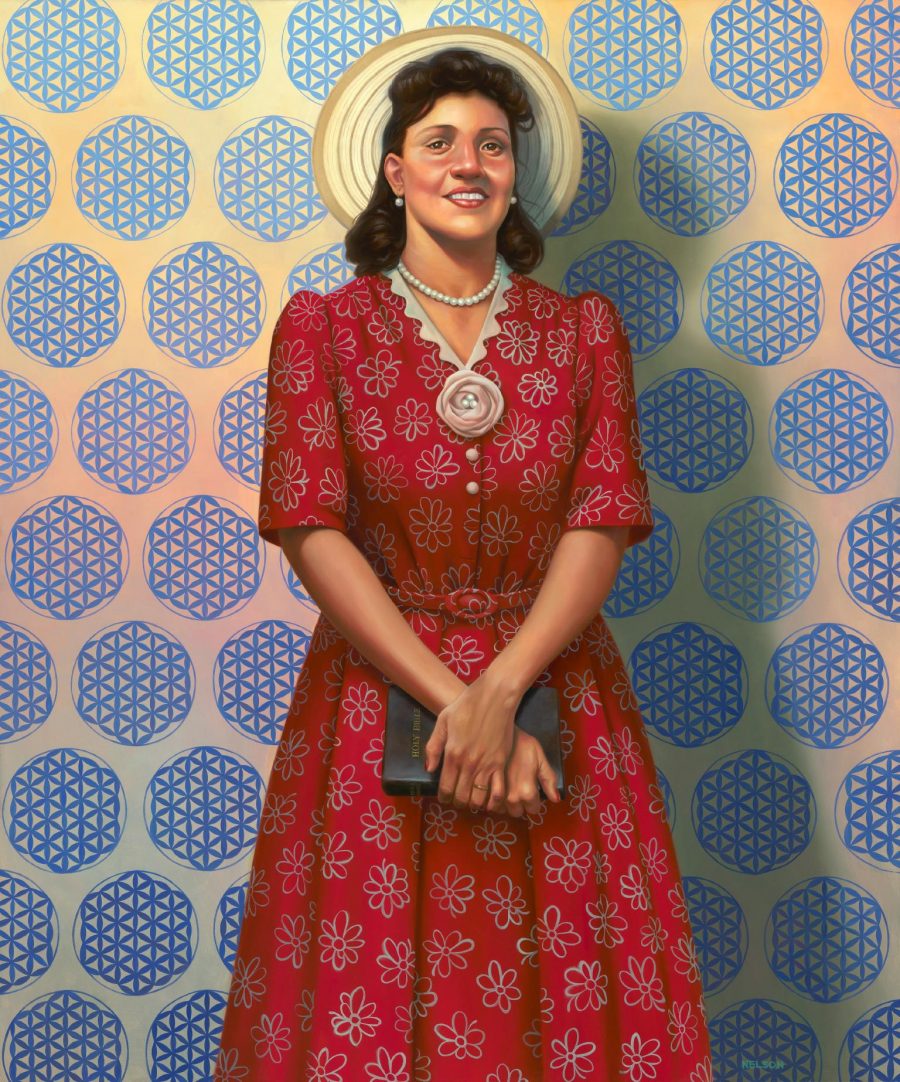
She has “become one of the most powerful symbols for informed consent in the history of science,” Nela Ulaby writes at NPR. She is also a symbol, says Bill Pretzer, senior curator at the National Museum of African American History and Culture (NMAAHC), “that history can be remade, re-remembered.” To that end, Henrietta has been immortalized as a whole human being, not just the source of extraordinarily immortal cells. Her portrait, by African-American artist Kadir Nelson, now hangs in the National Portrait Gallery, a representation of both the historical figure and her world-historical biological legacy.
Drawing on the photograph that adorns the cover of Skloot’s book, the portrait shows her “just like they said she was in life,” says her granddaughter Jeri Lacks-Whye, “happy, outgoing, giving,” and stylishly dressed. The two missing buttons on her dress represent the cells taken from her body, and the pattern behind her, which “almost looks like wallpaper,” says National Portrait Gallery curator Dorothy Moss, is “actually representative of her cells.” Other tributes, notes Ulaby, include a “high school for students interested in medicine” and “a minor planet whirling in the asteroid belt between Mars and Jupiter.” The cells have also generated billions of dollars in profit.
In life, she could never have imagined this strange kind of fame and fortune. The HeLa cells were instrumental in the development of the polio vaccine and research in cloning, gene mapping, and in vitro fertilization. They have traveled into space and around the world hundreds of times. The story of the person they came from, says Skloot in a 2010 interview, reminds us that “there are human beings behind every biological sample used in the laboratory… but they’re usually left out of the equation.” Making those lives an essential part of the conversation in medical research can help keep that research ethically honest, equitable, and, one hopes, based in serving human needs over corporate greed.
Everyone knows “My Favorite Things.” Most know it because of the 1965 movie version of the Broadway musical for which Richard Rodgers originally composed the song. But many jazz enthusiasts credit the one true “My Favorite Things” to a different musical genius entirely: John Coltrane. The free jazz-pioneering saxophonist’s version of Rodgers’ show tune (a filmed performance of which we featured here on Open Culture a few years ago) first came out as the title track of an album he put out in 1961, two years after The Sound of Music’s original Broadway debut. Clocking in at nearly fourteen minutes, it gave listeners a tour de force demonstration of dramatic musical transformation.
“In 1960, Coltrane left Miles [Davis] and formed his own quartet to further explore modal playing, freer directions, and a growing Indian influence,” says the documentary The World According to John Coltrane. “They transformed ‘My Favorite Things,’ the cheerful populist song from ‘The Sound of Music,’ into a hypnotic eastern dervish dance. The recording was a hit and became Coltrane’s most requested tune—and a bridge to broad public acceptance.”
If Coltrane’s interpretation of the song brought it toward the East, what would an Eastern interpretation of his interpretation sound like? Now, thanks to Pakistan’s Sachal Jazz Ensemble, you can hear, and see, Coltrane’s “My Favorite Things” itself transformed dramatically again.
You may remember the Sachal Jazz Ensemble from when we featured their performance of Dave Brubeck’s “Take Five.” In the video up top, led by no less an American jazz luminary than Winton Marsalis, they and their traditional instruments (bansuri, tabla, sitar, dholak, and more), played with a modern sensibility, give a similar treatment to “My Favorite Things.” Their interpretation, though it runs only a comparatively brisk eight minutes or so, will sound quite unlike any jazz standard you’ve ever heard — or any show tune or piece of traditional Pakistani music, for that matter. It also hints at the vast musical possibilities still untapped by the hybridization of musical traditions, even when used to play a song many of us thought we’d been sick of for the past fifty years.
Based in Seoul, Colin Marshall writes and broadcasts on cities and culture. His projects include the book The Stateless City: a Walk through 21st-Century Los Angeles and the video series The City in Cinema. Follow him on Twitter at @colinmarshall or on Facebook.
Jamerson is the Schoenberg of getting from the I chord to the IV chord. He’s algorithmically generating a new pattern every phrase…[He] belongs with Bach, Debussy and Mozart.
- Jack Stratton
Sideman James Jamerson, Paul McCartney’s musical hero and a co-author of the Motown sound, is a great illustration of the bass’ importance in pop and R&B history.
Jack Stratton, leader of the modern American funk band, Vulfpeck, named Jamerson to his Holy Trinity of Bass, along with Chic’s Bernard Edwards and Sly and the Family Stone’s Larry Graham.
(Joe Dart, Vulfpeck’s bassist, is a pretty hot ticket too.)
Stratton’s reverence extended to a side project in which he visually plots some of Jamerson’s savoriest baselines.
No wonder it’s the most listened to isolated bass track on No Treble, the online magazine for bass players.
All together now:
Stratton’s visualizations of the Jameson lines for Stevie Wonder’s “I Was Made to Love Her” and “For Once In My Life” are pretty mesmerizing too.
Ayun Halliday is an author, illustrator, theater maker and Chief Primatologist of the East Village Inky zine. Her solo show Nurse!, in which one of Shakespeare’s best loved female characters hits the lecture circuit to set the record straight premieres in June at The Tank in New York City. Follow her @AyunHalliday.
We're hoping to rely on loyal readers, rather than erratic ads. Please click the Donate button and support Open Culture. You can use Paypal, Venmo, Patreon, even Crypto! We thank you!
Open Culture scours the web for the best educational media. We find the free courses and audio books you need, the language lessons & educational videos you want, and plenty of enlightenment in between.