From dead parrots to The Meaning of Life, Monty Python covered a lot of territory. Educated at Oxford and Cambridge, the Pythons made a habit of weaving arcane intellectual references into the silliest of sketches. A classic example is “Mrs. Premise and Mrs. Conclusion Visit Jean-Paul Sartre,” (above) from episode 27 of Monty Python’s Flying Circus.
The sketch features writing partners John Cleese as Mrs. Premise and Graham Chapman as Mrs. Conclusion, gabbing away in a launderette about how best to put down a budgie. Mrs. Premise suggests flushing it down the loo. “Ooh! No!” protests Mrs. Conclusion. “You shouldn’t do that. No that’s dangerous. Yes, they breed in the sewers, and eventually you get evil-smelling flocks of huge soiled budgies flying out of people’s lavatories infringing their personal freedom.”
From there the conversation veers straight into Jean-Paul Sartre’s The Roads to Freedom. It’s a classic sketch–vintage Python–and you can read a transcript here while watching it above.
Another classic is the “Philosopher’s Drinking Song,” shown above in a scene from Monty Python Live at the Hollywood Bowl. The song was written and sung by Eric Idle. In the sketch, members of the philosophy department at the “University of Woolloomooloo” lead the audience in singing, “Immanuel Kant was a real pissant who was very rarely stable; Heidegger, Heidegger was a boozy beggar who could think you under the table…”
And one of our favorites: “The Philosophers’ Football Match” (above), a filmed sequence from Monty Python Live at the Hollywood Bowl, pitting the Ancient Greeks against the Germans, with Confucius as referee. The sketch was originally broadcast in 1972 in a two-part West German television special, Monty Python’s Fliegender Zirkus.
If you would like to support the mission of Open Culture, consider making a donation to our site. It’s hard to rely 100% on ads, and your contributions will help us continue providing the best free cultural and educational materials to learners everywhere. You can contribute through PayPal, Patreon, and Venmo (@openculture). Thanks!
Note: An earlier version of this post appeared on our site in November 2011.
Though different modern pianos may not sound exactly the same as one another, they all sound more or less like pianos to our ears. But the piano didn’t appear fully formed in the world of music as the instrument we know today: it has a variety of predecessors, not all of which sound very similar to the modern piano at all, and a few distinctive-sounding examples of which you can hear demonstrated in these videos from BaroqueBand. In the first, musician and educator David Schrader plays the first two: a replica of a German clavichord, “the oldest stringed keyboard instrument we know of,” dating from around 1600, and a harpsichord, built according to plans dating back to 1617.
The clavichord strikes its strings like a modern piano, but the harpsichord plucks them, using a series of “tiny little guitar picks” called plectrums. Schrader explains this while offering a look inside the workings of these instruments, just as he does with their descendants in the second video: a replica of an early Viennese piano built by Alton Walter, who in the 1780s built an instrument for a certain Wolfgang Amadeus Mozart, and a modern Steinway grand piano made in Hamburg.
The eight bars of one of Mozart’s piano sonata we hear on the Steinway sound good, especially performed by Schrader’s skilled hands, but the Viennese piano offers additional controls that enable the player to achieve a kind of “tone color” that modern pianos don’t.
Hence the interest some musicians and groups (such as the Orchestra of the Age of the Enlightenment, recently featured here on Open Culture) have in playing classical music with the same instruments from the eras in which the pieces were composed. “Each of these historical instruments served the music of its own time best,” as Schrader puts it. “After all, you wouldn’t necessarily restore an old oil painting with acrylic paint. Even if you choose not to play the historical instruments, if you study them and how they work, it will modify your approach to make for a clearer, nicer performance on the modern instrument.” But of course, “those of us who choose to eat everything on the plate will play all the instruments” — and will enjoy a performing experience closer to that which the composer intended as a result.
Based in Seoul, Colin Marshall writes and broadcasts on cities, language, and culture. His projects include the book The Stateless City: a Walk through 21st-Century Los Angeles and the video series The City in Cinema. Follow him on Twitter at @colinmarshall or on Facebook.
Thanks for watching history. I hope I mentioned everything. — Bill Wurtz
Here at Open Culture, we happily acknowledge that learning is not a one-size-fits-all proposition.
The internet may be doing a number on our attention spans, but as the world has grown smaller, the educational buffet has grown richer, more varied, and vastly more affordable.
And then there’s world history according Bill Wurtz, above, a creator of short, anachronistic-looking videos, whose YouTube fame was kindled by Vine, a now defunct app for sharing short-form videos.
Chafing at Vine’s 7‑second time constraints, Wurtz undertook a more ambitious project, a condensed History of Japan that would employ the same techniques he brought to bear in his shorter works: graphic text, clip art, and Microsoft Paint drawings. He zeroed in on the subject because he knew precious little about Japan, and looked forward to doing some virgin research.
Wurtz followed up the 9‑minute History of Japan, above, with History of the Entire World, I guess.
The nonchalance of the title is reflected in Wurtz’s offhanded narration. Any word or phrase over two syllables runs a risk of being transformed into an infomercial-worthy musical jingle: space dust, the moon, Egypt…
You may bridle at first, but stick it out. Its charms sneak up on you.
Time is not particularly relative in Wurtz’s compressed universe. Whether it’s 10 minutes passing before some major development or 500 million years, their passage is accorded equal heft.
Humans show up around the four minute mark, grabbing stuff, banging rocks, figuring out agriculture…
This is the rare history video where science plays a major role. It takes time out for weather updates—the floor is no longer lava, the entire world is now an ocean… it’s sobering to remember that ozone is what made it safe for multi-celled life forms to venture forth on land.
Empires rise and fall, unconquerable rulers are unseated and forgotten.
(That’s the Tamil Kings. Nobody conquers the Tamil Kings. Who are the Tamil Kings? Merchants probably and they’ve got spices…)
Of course the problem with a great overview such as this is the back end’s shelf life can prove rather short. It’s been a little over a year and a half since Wurtz posted the video, and thus far, his parting shots still feel pretty relevant: armed drones, 3d printing, plastic-choked oceans, and a seemingly unbridgeable gap between the desire to save the world and an actual plan for doing so.
Fried by 11 months of intensive research and labor on History of the Entire World, I guess, Wurtz is currently taking a leave of absence from history. These days, he’s pouring his energies into original music videos like “At the Airport Terminal.” He also devotes a bit of every day to answering fans’ questions, routinely turning in upwards of a dozen succinct humble, all-lowercase replies:
1.18.19 7:00 pm what inspired you to make “the entire world, i guess”? was it a project you already had in mind from before or did you start it when you saw you could do more than just japan
it’s always a nice idea to try to explain the whole world in one video. it’s surely something i’ve always wanted to do, but wasn’t confident/experienced/stupid enough to believe i could do it until after i had done japan which worked so well
1.18.19 12:53 am are you ever going to make anything else as in depth as history of japan or the world?
that would take so much time that by the time it was done you probably wouldn’t care anymore, but someone else will so i still might do it
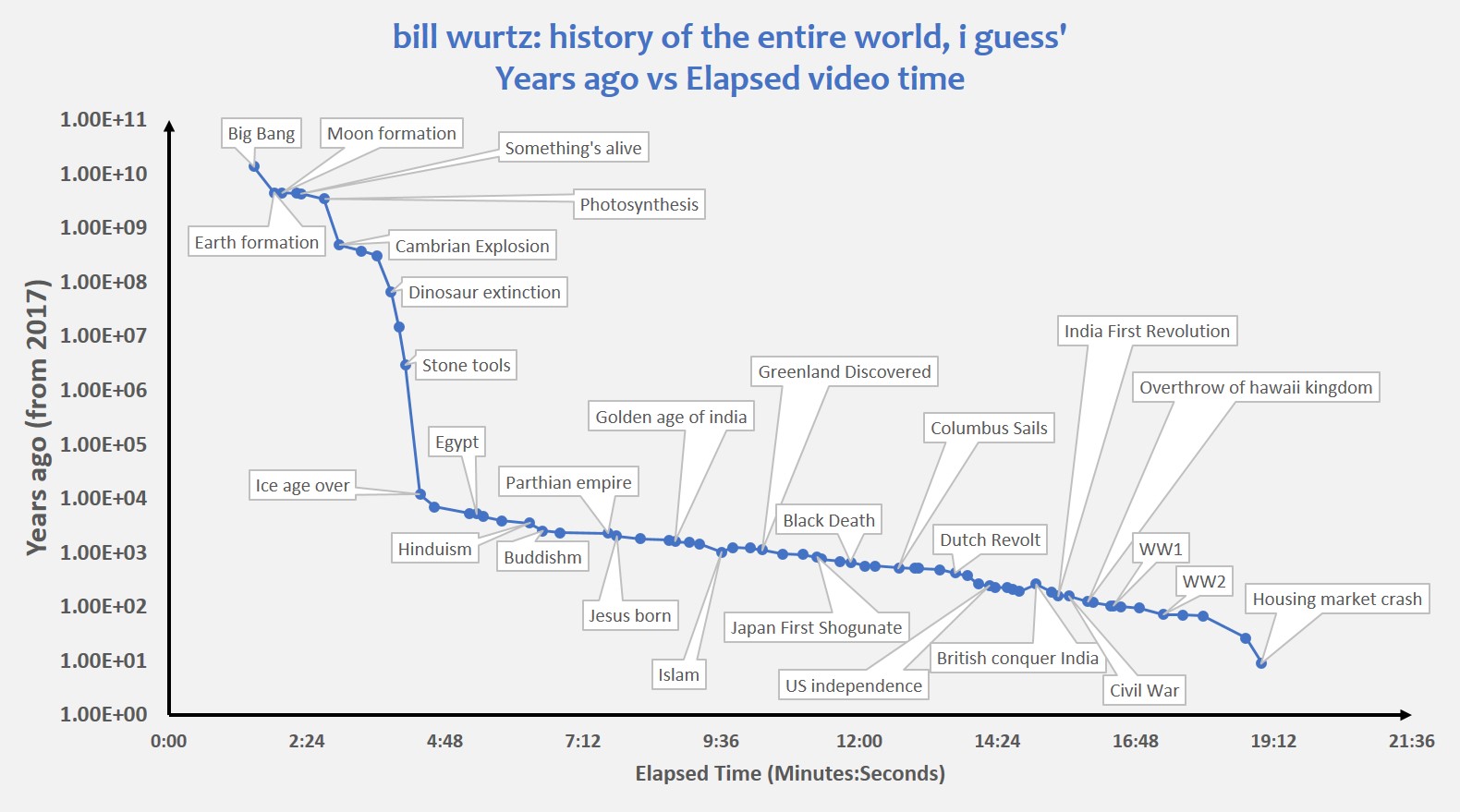
Unsurprisingly, he’s the subject of a lively sub-reddit. One fan, reddit user n44m, was inspired to plot the timeline of History of the Entire World, I Guess, below.
To learn more about some of the civilizations, events and persons featured in History of the Entire World, I Guess, check out another fan’s annotated transcriptionhere.
And rather than nitpick about certain critical bits of history that were left on the cutting room floor, try writing a script for your own history based animation:
The more you learn, the more you find out how much you’re gonna have to leave out. It’s like 99%. That was painful. — Bill Wurtz
We're hoping to rely on loyal readers, rather than erratic ads. Please click the Donate button and support Open Culture. You can use Paypal, Venmo, Patreon, even Crypto! We thank you!
Open Culture scours the web for the best educational media. We find the free courses and audio books you need, the language lessons & educational videos you want, and plenty of enlightenment in between.