Bob Odenkirk & Errol Morris Create Comedic Shorts to Help You Take Action Against Global Warming: Watch Them Online

My beach house must be some­where around here. I used to be able to see the ocean from it. I should be able to see it from the ocean. Ooo, that looks famil­iar. Lady Lib­er­ty. Ha ha! Hel­looo! All the best to you.     —Admi­ral Hor­a­tio Horn­tow­er

Are there any Bet­ter Call Saul fans among the glob­al warm­ing deniers?

A sce­nario in which one can simul­ta­ne­ous­ly pooh pooh the melt­ing of the polar ice caps and embrace The Thin Blue Line?

Direc­tor Errol Mor­ris and his star, Bob Odenkirk, may not change any minds with their Glob­al Melt­down spots they pro­duced in part­ner­ship with the Insti­tute for the Future, but hope­ful­ly the emphat­ic end cards will stir some fans to action.

The absur­dist 30-sec­ond shorts fea­ture Odenkirk, encrust­ed in epaulets and naval insignia, as the fic­tion­al Horn­tow­er, “an admi­ral of a fleet of one and per­haps the last man on Earth.” Marooned on a small block of ice, he rails against the inex­pert­ly ani­mat­ed wildlife encroach­ing on his domain.

(“You don’t even have the facil­i­ty of lan­guage!” he tells a pen­guin, and lat­er threat­ens a wal­rus that it will “get paint­ed out” of the final cut for “com­plain­ing all the time…”)

Cer­tain­ly a doc­u­men­tar­i­an of Mor­ris’ stature could have tak­en a length­i­er, more seri­ous approach to the sub­ject, but as he notes:

Log­ic rarely con­vinces any­body of any­thing. Cli­mate change has become yet anoth­er vehi­cle for polit­i­cal polar­iza­tion. If Al Gore said the Earth was round there would be polit­i­cal oppo­si­tion insist­ing that the Earth was flat. It’s all so pre­pos­ter­ous, so con­temptible.

Odenkirk also has some out-of-uni­form con­cerns about cli­mate change, as expressed in “Where I Got These Abs,” a 2011 Shouts & Mur­murs piece for The New York­er:

The mid­dle ab on the left (not my left, your left, if you are look­ing at me) is called Ter­rence. It’s a dig­ni­fied ab. It tens­es each time I read an op-ed arti­cle about glob­al warm­ing. The article’s point of view is imma­te­r­i­al; sim­ply being remind­ed that I can do noth­ing to stop the hor­rif­ic future of floods and cat­a­stro­phe gives this ab a taut yank that lingers, burn­ing calo­ries in my well-creased fore­head at the same time. 

Watch all of Mor­ris and Odenkirk’s Admi­ral Horn­tow­er spots, cur­rent­ly total­ing nine, with ten more to come, on Glob­al Melt­down’s YouTube chan­nel.

via Kot­tke

Relat­ed Con­tent:

Cli­mate Change Gets Strik­ing­ly Visu­al­ized by a Scot­tish Art Instal­la­tion

Glob­al Warm­ing: A Free Course from UChica­go Explains Cli­mate Change

NASA Cap­tures the World on Fire

Ayun Hal­l­i­day is an author, illus­tra­tor, the­ater mak­er and Chief Pri­ma­tol­o­gist of the East Vil­lage Inkyzine.  Join her in NYC this Mon­day, Sep­tem­ber 9 for the new season’s kick­off of her book-based vari­ety show, Necro­mancers of the Pub­lic Domain. Fol­low her @AyunHalliday.

Why Learn Latin?: 5 Videos Make a Compelling Case That the “Dead Language” Is an “Eternal Language”

“I tried to get Latin can­celed for five years,” says an exas­per­at­ed Max Fis­ch­er, pro­tag­o­nist of Wes Ander­son­’s Rush­more, when he hears of his school’s deci­sion to scrap Latin class­es. “ ‘It’s a dead lan­guage,’ I’d always say.” Many have made a sim­i­lar­ly blunt case against the study of Latin. But as we all remem­ber, Max’s edu­ca­tion­al phi­los­o­phy over­turns just as soon as he meets Miss Cross and brings up the can­cel­la­tion to make con­ver­sa­tion. “That’s a shame because all the Romance lan­guages were based on Latin,” she says, artic­u­lat­ing a stan­dard defense. “Nihi­lo sanc­tum estne?” Max’s reply, after Miss Cross clar­i­fies that what she said is Latin for “Is noth­ing sacred?”: “Sic tran­sit glo­ria.”

From ad hoc and bona fide to sta­tus quo and vice ver­sa, all of us know a lit­tle bit of Latin, even the “dead lan­guage’s” most out­spo­ken oppo­nents. But do any of us have a rea­son to build delib­er­ate­ly on that inher­it­ed knowl­edge? The video at the top of the post offers not just one but “Three Rea­sons to Study Latin (for Nor­mal Peo­ple, Not Lan­guage Geeks).”

As its host admits, “I could tell you that study­ing Latin will set you up to learn the Romance lan­guages or give you a base of knowl­edge for fine arts and lit­er­a­ture. I can tell you that you’ll be able to read Latin on old build­ings, hymns, state mot­toes, or that read­ing Cicero and Vir­gil in the orig­i­nal is divine­ly beau­ti­ful.” But the num­ber one rea­son to study Latin, he says, is that it will improve your lan­guage acqui­si­tion skills.

And lan­guage acqui­si­tion isn’t just the skill of learn­ing lan­guages, but “the skill of learn­ing oth­er skills.” It teach­es us that “thoughts them­selves are formed dif­fer­ent­ly in dif­fer­ent lan­guages,” and learn­ing even a sin­gle for­eign word “is the act of learn­ing to think in a new way.” Study a for­eign lan­guage and you enter a com­mu­ni­ty, just as you do “every time you learn a new pro­fes­sion, learn a new hob­by,” or when you “inter­act with his­to­ri­ans or philoso­phers, inter­act with the writ­ers of cook­books, or gar­den­ing books, or even writ­ers of soft­ware.” Latin in par­tic­u­lar will also make you bet­ter at speak­ing Eng­lish, espe­cial­ly if you already speak it native­ly. Not only are you “unavoid­ably blind to the weak­ness­es and strengths of your native mean­ing car­ry­ing sys­tem — your lan­guage — until you test dri­ve a new one,” the more com­plex, abstract half of the Eng­lish vocab­u­lary comes from Latin in the first place.

Above all, Latin promis­es wis­dom. Not only can it “train you to con­cep­tu­al­ize one thing in the con­text of many things and to see the con­nec­tions between all of them,” it can, by the time you’re under­stand­ing mean­ing as well as form, “grow you in big-pic­ture and small-pic­ture think­ing and give you the dex­ter­i­ty to move back and forth between both.” Just as you are what you eat, “your mind becomes like what you spend your time think­ing about,” and the rig­or­ous­ly struc­tured Latin lan­guage can imbue it with “log­ic, order, dis­ci­pline, struc­ture, pre­ci­sion.” In the TED Talk above, Latin teacher Ryan Sell­ers builds on this idea, call­ing the study of Latin “one of the most effec­tive ways of build­ing strong fun­da­men­tals in stu­dents and prepar­ing them for the future.” Among the time­less ben­e­fits of the “eter­nal lan­guage” Sell­ers includes its abil­i­ty to increase Eng­lish “word pow­er,” its “math­e­mat­i­cal” nature, and the con­nec­tions it makes between the ancient world and the mod­ern one.

Latin used to be more a part of the aver­age school cur­ricu­lum than it is now, but the debates about its use­ful­ness have been going on for gen­er­a­tions. Why Study Latin?, the 1951 class­room film above, cov­ers a wide swath of them in ten min­utes, from read­ing clas­sics in the orig­i­nal to under­stand­ing sci­en­tif­ic and med­ical ter­mi­nol­o­gy to becom­ing a sharp­er writer in Eng­lish to trac­ing mod­ern West­ern gov­ern­men­tal and soci­etal prin­ci­ples back to their Roman roots. And as the School of Life video below tells us, some things are still best expressed in Latin, an eco­nom­i­cal lan­guage that can pack a great deal of mean­ing into rel­a­tive­ly few words: Veni, vidi, vici. Carpe diem. Homo sum: humani nil a me alienum puto. And of course, Latin makes every expres­sion sound weight­i­er — it gives a cer­tain grav­i­tas, we might say.

If all these argu­ments have sold you on the ben­e­fits of Latin, or at least got you intrigued enough to learn more, watch “How Latin Works” for a brief overview of the his­to­ry and mechan­ics of the lan­guage, as well as an expla­na­tion of what it has giv­en to and how it dif­fers from Eng­lish and the oth­er Euro­pean lan­guages we use today. You might then pro­ceed to the free Latin lessons avail­able at the the Uni­ver­si­ty of Texas’ Lin­guis­tics Research Cen­ter, pre­vi­ous­ly fea­tured here on Open Cul­ture. The more Latin you acquire, the more you’ll see and hear it every­where. You might even ask the same ques­tion Max Fis­ch­er pos­es to the assem­bled admin­is­tra­tors of Rush­more Acad­e­my: “Is Latin dead?” His moti­va­tions have more to do with romance than Romance, but there are no bad rea­sons to learn a lan­guage, liv­ing or oth­er­wise.

Relat­ed Con­tent:

Learn Latin, Old Eng­lish, San­skrit, Clas­si­cal Greek & Oth­er Ancient Lan­guages in 10 Lessons

What Ancient Latin Sound­ed Like, And How We Know It

Hip 1960s Latin Teacher Trans­lat­ed Bea­t­les Songs into Latin for His Stu­dents: Read Lyrics for “O Teneum Manum,” “Diei Duri Nox” & More

Why Should We Read Virgil’s Aeneid? An Ani­mat­ed Video Makes the Case

The Tree of Lan­guages Illus­trat­ed in a Big, Beau­ti­ful Info­graph­ic

Based in Seoul, Col­in Mar­shall writes and broad­casts on cities, lan­guage, and cul­ture. His projects include the book The State­less City: a Walk through 21st-Cen­tu­ry Los Ange­les and the video series The City in Cin­e­ma. Fol­low him on Twit­ter at @colinmarshall or on Face­book.

Yale Presents an Archive of 170,000 Photographs Documenting the Great Depression

dorothea lange

Dur­ing the Great Depres­sion, The Farm Secu­ri­ty Administration—Office of War Infor­ma­tion (FSA-OWI) hired pho­tog­ra­phers to trav­el across Amer­i­ca to doc­u­ment the pover­ty that gripped the nation, hop­ing to build sup­port for New Deal pro­grams being cham­pi­oned by F.D.R.‘s admin­is­tra­tion.

Leg­endary pho­tog­ra­phers like Dorothea Lange, Walk­er Evans, and Arthur Roth­stein took part in what amount­ed to the largest pho­tog­ra­phy project ever spon­sored by the fed­er­al gov­ern­ment. All told, 170,000 pho­tographs were tak­en, then cat­a­logued back in Wash­ing­ton DC. The Library of Con­gress became their even­tu­al rest­ing place.

walker evans

We first men­tioned this his­toric project back in 2012, when the New York Pub­lic Library put a rel­a­tive­ly small sam­pling of these images online. But now we have big­ger news.

Yale Uni­ver­si­ty has launched Pho­togram­mar, a sophis­ti­cat­ed web-based plat­form for orga­niz­ing, search­ing, and visu­al­iz­ing these 170,000 his­toric pho­tographs.

arthur rothstein

The Pho­togram­mar plat­form gives you the abil­i­ty to search through the images by pho­tog­ra­ph­er. Do a search for Dorothea Lange’s pho­tographs, and you get over 3200 images, includ­ing the now icon­ic pho­to­graph at the bot­tom of this post.

Pho­togram­mar also offers a handy inter­ac­tive map that lets you gath­er geo­graph­i­cal infor­ma­tion about 90,000 pho­tographs in the col­lec­tion.

And then there’s a sec­tion called Pho­togram­mar Labs where inno­v­a­tive visu­al­iza­tion tech­niques and data exper­i­ments will grad­u­al­ly shed new light on the image archive.

Accord­ing to Yale, the Pho­togram­mar project was fund­ed by a grant from the Nation­al Endow­ment for the Human­i­ties (NEH). Direct­ed by Lau­ra Wexler, the project was under­tak­en by Yale’’s Pub­lic Human­i­ties Pro­gram and its Pho­to­graph­ic Mem­o­ry Work­shop.

rothstein 3
Top image: A migrant agri­cul­tur­al work­er in Marysville migrant camp, try­ing to fig­ure out his year’s earn­ings. Tak­en in Cal­i­for­nia in 1935 by Dorothea Lange.

Sec­ond image: Allie Mae Bur­roughs, wife of cot­ton share­crop­per. Pho­to tak­en in Hale Coun­ty, Alaba­ma in 1935 by Walk­er Evans.

Third image: Wife and chil­dren of share­crop­per in Wash­ing­ton Coun­ty, Arkansas. By Arthur Roth­stein. 1935.

Fourth image: Wife of Negro share­crop­per, Lee Coun­ty, Mis­sis­sip­pi. Again tak­en by Arthur Roth­stein in 1935.

Bot­tom image: Des­ti­tute pea pick­ers in Cal­i­for­nia. Moth­er of sev­en chil­dren. Age thir­ty-two. Tak­en by Dorothea Lange in Nipo­mo, Cal­i­for­nia, 1936.

lange bottom

If you would like to sign up for Open Culture’s free email newslet­ter, please find it here. It’s a great way to see our new posts, all bun­dled in one email, each day.

If you would like to sup­port the mis­sion of Open Cul­ture, con­sid­er mak­ing a dona­tion to our site. It’s hard to rely 100% on ads, and your con­tri­bu­tions will help us con­tin­ue pro­vid­ing the best free cul­tur­al and edu­ca­tion­al mate­ri­als to learn­ers every­where. You can con­tribute through Pay­Pal, Patre­on, and Ven­mo (@openculture). Thanks!

Note: An ear­li­er ver­sion of this post appeared on our site in 2014.

Relat­ed Con­tent:

Har­vard Puts Online a Huge Col­lec­tion of Bauhaus Art Objects

Down­load for Free 2.6 Mil­lion Images from Books Pub­lished Over Last 500 Years on Flickr

130,000 Pho­tographs by Andy Warhol Are Now Avail­able Online, Cour­tesy of Stan­ford Uni­ver­si­ty

The Medieval Mas­ter­piece, the Book of Kells, Is Now Dig­i­tized & Put Online

Hear the Very Moment When World War I Came to an End

Robert Graves’ poem “Armistice Day, 1918” begins with a riot of sound in a town in North East Eng­land. “What’s all this hub­bub and yelling, / Com­mo­tion and scam­per of feet,” he writes, “With ear-split­ting clat­ter of ket­tles and cans, / Wild laugh­ter down Mafek­ing Street?” The poem grows somber, then embit­tered, end­ing in a chill­ing silence for the “boys who were killed in the trench­es, / Who fought with no rage and no rant.” It’s a famil­iar con­trast from much World War I poetry—the hoot­ing civil­ian crowds and the grim, silent sol­diers count­ing their loss­es.

One project, cre­at­ed as part of the 100th anniver­sary of the Armistice last year, gave us a dif­fer­ent take on this WWI theme of sound and silence —using inno­v­a­tive tech­niques from 1918 that turned the final shelling of the war into visu­al data, then trans­lat­ing that data back into sound a cen­tu­ry lat­er. Rather than cel­e­bra­tion, the “ear-split­ting clat­ter” is the sound of mass death, and the silence, though sure­ly “uneasy,” as Matt Novak writes, must also have been rev­e­la­to­ry.

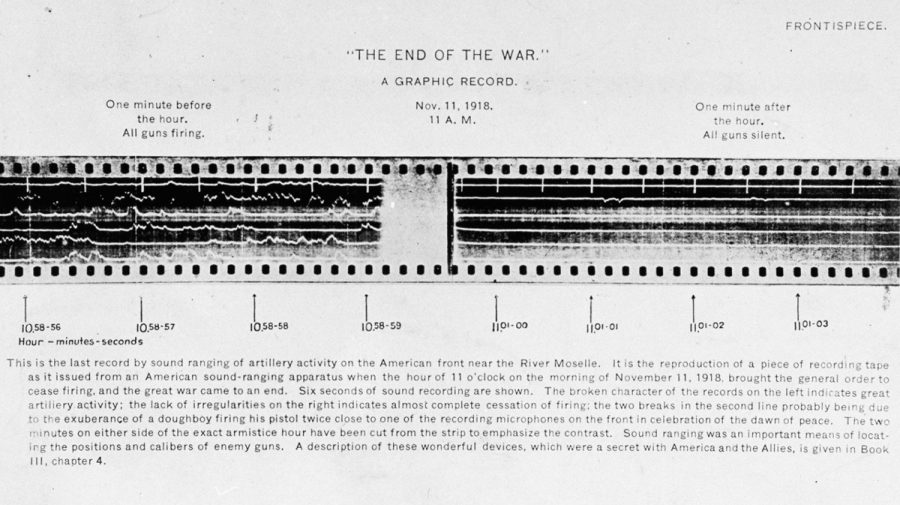
In the “graph­ic record” of the Armistice, just below, we can “see” the deaf­en­ing sounds of war and the first three silent sec­onds of its end, at 11 A.M. Novem­ber 11th, 1918. The film strip records six sec­onds of vibra­tion from six dif­fer­ent sources, as the graph­ic, from the Army Corps of Engi­neers, informs us. “The bro­ken char­ac­ter of the records on the left indi­cates great artillery activ­i­ty; the lack of irreg­u­lar­i­ties on the right indi­cates almost com­plete ces­sa­tion of fir­ing.”

You might notice a cou­ple lit­tle breaks in one line on the right—likely the result of an exu­ber­ant “dough­boy fir­ing his pis­tol twice close to one of the record­ing micro­phones on the front in cel­e­bra­tion of the dawn of peace.” But this was 1918—field record­ing tech­nol­o­gy bare­ly exist­ed, though a few bat­tle­field attempts were made (at least one sur­vives). The “micro­phones” in ques­tion were actu­al­ly “bar­rels of oil dug into the ground,” notes Jason Daley at Smith­son­ian.

This tech­nique, called “sound rang­ing,” worked by reg­is­ter­ing vibra­tion, sim­i­lar to a seis­mo­graph’s oper­a­tion, and helped spe­cial units locate ene­my fire, using “pho­to­graph­ic film to visu­al­ly record noise inten­si­ty.” The film above was part of the cen­te­nary exhi­bi­tion at London’s Impe­r­i­al War Muse­um, which also com­mis­sioned sound design­ers Coda to Coda to recon­struct the dra­mat­ic moment with an audio inter­pre­ta­tion. At the top of the post, hear what the sec­onds before and after the Armistice like­ly sound­ed like, as record­ed on the Amer­i­can front at the Riv­er Moselle.

Lis­ten­ing to the sec­onds of the war’s end from the bat­tle­field perspective—rather than streets filled with cheer­ing crowds—is rather chill­ing, “a sud­den reprieve from the stac­ca­to of weapons blast­ing,” Novak writes. The “graph­ic record” of the Armistice also shows us “just how hor­rif­i­cal­ly pre­cise and cru­el war can be.” The slaugh­ter could have been stopped in an instant, by the mutu­al decree of world lead­ers, at maybe any time dur­ing those har­row­ing four years.

On Novem­ber 11 at 11 A.M., “the guns fell silent,” writes the Impe­r­i­al War Muse­um, and “a new world began.” But as artists like Graves remind us, for the return­ing maimed and trau­ma­tized sol­diers and the hun­dreds of thou­sands of bereaved fam­i­lies, the war didn’t end when the noise final­ly stopped.

Relat­ed Con­tent:

Peter Jackson’s New Film on World War I Fea­tures Incred­i­ble Dig­i­tal­ly-Restored Footage From the Front Lines: Get a Glimpse

Hear the Sounds of World War I: A Gas Attack Record­ed on the Front Line, and the Moment the Armistice End­ed the War

Watch World War I Unfold in a 6 Minute Time-Lapse Film: Every Day From 1914 to 1918

Josh Jones is a writer and musi­cian based in Durham, NC. Fol­low him at @jdmagness

The Paul McCartney is Dead Conspiracy Theory, Explained

Hoax­es used to be fun, I imag­ine, before the inter­net turned them into weapons of mass dis­in­for­ma­tion. One shud­ders to think what kind of luna­cy might have result­ed had the Paul McCart­ney-is-dead-and-has-been-replaced-by-a-looka­like hoax first spread on Face­book instead of col­lege news­pa­pers, local radio sta­tions, and good-old word of mouth. The hoax is emblem­at­ic not only of how mis­in­for­ma­tion spread dif­fer­ent­ly fifty years ago, but also how the coun­ter­cul­ture fig­ured out infor­ma­tion war­fare, and used it to pro­duce reams of satir­i­cal pro­to-viral con­tent.

Whether the author of the orig­i­nal 1969 arti­cle—“Is Bea­t­le Paul McCart­ney Dead?,” from the Drake Uni­ver­si­ty stu­dent news­pa­per the Times-Del­ph­ic—intend­ed to fool the pub­lic hard­ly mat­ters. His spec­u­la­tion reads like par­o­dy, like a star chart crossed with lurid tabloid gos­sip that, through a strange twist of fate cre­at­ed a net­work of peo­ple who believed that Paul was killed in a 1966 car crash and the band found an imposter named Bil­ly Shears to replace him.

It should be not­ed that Paul McCart­ney is very much alive and has not been played by an imper­son­ator for fifty years. There are no “two sides” to this sto­ry. There is the life of Paul McCart­ney and there is a strange and amus­ing rumor that nev­er harmed any­one, except the Paul McCart­ney of its imag­i­na­tion. “Paul is Dead” ranks high­ly among “music’s most WTF con­spir­a­cy the­o­ries,” also the title of the Rolling Stone video above, which aims to explain “the orig­i­nal insane rock n’ roll con­spir­a­cy the­o­ry.”

The Bea­t­les had a lot of fun with the con­spir­a­cy, dou­bly hoax­ing their fans by play­ing along occa­sion­al­ly. McCart­ney respond­ed with his clas­sic wit: “If I were dead, I’d be the last to know it.” But pub­licly con­firm­ing or deny­ing Paul McCartney’s body snatch­ing did­n’t mat­ter. Like those who claimed Stan­ley Kubrick staged the moon land­ing and left clues in The Shin­ing, true believ­ers found evi­dence every­where they looked.

The cov­er of Sgt. Pepper’s sup­pos­ed­ly rep­re­sents Paul’s funer­al; his dop­pel­gänger alleged­ly wears a patch with the let­ters O.P.D.—officially pro­nounced dead.” (It’s actu­al­ly O.P.P., “Ontario Provin­cial Police.”); lyrics played back­wards spell it out: “Paul is Dead.” As with most crack­pot the­o­ries, there is one cru­cial miss­ing ele­ment: motive. Why would the band not only cov­er up Paul’s death but leave trails of bread­crumbs on every sub­se­quent record?

Why does the vil­lain explain their entire plan to the hero as soon as they get the upper hand? Why do killers leave detailed, incrim­i­nat­ing doc­u­ments called “The Plan” on their hard dri­ves on Date­line? Who can say? In the world of weird con­spir­a­cy the­o­ries, con­spir­a­tors are com­pelled to place cryp­tic but deci­pher­able clues all over the place. It’s like they want to be caught, or it’s like con­spir­a­cy fans des­per­ate­ly want to believe they do. Either way, as far as con­spir­a­cy the­o­ries go, “Paul is Dead” earns its “WTF” sta­tus. It also bears the dis­tinc­tion of nev­er actu­al­ly hav­ing involved anyone’s death.

Relat­ed Con­tent:

How the “Paul McCart­ney is Dead” Hoax Start­ed at an Amer­i­can Col­lege News­pa­per and Went Viral (1969)

The Band Every­one Thought Was The Bea­t­les: Revis­it the Klaatu Con­spir­a­cy of 1976

Stan­ley Kubrick’s Daugh­ter Vivian Debunks the Age-Old Moon Land­ing Con­spir­a­cy The­o­ry

Josh Jones is a writer and musi­cian based in Durham, NC. Fol­low him at @jdmagness

The History of Europe from 400 BC to the Present, Animated in 12 Minutes

What does the future of Europe look like? Geopo­lit­i­cal times such as these do make one pon­der such ques­tions as, say, “In what shape (if any) will the Euro­pean Union make it through this cen­tu­ry?” But as any his­to­ri­an of Europe knows, that con­ti­nent has sel­dom had an easy time of it: Euro­pean his­to­ry is a his­to­ry of con­quests, rebel­lions, alliances made and bro­ken, and of course, wars aplen­ty — a major piece of the ratio­nale behind the cre­ation of orga­ni­za­tions like the Euro­pean Union in the first place. As a result, the divi­sion of Europe by the many groups and indi­vid­u­als who have laid claim to pieces of it has, over the past 2500 years, sel­dom held steady for long, as you can see on the ani­mat­ed map above.

The Roman Empire did man­age to paint the map red, lit­er­al­ly, in the sec­ond and third cen­turies, but dur­ing all eras before and after it looks as mul­ti­col­ored as it was polit­i­cal­ly dis­unit­ed. In ear­li­er times, Europe was home to peo­ples with names like the Gauls, Iberi­ans, Celts, and Scythi­ans, as well as empires like the Achaemenid and Seleu­cid Empire.

After the First World War, though — and the dis­so­lu­tion of such enti­ties as the Ottoman Empire, Aus­tria-Hun­gary, and the Pol­ish-Lithuan­ian Com­mon­wealth — the labels start to look more famil­iar. Most of us remem­ber the event marked by the last big change to this map, the end of the Union of Sovi­et Social­ist Republics. (Many of us even spent years there­after in class­rooms whose world maps still depict­ed the USSR as one mighty bloc.)

The map’s ani­ma­tion begins in 400 BC and ends in 2017 with Europe as a col­lec­tion of nation-states, each of which we now regard as not just polit­i­cal­ly but cul­tur­al­ly dis­tinct. But watch­ing the full two-and-a-half-mil­len­nia time-lapse reminds us that every coun­try in Europe has bro­ken off from, joined with, or oth­er­wise descend­ed from anoth­er place, indeed many oth­er places, most of which have long since ceased to exist. In the 21st cen­tu­ry, one often hears Europe described as essen­tial­ly unchang­ing, stuck in its ways, ossi­fied, and an after­noon spent watch­ing the pro­ceed­ings of Euro­pean Union bureau­cra­cy would hard­ly dis­abuse any­one of that notion. But then, would­n’t observers of Europe have felt the same way back in the hey­day of Rome?

Relat­ed Con­tent:

The His­to­ry of Europe: 5,000 Years Ani­mat­ed in a Time­lapse Map

Watch World War I Unfold in a 6 Minute Time-Lapse Film: Every Day From 1914 to 1918

Watch World War II Rage Across Europe in a 7 Minute Time-Lapse Film: Every Day From 1939 to 1945

The Entire His­to­ry of Japan in 9 Quirky Min­utes

Watch the His­to­ry of the World Unfold on an Ani­mat­ed Map: From 200,000 BCE to Today

A His­to­ry of the Entire World in Less Than 20 Min­utes

Based in Seoul, Col­in Mar­shall writes and broad­casts on cities, lan­guage, and cul­ture. His projects include the book The State­less City: a Walk through 21st-Cen­tu­ry Los Ange­les and the video series The City in Cin­e­ma. Fol­low him on Twit­ter at @colinmarshall or on Face­book.

The Wisdom of Ram Dass Is Now Online: Stream 150 of His Enlightened Spiritual Talks as Free Podcasts

Image by Barabeke, via Cre­ative Com­mons

“Over the course of his life, it would appear that Ram Dass has led two vast­ly dif­fer­ent lives,” writes Katie Ser­e­na in an All That’s Inter­est­ing pro­file of the man for­mer­ly known as Richard Alpert. By embody­ing two dis­tinct, but equal­ly influ­en­tial, beings in one life­time, he has also embod­ied the fusion, and divi­sion, of two sig­nif­i­cant cul­tur­al inher­i­tances from the 60s: the psy­che­del­ic drug cul­ture and the hip­pie syn­cretism of East­ern reli­gion Chris­tian­i­ty, Yoga, etc.

These strains did not always come togeth­er in the health­i­est of ways. But Ram Dass is a unique indi­vid­ual. As Alpert, the Mass­a­chu­setts-born Har­vard psy­chol­o­gy pro­fes­sor, he began con­trolled exper­i­ments with LSD at Har­vard with Tim­o­thy Leary.

When both were dis­missed, they con­tin­ued their famous ses­sions in Mill­brook, New York, from 1963 to 1967, in essence cre­at­ing the lab­o­ra­to­ry con­di­tions for the coun­ter­cul­ture, in research that has since been val­i­dat­ed once again as hold­ing keys that might unlock depres­sion, anx­i­ety, and addic­tion.

Then, Alpert trav­elled to India in 1967 with a friend who called him­self “Bha­ga­van Das,” begin­ning an epic spir­i­tu­al jour­ney that rivals the leg­ends of the Bud­dha, as he describes it in the trail­er below for the new doc­u­men­tary Becom­ing Nobody. He trans­formed from the infa­mous Richard Alpert to the soon-to-be-world-famous Ram Dass (which means “ser­vant of god”), a guide for West­ern seek­ers who encour­ages peo­ple not to leave it all behind and do as he did, but to find their path in the mid­dle of what­ev­er lives they hap­pen to be liv­ing.

“I think that the spir­i­tu­al trip in this moment,” he said in one of his hun­dreds of talks, “is not nec­es­sar­i­ly a cave in the Himalayas, but it’s in rela­tion to the tech­nol­o­gy that’s exist­ing, it’s in rela­tion to where we’re at.” It might sound like a friend­ly mes­sage to the sta­tus quo. But Ram Dass is a true sub­ver­sive, who asked us, through all of the reli­gious, aca­d­e­m­ic, and psy­che­del­ic trap­pings he picked up, put down, and picked up again at var­i­ous times, to take a good hard look at who we’re try­ing to be and why.

Ram Dass’ moment has come again, “as the par­al­lels between today’s fraught polit­i­cal envi­ron­ment and that of the Viet­nam era mul­ti­ply,” writes Will Welch at GQ. “Yoga, organ­ic foods, the Grate­ful Dead,” and psychedelics—“all of them are back in fash­ion,” and so are Ram Dass’ talks about how we might find clar­i­ty, authen­tic­i­ty, and con­nec­tion in a dis­tract­ed, tech­no­crat­ic, polar­iz­ing, pow­er- and per­son­al­i­ty-mad soci­ety.

There are 150 of those talks now on the pod­cast Ram Dass Here and Now, with intro­duc­tions from Raghu Markus of Ram Dass’ Love Serve Remem­ber Foun­da­tion. You can stream or down­load them at Apple Pod­casts or at the Be Here Now Net­work, named for the teacher’s rad­i­cal 1971 book that gave the coun­ter­cul­ture its mantra. Ram Dass is still teach­ing, over fifty years after his trans­for­ma­tion from acid guru to… well, actu­al guru.

In a recent inter­view with The New York Times, he described “nos­tal­gia for the ‘60s and ‘70s” as a younger gen­er­a­tion show­ing “they’re tired of our cul­ture. They’re inter­est­ed in cul­ti­vat­ing their minds and their soul.” How do we do that? The jour­ney does resem­ble his in one way, he says. If we want to change the cul­ture, we first have to change our­selves. Fig­ure out who we’ve been pre­tend­ing to be, then drop the act. “Once you have become some­body,” he says in the talk fur­ther up from 1976, “then you are ready to start the jour­ney to becom­ing nobody.”

Learn much more about Ram Dass’ jour­ney and hear many more of his inspir­ing talks at the Be Here Now Net­work.

Relat­ed Con­tent:

Med­i­ta­tion for Begin­ners: Bud­dhist Monks & Teach­ers Explain the Basics

The Wis­dom of Alan Watts in Four Thought-Pro­vok­ing Ani­ma­tions

The His­toric LSD Debate at MIT: Tim­o­thy Leary v. Pro­fes­sor Jerome Lettvin (1967)

Josh Jones is a writer and musi­cian based in Durham, NC. Fol­low him at @jdmagness

Demystifying the Falsetto Obsession in Pop & Rock Music

Though its name sounds deroga­to­ry, falset­to is not some kind of trick­ery but a tech­nique used by humans for as long as they have been singing. It has its his­to­ries in indige­nous, folk, and clas­si­cal music. Yet mod­ern ears prob­a­bly asso­ciate it most with pop music of all kinds—from the har­mo­nious vocal blends of Doo Wop to the oper­at­ic har­monies of Queen (espe­cial­ly Roger Tay­lor, below) to… well, vir­tu­al­ly every song from a male singer today.

Falset­to is dif­fer­ent from what’s called “head voice,” as many a vocal coach will point out. “Usu­al­ly found in the upper reg­is­ters of male and female singers,” writes one such coach, “the breathy qual­i­ty of falset­to” is often “used for effect to sound oth­er­world­ly and beau­ti­ful or young.” Need a fuller explo­ration of why falset­to has such pur­chase in pop­u­lar music? See the above Vox Ear­worm explain­er by Estelle Caswell, tack­ling “pop music’s falset­to obses­sion.”

Falset­to has had phas­es when women adopt­ed it to major­ly promi­nent effect (see the age of Julee Cruise and Mazzy Star). It has of late become a very clear trend among male pop stars, Caswell the­o­rizes: “Justin Bieber, The Week­nd, Bruno Mars, Drake, Char­lie Puth, Shawn Mendes, Adam Levine, Sam Smith… the list goes on and on and on.” What’s all this about?

Caswell decid­ed to “crunch the num­bers and quan­ti­fy” the use of falset­to in pop to see if her per­cep­tion of its cur­rent ubiq­ui­ty could be sub­stan­ti­at­ed. Enlist­ing the help of data sci­ence and detailed ana­lyt­ics from Pan­do­ra, she traced falset­to singing in pop­u­lar music from a yodel­er in 1911 to “the icon­ic voice of Thom Yorke.” The Bill­board Hot 100 is fed into the dataset, “fan­cy pro­grams” do their thing and humans try to cor­rect errors.

Opera singer Antho­ny Roth Costan­zo shows up to explain the dif­fer­ence between falset­to and vocal reg­is­ter, and we learn much more about what falset­to is, and isn’t, and how, and maybe why, it’s so pop­u­lar a style for male pop vocal­ists. Caswell also put togeth­er a Spo­ti­fy playlist of falset­to pop and rock, fea­tur­ing every­thing from the afore­men­tioned Queen and Radio­head to Cur­tis May­field, Frankie Val­li, the Bee Gees, and Child­ish Gam­bi­no.

What does the data say? Caswell is hon­est to a fault about the prob­lems with a sta­tis­ti­cal approach—there are too many hit songs miss­ing from the Pan­do­ra dataset, and the AI’s falset­to scor­ing sys­tem (yes, such a thing exists) has seri­ous flaws. Turns out it may take a human ear to rec­og­nize the tech­nique, and even then, there’s room for dis­agree­ment.

But to sum up: mil­len­ni­als might feel like they live in a gold­en age of falset­to male pop singers because it’s all they’ve ever known. But ask any­one who grew up hear­ing Queen, the Bee Gees, or Mar­vin Gaye, or The Four Tops, even the Stones’ “Emo­tion­al Res­cue,” or the yodel­er who had that hit in 1911….

Relat­ed Con­tent:

Hear Mar­vin Gaye Sing “I Heard It Through the Grapevine” A Capel­la: The Haunt­ing Iso­lat­ed Vocal Track

How to Sing Two Notes At Once (aka Poly­phon­ic Over­tone Singing): Lessons from Singer Anna-Maria Hefele

Hear Fred­die Mer­cury & Queen’s Iso­lat­ed Vocals on Their Endur­ing Clas­sic Song, “We Are The Cham­pi­ons”

Josh Jones is a writer and musi­cian based in Durham, NC. Fol­low him at @jdmagness

« Go BackMore in this category... »
Quantcast