Two and a half years ago, we featured the concept art for Studio Ghibli’s theme park here on Open Culture, and just two weeks ago it opened its doors. Located on the grounds of Expo 2005 in Japan’s Aichi Prefecture (a three- to four-hour train trip west from Tokyo, or a two-hour train trip east of Osaka), Ghibli Park comprises several themed areas like the Grand Warehouse, the Hill of Youth, and Dondoko Forest. Just hearing those names surely fires up the imaginations of many a Ghibli fan, even before they hear about the park’s visitor-ready reconstructions of everything from Castle in the Sky’s ruined gardens to Whisper of the Heart’s antique shop to My Neighbor Totoro’s Catbus.
“Unlike Disneyland, Ghibli Park does not feature roller coasters or rides,” writes My Modern Met’s Margherita Cole. “Instead, it welcomes visitors to immerse themselves in life-size sets that are harmoniously integrated with nature.” You can get a sense of how this concept has been executed in the fifteen-minute video at the top of the post from Japan-based travel vloggers Didi and Bryan.
In it, they pass through the aforementioned spaces as well as others including Cinema Orion, which screens ten short films once only viewable at the Ghibli Museum, and the Siberia milk stand, which offers the eponymous sponge cake from The Wind Rises, Ghibli mastermind Hayao Miyazaki’s final animated feature — or rather, his penultimate animated feature.
The repeatedly un-retired Miyazaki returned to the studio in 2016 to begin a film called How Do You Live?. Though the COVID-19 pandemic slowed down its production by forcing him and his collaborators to work from home, it seems not to have thrown the new theme park’s construction far off track. In three years’ time, Cole writes, “Ghibli Park will open its last two sections — Mononoke no sato (‘Mononoke Village’) and Majo no tani (‘Valley of the Witch’) — which are dedicated to the films Princess Mononoke and Kiki’s Delivery Service, respectively. There may even be a future ride in store, as some of the concept art appears to depict spinning teacups inspired by Kiki’s cat Jiji.” That will require careful designing: a certain other animation studio with long-standing theme parks has a teacup ride of its own — and little patience for apparent imitators, no matter the artistic heights to which they soar.
Based in Seoul, Colin Marshall writes and broadcasts on cities, language, and culture. His projects include the Substack newsletterBooks on Cities, the book The Stateless City: a Walk through 21st-Century Los Angeles and the video series The City in Cinema. Follow him on Twitter at @colinmarshall or on Facebook.
The first compact discs and players came out in October of 1982. That means the format is now 40 years old, which in turn means that most avid music-listeners have never known a world without it. In fact, all of today’s teenagers — that most musically avid demographic — were born after the CD’s commercial peak in 2002, and to them, no physical medium could be more passé. Vinyl records have been enjoying a long twenty-first-century resurgence as a premium product, and even cassette tapes exude a retro appeal. But how many understand just what a technological marvel the CD was when it made its debut, with (what we remember as) its promise of “perfect sound forever”?
“You could argue that the CD, with its vast data capacity, relatively robust nature, and with the further developments it spurred along, changed how the world did virtually all media.” So says Alec Watson, host of the Youtube channel Technology Connections, previously featured here on Open Culture for his five-part series on RCA’s SelectaVision video disc system.
But he’s also made a six-part miniseries on the considerably more successful compact disc, whose development “solved the central problem of digital sound: needing a for-the-time-absurdly massive amount of raw data.” Back then, computer hard drives had a capacity of about ten megabytes, whereas a single disc could hold up to 700 megabytes.
Figuring out how to encode that much information onto a thin 120-millimeter disc required serious resources and engineering prowess (available thanks to the involvement of two electronics giants, Sony and Philips), but it constituted only one of the technological elements needed for the CD to become a viable format. Watson covers them all in this miniseries, beginning with the invention of digital sound itself (including the Nyquist-Shannon sampling theorem on which it depends). He also explains such physical processes as how a CD player’s laser reads the “pits” and “lands” on a disc’s surface, producing a stream of numbers subsequently converted back into an audio signal for our listening pleasure.
The CD has also changed our relationship to that pleasure. “If CDs marked a new era, it is perhaps as much in the way they suggest specific ways of interacting with recorded music as in questions of fidelity,” writes The Quietus’ Daryl Worthington. “The fact CDs can be programmed, and tracks easily skipped, is perhaps their most significant feature when it comes to their legacy. They loosened up the album as a fixed document.” Paradoxically, “they’re also the format par excellence for the album as a comprehensive, self-contained unit to be played from start to finish.” Even if you can’t remember when last you put one on, fourteen million of them were sold last year, as against five million vinyl LPs and 200,000 cassettes. At 40, the CD may no longer feel like a miraculous technology, but we can hardly count it out just yet.
Based in Seoul, Colin Marshall writes and broadcasts on cities, language, and culture. His projects include the Substack newsletterBooks on Cities, the book The Stateless City: a Walk through 21st-Century Los Angeles and the video series The City in Cinema. Follow him on Twitter at @colinmarshall or on Facebook.
When considering whether to buy yet another book, you might well ask yourself when you’ll get around to reading it. But perhaps there are other, even more important considerations, such as the intellectual value of the book in its still-unread state. In our personal libraries we all keep at least a few favorites, volumes to which we turn again and again. But what would be the use of a book collection consisting entirely of books we’ve already read? This is the question put to us by the reading (or at least acquiring) life of no less a man of letters than Umberto Eco, seen in the video above walking through his personal library of 30,000 books — a fair few of which, we can safely assume, he never got through.
As Nassim Taleb tells it, Eco separated his visitors into two categories: “those who react with ‘Wow! Signore professore dottore Eco, what a library you have. How many of these books have you read’ and the others — a very small minority — who get the point is that a private library is not an ego-boosting appendages but a research tool.”
One’s library should therefore contain not just what one knows, but much more of what one doesn’t yet know. “Indeed, the more you know, the larger the rows of unread books. Let us call this collection of unread books an antilibrary.” This passage comes from Taleb’s The Black Swan, a book all about the human tendency — defied by Eco — to overvalue the known and undervalue the unknown.
“The antilibrary’s value stems from how it challenges our self-estimation by providing a constant, niggling reminder of all we don’t know,” writes Big Think’s Kevin Dickinson. “The titles lining my own home remind me that I know little to nothing about cryptography, the evolution of feathers, Italian folklore, illicit drug use in the Third Reich, and whatever entomophagy is.” The New York Times’ Kevin Mims connects Taleb’s concept of the antilibrary to the Japanese concept of tsundoku, previously featured here on Open Culture, which captures the way books tend to pile up unread in our homes. There’s nothing inherently wrong with that, as long as we’ve stocked those piles with valuable knowledge — and more of it than we can ever use.
Based in Seoul, Colin Marshall writes and broadcasts on cities, language, and culture. His projects include the Substack newsletterBooks on Cities, the book The Stateless City: a Walk through 21st-Century Los Angeles and the video series The City in Cinema. Follow him on Twitter at @colinmarshall or on Facebook.
“By the time of his death”—almost two years before, in fact—“Van Gogh’s work had begun to attract critical attention,” writes the Metropolitan Museum of Art, who point out that Van Gogh’s works shown “at the Salon des Indépendants in Paris between 1888 and 1890 and with Les XX in Brussels in 1890… were regarded by many artists as ‘the most remarkable’” in both exhibits. Critics wrote glowing appreciations, and Van Gogh seemed poised to achieve the recognition everyone knows he deserved in his lifetime. Still, Van Gogh himself was not present at these exhibitions. He was first in Arles, where he settled in near-seclusion (save for Gauguin), after cutting off part of his ear. Then, in 1889, he arrived at the asylum near Saint-Rémy, where he furiously painted 150 canvases, then shot himself in the chest, thinking his life’s work a failure, despite the public recognition and praise his brother Theo poignantly tried to communicate to him in his final letters.
Now imagine that Van Gogh had actually been able to experience the acclaim bestowed on him near the end—or the acclaim bestowed on him hundreds of times over in the more than 100 years since his death. Such is the premise of the clip above from Doctor Who, Series 5, Episode 10, in which Van Gogh—who struggled to sell any of his work through most of his lifetime—finds himself at the Musée d’Orsay in Paris in 2010, courtesy of the TARDIS. Granted, the scene milks the inherent pathos with some maudlin musical cues, but watching actor Tony Curran react as Van Gogh, seeing the gallery’s collections of his work and the wall-to-wall admirers, is “unexpectedly touching,” as Kottke writes. To drive the emotional point even further home, the Doctor calls over a docent played by Bill Nighy, who explains why “Van Gogh is the finest painter of them all.” Laying it on thick? Fair enough. But try not getting a little choked up at the end, I dare you.
Note: An earlier version of this post appeared on our site in 2016.
If you would like to sign up for Open Culture’s free email newsletter, please find it here. It’s a great way to see our new posts, all bundled in one email, each day.
If you would like to support the mission of Open Culture, consider making a donation to our site. It’s hard to rely 100% on ads, and your contributions will help us continue providing the best free cultural and educational materials to learners everywhere. You can contribute through PayPal, Patreon, and Venmo (@openculture). Thanks!
When Joni Mitchell heard the great cabaret artist Mabel Mercer in concert, she was so struck by the older woman’s rendition of “Both Sides Now,” the enduring ballad Mitchell wrote at the tender age of 23, that she went backstage to show her appreciation:
… but I didn’t tell her that I was the author. So, I said, y’know, I’ve heard various recordings of that song, but you bring something to it, y’know, that other people haven’t been able to do. You know, it’s not a song for an ingenue. You have to bring some age to it.
Well, she took offense. I insulted her. I called her an old lady, as far as she was concerned. So I got out of there in a hell of a hurry!
But I think I finally became an old lady myself and could sing the song right.
This is just one of many candid treats to be found in Mitchell’s interview with Elton John, for his Apple Music 1 show Rocket Hour.
For the most part, Mitchell’s reminiscences coalesce around various iconic tracks from her nearly sixty years in the music industry.
“Carey,” off Mitchell’s 1971 album Blue, sparks memories of an exploding stove during a hippie-era sojourn in Matala on Crete’s south coast, with an Odyssey reference thrown in for good measure.
“Amelia” was hatched, as were most of the tunes on 1976’s Hejira, while Mitchell was on a solo road trip in a secondhand Mercedes, an experience that caused her to dwell on the first female aviator to cross the Atlantic solo. (She scribbled down lyrics that had come to her at the wheel whenever she pulled over for lunch.)
Regarding “Sex Kills” from 1994’s Turbulent Indigo, John quotes a Rolling Stone article in which Mitchell discussed the “ugliness” she was detecting in popular music:
I think it’s on the increase. Especially towards women. I’ve never been a feminist, but we haven’t had pop songs up until recently that were so aggressively dangerous to women.
“What did you mean by that?” John asks. “ People saying rap music with ‘my hos’ and stuff like that?”
She may not seem overly fussed about it now, but don’t get her started on what young women wear to the Grammys!
John also invited Mitchell to discuss three songs that have influenced her.
Her picks:
Lambert, Hendricks & Ross’s “Charleston Alley” (a musical epiphany as a high schooler at a college party)
Edith Piaf’s “Les Trois Cloches” (a musical epiphany as an 8‑year-old at a birthdayparty)
And Chuck Berry’s “Johnny B. Goode” (dancing ‘round the jukebox at Saskatoon swimming pool)
Circling back to “Both Sides Now,” Mitchell prefers the orchestral arrangement she recorded as an alto in 2002 to the original’s girlish soprano, with its possibly unearned perspective. (“It’s not a song for an ingenue…”)
When I performed it, the orchestra gathered around me and I’ve played with classical musicians before and they were always reading the Wall Street Journal behind their sheet music and they always treat you like it’s a condescension to be playing with you, but everybody, the men — Englishmen! — were weeping!
Big Think uploaded the video on how to argue above at the end of last month, just in time for the United States midterm election. Where politics — or rather, politically inflected conflicts — have become more or less another national sport, everyone is always looking for an edge. But the expert who stars in the video, Harvard’s International Negotiation program head and Negotiating the Nonnegotiable author Daniel Shapiro, has an unusually capacious notion of what it means to win an argument. Our goal, as he conceives of it, is to have “more effective conversations,” and this entails understanding three keys to having those conversations: identity, appreciation, and affiliation.
“The moment your identity gets hooked in these conflicts,” Shapiro says, “all of a sudden your emotions become a hundred times more powerful” — and the debate at hand becomes a hundred times less tractable. You therefore must “know who you are and what you stand for,” the “values and beliefs” driving you to argue for your particular position.
Ideally, you’ll also put some effort toward finding out the same things about your opponent, or rather your interlocutor. This is where appreciation comes in. Shapiro’s advice: “When you’re in the midst of the conflict, don’t talk. Take the first ten minutes to consciously listen to the other side. What’s the value behind their perspective? What’s the logic, the rationale?”
This allows you to assess the “emotional connection” between yourself and the other person. The trick is to “turn that other person from an adversary into a partner” by framing the conversation as not a conflict but as “facing a shared problem,” not least by asking their advice on how to solve it. You can learn more about Shapiro’s concept of “interest-based negotiation” in this other short Big Think video, and much more about his principles of argumentation in his talk at Google just above. In it, he breaks down the elements of the “tribes effect” that keeps us butting heads, including our attitudes about taboos and our tendency toward identity politics. And all of this is especially valuable viewing, of course, with the approach of that day of dinner-table argumentative bloodsport known as Thanksgiving.
Based in Seoul, Colin Marshall writes and broadcasts on cities, language, and culture. His projects include the Substack newsletterBooks on Cities, the book The Stateless City: a Walk through 21st-Century Los Angeles and the video series The City in Cinema. Follow him on Twitter at @colinmarshall or on Facebook.
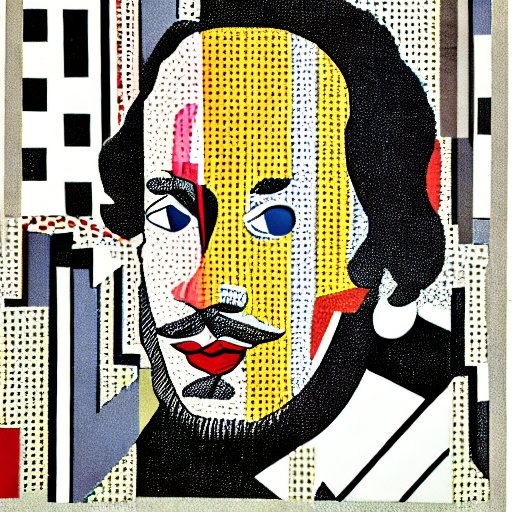
William Shakespeare’s plays have endured not just because of their inherent dramatic and linguistic qualities, but also because each era has found its own way of envisioning and re-envisioning them. The technology involved in stage productions has changed over the past four centuries, of course, but so has the technology involved in art itself. A few years ago, we featured here on Open Culture an archive of 3,000 illustrations of Shakespeare’s complete works going back to the mid-nineteenth century. That site was the PhD project of Cardiff University’s Michael Goodman, who has recently completed another digital Shakespeare project, this time using artificial intelligence: Paint the Picture to the Word.
“Every image collected here has been generated by Stable Diffusion, a powerful text-to-image AI,” writes Goodman on this new project’s About page. “To create an image using this technology a user simply types a description of what they want to see into a text box and the AI will then produce several images corresponding to that initial textual prompt,” much as with the also-new AI-based art generator DALL‑E.
Each of the many images Goodman created is inspired by a Shakespeare play. “Some of the illustrations are expressionistic (King John, Julius Caesar), while some are more literal (Merry Wives of Windsor).” All “offer a visual idea or a gloss on the plays: Henry VIII, with the central characters represented in fuzzy felt, is grimly ironic, while in Pericles both Mariana and her father are seen through a watery prism, echoing that play’s concern with sea imagery.”
Based in Seoul, Colin Marshall writes and broadcasts on cities, language, and culture. His projects include the Substack newsletterBooks on Cities, the book The Stateless City: a Walk through 21st-Century Los Angeles and the video series The City in Cinema. Follow him on Twitter at @colinmarshall or on Facebook.
There’s a passage from Kurt Vonnegut’s Breakfast of Champions that crosses our desk a lot at this time of year. It’s the one in which he declares Armistice Day, which coincidentally falls on his birthday, sacred:
What else is sacred? Oh, Romeo and Juliet, for instance.
And all music is.
Here, here!
Hopefully Shakespeare won’t take umbrage if we skip over his doomed teenaged lovers to celebrate Kurt Vonnegut’s 11/11 Centennial with songs inspired by his work.
The driving force behind the KTE Tim Langsford, a drummer who mentors Autistic students at the University of Plymouth, was looking for ways to help his “foggy mind remember the key concepts, characters, and memorable lines that occur in each” of Vonnegut’s 14 books.
The solution? Community and accountability to an ongoing assignment. Langsford launched the Plymouth Vonnegut Collective in 2019 with a typewritten manifesto, inviting interested parties to read (or re-read) the novels in publication order, then gather for monthly discussions.
His loftier goal was for book club members to work collaboratively on a 14-track concept album informed by their reading.
They stuck to it, with efforts spanning a variety of genres.
The psychedelic God Bless You, Mister Rosewatermixes quotes from the book with edited clips of the collective’s discussion of the novel.
The project pushed Langsford out from behind the drum kit, as well as his comfort zone:
It has taken an awful lot to be comfortable with the songs on which I sing. However, I have tried to invoke KV’s sense of creation as if no one is watching. It doesn’t matter so do it for yourself…. Although do I contradict that by sharing these things to the internet rather than trashing them unseen or unheard?!
Ah, but isn’t one of the most beautiful uses of the Internet as a tool for finding out what we have in common with our fellow humans?
Congratulations to our fellow Vonnegut fans in Plymouth, who will be celebrating their achievement and the legendary author’s 100th birthday with an event featuring poetry, art, music and film inspired by the birthday boy’s novels.
Folk rocker Al Stewart is another who “was drawn by the Sirens of Titan.” The lyrics make perfect sense if the novel is fresh in your mind:
The band gave the author a writing credit. He repaid the compliment with a fan letter:
I was at my daughter’s house last night, and the radio was on. By God if the DJ didn’t play our song, and say it was number ten in New York, and say how good you guys are in general. You can imagine the pleasure that gave me. Luck has played an enormous part in my life. Those who know pop music keep telling me how lucky I am to be tied in with you. And I myself am crazy about our song, of course, but what do I know and why wouldn’t I be? This much I have always known, anyway: Music is the only art that’s really worth a damn. I envy you guys.
If that isn’t nice, we don’t know what is.
Vonnegut’s best known work, the time-traveling, perennially banned anti-war novel,Slaughterhouse-Five, presents an irresistible songwriting challenge, judging from the number of tunes that have sprouted from its fertile soil.
She titled her recent EP of five Vonnegut-inspired songs, Everything is Sateen, a nod to the Sateen Dura-Luxe house paint Vonnegut’s abstract expressionist, Rabo Karabekian, favors in Bluebeard.
We’re fairly confident that Hwang’s No Answer, offered above as a thank you to crowdfunders of a recent tour, will be the bounciest adaptation of Slaughterhouse-Five you’ll hear all day.
Keep listening.
Sweet Soubrette, aka Ellia Bisker, another Bushwick Book Club fixture and one half of the goth-folk duo Charming Disaster, leaned into the horrors of Dresden for her Slaughterhouse-Five contribution, namechecking rubble, barbed wire, and the “mustard gas and roses” breath born of a night’s heavy drinking.
Songwriting musicologist Gail Sparlin’s My Blue Heaven: The Love Song of Montana Wildhack — seen here in a library performance — is as girlish and sweet as Valerie Perrine’s take on the character in George Roy Hill’s 1972 film of Slaughterhouse-Five.
Back in 1988, Hawkwind’s The War I Survived suffused Slaughterhouse-Five with some very New Wave synths…
The chorus of Sam Ford’s wistful So It Goes taps into the novel’s time traveling aspect, and touches on the challenges many soldiers experience when attempting to reintegrate into their pre-combat lives :
That ain’t the way home
Who says I wanna go home? I’m always home I’m always home.
Having invoked Vonnegut’s evergreen phrase, there’s no getting away without mentioning Nick Lowe’s 1976 power pop hit, though it may make for a tenuous connection.
Hi ho!
Still, tenuous connections can count as connections, especially when you tally up all the references to Cat’s Cradle’s secret government weapon, Ice Nine, in lyrics and band names.
Then there are the submerged references. We may not pick up on them, but we’re willing to believe they’re there.
Pearl Jam’s front man Eddie Vedder wrote that “books like Cat’s Cradle, God Bless You, Mr. Rosewater, Player Piano…they’ve had as much influence on me as any record I’ve ever owned.”
A memorable Breakfast of Champions illustration is said to have lit a flame with New Order, propelling Vonnegut out onto the dance floor.
And Ringo Starr edged his way to favorite Beatle status when he tipped his hat to Breakfast of Champions, dedicating his 1973 solo album to “Kilgore Trout and all the beavers.”
There are dozens more we could mention — you’ll find some of them in the playlist below — but without further ado, let’s welcome to the stage Special K and His Crew!
Yes, that’s Phish drummer (and major Vonnegut fan) Jon Fishman on vacuum.
But who’s that mystery front man, spitting Chaucer’s Canterbury Tales?
Happy 100th, Kurt Vonnegut! We’re glad you were born.
We're hoping to rely on loyal readers, rather than erratic ads. Please click the Donate button and support Open Culture. You can use Paypal, Venmo, Patreon, even Crypto! We thank you!
Open Culture scours the web for the best educational media. We find the free courses and audio books you need, the language lessons & educational videos you want, and plenty of enlightenment in between.