We may take it for granted that the earliest writing systems developed with the Sumerians around 3400 B.C.E. The archaeological evidence so far supports the theory. But it may also be possible that the earliest writing systems predate 5000-year-old cuneiform tablets by several thousand years. And what’s more, it may be possible, suggests paleoanthropologist Genevieve von Petzinger, that those prehistoric forms of writing, which include the earliest known hashtag marks, consisted of symbols nearly as universal as emoji.
The study of symbols carved into cave walls all over the world—including penniforms (feather shapes), claviforms (key shapes), and hand stencils—could eventually push us to “abandon the powerful narrative,” writes Frank Jacobs at Big Think, “of history as total darkness until the Sumerians flip the switch.” Though the symbols may never be truly decipherable, their purposes obscured by thousands of years of separation in time, they clearly show humans “undimming the light many millennia earlier.”
While burrowing deep underground to make cave paintings of animals, early humans as far back as 40,000 years ago also developed a system of signs that is remarkably consistent across and between continents. Von Petzinger spent years cataloguing these symbols in Europe, visiting “52 caves,” reports New Scientist’s Alison George, “in France, Spain, Italy and Portugal. The symbols she found ranged from dots, lines, triangles, squares and zigzags to more complex forms like ladder shapes, hand stencils, something called a tectiform that looks a bit like a post with a roof, and feather shapes called penniforms.”
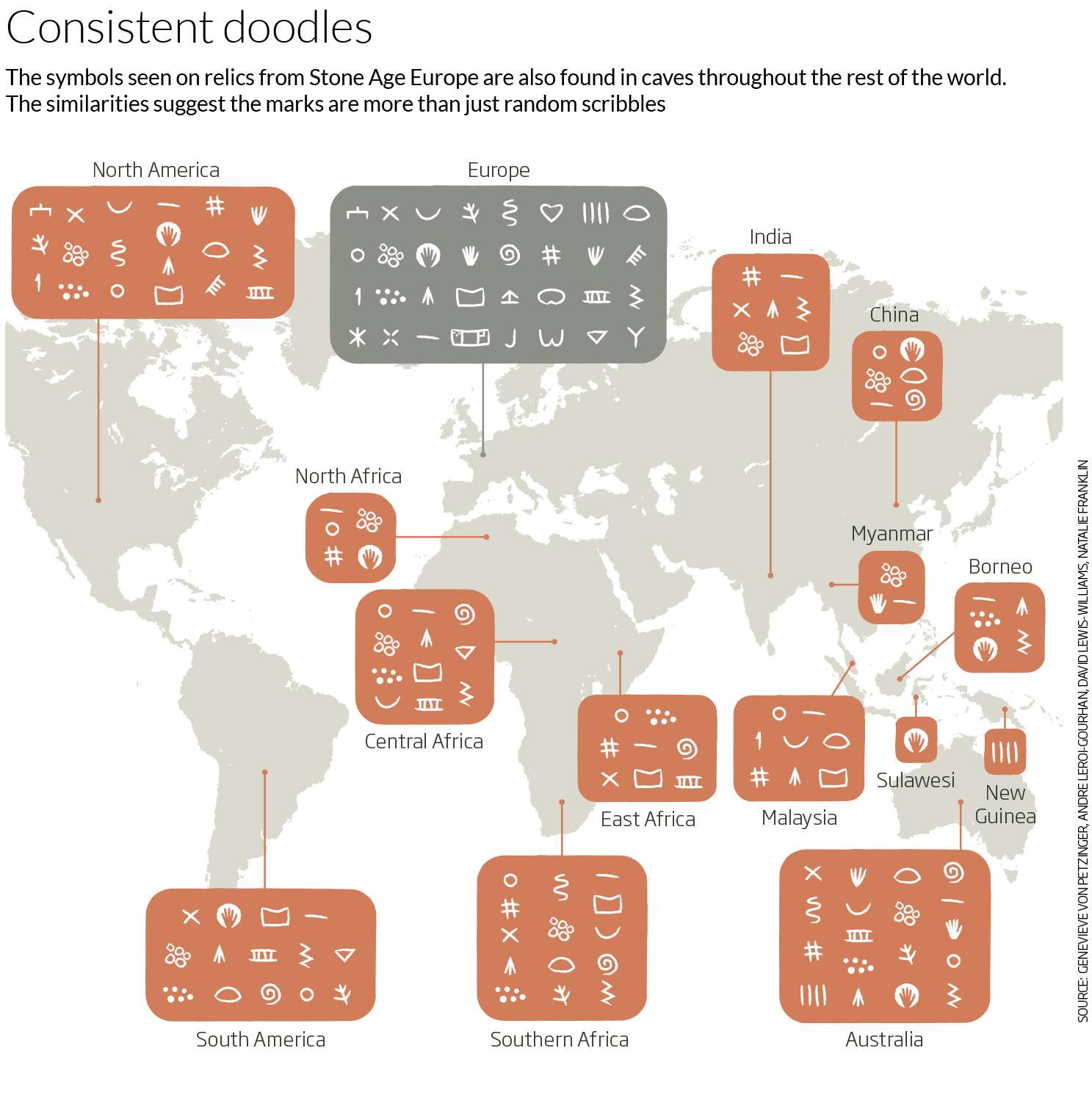
She discovered 32 signs found all over the continent, carved and painted over a very long period of time. “For tens of thousands of years,” Jacobs points out, “our ancestors seem to have been curiously consistent with the symbols they used.” Von Petzinger sees this system as a carryover from modern humans’ migration into Europe from Africa. “This does not look like the start-up phase of a brand-new invention,” she writes in her book The First Signs: Unlocking the mysteries of the world’s oldest symbols.
In her TED Talk at the top, von Petzinger describes this early system of communication through abstract signs as a precursor to the “global network of information exchange” in the modern world. “We’ve been building on the mental achievements of those who came before us for so long,” she says, “that it’s easy to forget that certain abilities haven’t already existed,” long before the formal written records we recognize. These symbols traveled: they aren’t only found in caves, but also etched into deer teeth strung together in an ancient necklace.
Von Petzinger believes, writes George, that “the simple shapes represent a fundamental shift in our ancestors’ mental skills,” toward using abstract symbols to communicate. Not everyone agrees with her. As the Bradshaw Foundation notes, when it comes to the European symbols, eminent prehistorian Jean Clottes argues “the signs in the caves are always (or nearly always) associated with animal figures and thus cannot be said to be the first steps toward symbolism.”
Of course, it’s also possible that both the signs and the animals were meant to convey ideas just as a written language does. So argues MIT linguist Cora Lesure and her co-authors in a paper published in Frontiers in Psychology last year. Cave art might show early humans “converting acoustic sounds into drawings,” notes Sarah Gibbens at National Geographic. Lesure says her research “suggests that the cognitive mechanisms necessary for the development of cave and rock art are likely to be analogous to those employed in the expression of the symbolic thinking required for language.”
In other words, under her theory, “cave and rock [art] would represent a modality of linguistic expression.” And the symbols surrounding that art might represent an elaboration on the theme. The very first system of writing, shared by early humans all over the world for tens of thousands of years.
Note: An earlier version of this post appeared on our site in 2019.
Related Content:
Tracing English Back to Its Oldest Known Ancestor: An Introduction to Proto-Indo-European
Was a 32,000-Year-Old Cave Painting the Earliest Form of Cinema?
Josh Jones is a writer and musician based in Durham, NC.




Hmm, regardless if some of these symbols look similar, there is no evidence that they mean the same thing in different parts of the world as the author seems to suggest. This looks like pretty sloppy research.
35000 years before we started making up religions
Airplane nose diving symbol is interesting 😀
Similarity doesn’t mean there was a common shared language: probably they painted the idea of a thing and that thing was common. Eg., I paint a cow to indicate the cow: since, an an early human, I’m not Michelangelo, it is possible I paint the cow like any other human would do at the time.
Ah but they didn’t paint a cow did they… ? We know these cave dwellers knew how to paint animals cuz there’s countless paintings of animals in those times and not only in caves but on rocks and boulders etc. But they didn’t paint animals, they specifically drew the “signs” if you will.
At the end of the day neither you or myself were there and so we cannot say for certain.
I called that one ‘branch’
I don’t mean to sound rude, but honestly, HOW LONG have we been studying, and making discoveries of early civilization, and id have to think, by now, we have come to the conclusion, that, HUMANS, regardless of the geography, were, intelligent, and that their DISCOVERY or creation Of a symbol, to represent an object or word, is and was BRILLIANT, every time. And the astounding realization of how remarkably similar, or if not, in fact, the same, Given the difference in regent and origin, only makes me question OUR INTELLIGENCE, NOT THEIRS. Like first time parents seeing their baby make the connection between sound and object, ” they are GENIUS!’ LOL Don’t get me wrong, I am fascinated with every and any discovery of our past, but, after a while, I’m starting to think, WE,are insulting THEIR intelligence,of that time.
What is missed by most opinions regarding petroglyphs is their relation to the time and place that the author is memorializing or communicating. Take for instance the desert southwest where these symbols are scribed in line or picture on rock and boulder. They are meaningful only by the sun or lunar light cast upon them that reflects a significant event. Hunting, farming, travel, water, location, buried jars internment etc… All of the real life events worthy of intelligent human beings living in simpler and meaner conditions. I have a thousand examples just from hiking desert washes for years. No degree needed for a correct observation.
Did you actually read the research paper before you made your comments?
Thank you…all of you.
Would this suggest that there was one common language to mankind and then at some point it changed and scattered? I ask because I like to read about biblical history and it kinda correlates with the story of the Tower of Babel. Thoughts?
Great reply!
At face value, the meaning of each symbol is comprehensible even today. Snakes, fire, danger, wheat, you can enter won’t come back-that sort of thing.
It would be interesting to compare this to mDNA and Y DNA haplotype distributions of peoples
From a Biblical standpoint I always find it funny that earliest writings discount the Biblle. As many,many scholars,some Christian and some not readily admit that the first Hebrew writings existed 3,400 years ago and possibly a bit earlier. They also admit that Hebrew was the first written language and all others follow that.
I bet the hand with the circle and the hand without the circle means day and the other means night
Hi there,
This is the editor of Open Culture, and we’re just wondering if anyone can tell us how they found this article since it is getting a lot of visits right now.
Thanks very much,
Open Culture
One is a tracing of a hand. One is a mouthful of pigment spat at a hand on a wall. They are more likely the hunter/gatherer version of “I was here”.
I have a theory that the first use of language was not vocal, but rather akin to sign language by gestures (as developed by Native Americans to communicate across language barriers). Such gestures would have arisen from the inate “wiring” of the human brain and innately understood to represent concrete ideas (like pointing towards something) and eventually more abstract ideas. Something along this scheme would have developed complexity in a rapid way similar to learning another language — once you find a commonly understood symbol or word, it gets built upon and develops into more abstract symbols, gestures and words. Eventually, symbols become and abstract complex ideas become “syncratic.”
Discuss signs with indigenous Australians. An exhibit of signs and stories showed that signs had very different meanings for the same signs. They seemed to be used as memory cues for storytellers, and not expected to only have only one meaning. There was an exhibit of these at Asia Society NY around the 1980s, and many different stories. It’s worth finding that information.
I found it upon my google feed when opening a new google search window.
The article link and teaser showed up on my google start/home page. Top row.
The article was featured on one of the aggregate news sites for me. Can’t remember if it was Google or another one.
The argument of similar meaning is the fact that the signs are invariant. If we look at cuneiform or the Phoeninian alphabet, we see that the reused symbols change as the value changes.
With the cave paintings, invariance over such a large region over a 30,000 year timeframe is simply not consistent with what we know about symbolic representation of varying values.
About 40000 years ago the magnetic poles half flipped to be at equator. This allowed suns radiation to blast earth making humans retreat to caves & only hunt & gather dawn, dust & moonlight. Auroras visible during day & night
It was a featured article on my Google homepage
This is easily explained,but of 8billion humans,only a handful actually know how human is put together and functions. When the universe began from singularity everything is in potential,everything is there already,a discovery is just recognition of what is already there. 8 billion are connected by the unconscious,the unconscious is dark energy. We are from singularity.
Phoenician, not Hebrew, is recognized by scholars as the first alphabet. Then also, it would be proto-Sinaitic. Look it up
I am impressed & cinvinced with this finding in that it depictes a soccer field, no where except around Britain, Spain, Germany, representing Premier League, La-Liga, Bundesliga, and so on.
I am impressed & convinced with this finding in that it depictes a soccer field, no where except around Britain, Spain, Germany, representing Premier League, La-Liga, Bundesliga, and so on.
I read this after it popped up on my Google feed. I’ve been trying to click on more science, culture, and history stuff, to improve the mental nutrition value of my doom scrolling. Can’t say if that was a consequence, or the cause, of it getting more popular.
Chrome app recommended articles
Symbols with meaning are the definition of a written language and it is shown here that they used these symbols across the world. It’s a worldwide written language and everyone knew what it meant at that time. Only after the flood did humans forget the original meaning and invented new languages.
“I am an enthusiast in communication and language. Most people do not distinguish between language and speech, but your work is very enlightening for researchers of the origins of communication. Thank you.”
Open Culture — Thank you for this most interesting publication. It showed up on my Firefox homepage in the section for Education.
I’m guessing one of the reoccurring symbols is for an arena or theater, or the like. It feels meaningful that we really are deeply ingrained to connect with others.
And why wouldn’t have symbols evolved as a universal language? As has contemporary mathematics and scientific symbols.
Very good Thank you
The article reminded me of the scene about the world’s first artist and first art critic in the movie, “The History of the World part I”
Looks like the Europeans were alone in drawing the symbols for GameBoy and hit-marker. Time travelers?
What was updated in this article from the 2019 version?
Google News suggested it to me
Right on!
That’s really interesting.
I ordered her book, looks interesting even if it’s ‘wrong’ or whatever. My position about these things, is that they are not language or speech or necessarily representative of physical things, but images used as metaphors for something else. Images like these communicate meanings that are difficult to put into words, and are, in my opinion, closer to mathematical symbols than written language/letters. The ‘swastika’ is the best-known: point, radius, rotation: a dynamic symbol representing the movement/Force of the known Cosmos. It’s more a scientific/mathematical symbol than a written letter. Like a STOP sign: the word: ‘STOP’ verbally tells you to stop, but the octagonal symbol means: ‘STOP’. Two different things, that work in different ways, on, in my opinion, different parts of the brain. Looking for a record of a spoken language with these symbols/images is, in my opinion, a waste of time as that’s not how these things work.
Another example is symbols on a map: they are somewhat representative but more abstract, and are not ‘words’ as such.
Eh, my opinion.
I ordered her book anyway, if for no other reason than to see a collection of the symbols in one place instead of having to peruse multiple books and websites.
:) Here come the “bible” Maniacs with their unfounded, unfactual invented theories.
I found the article on my Google feed.
Let’s get to the most important question, indeed the only question about this earliest language? How Black were the inventors of language?
Love those comments about “biblical history” ‑if you’re looking at a BOOK OF FABLES AND METAPHORS for your historical facts, well keep looking as you’re not likely to find any.
The comment about Hebrew being the first written language when they know full well that we have numerous examples of writing that predate it. Or maybe they don’t considering where their historical “facts” came from. SMH
Put yourself into the situation and abstract your perception to this environment. I would begin, with investigating food. That is and was the major need and topic of the time for animals and less elevated humans. So most symbols likely mean a kind of food source. And yes, the meaning might be different, like a bird symbol, at one place that is a different kind of bird, but still a bird. I am sure that all symbols represent a rough view, like a class or general type of something, and not something specific.
Good luck.
I humbly suggest all of this is covered in electric universe theory. A 20@5 book Thunderbolts of the Gods will show you earlier research correlating universal symbols. Some go so far to say slight differences in form correlate to where on earth they viewed the enormously powerful upper atmosphere or space located plasma streams we in the 21st century have no life conception of.
While “rejected”.by mainstream science since the 1950s and Immanuel Velikovsky (Worlds in Collision„ etc), aspects of EU theory are percolating into space science as we learn the reality of unimaginably large cables of entwined electricity stretching many many light years through (supposedly) empty space.
It’s “pseudo science” if outside of the academy but real science if someone in officialdom says the same thing.
A bit of cross cultural or cross disciplinary reading can do wonders for your outlook.
I was wondering if someone would mention the bible. Thank you for your response. It fits very nicely. But I don’t think they are about to admit it. Then they would have to read it and get answers to so many other questions.
Hard to imagine but, at one time, everyone on earth spoke the same language, but how do you explain all the different languages without looking in The Book.