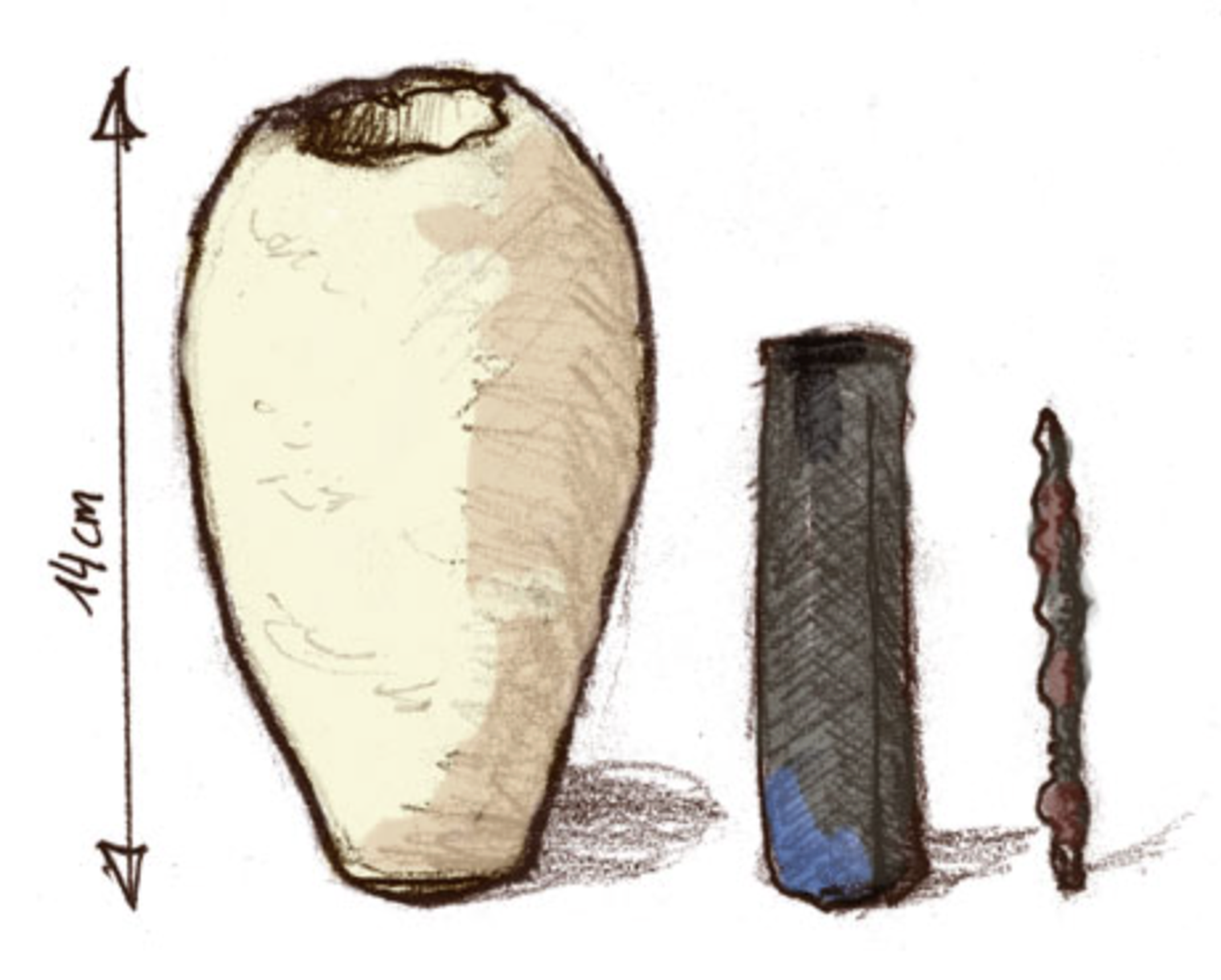
Image by Ironie, via Wikimedia Commons
The average Open Culture reader may well be aware that there is such a thing as Archaeology YouTube. What could come as more of a surprise is how much back-and-forth there is within that world. Below, we have a video from the channel Artifactually Speaking in which Brad Hafford, a University of Pennsylvania archaeologist, gives his take on the so-called Baghdad Battery, an ancient artifact discovered in modern-day Iraq. He does so in the form of a response to an earlier video on the Baghdad Battery from another channel hosted by a young archaeology educator called Milo Rossi. At some points Hafford agrees, and at others he has corrections to make, but surely both YouTubers can agree on the fascination of the object in question. After all: an ancient battery?
Even those of us without any particular investment in archaeology may find our curiosity piqued by the notion that some long-vanished civilization had managed to harness electricity. The name Baghdad Battery was granted in the first place by Wilhelm König, who was the director of the laboratory of the National Museum of Iraq in the nineteen-thirties, when the object was originally discovered.
Given that it consisted of not just a ceramic pot but also a copper tube and an iron rod, all attached to one another with bitumen (a substance present in crude oil used today in asphalt), the idea of its being used for power storage was logical, in its way, if also fantastically anachronistic. Not that König suggested the Baghdad Battery was used to power, say, a grid of streetlights; rather, he supposed that it could have been involved in some kind of electroplating system.
Unfortunately for König’s hypothesis, none of the other gilded artifacts recovered from ancient Iraq, no matter how fine their craft, were actually electroplated. More practically speaking, the Baghdad Battery has no means of connection to a circuit, a necessity to charge it up in the first place. As of now, the professional consensus holds that it must have been ceremonial: a default, as Rossi frames it, whenever archaeologists throw up their hands at a lack of dispositive evidence about an artifact’s original purpose. Though Hafford acknowledges that tendency, he also lays out the reasons he believes the mysteries don’t go quite as deep as popularizers tend to assume. Like any good YouTuber, archaeological or otherwise, Rossi responded with another video of his own, in which he addresses Hafford’s criticisms, and also keeps the Baghdad Battery — as well as its newly created namesake cocktail — firing up our imaginations a little longer.
Related Content:
Behold the Oldest Written Text in the World: The Kish Tablet, Circa 3500 BC
20 New Lines from The Epic of Gilgamesh Discovered in Iraq, Adding New Details to the Story
Based in Seoul, Colin Marshall writes and broadcasts on cities, language, and culture. His projects include the Substack newsletter Books on Cities and the book The Stateless City: a Walk through 21st-Century Los Angeles. Follow him on the social network formerly known as Twitter at @colinmarshall.





Perhaps there was not a technology but some guys found out that by making this pot with these metals and putting stuff in it that you could get a weird sensation on your tongue. An electrical jolt. This would have been amazing, It could be that this was something that was found out, played with but darn, would you see a lot of future in something that zaps your tongue???? It could have been a simple thing, discovered that generated and electrical current, it was felt by people, but the value of the new discovery lacked merit in every day life so it was forgotten and lost. This makes sense to me. I dont see a legacy technology, but I do see the potential for some person to develop and electrical current that was sensed but went nowhere…….