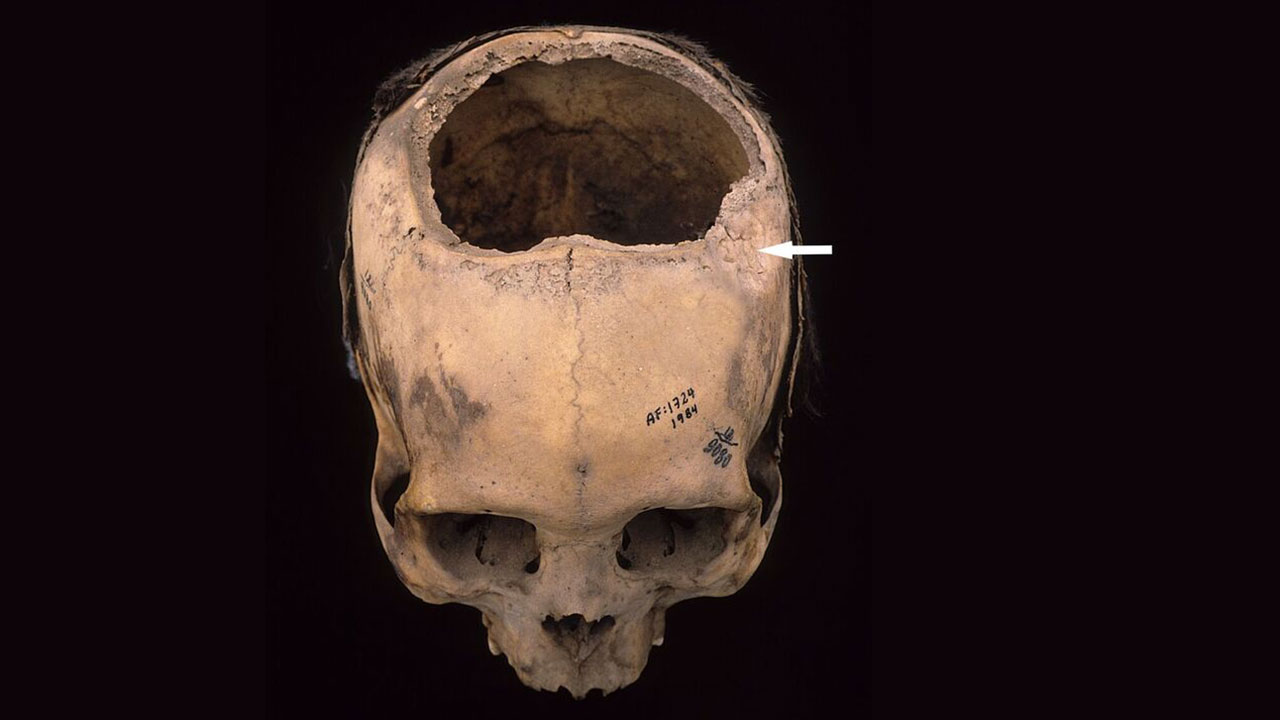
Granted access to a time machine, few of us would presumably opt first for the experience of skull surgery by the Incas. Yet our chances of survival would be better than if we underwent the same procedure 400 years later, at least if it took place on a Civil War battlefield. In both fifteenth-century Peru and the nineteenth-century United States, surgeons were performing a lot of trepanation, or removal of a portion of the skull. Since the Neolithic period, individuals had been trepanned for a variety of reasons, some of which now sound more medically compelling than others, but the Incan civilization took it to another level of frequency, and indeed sophistication.
Anyone with an interest in the history of technology would do well to study the Incas, who were remarkable in both what they developed and what they didn’t. Though there was no Incan alphabet, there was khipu, (or quipu), previously featured here on Open Culture, a system of record-keeping that used nothing but knotted cords.
The Incas may not have had wheeled vehicles or mechanical devices as we know them today, but they did have precision masonry, an extensive road system, advanced water management for agricultural and other uses, high-quality textiles, and plant-derived antiseptic — something more than a little useful if you also happen to be cutting a lot of holes in people’s skulls.
Studying the history of trepanation, neurologist David Kushner, along with bioarchaeologists John Verano and Anne Titelbaum, examined more than 600 Peruvian skulls dating from between 400 BC and the mid-sixteenth-century, which marked the end of the Incans’ 133-year-long run. As Science’s Lizzie Wade reports, the oldest evidence shows an unenviable 40% survival rate, but the surgical technique evolved over time: by the Inca era, the number rises to between 75% and 83%, as against 46% to 56% in Civil War military hospitals. Some Incan skulls even show signs of having undergone up to seven successful trepanations — or non-fatal ones, at any rate. Though that venerable form of surgery may no longer be practiced, modern neurosurgeons today use techniques based on the same principles. Should we find ourselves in need of their services, we’ll no doubt prefer to keep our distance from the time machine.
Related content:
Discover Khipu, the Ancient Incan Record & Writing System Made Entirely of Knots
Artificial Intelligence & Drones Uncover 303 New Nazca Lines in Peru
Based in Seoul, Colin Marshall writes and broadcasts on cities, language, and culture. He’s the author of the newsletter Books on Cities as well as the books 한국 요약 금지 (No Summarizing Korea) and Korean Newtro. Follow him on the social network formerly known as Twitter at @colinmarshall.




How did they complete the skull surgery?