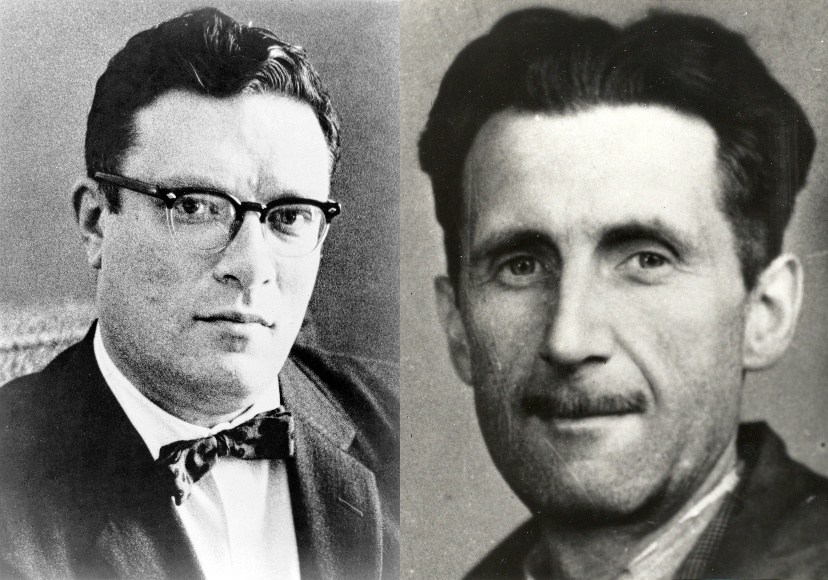
Here in the twenty-twenties, a young reader first hearing of George Orwell’s Nineteen Eighty-Four would hardly imagine it to be a work of science fiction. That wouldn’t have been the case in 1949, when the novel was first published, and when the eponymous year would have sounded like the distant future. Even as the actual nineteen-eighties came around, it still evoked visions of a techno-totalitarian dystopia ahead. “So thoroughly has 1984-ophobia penetrated the consciousness of many who have not read the book and have no notion of what it contains, that one wonders what will happen to us after 31 December 1984,” wrote Isaac Asimov in 1980. “When New Year’s Day of 1985 arrives and the United States is still in existence and facing very much the problems it faces today, how will we express our fears of whatever aspect of life fills us with apprehension?”
The occasion was one of a series of syndicated newspaper columns that Asimov seems to have published each new year. At the dawn of Nineteen Eighty-Four’s decade, the syndicate asked him to revisit Orwell’s novel, which had already been a common cultural reference for decades. As a work of science fiction (the genre for which his own name had practically come to stand), he finds it lacking, to say the least. “The London in which the story is placed is not so much moved thirty-five years forward in time, from 1949 to 1984, as it is moved a thousand miles east in space to Moscow,” he writes. Far from attempting to imagine the future, in Asimov’s view, Orwell simply converted the England he knew into a dreary Stalinist-type state. Apart from certain implausible surveillance systems, the setting is “incredibly old-fashioned when compared with the real world of the 1980s.”
Orwell doesn’t even bother to imagine any new vices: “His characters are all gin hounds and tobacco addicts,” Asimov writes, “and part of the horror of his picture of 1984 is his eloquent description of the low quality of the gin and tobacco.” That telling detail hints at one of Orwell’s major sources of inspiration: the British Ministry of Information, his wife’s employer during World War II, and the source of the material he broadcast to India while working at the BBC around the same time. The Ministry’s canteen, according to his letters, was not of the highest standard. What’s more, the 850-word “Basic English” that it insisted on using in its broadcasts bears more than a passing resemblance to Nineteen Eight-Four’s Newspeak, the pared-down language developed and mandated by the government in order to limit its citizens’ range of thought.
Asimov doesn’t buy that either. “There is no sign that such compressions of the language have ever weakened it as a mode of expression,” he writes. “As a matter of fact, political obfuscation has tended to use many words rather than few, long words rather than short, to extend rather than to reduce.” (This, of course, was something Orwell knew.) Whatever Nineteen Eighty-Four’s shortcomings as prophecy, sci-fi, or indeed literature, Asimov does credit Orwell with a certain geopolitical savvy. Its world-ruling trio of Oceania, Eurasia, and Eastasia “fits in, very roughly, with the three actual superpowers of the 1980s: the United States, the Soviet Union, and China.” Orwell knew, as many didn’t, that the latter two would not join forces, perhaps thanks to his own frustrating experience fighting for factionalism-prone left causes. But not even as future-oriented a mind as Asimov’s would have guessed that, just a few years later, the USSR would be out of the game — and a few decades later, the word Orwellian would be applied most often to China.
Read Asimov’s take on 1984 here.
If you would like to support the mission of Open Culture, consider making a donation to our site. It’s hard to rely 100% on ads, and your contributions will help us continue providing the best free cultural and educational materials to learners everywhere. You can contribute through PayPal, Patreon, and Venmo (@openculture). Thanks!
Related content:
An Animated Introduction to George Orwell
An Introduction to George Orwell’s 1984 and How Power Manufactures Truth
George Orwell Explains in a Revealing 1944 Letter Why He’d Write 1984
George Orwell’s Harrowing Race to Finish 1984 Before His Death
Isaac Asimov Predicts in 1964 What the World Will Look Like in 2014
Based in Seoul, Colin Marshall writes and broadcasts on cities, language, and culture. He’s the author of the newsletter Books on Cities as well as the books 한국 요약 금지 (No Summarizing Korea) and Korean Newtro. Follow him on the social network formerly known as Twitter at @colinmarshall.




Read his works he understood human nature and in some ways was correct about 1984. Unfortunately 42 years later what was Government approved speech in Dictatorships has become censorship and approved speech across Europe and the Americas in the name of inclusivity.
Asimov just doesn’t get it.
Remembered the 1980s, when Orwell’s surveillance systems were implausible? That was cute.
I think 1984 may have been a different kind of Sci-fi one which Asimov might not have considered as Sci-fi.
While he is certainly not wrong about the description of London given, the point of that description isn’t to show the future per say.
But rather what happens when a government is in control of everything.
1984 is far from perfect but its also by no uncertain means the mess of a story this article’s persentation of Asimov’s interview makes it out to be.
What is especially concerning is some of the things that are from 1984 that are becoming a reality just 42 years after the book’s setting.
The surveillance system that Asimov described as absurd is now far closer to reality that in the 80s.
The dumbing down of political speech which Orwell claimed would be used to control the masses, while not a word for word prediction does at least appear to be happening as rhetoric on all sides slowly becomes “You are either with us or against us”
This fact alone makes me personally quite mournful for the human race.
Whether or not 1984 is or isn’t Sci-fi isn’t necessarily important to me.
1984 is a highly cynical depiction of the human race, 1 I would rather not see come to life.
Yet the fact that even some of elements are seemingly jumping from the book’s pages into the real world is beyond disappointing.
Asimov’s vehemence demonstrates that his scathing and heavily biased opinion of Orwell’s novel resides in his unbending humanistic politics, not in any reasoned comprehension of the book. He let his own personal beliefs in the goodness of humankind colour his opinion of anyone who had a less favourable opinion. Indeed, his understanding of the human psyche was very shallow, with little knowledge of psychosis, obsession, or the hundreds of different ways our brains can trick ourselves, let alone make complicated schemes for the common bad. He could see it only in terms of positivity, of the good, with his villains poorly painted and easily disposed. He simply didn’t have the imagination to entertain the idea that such dark futures are entirely possible and indeed, are only one or two steps away at any given moment, provided the conditions for allowing evil to flourish are there. In the 2020s, with Trump and Putin in power, it is very easy to imagine a world as controlling as 1984 because one of the biggest super powers in the world elected a senile megalomaniac, psychotic and fascist into the presidency, and he’s repeatedly demonstrated he’s above the law, domestically and internationally. We are only two steps away from a post war dystopia like that in 1984. But Asimov came out of WW2, full of hope that the good guys will prevail. It’s a particularly insular and dangerously cozy view of the future, but that’s fine, so long as you acknowledge that any future is possible, good and bad. Being stupidly adamant that worlds like 1984 can’t exist based on today’s technology and your belief in the intrinsic goodness of humanity is madness. It says much more about Asimov than it does about Orwell.
Yup, righttrash suppression of everything that doesn’t suit them is now commonplace; but defeats in Hungary, UK, Poland, Canada, Australia, Spain etc show that most decent people aren’t as dumb as the rightwhingers hope 👌🏾
What a drill and uninspired comment..
The real genius of Orwell’s 1984 is not whether or not it breaks any new ground in sci-fi or creates some unknown world. The genius of the work is to invite English speaking people who think they are inoculated against becoming a totalitarian state how easy it is to not only fall prey to such a state, but enable totalitarianism to take hold.
In my lifetime, in the USA, we have been creeping more and more to the world of 1984. With Trump, we have taken the Incremental, arithmetic slope to exponential if not logarithmic one enabled by his maga base + people ignorant of Orwell or any other warnings.
Hi there,
We were just curious how you found this post. We noticed a lot of people were visiting this post today, but we were not sure what/who brought everyone here. Thanks for any insights.
Thanks
Open Culture
Isaac Asimov (1920–1992) was a secular, atheist Jewish author who was skeptical of Zionism and never visited Israel. While proud of his heritage, he viewed the creation of Israel in 1948 as creating a vulnerable “ghetto” in a hostile region. He believed in universal human identity over nationalism and did not believe any group “deserves” a designated homeland
He wasn’t wrong about everything. But he sure struck out on Orwell.
So far nobody commenting has much positive to write about Asimov’s review of 1984. Not difficult to see why. As a work of science fiction Asimov’s criticisms seem reasonable but irrelevant. When Orwell wrote his book I highly doubt he conceived or was thinking of writing a “science fiction” novel. He likely just thought he was writing 1984. Asimov on the other hand sets out to write science fiction novels and does so. If 1984 is only science fiction what’s Animal Farm? Only some fantasy?
No sane or decent person would look at the state of northern and western Europe and call that a victory.
Perspective is everything. You see a totalitarianism in the U.S. Popularist movement. The majority of Americans see it in the Globalist DNC Democrat Corporatist movement. The world’s a funny place.
Smile! You were in my Google News Feed on my phone!
You’re a fucking idiot
I posted this article to FB. I have totally despised Isaac Asimov since my teen years back in the 1960s. He was a fourth rate intellect who would fit in well with Peter Theil, Jeff Bezos, and Mark Zuckerberg to name a few. He has the same ultra-nerd incapacity of Neal Stephenson to understand the subtleties of human relationships. He could not hold a candle to the brilliance of George Orwell.
My Google Chrome Discover feed thought I would be interested in this article. Score one for Google!
..and a prophetic future now coming to pass as the Biblically foretold End Times.
I mean he was mostly saying it wasn’t really sci fi… Which it kinda isn’t. They didn’t have as many categories in 1940’s… I’d say it’s a dystopian book. And that genres only been separated into its own section for a couple decades. Before it was put in fiction, scifi, or fantasy.
But if 1984 was published with current markets it would probably be YA dystopian fiction.
Google News feed suggested it. It definitely flags my account as liking sci-fi and reading. When I check the subtext on in the suggestion it’s aiming at me due to the sci-fi topic.
The current us political sphere seems to be split into about 3 groups near 30% each so I don’t think you can categorize any one view as “most”.
The UK is becoming exactly what Orwell described in 1984 and the ideology of the left has spread across Europe and they have used the left’s useful idiots to do so. The idea that contractions need to be accepted and not questioned is something we see today. We have a never ending war on climate which literally funnels money to the elites. We have open borders that are ruining society and brining a new level of social breakdown into Europe and the idea of speaking about it brings the police to your door all over Europe. So no, pretty sure it’s the leftists ideology that is going to destroy society not because it crazy but because these are week minded individuals that will allow society to breakdown in that name of inclusion and the punishment of being cancelled and all the other nonsense. It’s just a matter of time until we get our social credit scores. If you look at who seem to want the over policing of society it’s the left under the guise of compassion and being pushed by woman whose unmet need to take care of people has been pushed into politics and society. You clearly don’t understand orwell and your comment makes no sense. You should read the book before you speak about it. When the Totalitarianism eventually comes because of the useful idiots they will be the first to be eliminated. Its has happened before and will happen again. But don’t worry 2+2 for you will always = 5.
Couldn’t agree more. The original article is terrible.
My phone suggested this. When I swipe left to right on the home screen. Think it’s a google feature on my Samsung.
I find it funny that Asimov thought he was right and Orwell wrong in 1984, but now it seems like Orwell was right after all about as long again after 1984 as the book was written before then.
The world is a scary place and Big Brother is watching (and putting his name and face everywhere to remind us)
A post on Bluesky linked to this article, so that may be why it’s gotten traction beyond it’s usual scope.
Asimov held a lot of ideas, but it’s amusing to me that one of his criticisms is that Orwell’s book isn’t futuristic enough. Having read Foundation recently, I was struck by how many things hadn’t changed from 1942–44, when Asimov wrote it. Instellar societies reverted to ‘barbarism’, which appeared to be just 19th century European aristocracy. Somehow they have instellar travel but no idea how it works — and energy comes in three varieties — Coal, Oil and Atomic. What Asimov’s future DOESN’T have are women with agency or any existence between wife and mother. When the Empire tells Hari Seldon that the Foundation has 100,000 members, he counters that the number is inflated, because they’re counting the women and children. There is only one female character in the entire book, a vain royal who is shrill and bought off with trinkets.
And complaining that people 30 years in the future would just complain about the Gin? Asimov’s future had people 12,000 years in the future complaining about getting good cigars. Just because he puts it in space doesn’t really change anything, IMHO.
It’s amazing that anyone can look at the American far right defunding science by canceling grants for studies that AI says have their dispreferred political viewpoint (“are too woke” by having the word “diversity” in them, even if they’re talking about biodiversity); installing regime ombudsmen at universities and demanding they cancel entire courses of study, using the threat of canceling funding, of disaccreditation, and of denying international students their visas; and banning books from both school and public libraries, or in the case of Florida College, literally destroying dumpsters full of them; and can still think it’s the people who are trying to include each other who are being censorious.
Google feed on mobile served up this article for me.
As many have also said, you have gotten attention of the Google algorithms and they are directing our tele(phone) screens to you site.
I found this article on my Chrome news feed 🫡
Asimov’s critique was unnecessary. As a bonified SF writer, he could have explained to the public that not all futuristic works are science fiction — they don’t have to be. I was a fan of Dr. Asimov as a teen, but this essay is silly. George Orwell’s novel was brilliant and frightening — great work by a political writer who was also a wonderful user of the English language. He lived the era of fascism and Stalinism. He extrapolated what he saw and described what our world would be like if they continued, in culture, in psychology and even his invention of “Newspeak” about which he had a lot to say. He had no need to burden his work with scientific speculations. Dr. Asimov also speculated about cultures and psychology and he filled our whole galaxy with his musings of which I am skeptical, but he understood something which made them great stories that fascinated young people now for several generations and that was his feeling for people. Perhaps neither was science fiction but they were both great writers in different genres.
Asimov is looking at the shit too literally. He misses the mark on this one.
Yep,if anyone would bring a society to something similar to 1984 it would be the left. For an example just go to democrat underground and disagree with them on anything. Not troll them, simply disagree and watch what happens. They’ll shut down your account with the quickness.
Left wingers believe only they should have free speech and everyone else should be silenced.
You were recommended by my Google Discover feed, personally. Thou have been blessed by the Great Algorithm.
I got here because there was link to an article on Asimov commenting on Orwell that showed up on my Google home page… And I am a fan of both authors
Whaaaaaaat???
I recognize patterns and see a probability of a time line shift with the alignment of book… 1.) prophecy should, just by expression, change the timeline, at very least, if not the future altogether… So technically any prophet who truely foreseen the future accurately, failed as a prophet, for making people aware of the future, should have a cause and effect chain that alters the future. 2.) when/if pattern recognition in efficiency is on point to show the future, if things continue, involves something of an authoritarian agenda, and is well known material, well,u can’t continue with same agenda on same timeline, that would be to obvious, and people would easily make the connection–
But push back dates 50–60 years…
I see large stepping stones being laid now.
The 3 superstars are back, and reaching. The class seperation and wage gap of unfathomable, and fictional like proportion, the constant threat bearing down by either of an “axis” threat or of a pandemic nature (including forced compliance stomping on human rights), and even the fact that C.D.C.
(Centers for Disease Control and prevention) actually changed the definition of the word vaccination to better align with agenda,or the the press conference where the Canadian military acknowledged their use of wartime propaganda techniques upon their own citizens since around the beginning of 2020, without informing anyone,without permission or awareness from federal government, or populous, and without any plans to stop (apparently they have reported this had stopped, yet the the point of propaganda is to use reporting to muddy clear waters of information communications…)
Political double speak is austentatious if it’s not more complex that Orwell’s easy read. The fact that it is written in most compatible comprehensive format is actually efficient to its longevity as a warning, considering the literacy rate of average US highschool graduate! I myself, didn’t read well because of a plethora of learning disabilities which I simply call O.C.A.D.D. But I was given this book to read, when I was 18, if sparked a love of the written word, within me… Still one of my favorite books, and I owe a great deal of my intellectual capacity to it.
Think critically. Ask questions. Don’t allow certainty to cement. And read!!
1984 almost perfectly describes the modern globalism movement, which in America is the democrat party, “progressive movement”, and the RINO republicans.
2+2=5 is the basis of leftist propaganda. Repeated over and over again, word for word, using as many “sources” as possible. Don’t believe your eyes, don’t believe the video evidence, believe the party narrative.
Newspeak is prevalent, just a bit different. Words no longer hold their original meaning, instead they are misused, and then the misuse is applied to the past, thus changing the past.
Even Winston’s job is a stark warning against the censorship the Internet has enabled. The past is rewritten to fit the agenda of today.
We would be living in full 1984 had Trump not saved us.
Asimov’s take on “Nineteen Eighty-Four” is practically a cliche in its own right: Someone rises to the upper echelons of their chosen field, becomes respected and popular enough to have people hanging on their every word… and uses that status, whether intentionally or not, to gatekeep and to take swipes at other popular figures or ideas.
For recent examples, think Quentin Tarantino’s completely unnecessary (but wholly in character) swipes at Paul Dano and Matthew Lillard. Or Timothée Chalamet’s ill-considered comments about ballet and opera as genres.
It’s rarely worth even validating such comments by acknowledging them or treating them as anything more than what they are: Someone famous airing their personal thoughts, when they would be better served by keeping them inside their head where they belong.
It was on my Google Chrome Discover Feed. I’ve been predominantly looking at a lot of AI related content in the past week or so. Hope that helps.
So many people are really able to compare, view as similar, the censorship of social media — made, as you say, to support inclusivity, and to not allow people to say really bad things — with censorship in totalitarian regimes…
And you wonder why we don’t consider your opinion relevant…
(There’s of course also a high likelihood you are just trolling, as, indeed, there must always be a “literally 1984” comment whenever 1984 is mentioned…)
No way those people in this comment section would be representative of a larger part of our society :)
Eith
Either they flocked here because commenting “literally 1984” is just what they do all years long…
Or the attention this article got or they sensed it would get attracted paid trolls.
No way your average Trump voter would write you a tract about how “our society is literally 1984” just after reading about this Asimov’s commentary on the book from 1984. As I said, I don’t find the number of those comments in this thread to be representative…
Agree
“NEW SPEAK ” ?? MINISTRY OF TRUTH ?? NEW WORLD WIDE DISEASE ??
While MAGA tech billionaires are reducing the language, buying governments and extending control by surveillance and military force into every human life… some of these comments are busy inverting Orwell’s warnings. He wasn’t writing ‘science fiction’ or glib prophesies. He drew on experience and observed post-war tendencies. 1984 wasn’t a ‘sell by’ date (so you can pick out the mouldy bits and still read it for the warnings).
Please expand your understanding of 1984-esque leaders to include the likes of Obama, Biden, Trudeau, Carney, Xi and every Euro leader
for examples of fascists who operate a mass surveillance state, where truth is subjective and changeable.
They ALL are part of it.
Arkady darrell
Beta darrell
Bliss
Denores
Gladia
All monumental figures who changed centuries of history in asimovs books
I remember reading a children’s book to my children called Wiggins for President, later reissued as Freddy the Politician, written by Walter R Brooks. I kept thinking this was a blatant ripoff from 1984 until I looked at the issue date. Freddy,or Wiggins, was issued in 1939. The book 1984 was issued in 1949. Take a look at this children’s book and judge for yourself. Not word for word plagiarism but incredibly similar in subject and structure. The book 1984 has simply been made harsher in tone than a children’s book.
Anyone who thinks Trump and maga reflect Nineteen Eighty-Four in any way, shape, or form are ignorant of both Trump/Maga and Nineteen Eighty-Four. Knock it off.
Hats off to you sir. Many of these post agree with you, as do I.
True colors comment from a red that?¹azimov was !!
True colors comment from a red that?¹azimov was !!was My first email sent stupid?
This article is featured in the discover section of Google Chrome. That’s how I found it perhaps that is where others did.
Imagine being this retarded.
Is the imposition of leftwing concerns about sticking up for marginalised groups onto every aspect of society a problem? Maybe. Is the right wing backlash a problem? Definitely.
Umm, no, it seems you don’t get Asimov or his point.
Indeed, *as sci fi* 1984 is unremarkable. That’s because it is pretty light in the department of that genre. But, as a reflection of politics and human nature (including the “book” shared in part in the middle of the story) it is quite brilliant. And that doesn’t seem to be what Asimov was critiquing.
Azimov missed out on this one, big time. While “1984” was certainly a work of speculative fiction and not meaningfully one of tech political science fiction, there are other sciences. It certainly was an extrapolation of political, social, and psychological sciences all gone dark, much in the way some books gondark with hardware or biological extrapolations.
Couple of thoughts.
1.) The format of this comment section is horrible. People replying to an individual comment don’t have the comment they are replying to highlighted in any way so differentiating between those and just comments on the article itself are hard to navigate.
2.) Interesting how people try to pin the controlling aspects of government Orwell correctly anticipated on “the other side”. So tired of people only able to see life through their political prisms.
3.) Enjoyed Asimov as a kid used to get his monthly publication of various Sci Fi stories but have long forgotten the name of said publication. If you remember let me know.
Not sure if the algorithm picked it up first and led everyone here or what. This was on my Google news feed. I like literature and Sci-Fi. This seems to fit in with that.
“Why is everyone here? Where did you all come from?”
This cracks me up- someone must have left the door unlocked!
It wasn’t written about the future, it was written about a warning of the past.
The world has just come out of WWII and there was many lessons to be taught to avoid a repeat
Sadly, so many have said “If you don’t have the exact same politics as me, then you’re helping create an Orwellian nightmare.” This is a problem that Orwell examined in Animal Farm.
Hello everyone 👋
Google recommended it right to my feed
What Asimov doesn’t get is that it is about 1948. The present thinly disguised as the future.
Came up on my Google Discover feed.
Thank you, Joe, for sharing your opinion.
It often seems that many leftist intellectuals/hypocrites overlook the negative consequences their policies can have. While there is frequent discussion about a potential Trump dictatorship, I believe the Biden presidency has clearly demonstrated a different form of control through the Democratic Party. To me it’s the Democratic Party dictatorship. In my view, policies regarding COVID-19 vaccines, DEI initiatives, and mandated pronoun usage reflect an “if you’re not with us, you’re against us” mentality.
I believe it is important to address these issues and the division they create.
I noticed it on my Google news feed
A surprisingly dismissive review by Asimov, and the author only piles on with his own misinterpretations of a book that has, to say the least, stood the test of time. Orwell chose the date 1984 because it deliberately transposed 1948, the year in which he wrote the book. It’s essentially satire about the authoritarian state that he perceived the United Kingdom transforming into as the Cold War transformed western democracies via the Red Scare into paranoid governmental institutions.
You are denying access to this website for people in Russia. Nice “open” culture lmao.
It has nothing to do with the past, and everything to do with present days.
Are we dealing with cognitive decline?
It has nothing to do with the past, and everything to do with present days.
Are we dealing with cognitive decline?
Yeah buddy, I don’t think Asimov gets it.
👍
Asimov’s review misses the deeper challenge Orwell was issuing — one that has only intensified in the decades since.
Orwell wasn’t primarily writing narrow anti-Stalinist nostalgia or flawed “sci-fi.” He was exposing the emerging New Class (the university-educated administrators, experts, bureaucrats, and intellectuals) who love centralized power, planning, and “scientific” oversight not to liberate workers, but to secure their own guardianship over the “ignorant” masses.
Asimov, with his faith in rational expertise and technocratic progress (psychohistory, anyone?), embodied much of that same optimistic class. He therefore underplayed Orwell’s warning: how this intelligentsia hollows out democracy into an empty ritual while expanding the administrative state, controlling education/media, and dreaming of ever-greater supranational coordination.
What Asimov dismissed as old-fashioned has instead assimilated more thoroughly — think Borg-like: “Resistance is futile. You will be improved… by experts.” The surveillance, language manipulation, and elite contempt for the proles have evolved into softer, more pervasive forms, all while the New Class grows its institutional power.
Orwell saw it coming. Asimov, ironically, helped illustrate why it would be so hard to stop.
Isaac was an optimistic person. He preferred uplifting stories. He was writing in a world of nearly 50 years ago about a tale written years before that. Our modern look back can find flaws. But Isaac was only asked to look at 1984 as science fiction, not as literature. Even today sci-fi has many different interpretations.
I find some of the comments especially harsh. The writers sound bitter and angry.They attack Asimov for expressing his opinion.
Personally, Isaac much preferred writing non-fiction.
The Google suggestions on the home page were recommending this article to me on the day you’re asking about. I presume that’s what brought many here.
It’s utterly a disservice for anyone to write off such a brilliant and timeless book by foreclosing it’s essence and prognostication. Perhaps Asimov may be excused of this whimsical error because he anchored his misplaced objections on his bland genre which did not reflect the monstrous intensity and depravity of humanity portrayed by Orwell yet exemplified even in the present.
It came up in my Google News feed, or a page that comes up now and again on my phone suggesting articles I might like.