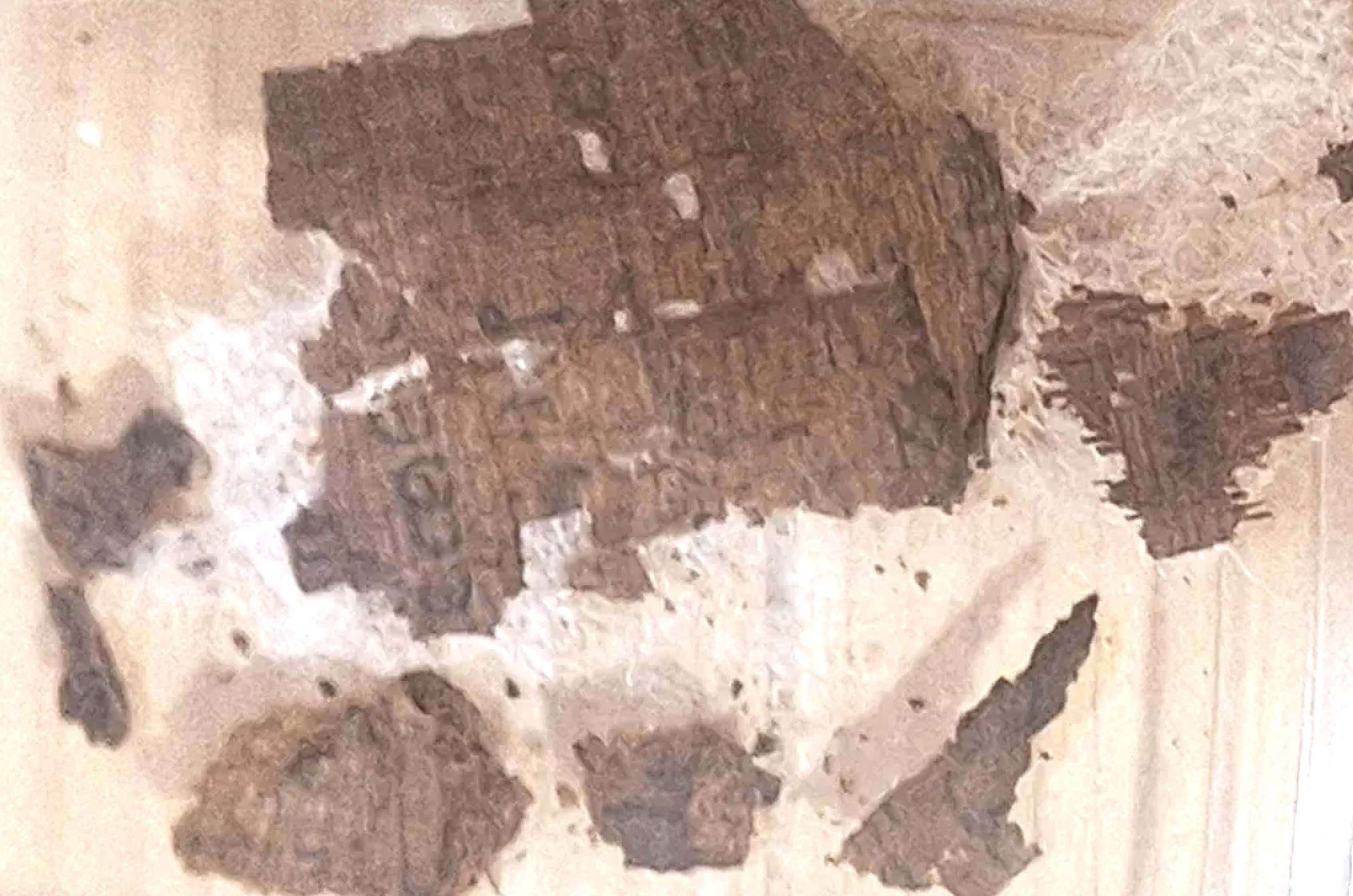
Renaissance Europe admired ancient Rome, ancient Rome admired ancient Greece, and ancient Greece admired ancient Egypt. But the admiration could actually go both ways in that last case, since the two civilizations’ periods of existence overlapped. The Greeks made no secret of their regard for Egypt as a far deeper well of knowledge and wisdom (indeed, much of what we know about ancient Egypt today comes from Greek records), but archaeological evidence shows that the Egyptians, in turn, were hardly dismissive of Greek accomplishment. Many Hellenic texts have been discovered in Egyptian burial sites, but only recently has a Greek literary work turned up packaged with a mummy — and not just any literary work, but pages from Homer’s Iliad.
Unearthed from a 1,600-year-old Roman-era tomb in the Egyptian town of Al Bahnasa, the fragment contains lines from Book 2’s epic “catalogue of ships,” which lists all the vessels the Achaean army sends off to Troy. It dates from an era in ancient Egypt, centuries after the reign of the Greek-descended Cleopatra, when “Greek literary papyri may have functioned as a crucial cultural passport,” as the New York Times’ Franz Lidz writes.
“Being Hellenic connoted an exclusive social status and financial privilege — and had to be meticulously documented through genealogies going back across several centuries.” It’s possible that pages of the Iliad were assumed to act as a kind of Greek passport that would let the deceased bypass the trials of the underworld described in the Egyptian Book of the Dead.
So venerated was Homer’s work at this stage of ancient Egyptian history, in fact, that physicians also credited it with curative properties. “For a bed-bound patient shivering with malaria, the prescription was simple: Brace your head against a papyrus scroll of Book 4 to break the fever.” Whatever the effectiveness of the Iliad against infectious disease, or even to assure safe passage into the world beyond, its continued study around the world more than a millennium and a half after it was getting slipped into Egyptian tombs — and the better part of three millennia after its composition — suggests a kind of historical and cultural power not possessed by ordinary literature. If Christopher Nolan’s coming adaptation of the Odyssey happens to do well enough to get Hollywood back on its feet, perhaps we’ll have to give it to the ancient Egyptians and admit that Homer really does offer salvation after all.
Related content:
Homer’s Iliad and Odyssey: Free AudioBooks & eBooks
Hear Homer’s Iliad Read in the Original Ancient Greek
The Only Illustrated Manuscript of Homer’s Iliad from Antiquity
The Oldest Tattoos Ever Discovered on an Egyptian Mummy Date Back 5,000 Years
The Ancient Egyptian Book of the Dead: A Guidebook for Surviving the Afterlife
Based in Seoul, Colin Marshall writes and broadcasts on cities, language, and culture. He’s the author of the newsletter Books on Cities as well as the books 한국 요약 금지 (No Summarizing Korea) and Korean Newtro. Follow him on the social network formerly known as Twitter at @colinmarshall.




Leave a Reply