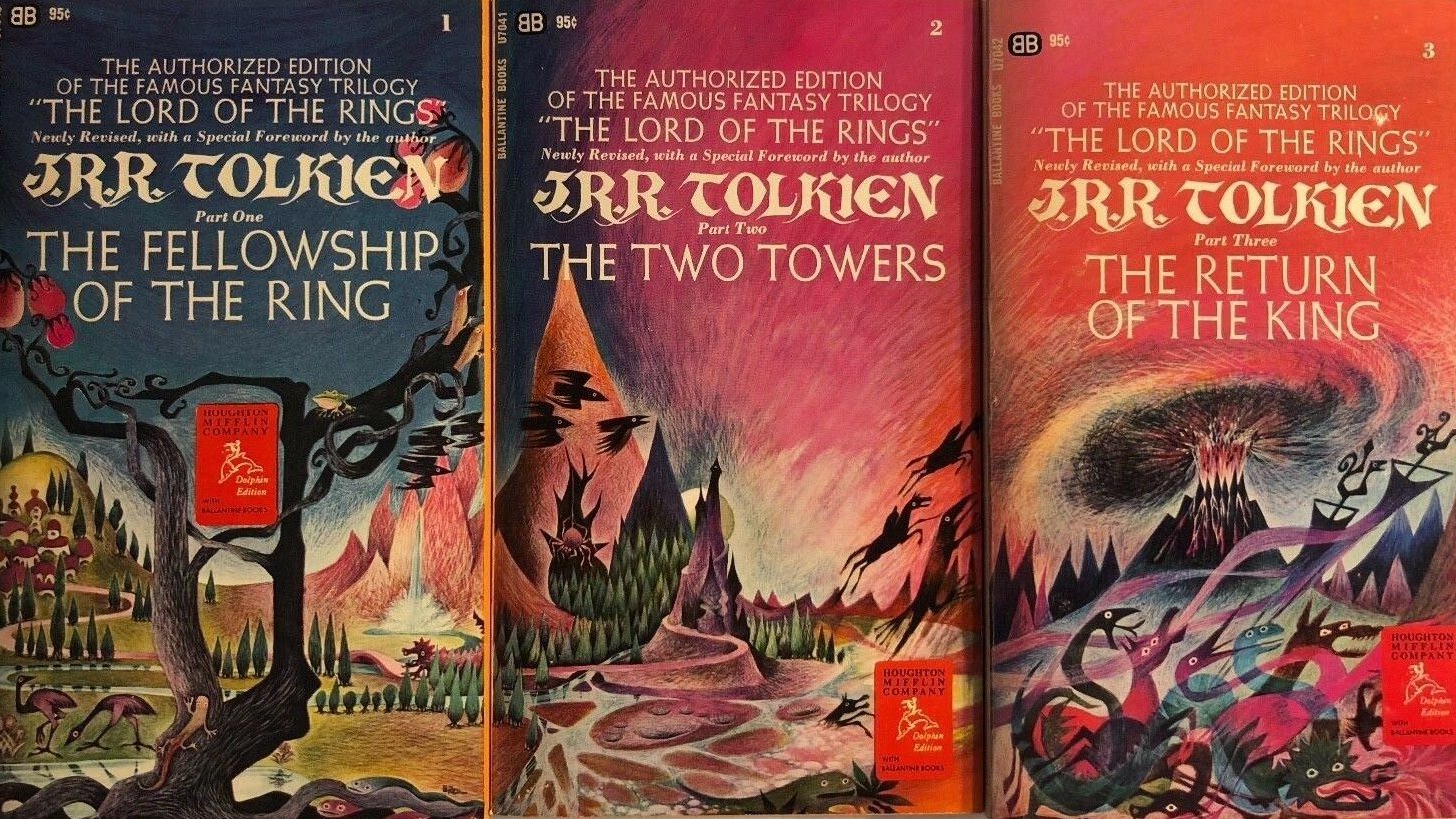
When J.R.R. Tolkien’s Lord of the Rings books appeared in the mid-1950s, they were met with very mixed reviews, an unsurprising reception given that nothing like them had been written for adult readers since Edmund Spenser’s epic 16th century English poem The Faerie Queene, perhaps. At least, this was the contention of reviewer Richard Hughes, who went on to write that “for width of imagination,” The Lord of the Rings “almost beggars parallel.”
Scottish writer Naomi Mitchison did find a comparison: to Sir Thomas Malory, author of the 15th century Le Morte d’Arthur — hardly misplaced, given Tolkien’s day job as an Oxford don of English literature, but not the sort of thing that passed for contemporary writing in the 1950s, notwithstanding the serious appreciation of writers like W.H. Auden for Tolkien’s trilogy. “No previous writer,” the poet remarked in a New York Times review, “has, to my knowledge, created an imaginary world and a feigned history in such detail.”
Auden did find fault with Tolkien’s poetry, a fact upon which critic Edmund Wilson seized in his scathing 1956 Lord of the Rings review. “Mr. Auden is apparently quite insensitive — through lack of interest in the other department,” wrote Wilson, “to the fact that Tolkien’s prose is just as bad. Prose and verse are on the same level of professorial amateurishness.” Five years later, the Nobel prize jury would make the same judgement when they excluded Tolkien’s books from consideration. Tolkien’s prose, wrote jury member Anders Österling, “has not in any way measured up to storytelling of the highest quality.”
The note was discovered recently by Swedish journalist Andreas Ekström, who delved into the Nobel archive for 1961 and found that “the jury passed over names including Lawrence Durrell, Robert Frost, Graham Greene, E.M. Forster, and Tolkien to come up with their eventual winner, Yugoslavian writer Ivo Andrić,” as Alison Flood reports at The Guardian. (The Nobel archives are sealed until 50 years after the year the award is given.) Ekström has been reading through the archives “for the past five years or so,” he says, “and this was the first time I have seen Tolkien’s name among the suggested candidates.” His name appeared on the list chiefly through the machinations of his closest friend and chief supporter, C.S. Lewis.
Lewis, “also of Oxford,” Wilson sneered, “is able to top them all” in praise of Tolkien’s books. From the first appearance of his Middle Earth fantasy in The Hobbit, Lewis promised to “do all in my power to secure for Tolkien’s great book the recognition it deserves,” as he wrote in a 1953 letter to British publisher Stanley Unwin. In what might be considered an unethical promotion of his friend’s work today, Lewis responded tirelessly to critics of the trilogy, going so far, after the publication of The Two Towers, to pen an essay on the subject titled “The Dethronement of Power.” Here, Lewis explains the prolix quality of Tolkien’s prose — that which critics called “tedious” — as a narrative necessity: “I do not think he could have done it any other way.”
Tolkien’s biggest fan also urged readers to spend more time with the books and promised that the rewards would be great. In defense of the second work of the trilogy, he concluded, “the book is too original and too opulent for any final judgment on a first reading. But we know at once that it has done things to us. We are not quite the same men. And though we must ration ourselves in our rereadings, I have little doubt that the book will soon take its place among the indispensables.” And so has all of Tolkien’s work, becoming the literary standard by which high fantasy is measured, with or without a Nobel prize.
Note: An earlier version of this post appeared on our site in 2021.
Related Content:
J.R.R. Tolkien Snubs a German Publisher Asking for Proof of His “Aryan Descent” (1938)
110 Drawings and Paintings by J.R.R. Tolkien: Of Middle-Earth and Beyond
Discover J.R.R. Tolkien’s Little-Known and Hand-Illustrated Children’s Book, Mr. Bliss
Josh Jones is a writer and musician based in Durham, NC.




Tolkien got the last laugh.
And I thought I was the only one who thought his writing was tedious. Great story and concepts for sure, but the execution wasn’t engaging enough for me. REH for all his flaws is far more engaging.
I hate to say it, but I wonder if maybe JRRT was subbed by Team Nobel because he wasn’t dark, pessimistic, and perverse enough. I read his books (twice) when I was younger, and they still resonate with me today. For me, the world and experience of LOTR is the truest expression of loyalty, sacrifice, and brotherhood. I’m not sure if that was winning many prizes in the late 20th century.
Well said. It was also a season of pro-secularism across the globe and LoTR made for an easy target.
Wow! The opinions of the Nobel Committee hasn’t aged well.
Though in fairness I have to ask. Did the movies of Peter Jackson change the calculus? They were extremely well done and brought in millions of new fans. Myself included.
I assess the answer as ‘No’. Jackson hewed close to the page. It would be nearly impossible to achieve what those movies achieved, without a strong literary foundation.
At least Tolkien could take comfort in being snubbed along with many other excellent writers.
And yet, for whatever qualities of writing you consider positive, I have read, enjoyed, and recognized the authorship of C.S. Lewis. I have no idea whoever it is that holds the initials REH… Time is always the final editor of a piece of writing and its relevancy.
I had the same question and got the following from Google:
“REH” refers to Robert Ervin Howard (1906–1936), the American pulp fiction author widely recognized as the father of the sword and sorcery subgenre. He is best known for creating iconic characters such as Conan the Barbarian, Kull of Atlantis, and Solomon Kane, and is often referred to by these initials by fans and scholars
I have read the Trilogy and The Hobbit uncounted times in the last fifty years and love them. But I also love CS Lewis, Edgar Rice Burroughs, Asimov, Gibson, and Bradbury among lots of others. They each have their own style and within a few pages I settle into it and enjoy.
How many people have “The Bridge on the Drina” in their libraries or can say that they have read it?
I guess the lack of any comments on the winner’s opus major speaks volumes on the influence of the Nobel committee on the reading public.
Huh. I figured that title would go to Geoffrey of Monmouth since he pinned the Arthur/Merlin tales back in the 12 century. Kind of like Mary Shelley created sci-fi when she wrote Frankenstein
This web site is FUCKING shit. Impossible to actually read the article with all the adds and crap.
use the Vivaldi browser. no ads.
I suspect a bigger factor in the snub may have been genrism. The stuffed shirts of the Swedish Academy were not prepared to acknowledge fantasy as serious literature. They would no more have recognized LOTR than a comic book. They may also have raised an eyebrow at Tolkien ‘s wholesale borrowings from the old Scandinavian literature. People can be funny about such things.
The Nobel committee and the prizes lost their credibility when a peace prize was bestowed upon Obama just for being elected. No accomplishments per Alfred Nobel’s will:
… The Nobel Peace Prize is awarded to individuals or organizations that have done the most to promote fraternity among nations, reduce standing armies, or establish peace congresses, as specified by Alfred Nobel’s will.
Yeah, that sounds about right. There’s objectively talented & then there’s subjectively over-rated. His books were objectively good but 3/4 of every English class (in highschool, college or grad school) flat-out fell asleep in class when they were on thr required reading list. I mean, the movies were kind-of catchy but…even those were 88%, “So what’s going on in THIS one?”-“Walking! More walking”. Compared to the other best-selling novels of that era, it would have been impossible, anyway. At the time, the fantasy genre was considered, “trash”. Tolkien had about as much of a shot at winning a Nobel as Stephen King did from the Horror genre.
Oh dear, Sam. Your love of partisan politics in the US is showing here. Obama was basically promoting the exact same message as the Norwegian Nobel Committee’s goals, the ones you actually specified in your post. It’s not difficult to Google this information but Obama was awarded the prize not for being elected but rather for trying to foster new, more in-depth relationships with other countries, focusing on 4 main areas:
1. International Diplomacy: Obama was credited with creating a “new climate” in international relations, pushing for prioritising dialogue & negotiations to resolve conflicts;
2. Nuclear Disarmament: in their press release, the Committee highlighted his support, in both words & deeds, for a vision of a world free from nuclear weapons;
Multilateralism: His approach prioritised the United Nations & other international institutions, shifting away from the unilateralism of previous years;
4. Encouragement: Many viewed the award as an incentive from the Committee to support his foreign policy goals early in his presidency because his goals were completely aligned with theirs.
Granted it may be considered that the prize had been awarded prematurely but the 4th point explains this.
Anyone can see the importance of international cooperation. Just look at the current situation in the world, caused by the current idiot-in-chief in charge of the US. How many acts of violence has he committed, both nationally & internationally? How many countries has he invaded or at least threatened to? How many times has he railed against international organisations, such as the UN, NATO, even the International Committee of the Red Cross whose funding he slashed. He’s even attacking the Pope because Leo actually dared to speak about peace, leading his chronies & sycophants, even Catholic ones, to say the Pope doesn’t understand theology.
Leo has said that Trump’s actions are against Catholic War Theory, traditionally known as the Just War Doctrine, a moral framework rooted in scripture. It was developed by St Augustine & St Thomas Aquinas, & has 2 main tenets, Jus ad Bellum & Jus in Bello, & basically dictates how a country can morally declare war once all other criteria have been met & then how the war must be conducted to minimise the violence & attacks on innocents. If you read the Just War Doctrine, you’ll see Trump fails pretty much every tenet, with the attacks on civilians (bombing a girls’ school), the treatment of prisoners (remember the attacks on the boats, how the survivors of destroyed boats were not rescued but deliberately killed?), how war should be a fight between good & evil, not for financial or territorial gain, how you should not declare war but simply protect yourself. I could go on, but this post is already too long. The Trump camp has said that the Pope doesn’t understand the Just War Doctrine! He is an Augustinian, & was Prior General (head of the worldwide order) of the Augustinians from 2001 to 2013. If anyone understands the Just War Doctrine, it’s him! It’s certainly not a non-Catholic narcissist, eaten up with jealousy & desparate both for power & to detract from potential crimes, & a recent convert to Catholicism.
In his desire to rip down all of Obama’s achievements, due to racism & unfettered jealousy, Trump has plunged the world into chaos. How stupid do you have to be to rip up a treaty that had restricted Iran’s nuclear ambitions, a treaty they were obeying, for example, then act surprised that they might suddenly be doing things the treaty did not allow them to do.
Under Obama, the US was a country that valued peaceful cooperation between countries. It wasn’t perfect, but you cannot deny that the world was a safer place with him in charge in the US, compared to Trump’s approach which is doing everything the Committee hates & has been working against since its inception.
Many classics get rejected several times until someone recognizes the quality. It may be rarer than we think.
The Nobel Peace Prize and the Nobel Prize in Literature have nothing to do with each other. The committees aren’t even in the same country.
Still hurt that Trump didn’t get one and had to steal one, huh?
I grew up as an adolescent in the early 1990’s and gravitated towards the fantasy section of local and school libraries. This is where I discovered middle-Earth as an 11 year old, and maybe I just got extremely lucky but it was the perfect timing. I was an avid reader, and nothing I had read to that point in my young life had so expertly used words to paint a picture in my mind. Perhaps his stories, grounded in the traditions of western literature that predate the nihilism that infected the works of the 20th century, speak to us on a level deeper than our fears and existential dread that was the en vogue subject matter at the time. I was thrilled to see his work receive widespread popular recognition at a time you could be teased or targeted for being interested in such stories. That said I wish I had never watched the films because they replaced in my mind the world which his words so expertly created.
Mr. Obama deserved that. Did you somehow fail to notice how he stands head and shoulders over every other president of the last fifty years especially the racist neocons and maga crooks?
Thanks. Good reply.
Tolkien’s books are ultra violent, they encourage smoking, and they “demonize the other”. What’s more, they present a mixed up, garbled idea of Mythology. I think they are trashy rubbish.
Cry more Republican.
You are in the smallest minority in your opinion of Tolkien’s writing!
Tolkien’s works stand the test of time & is the one who modern high fantasy & medieval fantasy writers refer to as an inspiration. His influence today is more than enough reward in of itself.
Has the author never heard of Mervyn Peake’s “Titus Groan” trilogy written in 1946? Easily on a par with Tolkien.
Peake was stylistically far superior to Tolkien.
Jackson and the studio would not have committed to such a project on a mediocre book series.
Jackson stands on Tolkiens shoulders not the other way around.
IMO they couldnt have picked a better Gandalf than Ian Mckellan, but most of the other characters look different in my mind than the movie characters. Sean Bean is pretty perfect for Boromir too. I dont think the differences from my mind’s eye to the movie screen take anything away from the novels though.
Not stylistically superior just stylistically & thematically different Peaks represented an unexpected (in his day) fantastically realized tidy bit of epic storytelling. But honestly there’s nothing to compare as they approached writing from totally different concepts of what story is used for in a societal sense it’s like comparing The Black and the Red by Stendhal to Charlie and the Great Glass Elevator or or it’s prequel Charlie and the Chocolate Factory senseless to even have them in the same sentence!
Not stylistically superior just stylistically & thematically different Peaks represented an unexpected (in his day) fantastically realized tidy bit of epic storytelling. But honestly there’s nothing to compare as they approached writing from totally different concepts of what story is used for in a societal sense it’s like comparing The Black and the Red by Stendhal to Charlie and the Great Glass Elevator or or it’s prequel Charlie and the Chocolate Factory senseless to even have them in the same sentence!
The Nobel Peace Prize and Nobel Literature Prize are decided by different committees who have no overlap.
“Can’t sing, Can’t act, Can’t dance a little”
The Nobel Peace Prize and the Nobel Prize in literature are two different things. Both established by Alfred Nobel in his will, but they have different judges and different criteria. The Swedish Academy awards the literature prize, the Norwegian Nobel Committee awards the peace prize.
Still, glad you got your political views off your chest.
It may also surprise you to know that the Nobel Prizes in chemistry and physics are also awarded by a different body.
Nihilistic? Maga moron uses words they don’t understand again