In the 1990s, somewhere on his long road to stardom, Louis CK made an appearance on a satirical “Artumentary” aired by MTV. In it, CK plays the role of David Cross, a would-be artist who specializes in photographing toilets filled with ink — a not-so-subtle metaphor for the tripe that often gets passed off as avant-garde art. In case there’s any ambiguity about the underlying message, Cross add wryly, “Basically, see, MTV will show you a lot of crap, and they’ll tell you it’s art. But I show you crap, and it’s, like, art.”
In the matter of a month, a group called Northern Imagination raised $127,000 on Kickstarter, the amount needed to fund the building of a statue dedicated to the inventor Nikola Tesla in Silicon Valley. It’s a way of paying tribute to “the person who used his brilliance to advance society” by making “hundreds of significant and groundbreaking inventions in areas of wireless energy, wireless communication, magnetism, radio, x‑rays, cosmic rays, radar, robotics, engine-powered aircraft and much more.” As currently planned, the statue will sit on California Ave in Palo Alto (right in my neck of the woods). Naturally, it will host a free Wi-Fi hotspot and also a time capsule to be opened on Jan 7, 2043.
Meanwhile, halfway across the country, the “Dylan by Duluth” campaign is hoping to raise $159,000 (again on Kickstarter) to build a statue honoring Duluth’s favorite son, the troubadour Bob Dylan. Once complete, the bronze statue will stand approximately 12 feet 6 inches tall and hopefully sit somewhere near Highway 61. Three days in, the still-very-young campaign has received $5,089 from 40 backers. You can help make the Dylan monument a reality right here.
UK’s Open University has developed a fun way to market their design courses: a series of six short animations called “Design in a Nutshell” that briefly survey important movements in the arts and architecture—from the late-nineteenth century Gothic Revival to late-twentieth century Postmodermism. While the former looked far into the past, seeking to preserve tradition, the latter looked everywhere, gleefully dismantling, recycling, and recombining fragmented and irrecoverable histories.
Between the two extremes, three inter-related post-WWI movements sought to make peace with the industrial present and design for a harmonious future. The first one featured, the Bauhaus movement (above)—founded in Weimar, Germany by Walter Gropius in 1919—integrated the fine arts and industrial design into one school. Famous teachers included artists Paul Klee and Wassily Kandinsky. Bauhaus designs permeate the larger movement known as Modernism.
The animation above gives us the briefest gist of Modernism, a sweeping umbrella term for a host of radical ‑isms in the arts, literature, design, and architecture—impressionism, cubism, fauvism, futurism, brutalism, surrealism…. European and American artists turned their back on the old-world past after the mass slaughter of World War One. Not all Modernists found solace in the breakdown of the old order. Writers like T.S. Eliot found much reason to despair. But designers like Eero Saarinen and the husband and wife team Charles and Ray Eames embraced industrial techniques and mass production to create forward-looking, minimalist furniture and buildings that still define the way we live now.
The episode above, “American Industrial Design,” describes how industrial designers made innovative use of new materials and production methods to create sleek, streamlined products that reinvigorated the American market in the midst of the Great Depression. Designers like Norman Bel Geddes created a futuristic landscape that inspired faith in technological progress, even as much of the country still lived on struggling farms.
Bel Geddes’ most notable achievement was his design of the “Futurama” ride (which gave the animated show its name) at the 1939–40 World’s Fair. Part of the General Motors exhibit, “Futurama” whisked riders past detailed miniatures of “the world of tomorrow.” The optimism of some Modernist designers would be shattered by the technological horrors of World War Two. But for a few brief decades, the future looked entirely manageable with the right designs, techniques, materials, and savvy marketing.
Located in the Montparnasse section of Paris, the Idem studio was originally built by the printer Emile Dufrenoy in 1880, as a space to house his lithographic presses. Moving into the next century, various owners preserved the art of lithography, producing lithographs by the likes of Matisse, Picasso, Miro, Braque, Chagall, Léger, Cocteau, and others. Today, the tradition continues. And, amazingly, the atelier still uses 19th century flatbed machines, powered by a gas steam boiler, to keep the tradition of lithography alive. While on a recent trip to Paris, the surrealist filmmaker David Lynch paid a visit to Idem and fell in love with what he saw, so much so that he produced a short documentary highlighting Idem’s artistic process. As a preface to the film, Lynch wrote on the Idem web site:
Hervé Chandès from the Fondation Cartier brought me over to Idem and introduced me to Patrice Forest. I see this incredible place, and I get the opportunity to work there. And this was like a dream! It just opened up this brand-new world of the lithography and the magic of lithography, the magic of the stones. And it was a great, great thing! This thing of lithography, this channel of lithography opened up and a bunch of ideas came flowing out and it led to about a hundred lithographs. I will say that Idem printing studio has a unique, very special mood, and it is so conducive to creating. Patrice has the greatest attitude for all the artists and he creates this space of freedom and this joy of creating. It’s so beautiful! And I think the place is very important—in other wors, the same stone could be moved to another place, and I think that the work that comes out would be different. It’s a combination of the stone, the place, the people, this mood, and out comes these certain ideas.
Whatever else British punk rock gave pop culture, it was always a revolution in fashion, engineered by Sex Pistols svengali Malcolm McLaren and his partner, designer Vivienne Westwood. The two pioneered punk’s S&M‑inspired look from their Chelsea boutique, SEX, a onetime record shop that morphed into the epicenter of London street fashion. McLaren passed away in 2010, but his former partner Westwood is still designing—only now her work is haute couture nostalgia, its shocking sneer at uptight British culture a museum piece. Her latest collection, Chaos, revisits many of the iconic designs of the mid-seventies made famous by the Sex Pistols, such as the “tits square” and “cowboy square” t‑shirts and the ubiquitous safety pin.
The name of Westwood’s retro latest work is reflected in a current exhibition at the Metropolitan Museum of Art called PUNK: Chaos to Couture, which began May 9th and runs until August 14th. In the video above, curator Andrew Bolton discusses the exhibition’s staging of low and high culture crossover. In the press materials, Bolton is frank about the contradictory aims of punk and high fashion:
Since its origins, punk has had an incendiary influence on fashion… Although punk’s democracy stands in opposition to fashion’s autocracy, designers continue to appropriate punk’s aesthetic vocabulary to capture its youthful rebelliousness and aggressive forcefulness.
This is not the first time Bolton has appropriated punk fashion for high art or worked with Vivienne Westwood. In 2006, Bolton curated a Met exhibit called AngloMania (catalog here), which drew its name and inspiration from another of Westwood’s collections.
Forget the airports, the ticket lines, and the crowds. Now you can step right into the Vatican’s most sacred spaces and inspect the wonders of Renaissance art and architecture with just a click of a mouse. The Vatican has posted a series of virtual tours created by students and faculty in the communication and computing science departments at Pennsylvania’s Villanova University. The four Papal Basilicas are included, along with the smaller Sistine and Pauline chapels. Here are six links to six amazing virtual tours:
Basilica of St. Peter: Designed by Michelangelo and others, St. Peter’s is the focal point of the Vatican, and perhaps the most famous example of Renaissance architecture. You can scroll up and down to inspect the walls and ceilings–including the famous dome–and zoom in for a close look at Michelangelo’s masterpiece the Pietà or Bernini’s ornate canopy, or baldachin, over the Papal Altar.
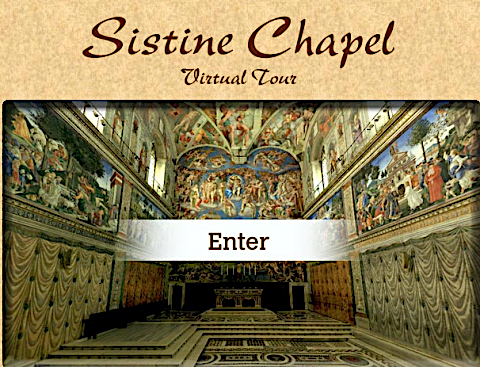
The Sistine Chapel: The most famous building in the Vatican, after St. Peter’s, is the Sistine Chapel, a part of the Pope’s official residence, the Apostolic Palace. Frescoes by Raphael, Bernini, Botticelli and others adorn the walls–and on the ceiling, one of the great masterpieces in the history of art: Michelangelo’s early 16th century depiction of scenes from the Book of Genesis, covering some 12,000 square feet. On a walking tour you would barely have enough time to recognize some of the major scenes. With this virtual tour you can spend all the time you want scanning around and zooming in to study the details.
Archbasilica of St. John Lateran: The Pope’s official ecclesiastical seat, St. John Lateran is the oldest Papal Basilica. But many of its most famous features are relatively recent. The basilica is perhaps best known for its neoclassical façade by Alessandro Galilei, completed in 1735.
Basilica of Paul Outside-the-Walls: Built outside the old city walls, this basilica contains the tomb of St. Paul. You can see the tomb and other features of the graceful church (which was rebuilt in the 19th century after a devastating fire) on the tour.
Basilica of St. Mary Major: This basilica is actually located outside the Vatican City compound, in Rome, but has extraterritorial status similar to that of a foreign embassy. Built in the fifth century, with some later additions, the basilica is a beautiful example of classical Roman architecture.
The Pauline Chapel: Another chapel in the Apostolic Palace, the Pauline Chapel is separated from the Sistine Chapel by the Sala Regia, or “Regal Room.” Although less well-known than the Sistine Chapel, the Pauline Chapel houses two great frescoes by Michelangelo: “The Conversion of Saul” and “The Crucifixion of St. Peter.”
If you would like to support the mission of Open Culture, consider making a donation to our site. It’s hard to rely 100% on ads, and your contributions will help us continue providing the best free cultural and educational materials to learners everywhere. You can contribute through PayPal, Patreon, and Venmo (@openculture). Thanks!
In September 1975, Brian Eno released his album Another Green World. The following month, the BBC’s acclaimed documentary series Arena first aired, using Another Green World’s title track as its theme music. 35 years later, the show finally got around to documenting Eno himself. This 2010 episode, also called Another Green World, captures the “intellectual guru of the rock world” (as a Desert Island Discs DJ calls him) at work in his studio, in conversation with a variety of interlocutors—including journalist Malcolm Gladwell, record producer Steve Lillywhite, and evolutionary biologist Richard Dawkins—and cycling around the green hills that roll around his neighborhood. Bono from U2, several of whose records Eno produced, calls the man “a mind-expanding drug,” and listening to Eno expound here upon his various ideas about and experiences with art, music, technology, journaling, and his native England, I’d have to agree.
The faintly hypnotic tone and pace of the episode — a sensibility not far removed from Eno’s famous “ambient” records like Discreet Music and Music for Airports— might also have something to do with that. We learn about Eno’s school days, his love of singing, his descent from a long line of “postmen with passion,” his getting more girls than Bryan Ferry in their days with Roxy Music, his preference for inconsistent instruments, his history with Catholicism, his enthusiasm for Stafford Beer’s management book Brain of the Firm, his work with audiovisual installations, and his ever-present interest in how complexity arises from simplicity. But we also feel like we’ve seen something not just about Eno, but Eno-like, where form meets function as closely as in all of Arena’smost memorable episodes and all of Eno’s most memorable projects. Or maybe I just like the sound of the rain outside during the studio segments — a sound which had a lot to do with Eno’s development of ambient music in the first place.
Sometimes the old ways work best. That assumption, or at least the assumption that the most centuries-tested techniques can still produce interesting results, underpins many of the Art Institute of Chicago’s Launchpad videos. The series, designed to give visitors context for the artifacts they see there, reveals the process behind the product, and some new products may come out of some very old processes indeed. In the case of the video at the top, we see the creation of an ancient Greek vase — or, rather, a new vase, created as the ancient Greeks did — from the clay purification to the kneading to the shaping to the illustration to the firing.
Just above, you can watch the ancient “free-blown technique” of glassmaking in action. Invented around 40 B.C., glass-blowing gave the glassmakers of the day a faster, cheaper, more controllable way to work, which enabled them to produce for a larger market than ever before. If you’d like to learn more about the method it displaced, the Art Institute also has a video demonstrating the older “core-formed” glassmaking technique. Pottery and glassware have an appealing practicality, and first-rate artisans of those forms could no doubt make a good deal of money, but how did the money itself come into being? The Launchpad video on coin production in Ancient Greece, below, sheds light on minting in antiquity. Serious artistically inclined numismatists will, of course, want to follow it up with its companion piece on coin production in the Roman world.
We're hoping to rely on loyal readers, rather than erratic ads. Please click the Donate button and support Open Culture. You can use Paypal, Venmo, Patreon, even Crypto! We thank you!
Open Culture scours the web for the best educational media. We find the free courses and audio books you need, the language lessons & educational videos you want, and plenty of enlightenment in between.