An FYI for art and poetry lovers: “Each month, TATE ETC. publishes new poetry by leading poets such as John Burnside, Moniza Alvi, Adam Thorpe, Alice Oswald and David Harsent who respond to works from the Tate Collection. (Subscribe to the Poem of the Month RSS feed.) This March Roger McGough presents his poem, Cadeau, based on Man Ray’s work of the same name.” Find the art and poem here.
The Art History Web Book
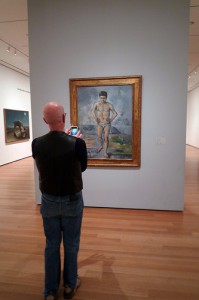 Now there’s a nice alternative to the traditional, expensive art history textbook. The folks at smARThistory have created a free multi-media web-book that offers a dynamic survey of art history. The online resource combines traditional images with audio and videos, and the beauty is that you don’t have to read this web-book in a linear fashion. Rather, you can sort through things by time period, style and artist and find the information that you want. In case you’re wondering about the credibility of this resource, it doesn’t hurt to mention that one of its founders, Beth Harris, is the Director of Digital Learning at the Museum of Modern Art in New York City, and the other, Steven Zucker, is Dean of the School of Graduate Studies at the Fashion Institute of Technology, part of the State University of New York. Have a look.
The Story Behind the Iconic Obama Campaign Poster
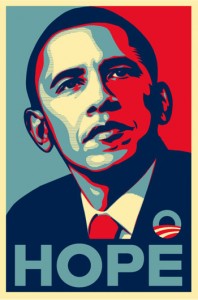 The story behind the artwork that defined the Obama campaign is a fascinating one. Shepard Fairey’s posters achieved prominence much in the same way that Obama did. They rose from the ground up. Everyday people supported and promoted his imaginative posters on the web, until they became something of a public phenomenon. And they turned the status quo — in this case, the tradition political poster — into something fresh and new. In this interview (iTunes — Feed — Stream), Fairey, once a self-proclaimed “outlaw street artist,” talks about how got started with his Obama pieces, and how his most celebrated work ended up in the permanent collection at the U.S. National Portrait Gallery.
P.S. As you’ll see, we’re in the midst of launching a new design. Things are going rather smoothly. But if you encounter any problems, please be patient and please let us know. We’ll be making small tweaks here and there. Thanks!
Visit the Prado Art Collection with Google Earth
Thankfully, it’s not all bad news here in Silicon Valley. Yesterday, Google and the Prado (the major art museum in Madrid) announced that you can launch Google Earth from wherever you live, travel virtually to Spain, and then take a close look at fourteen of the museum’s finest paintings. And, by “close,” I mean close. According to a Google spokesman said: “The paintings have been photographed in very high resolution and contain as many as 14,000 million pixels (14 gigapixels).” “With this high level resolution you are able to see fine details such as the tiny bee on a flower in The Three Graces (by Rubens), delicate tears on the faces of the figures in The Descent from the Cross (by Roger van der Weyden) and complex figures in The Garden of Earthly Delights (by El Bosco).” The fourteen paintings include pieces by Francisco de Goya, Diego Velázquez and Hieronymus Bosch. You can begin the tour (and get Google Earth software) from this landing page. The video below also offers a nice visual illustration of what this project is all about. (A quick tip: if you have Google Earth, make sure that you have “3D Buildings” checked off under “Layers.” Then do a search for “Prado” and click on “Museu del Prado.” From there, click on the image of the museum. Next, you should see a series of paintings that you can begin to explore.)

Next in Line for a Bailout? A Major Art Museum
Almost exactly a year ago, I caught up with Jori Finkel, a journalist who covers the Los Angeles arts scene, and we talked about an art-world controversy that she first wrote about in The New York Times. The controversy focused on museums seeking funding from art galleries, which can be a direct conflict of interests, and her lead example was L.A.’s Museum of Contemporary Art. Well, it turns out now that MOCA is in serious financial trouble, with its annual operating costs running up to $20 million and its endowment plunging below $10 million. It also turns out that last year’s scandal should have sent up some red flags. So we decided to do a follow-up interview with Jori and get her take on MOCA’s fiscal crisis and bailout plans.
DC: We’ve seen a lot of banks and financial institutions looking for bailouts, and the more we investigate them, the more we realize these institutions were simply acting recklessly. When the history of this crisis gets written, I imagine that we’ll realize that it wasn’t just the banks that mismanaged their funds and got caught on a limb. Is that what we’re seeing here with MOCA?
JF: I’m not aware of any crazy executive bonuses or expensive company retreats if that’s what you mean. No, what we’re looking at here are two rather classic nonprofit management problems: under-funding and overspending. L.A. Times critic Christopher Knight took MOCA trustees to task for not coughing up enough cash, and I’ve also written a lot about the crisis in cultural philanthropy in L.A. The biggest problem is that Hollywood types would rather give money to a cause, environmental or political, than to the arts.
But it’s naïve just to say the museum is under-funded. They were clearly overspending. Their staff ballooned to 200 while their endowment was shrinking, and museum ambitions clearly outstripped their actual, legitimate sources of funding. In most businesses, that would be reason to rethink, retrench, downsize. That apparently hasn’t happened on a large enough scale here. They seem to have put artistic ideals ahead of financial realities–putting what the museum should exhibit ahead of what it can afford to exhibit.
DC: During our interview last year, you raised some doubts about how MOCA was funding its major Murakami show. In retrospect, was that an early sign that things were going wrong at the museum? Were there other red flags?
JF: Yes, I think the fact that MOCA was hustling money for its Murakami show from commercial dealers who represent the artist was a sign of financial trouble and maybe even desperation. It looks in retrospect like a bright red flag. You raised the perfect question last year: Why was MOCA engaging in this practice when so many other museum leaders spoke out against it as unethical?
Another early warning sign came when the museum started closing down the Geffen Contemporary for a few months at a time. Some reporters are treating this fact like it’s new. It’s not. There was even a time three or four years ago when the MOCA web site carried a notice to film scouts—essentially saying the Geffen is yours for the right price. Can you imagine the Museum of Modern Art in New York doing this?
Google Brings Massive LIFE Photo Archive to The Web
A good days for fans of open culture: Google is bringing the massive LIFE photo archive online. 2 million photos are already uploaded, and another 8 million will be coming online soon. The current archive moves from The American Civil War to present, and it includes a large number of photos never seen before. Here’s one of MLK Jr, another of Pablo Picasso, and then one of FDR. All of these images will be added to Google Image Search, but if you want to peruse the collection, you can simply access it here. You can also read more about this ambitious undertaking on Google’s corporate blog.


Morphing Van Gogh Portraits
You’ll get the concept of this pretty quickly. And if you’re a fan, see these other clips (Women in Art & Women in Film). These creative videos by Philip Scott Johnson all reside in this larger YouTube collection, which has now made it on to our our growing list: Intelligent Life at YouTube: 80 Educational Video Collections.

Support Us
We're hoping to rely on loyal readers, rather than erratic ads. Please click the Donate button and support Open Culture. You can use Paypal, Venmo, Patreon, even Crypto! We thank you!

About Us

Open Culture scours the web for the best educational media. We find the free courses and audio books you need, the language lessons & educational videos you want, and plenty of enlightenment in between.
Advertise With Us

