Powerful. Simply powerful. In November, 1971, the Mariner 9 space orbiter was about to make history. It was rapidly approaching Mars, making it the first spacecraft to orbit another planet. There, it would produce a global mapping of the Martian surface and capture “the first detailed views of the martian volcanoes, Valles Marineris, the polar caps, and the satellites Phobos and Deimos.” This marked a major milestone in the great era of space exploration. The excitement leading up to the moment was palpable.
Just days before the Mariner 9 reached Mars, two of our greatest sci-fi writers, the dearly departed Ray Bradbury and Arthur C. Clarke, shared the stage with two eminent scientists, Carl Sagan and Bruce Murray, at a symposium held at Caltech. At one point, Bradbury captivated the audience when he read his poem, “If Only We Had Taller Been,” and gave an almost spiritual inflection to the Mariner 9 mission, reminding us of something that Neil deGrasse Tyson once said: the line separating religious epiphany and feelings created by space exploration is awfully, awfully thin.
Follow Open Culture on Facebook and Twitter and share intelligent media with your friends. Or better yet, sign up for our daily email and get a daily dose of Open Culture in your inbox. And if you want to make sure that our posts definitely appear in your Facebook newsfeed, just follow these simple steps.
Something extraordinary happens this week. The planet Venus will move across the face of the Sun for the last time in our lives.
Transits of Venus occur on a 243-year cycle, with pairs of transits eight years apart separated by gaps of 121.5 and 105.5 years. The last Venus transit happened in 2004. The next won’t occur until December of 2117. So if you want to see one, don’t put it off! “This is it, folks,” said Robert Naeye, Editor in Chief of Sky & Telescope magazine. “Unless modern medicine comes up with a miracle to extend human lifespans, this transit of Venus will be your final opportunity to watch our sister planet cross the Sun’s fiery disk as seen from Earth.”
The event will take place tomorrow, June 5, or the next day, June 6, depending on your location. In North America the transit will begin tomorrow, just after 6 p.m. Eastern Daylight Time. Because of the great distance between the Earth and Venus, the duration will be far longer than for a Solar eclipse: over six hours.
Here are six tips for making the most of this last-of-a-lifetime event:
1: Read up about it. For a quick and neatly organized overview your best bet is astronomer Chuck Bueter’s Transit Of Venus.org. The site includes all kinds of useful and interesting information, including the video above.
2: Find out when you can see it from your location. The international non-profit group Astronomers Without Borders has created an extremely handy Web page that will automatically generate a schedule of the transit for your location, based on your computer’s IP address. The site allows you to choose between a simple graphic representation (the default setting) or a more detailed data sheet. It even predicts the likelihood of cloud cover where you are.
3: Prepare for safe viewing. Looking directly into the sun can cause severe and permanent eye damage. There are a number of safe ways to view the transit of Venus, but it’s essential that you follow the advice of experts. Bueter has published an overview, “Six Ways to See the Transit.” Rick Fienberg of the American Astronomical Society has published a detailed article on how to build a “sun funnel.” And Doug Duncan, director of the University of Colorado’s Fiske Planetarium, has created a video explaining a very simple way to safely project an image of a solar event onto a two-dimensional surface using a pair of binoculars.
4: Check for events in your area. If you follow the links in step three you should be able to watch the transit on your own, but you might have more fun–and learn more–if you join a group. Astronomy clubs, planetariums and other science groups will be hosting transit-viewing events around the world. Check your local listings or go to the NASA Sun-Earth Day Web site for a comprehensive round-up of events across the globe. Just scroll the map on the NASA site over to your own geographic region and zoom in.
5:Download the app. If you have an Apple or Android device you can download a free Transit of Venus phone app that will allow you to send your own observations of the transit to a global experiment to measure the size of the Solar System. “In centuries past,” writes Steven van Roode of Astronomers Without Borders, which is organizing the project, “explorers traveled around the globe to time the transit of Venus to determine the size of the solar system. We invite you to inspire international collaboration during the 2012 transit of Venus by enabling a digital re-creation of those global expeditions. The phone app will allow citizens around the world to witness this rare phenomenon and to contribute their observation to a collective experiment to measure the sun’s distance.” Also, Sky & Telescope is helping people make the most of the transit by offering free use of its SkyWeek astronomy app through June 7. You can download it for iPhone or Android.
6: Watch the webcast. If you are unable to get a clear view of the transit from your location–or even if you are–you should check out either of a pair of live webcasts which will be held during the event. Astronomers Without Borders will transmit its webcast live from the Mount Wilson Observatory in California. The program will include interviews with experts and contributions from amateur astronomers, along with video tours of the historic observatory and its equipment, both antique and state-of-the-art. You can access the Astronomers Without Borders webcast here. Another major webcast will be broadcast by NASA from Mauna Kea, Hawaii beginning tomorrow at 9:45 p.m. UTC (Coordinated Universal Time) or 5:45 p.m. Eastern Time. You can access the NASA webcast here. For a schedule of the program, which will include many videos and interviews throughout the event, you can download a PDF.
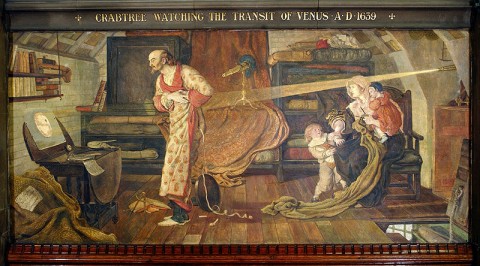
British astronomer William Crabtree, depicted observing the 1639 transit of Venus in a mural at Manchester Town Hall, painted in 1903 by Ford Madox Brown.
Just when you think you’ve had enough Neil deGrasse Tyson, another not-to-miss video comes along. This one comes from the 2006 Beyond Belief Conference, and it features the astrophysicist giving what’s been called the “greatest science sermon ever.” As a youngster, Tyson stepped into the Hayden Planetarium (the institution he now runs) and he felt an unshakable calling to study the universe. It wasn’t unlike the feeling someone undergoes when they’re religiously born again. And ever since, Tyson has experienced revelation after revelation, epiphany after epiphany, when studying the universe, and especially whenever he’s reminded that, chemically speaking, we are in the universe, and the universe is in us. We’re all made of the same stardust. How can that not leave us with an incredibly spiritual feeling?
Have you ever wondered how astronomers figure out the mind-boggling distances between the Earth and various astronomical objects? In this informative animated video from the Royal Observatory at Greenwich, we learn the fundamentals of the Cosmic Distance Ladder, the succession of methods used to determine those distances.
The video was made for “Measuring the Universe: from the transit of Venus to the edge of the cosmos,” an exhibit that will be on display at the observatory through September 2. The exhibit is timed to coincide with this year’s rare transit of Venus, which will be visible from Earth on June 5 and 6 and won’t happen again until 2117. The transit of Venus played a key role in the history of astrometry. In 1663 the Scottish mathematician and astronomer James Gregory proposed a method of timing the movement of Venus across the Sun from two widely separated points on the Earth and using the differential to calculate the sun’s mean equatorial parallax and, by triangulation, the Sun’s distance from the Earth.
Knowing the distance from the Earth to the Sun, we can then figure out the distances of some stars using the same method of trigonometric parallax. But as astronomer Olivia Johnson explains in the video, that technique can only be used to measure the closest stars. For distances greater than 500 light years, other methods are required. When the objects in question have a known luminosity–in other words, when they are “standard candles”–the inverse square law of light can be used to calculate distances. Those measurements, along with Hubble’s Law and the Doppler Effect, enable even further calculations extending to the edge of the known cosmos.
“What’s most incredible to me,” says Johnson, “is how all these measurements build on each other. It’s only by knowing the scale of our Solar System–the distance between the Earth and Sun–that we’re able to measure distances to nearby stars using parallax. If we can learn how far it is to some nearby standard candles using parallax, we can then use comparisons between standard candles to measure the distances to farther stars and galaxies. Finally, by studying the motions of galaxies with standard candles, we learn we can use redshift to measure distances throughout our expanding Universe.”
Last week NASA released Pursuit of Light, a short HD film that uses amazing data visualizations (mixed with live action footage) to tell stories about the Earth, The Moon, The Sun, The Planets, and the Deep Sky. And it’s all “wrapped in poetic implication about humanity’s need to explore,” says the film’s producer. Pursuit of Light will appear on Hyperwalls around the country, a new screen technology created by NASA’s Goddard Space Flight Center. But you can watch it first on the web, or freely download it here. H/T Metafilter
If you would like to support the mission of Open Culture, consider making a donation to our site. It’s hard to rely 100% on ads, and your contributions will help us continue providing the best free cultural and educational materials to learners everywhere. You can contribute through PayPal, Patreon, and Venmo (@openculture). Thanks!
Imagine a star (like our sun) wandering close to a supermassive black hole and finding itself mercilessly ripped apart by this beast weighing millions to billions times more than the hapless star. It doesn’t happen very often. But when it happens, it’s pretty spectacular. And now NASA has produced a computer simulation showing this spectacle, drawing on evidence gathered by NASA’s Galaxy Evolution Explorer and the Pan-STARRS1 telescope located in Hawaii. Here’s how NASA describes what you’re seeing in the clip above:
Some of the stellar debris falls into the black hole and some of it is ejected into space at high speeds. The areas in white are regions of highest density, with progressively redder colors corresponding to lower-density regions. The blue dot pinpoints the black hole’s location. The elapsed time corresponds to the amount of time it takes for a Sun-like star to be ripped apart by a black hole a million times more massive than the Sun.
NASA has more information on this stellar homicide here.
If you would like to support the mission of Open Culture, consider making a donation to our site. It’s hard to rely 100% on ads, and your contributions will help us continue providing the best free cultural and educational materials to learners everywhere. You can contribute through PayPal, Patreon, and Venmo (@openculture). Thanks!
Perhaps you heard the news this week. Four billionaires (Larry Page, Eric Schmidt, Ross Perot Jr. and Charles Simonyi) have thrown their financial weight behind Planetary Resources, Inc., a Washington-based startup with big and bold plans. Before our planet runs out of natural resources, this venture plans to start extracting water and metals from resource-rich asteroids flying near Earth. One asteroid, they speculate, may contain more platinum than we’ve ever mined from Earth. Above, the company gives you a quick introduction to their SciFi-esque plans. The first Planetary Resources spacecraft will launch within the next two years. via Devour
Norwegian photographer Ole C. Salomonsen has created a stunning time-lapse film of the aurora borealis over rugged Nordic landscapes.
Salomonsen lives in the city of Tromsø, 200 miles north of the Arctic Circle, where the sun doesn’t rise above the horizon between November and January. Tromsø is considered one of the best (inhabited) places on Earth to see Northern Lights. This past winter the light show was particularly intense, as the sun moved closer to the peak (expected in early 2013) of its 11-year cycle of electromagnetic activity.
The photographer went to extraordinary lengths to capture these images, traveling across northern Norway, Sweden and Finland over a half-year period beginning in September and ending earlier this month, when the daylight hours grew too long. “I have driven thousands of km between locations up here in the arctic this season,” Salomonsen writes on his Vimeo page. “I was running between 2–3 cameras like a madman.” He estimates he shot about 150,000 exposures to get the 6,000 or so frames used in the four-and-a-half-minute video above. He writes:
The video is a merge of two parts; the first part contains some more wild and aggressive auroras, as well as a few milky way sequences, hence either auroras are moving fast because they are, or they are fast due to motion of the milky way/stars. Still, some of the strait up shots are very close to real-time speed, although auroras mostly are slower, she can also be FAST! The second part has some more slow and majestic auroras, where I have focused more on composition and foreground.
The music is by Norwegian composer Kai-Anders Ryan. To learn about the technical aspects of Celestial Lights, and to see the film Salomonsen made during last year’s aurora season, visit his Vimeo page. And to see his beautiful still images, visit Salomonsen on Facebook and Flikr.
We're hoping to rely on loyal readers, rather than erratic ads. Please click the Donate button and support Open Culture. You can use Paypal, Venmo, Patreon, even Crypto! We thank you!
Open Culture scours the web for the best educational media. We find the free courses and audio books you need, the language lessons & educational videos you want, and plenty of enlightenment in between.