“I have always imagined that Paradise will be a kind of library,” Jorge Luis Borges famously wrote. Were he alive today, he might well regard the internet as becoming more paradisiacal all the time, at least in the sense that it keeps not just generating new texts, but absorbing existing ones and making them available free to readers.
And while his well-known story “The Library of Babel” envisions a magical or extremely high-tech library containing all possible texts (which the internet has started to make a reality), recent additions to the vast library of the internet have done him one better by incorporating not just pages of letters, but intricately designed and lavishly illustrated art texts as well.
Take the Getty Research Portal, which has just, for its fourth anniversary, unveiled a new design and a total volume count surpassing 100,000. “In assembling a virtual corpus of digitized texts on art, architecture, material culture, and related fields from numerous partners, the Portal aspires to offer a more expansive collection than any single library could provide,” writes project content specialist Annie Rana at the Getty’s blog The Iris. “Furthermore, with these freely downloadable materials, scholars and researchers can now be in possession of copies of rare books and other titles without having to travel to far-flung locales.”
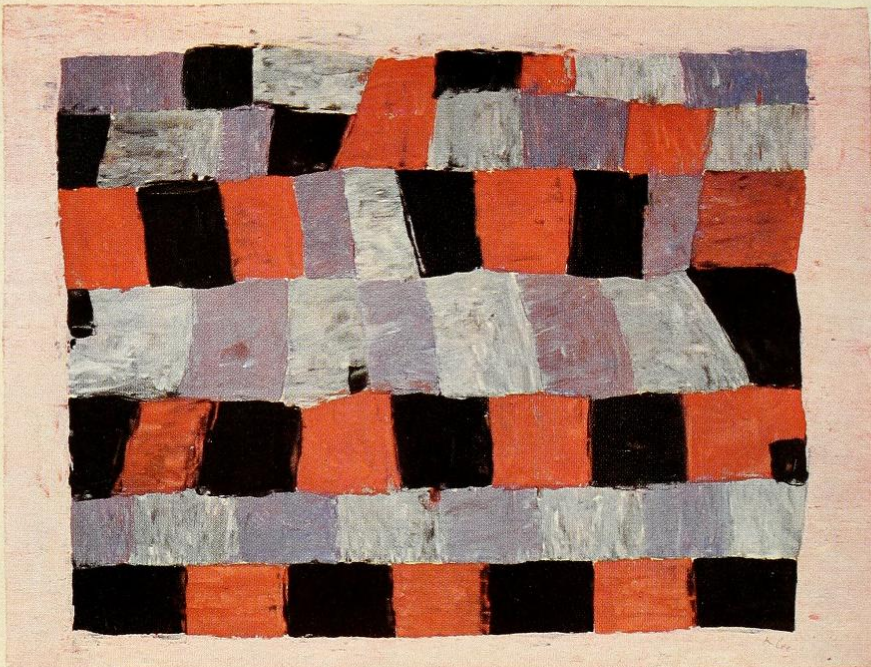
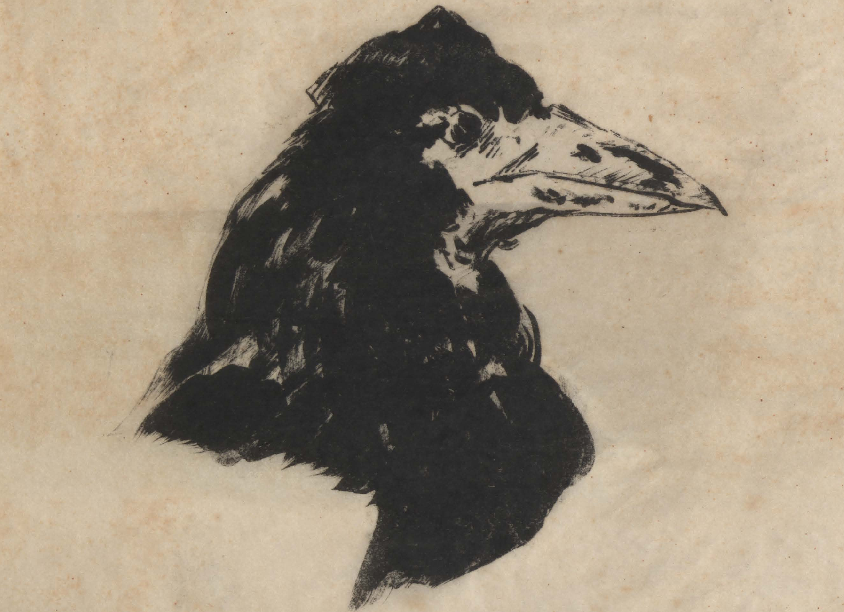
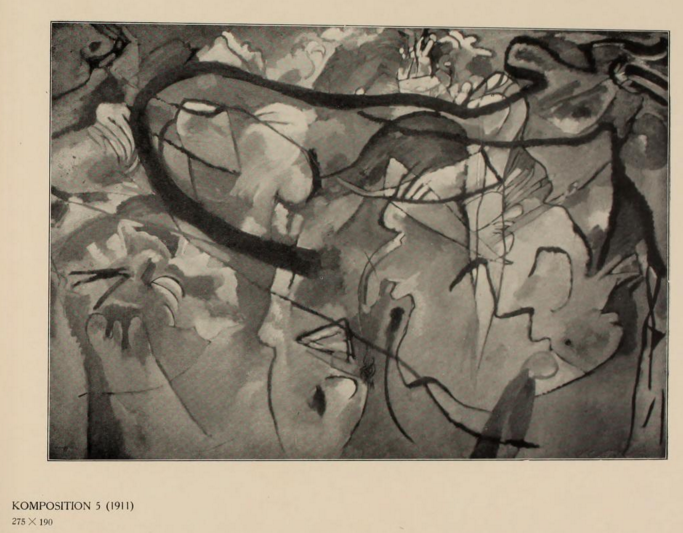
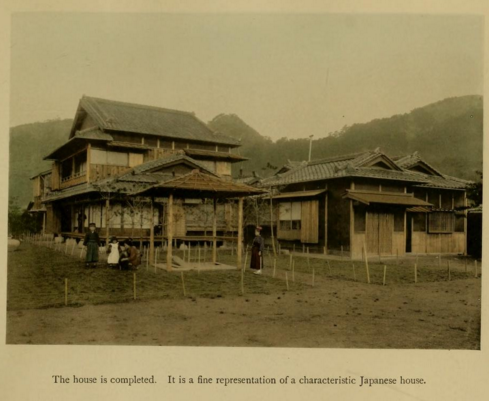
Still, the selection of items looks quite international already. The post highlights a few items of high potential interest to Open Culture readers, such as Edgar Allen Poe’s The Raven illustrated by Edouard Manet and translated into French by Stéphane Mallarmé, as well as a monograph on, an exhibition catalog about the work of, and writings by the Russian abstract painter and art theorist Wassily Kandinsky. But even though the Getty Research Portal seems only to have plans to grow larger and larger, everyone browsing through it will surely find something suited to their artistic interests, from Paul Klee (top) to Roy Lichtenstein to Japanese architecture and everything in between; you have only to step through the portal to find it.
At the time, the collection contained 2.6 million public domain images, but “eventually,” we noted in a previous post, “this archive will grow to 14.6 million images.” Well, it has almost doubled in size since our first post, and it now features over 5.3 million images, thanks again to Kalev Leetaru, who headed the digitization project while on a Yahoo-sponsored fellowship at Georgetown University.
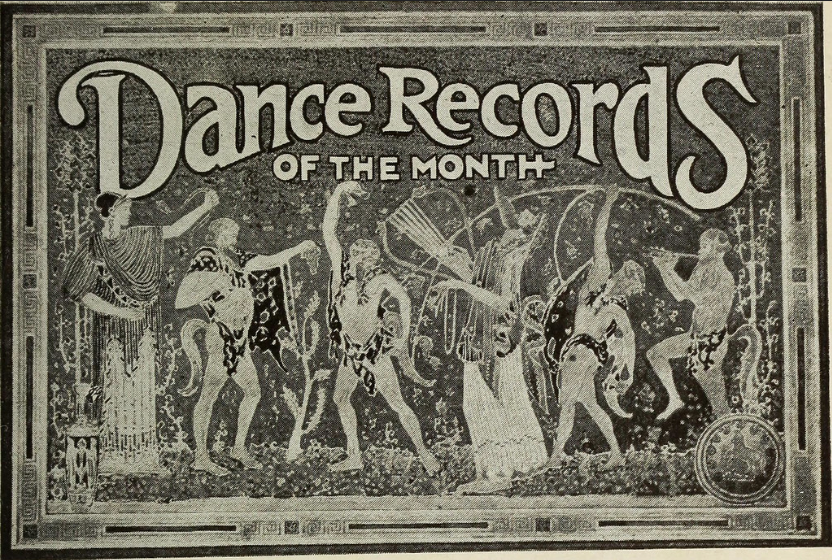
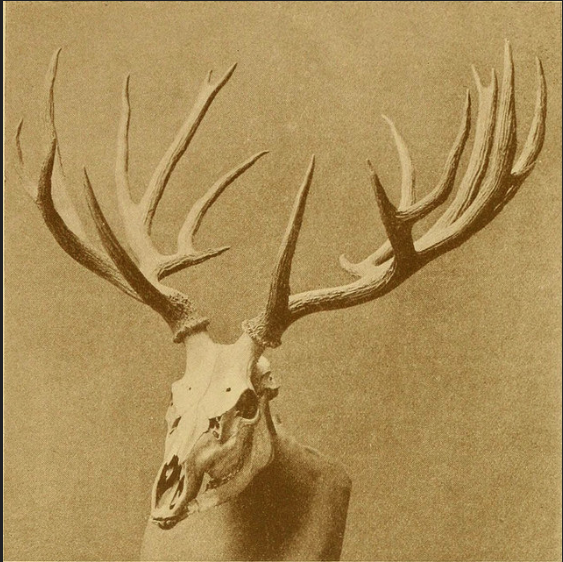
Rather than using optical character recognition (OCR), as most digitization software does to scan only the text of books, Leetaru’s code reversed the process, extracting the images the Internet Archive’s OCR typically ignores. Thousands of graphic illustrations and photographs await your discovery in the searchable database. Type in “records,” for example, and you’ll run into the 1917 ad in “Colombia Records for June” (top) or the creepy 1910 photograph above from “Records of big game: with their distribution, characteristics, dimensions, weights, and horn & tusk measurements.” Two of many gems amidst utilitarian images from dull corporate and government record books.
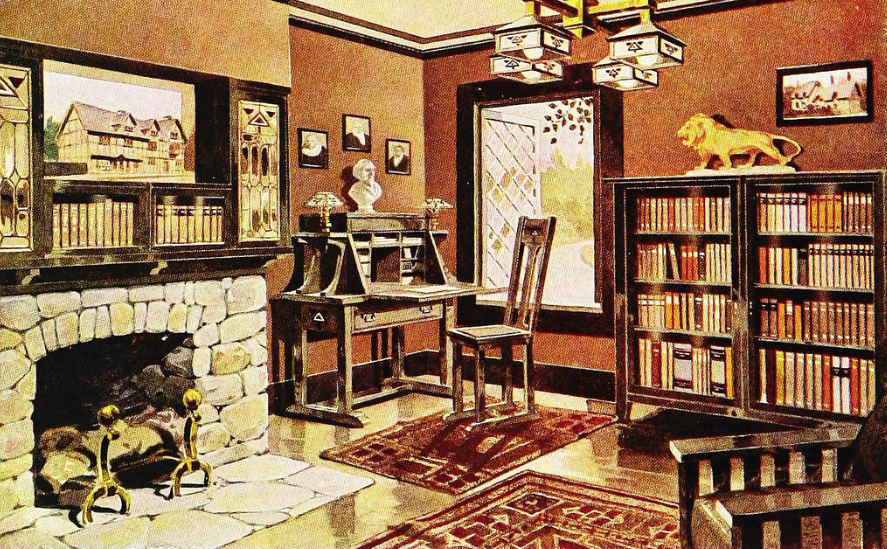
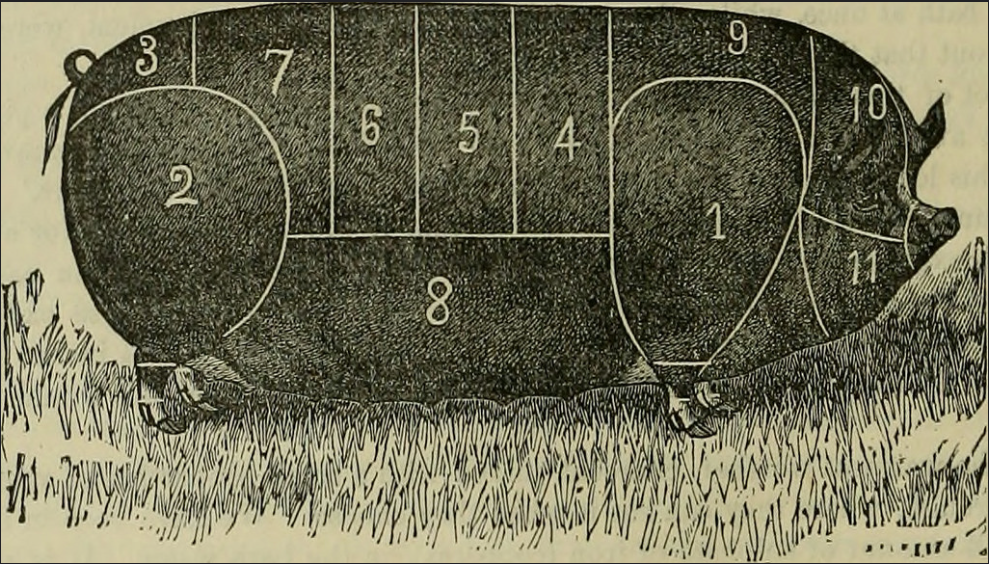
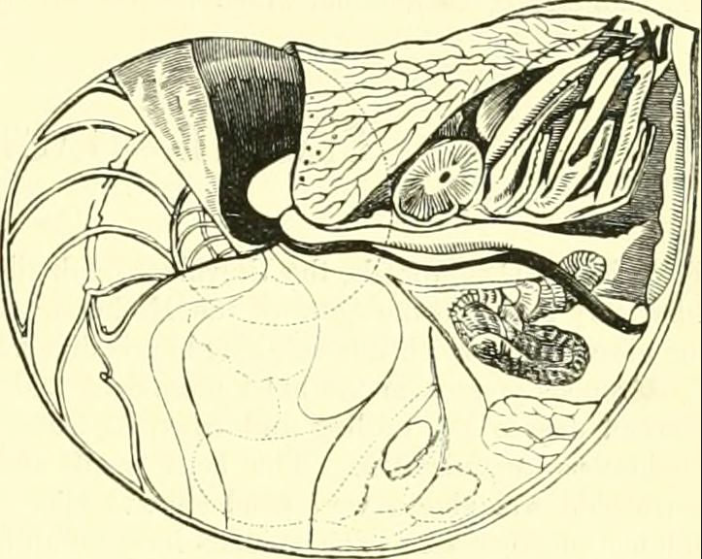
Search “library” and you’ll arrive at a fascinating assemblage, from the fashionable room above from 1912’s “Book of Home Building and Decoration,” to the rotund, mournful, soon-to-be carved pig below from 1882’s “The American Farmer: A Complete Agricultural Library,” to the nifty Nautilus drawing further down from an 1869 British Museum of Natural History publication. To see more images from any of the sources, simply click on the title of the book that appears in the search results. The organization of the archive could use some improvement: as yet millions of images have not been organized into thematic albums, which would greatly streamline browsing through them. But it’s a minor gripe given the number and variety of free, public domain images available for any kind of use.
Moreover, Leetaru has planned to offer his code to institutions, telling the BBC, “Any library could repeat this process. That’s actually my hope, that libraries around the world run this same process of their digitized books to constantly expand this universe of images.” Scholars and archivists of book and art history and visual culture will find such a “universe of images” invaluable, as will editors of Wikipedia. “What I want to see,” Leetaru also said, “is… Wikipedia have a national day of going through this [collection] to illustrate Wikipedia articles.”
Short of that, individual editors and users can sort through images of all kinds when they can’t find freely available pictures of their subject. And, of course, sites like Open Culture—which rely mainly on public domain and creative commons images—benefit greatly as well. So, thanks, Internet Archive Book Images Collection! We’ll check back later and let you know when they’ve grown even more.
As a young college student, I spent hours wandering through my university’s library, looking in a state of awe at the number of books contained therein by writers whose names I knew or who seemed vaguely familiar, and by hundreds, thousands, more I’d never heard of. Always content to immerse myself in secluded corners for days on end with a good book, I couldn’t have felt more at home.
The internet was in its infancy, and my online life at the time consisted of awkward, plain-text emails sent once or twice a week and the occasional clunky, slow-loading website, promising much but delivering little. Excitable futurists made extravagant predictions about how hypertext and interactivity would revolutionize the book. These seemed like intriguing but unnecessary solutions in search of a problem.
To the bookish, the book is a perfected technology that cannot be improved upon except by the publishing of more books. While interactive texts—with linked annotations, biographies, historical precis, critical essays, and the like—have much enhanced life for students, they have not in any way improved upon the simple act of reading for pleasure and edification—an activity, wrote Virginia Woolf, requiring nothing more than “the rarest qualities of imagination, insight, and judgment.”
Though Woolf would likely have been unimpressed with all that talk of hypertextual innovation, I imagine she would have marveled at the online world for offering something to the reader we have never had until the past couple decades: free and instant access to thousands of books, from literary classics to biographies to histories to poetry—all genres upon which Woolf offered advice about how to read on their own terms. Without the anxious admissions process and costly tuition, anyone with a computer now has access to a significant portion of the average college library.
And now anyone with a computer has access to a significant portion of the British Library’s rare collections as well, thanks to the venerable institution’s new online collection: “Discovering Literature: 20th Century.”
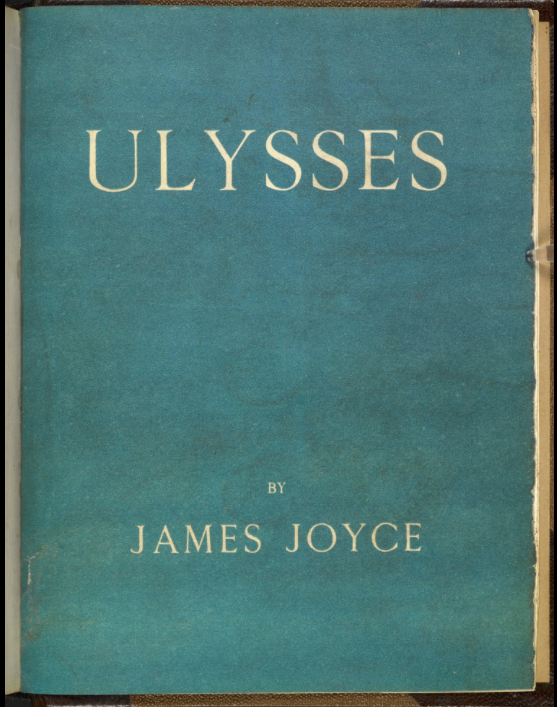
The online library offers a paradise for readers, certainly. And also a heaven for scholars. Included among the rare first editions and critical essays and interviews on the site’s main page are “online for the first time… literary drafts… notebooks, letters, diaries, newspapers and photographs from Virginia Woolf, Ted Hughes, Angela Carter and Hanif Kureishi among others.”
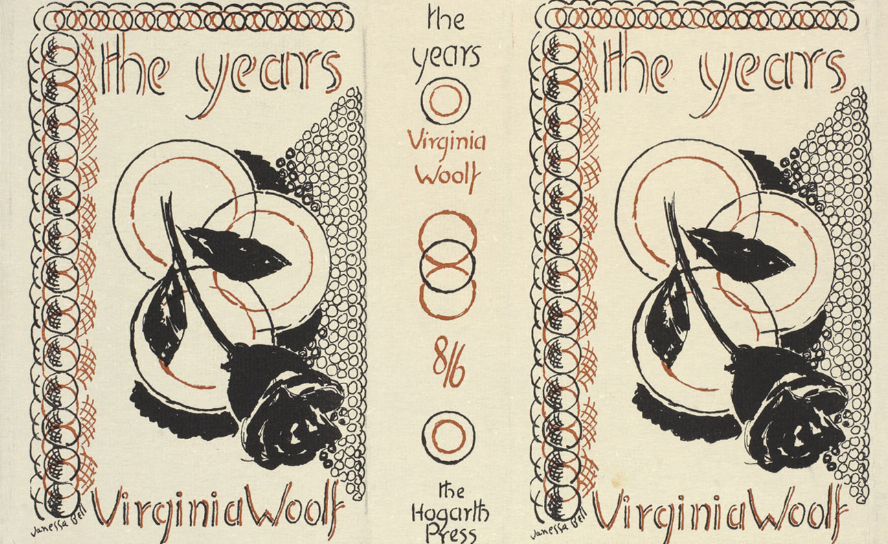
“Until now,” says Anna Lobbenberg, the Library’s Digital Programmes Manager, “these treasures could only be viewed in the British Library Reading Rooms or on display in exhibitions—now Discovery Literature: 20th Century will bring these items to anyone in the world with an internet connection.” It truly is, for the lover of books, a brave new world (a book whose 1932 original dust jacket you can see here).
“I can’t recall an opera in which the villain is a building,” writes Ron Hubbard in a review for the St. Paul Pioneer Press, “but that’s the case with The Shining, an adaptation of Stephen King’s novel about a haunted hotel and a family that winters within it. While ghosts play a prominent role in many operas, the spirits occupying the remote Rocky Mountain hotel in The Shining are servants to one powerful, malevolent master: the building itself.” Hubbard highlights the elaborate design that recreates the forbidding Overlook Hotel with a “stately set,” “swirling, spooky projections,” and building elements that “roll in and out behind screens swirling with patterns, creating an unsettling, kaleidoscopic effect.”
As every opera enthusiast soon finds out, no production can survive by design alone. But The Shining, according to Hubbard, earns full marks in other areas as well, including but not limited to its “score full of discomfiting themes that clash and collide to strongly sung and disarmingly believable portrayals of characters alive and otherwise.” He also emphasizes that the source material comes not from Kubrick’s film, but King’s novel: “Stanley Kubrick took great liberties with the story, going so far as to change how the conflict plays out and resolves. I actually found this operatic version considerably creepier, in large part because we get to know the ghosts better.”
“The novel and the movie are vastly different,” says librettist Mark Campbell in the video above, though they and they opera all tell “the story of Jack Torrance, who, because of economic reasons, accepts a job as the winter caretaker for a hotel in remote western Colorado.” And before long, as we know whether we’ve read the book or seen the movie, Jack “submits to a number of his demons” before the eyes of his terrified and increasingly endangered family. But it remains, Campbell says, “the story of a man who wants to do good — he just didn’t choose the right job, and ended up in a situation that did everything it could to tear him apart.”
The Shining the opera comes commissioned by Minnesota Opera’s New Works Initiative, “designed to invigorate the operatic art form with an infusion of contemporary works.” Given its completely sold-out success in St. Paul, where it premiered, we can safely say that this production has accomplished the mission of drawing vigor from a perhaps unexpected source, and even that it stands a chance of bringing its chilling artistry (not to mention its promisingly warned-about “strong language, gunshots, simulated nudity, theatrical haze, and strobe lighting”) to a city near you, preferably in the dead of winter to best suit the story — a time that, in Minnesota, already counts as forbidding enough.
Bill Gates — Microsoft CEO turned philanthropist and lifelong learner—has just recommended five books to put on your summer reading list. If you’re looking for a light beach read, you’ve come to the wrong place. But if you have a Gates-like mind, you might find that these books will make you “think in new ways” and perhaps keep you up past your bedtime. On his website, the video above comes accompanied by reasons for reading each work. Below we’re quoting directly from Mr. Gates:
Seveneves, by Neal Stephenson. I hadn’t read any science fiction for a decade when a friend recommended this novel. I’m glad she did. The plot gets going in the first sentence, when the moon blows up. People figure out that in two years a cataclysmic meteor shower will wipe out all life on Earth, so the world unites on a plan to keep humanity going by launching as many spacecraft as possible into orbit. You might lose patience with all the information you’ll get about space flight—Stephenson, who lives in Seattle, has clearly done his research—but I loved the technical details.Seveneves inspired me to rekindle my sci-fi habit.
How Not to be Wrong, by Jordan Ellenberg. Ellenberg, a mathematician and writer, explains how math plays into our daily lives without our even knowing it. Each chapter starts with a subject that seems fairly straightforward—electoral politics, say, or the Massachusetts lottery—and then uses it as a jumping-off point to talk about the math involved. In some places the math gets quite complicated, but he always wraps things up by making sure you’re still with him. The book’s larger point is that, as Ellenberg writes, “to do mathematics is to be, at once, touched by fire and bound by reason”—and that there are ways in which we’re all doing math, all the time.
The Vital Question, by Nick Lane. Nick is one of those original thinkers who makes you say: More people should know about this guy’s work. He is trying to right a scientific wrong by getting people to fully appreciate the role that energy plays in all living things. He argues that we can only understand how life began, and how living things got so complex, by understanding how energy works. It’s not just theoretical; mitochondria (the power plants in our cells) could play a role in fighting cancer and malnutrition. Even if the details of Nick’s work turn out to be wrong, I suspect his focus on energy will be seen as an important contribution to our understanding of where we come from.
The Power to Compete, by Ryoichi Mikitani and Hiroshi Mikitani. I have a soft spot for Japan that dates back three decades or so, when I first traveled there for Microsoft. Today, of course, Japan is intensely interesting to anyone who follows global economics. Why were its companies—the juggernauts of the 1980s—eclipsed by competitors in South Korea and China? And can they come back? Those questions are at the heart of this series of dialogues between Ryoichi, an economist who died in 2013, and his son Hiroshi, founder of the Internet company Rakuten. Although I don’t agree with everything in Hiroshi’s program, I think he has a number of good ideas. The Power to Compete is a smart look at the future of a fascinating country.
Sapiens: A Brief History of Humankind, by Noah Yuval Harari. Both Melinda and I read this one, and it has sparked lots of great conversations at our dinner table. Harari takes on a daunting challenge: to tell the entire history of the human race in just 400 pages. He also writes about our species today and how artificial intelligence, genetic engineering, and other technologies will change us in the future. Although I found things to disagree with—especially Harari’s claim that humans were better off before we started farming—I would recommend Sapiens to anyone who’s interested in the history and future of our species.
You can get more ideas from Bill Gates at Gates Notes.
If you’re looking to do some more DIY education this summer, don’t miss the following rich collections:
If you would like to support the mission of Open Culture, consider making a donation to our site. It’s hard to rely 100% on ads, and your contributions will help us continue providing the best free cultural and educational materials to learners everywhere. You can contribute through PayPal, Patreon, and Venmo (@openculture). Thanks!
Ta-Nehisi Coates has been riding a wave so high these past few years that most honest writers would confess to at least some small degree of envy. And yet anyone—writer or reader—who appreciates Coates’ rigorous scholarship, stylistic mastery, and enthralling personal voice must also admit that the accolades are well-earned. Winner of the National Book Award for his second autobiographical work, Between the World and Me and recipient of a MacArthur “Genius Grant,” Coates is frequently called on to discuss the seemingly intractable racism in the U.S., both its long, gritty history and continuation into the present. (On top of these credentials, Coates, an unabashed comic book nerd, is now penning the revived Black Panther title for Marvel, currently the year’s best-selling comic.)
As a senior editor at The Atlantic, Coates became a national voice for black America with articles on the paradoxes of Barack Obama’s presidency and the bootstraps conservatism of Bill Cosby (published before the comedian’s prosecution). His article “The Case for Reparations,” a lengthy, historical examination of Redlining, brought him further into national prominence. So high was Coates’ profile after his second book that Toni Morrison declared him the heir to James Baldwin’s legacy, a mantle that has weighed heavily and sparked some backlash, though Coates courted the comparison himself by styling Between the World and Me after Baldwin’s The Fire Next Time. In doing so, writes Michael Eric Dyson, “Coates did a daring thing… waged a bet that the American public could absorb even more of the epistolary device, and wrote a book-length essay to his son.”
Not only did America “absorb” the device; the nation’s readers marveled at Coates’ deft mixture of existential toughness and emotional vulnerability; his intense, unsentimental take on U.S. racist animus and his moving, loving portraits of his close friends and family. As a letter from a father to his son, the book also works as a teaching tool, and Coates liberally salts his personal narrative with the sources of his own education in African American history and politics from his father and his years at Howard University. In the wake of the fame the book has brought him, he has continued what he seems to view as a public mission to educate, and interviews and discussions with the writer frequently involve digressions on his sources of information, as well as the books that move and motivate him.
So it was when Coates sat down with New York Times Magazine and ProPublica reporter Nikole Hannah-Jones at New York’s Schomburg Center for Research in Black Culture last year. You can watch the full interview at the top of the post. During the course of the hour-long talk, Coates mentioned the books below, in the hopes, he says, that “folks who read” Between the World and Me “will read this book, and then go read a ton of other books.” He both began and ended his recommendations with Baldwin.
Finally, Coates references the famous debate between James Baldwin and William F. Buckley at Cambridge University in 1965, which you can read about and watch in full here.
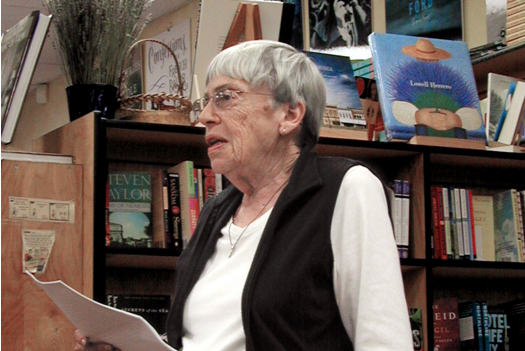
I’m sure I speak for many when I say that Ursula K. Le Guin’s novels and stories changed what I thought science fiction could be and do. Raised on H.G. Wells, Isaac Asimov, Robert Heinlein, and other mostly-white-male-centered classic sci-fi, I found Le Guin’s literary thought experiments startling and refreshing. Now it seems like almost a matter of course that science fiction and fantasy narratives come from a diversity of peoples and perspectives. But Le Guin remains the first to wake me from a dogmatic slumber about the potential of speculative fiction to imagine not only future technologies, but also expansive future identities.
Novels like The Left Hand of Darkness,The Dispossessed, and The Lathe of Heaven reflect Le Guin’s very broad range of interests in politics and the humanities and social sciences. She began her career as an academic studying Renaissance French and Italian literature, and her fiction synthesizes years of careful reading in anthropology, psychology, sociology, history, and Eastern and Western philosophy. Likewise, though she has been much influenced by traditional hard science fiction, Le Guin’s literary loves are wide and deep. All that’s to say she’s as admirable and interesting a reader as she is a writer. When she praises a book, I pay attention. Thanks to her genial, loquacious online presence for many years, her fans have had ample opportunity to find out what she’s reading and why.
Le Guin recently made a few lists of books she likes, and made sure to preface each one with a disclaimer: “This list is not ‘my favorite books.’ It’s just a list of books I’ve read or re-read, recently, that I liked and wanted to tell people about.” She leaps from genre to genre, writing mini-reviews of each book and linking each one to Powell’s, the independent bookstore in her beloved city of Portland, Oregon. Below, we’ve excerpted some of Le Guin’s “Books I’ve Liked” from each list, along with her commentary. Click on each date heading to see her complete lists of recommendations.
Seeing, by José Saramago. A sequel to his amazing novel Blindness. Saramago is not easy to read. He punctuates mostly with commas, doesn’t pararaph often, doesn’t set off conversation in quotes —; mannerisms I wouldn’t endure in a lesser writer; but Saramago is worth it. More than worth it. Transcendently worth it. Blindness scared me to death when I started it, but it rises wonderfully out of darkness into the light. Seeing goes the other way and is a very frightening book.
Changing Ones, by Will Roscoe. An examination of how gender has been constructed in Native American societies. Responsibly researched, very well written, generous in spirit, never oversimplifying a complex subject, this is a wonderfully enlightening book.
Age of Bronze: The Story of the Trojan War.I: A Thousand Ships, and II: Sacrifice by Eric Shanower. A graphic novel —; the first two volumes of a projected series. The drawing is excellent, the language lively, and the research awesome. Shanower goes back to the very origins of the war to follow the early careers of the various heroes —; Agamemnon and Menelaus, Achilles, Odysseus, Hector, Paris, Aeneas, and their families, parents, wives, lovers, children… Thus, by the end of Book Two, the actual siege of Troy, which the Iliad tells one part of, is yet to begin. I see a looming problem: the battles (of which there have been a good many already) are visually all alike, and there’s endlessly more to come —; battle scenes in Homer are brutally monotonous and interminable (as war is). But these two volumes are visually and narratively varied, and give a fascinating backgrounding and interpretation to the great stories.
Some young adult books I like — I had to read a lot of them this spring, and these stood out:
The Higher Power of Lucky by Susan Patron. This one has already won the Newbery Award and gone to Kiddilit Booksellers Heaven forever, so it doesn’t need my endorsement… but it’s a lovely, funny, sweet book, set in a truly godforsaken desert town in California.
Weedflower by Cynthia Kadohata. A novel that goes with its young heroine to one of the prison camps where our government sent all our citizens of Japanese ancestry in 1942 after Pearl Harbor. It’s a beautiful book, understated and strong and tender. If you read it you won’t forget it.
Charles Mann, 1491. A brilliant survey of what we know about the human populations of the Americas before the arrival of the Europeans, and a brief, often scathing history of how we’ve handled our knowledge. The author is not an archeologist or anthropologist, but he has done his homework, and is a fine reporter and summarizer, writing with clarity and flair, easy to read but never talking down. Discussing intensely controversial subjects such as dates of settlement and population sizes, he lets you know where he stands, but presents both sides fairly. A fascinating, mind-expanding book.
Michael Pollan, The Omnivore’s Dilemma. I have never eaten an Idaho potato since I read Pollan’s article about what potato fields are “treated” with, in his earlier book The Botany of Desire. This one is scary in a different way. It probably won’t stop you from eating anything, indeed it is a real celebration of (real) food; but the first section is as fine a description of the blind, incalculable power of Growth Capitalism as I ever read. (Did you know that cattle can’t digest corn, and have to be chemically poisoned in order to produce “cornfed beef”? So, there being lots and lots of grass, why feed them corn? Read the book!) There are some depressing bits in the section on “organic” food, too, but the last section, where he hunts and gathers his dinner, is funny and often touching.
Barbara Ehrenreich, Nickel and Dimed. Ehrenreich tries to get by on minimum wage, in three different towns, working as a waitress, a house cleaner, in a Wal-Mart… Yes, it came out eight years ago, and yes, it’s just as true now, if not truer. (I just read in my hometown paper that 47% of working people in Portland have to rely on food stamps. Not “welfare queens” — people with jobs, working people.) She writes her story with tremendous verve and exactness. It reads like a novel, and leaves you all shook up.
[Le Guin devoted this list to “Some Graphic Novels,” and wrote about her difficulty finding good “grown-up stuff.” Though most of it was not to her taste (“gross-out violence, or horror, or twee, or sexist, or otherwise not down my alley”), she kept “hoping, because the form seems to me such a hugely promising and adventurous one.” Below are two graphic novels she did like. Another, Age of Bronze, she mentioned above in her 2006 list.]
Marjane Satrapi’s Persepolis I and II, and her other books. (The movie of Persepolis was charming but it really didn’t add much to the book.) I admire her drawing, which is deceptively simple but very subtly designed, using the pure contrast-power of black-and-white. The drawings and the text combine so seamlessly that I’m not aware of looking back and forth between them, I’m just taking it all in at once — Which I think is pretty much my ideal for a graphic narrative?
Joann Sfar’s The Rabbi’s Cat I and II. Three connected stories in each volume. The first two stories in the first volume are pure delight. They are funny and wise and show you a world you almost certainly never knew existed. The rabbi is a dear, the rabbi’s daughter is a dear, and the rabbi’s cat is all cat, all through, all the way down. (I wondered why Sfar drew him so strangely, until I looked at the photograph of Sfar’s cat on the cover.) The second volume isn’t quite as great, but the first story in it is awfully funny and well drawn, with the most irresistible lion, and it’s all enjoyable. Sfar’s imagination and color are wonderful. His publisher should be pilloried in Times Square for printing the art in Vol II so small that you literally need a magnifying glass to read some of the continuity. — I gather that Sfar and Satrapi are friends. Are we on the way to having a great school of graphic novels by Foreigners Living in Paris?
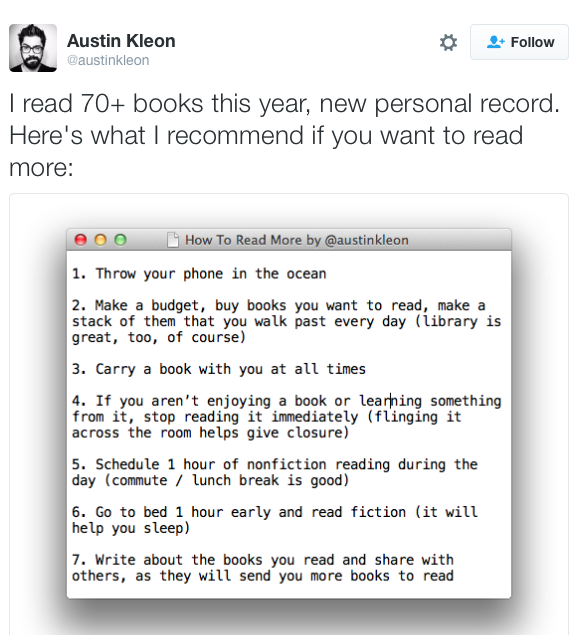
On Twitter, Austin Kleon, author of Steal Like an Artist: 10 Things Nobody Told You About Being Creativehas served up 7 tips for achieving the seemingly impossible–getting more books read in this age of constant distraction. The tips are simple and effective–effective enough to help Austin read 70+ books during a year, a new personal record.
No doubt, you have your own strategies for spending more time with books (and not just watching them pile up, unread, on your shelves. There’s a word for that in Japanese folks. It’s called “Tsundoku.”) If you care to share them, please put your best tips in the comments section below. We, and your fellow readers, thank you in advance.
Looking for free, professionally-read audio books from Audible.com? (Speaking of an easy way to spend more time with books.) Here’s a great, no-strings-attached deal. If you start a 30 day free trial with Audible.com, you can download two free audio books of your choice. Get more details on the offer here. Also note that Audibooks.com has a very similar offer that you can explore here.
We're hoping to rely on loyal readers, rather than erratic ads. Please click the Donate button and support Open Culture. You can use Paypal, Venmo, Patreon, even Crypto! We thank you!
Open Culture scours the web for the best educational media. We find the free courses and audio books you need, the language lessons & educational videos you want, and plenty of enlightenment in between.