You’ve perhaps heard the buzz around Dan Ariely’s new book, The Upside of Irrationality: The Unexpected Benefits of Defying Logic at Work and at Home. (If not, read this review in the NY Times.) Appearing at PopTech! last year, Ariely spent 20 minutes fleshing out an argument in his book. A professor of behavioral economics at Duke University, Ariely turns some basic assumptions about workplace compensation right on their head … and even explains why, in some strange way, it makes sense that highly compensated Wall Street bankers could do so much damage to our financial system.
I live in Silicon Valley where it’s easy to assume that you’re living at the center of technological innovation. But, as Sarah Lacy reminds us today in TechCrunch, Silicon Valley will probably not realize the promise of e‑learning. Rather, it will be investors and entrepreneurs in Brazil, India, South Africa and other emerging markets. Why will they get the job done? Because their educational systems haven’t fully matured. They’re still a work-in-progress. And this creates an environment much more favorable to innovation. You can get the rest of her thinking here.
Robert Shiller, who predicted the stock market crash earlier this decade and the bursting of the housing bubble in 2008, has a unique understanding of the financial markets and behavioral economics. In this free course provided by Yale University, Shiller demystifies the financial markets and explains “the theory of finance and its relation to the history, the strengths and imperfections of such institutions as banking, insurance, securities, futures, and other derivatives markets, and the future of these institutions over the next century.” It’s a course for our shaky financial times. The first lecture appears above, and the full course can be accessed on YouTube, iTunes and Yale’s web site. The course is also listed in our meta collection of Free Courses and our targeted selection of Free Economics Courses.
Peter Singer, an Australian-born philosopher who teaches at Princeton, created the animal rights movement back in the 1970s, and, more recently, launched a campaign to end world poverty. One can’t contemplate poverty without also considering greed, and that brings us to the clip above. Interviewed in 2009, Singer suggests that greed drives us biologically (as does social collaboration fortunately). Greed helps us survive and innovate. But there is also a point where it becomes pointless and pathological, and that’s what we have witnessed in the financial world. Greed brought us Bernie Madoff. But it has also brought us (my inferences) bankers who create a catastrophe one year and take record bonuses the next. And it has brought us to the point where our country has dangerously slipped off of its democratic moorings. Lloyd Blankfein, this clip is for you. Thanks Ted for sending this one along.
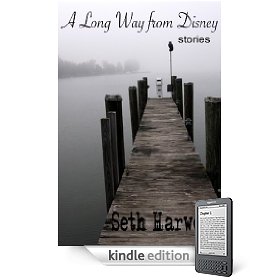
As some of you already know, back on December 27th, I released a sample of my first short story collection A Long Way from Disney on Amazon’s Kindle store and used social media strategies to market it. I did this for various reasons, but mainly because, as I’ve said here on OC before, I believe authors need to take on the role of scientists and experiment with what’s possible in today’s publishing world. (If you’re interested in how I publicized this, see my recent posts at AuthorBootCamp.com.)
From a scientific point of view, the experiment was a great success. I learned a great deal, which I’ll discuss below. I sold a lot of books (at $.99 each)–around 350 in the first week–and I got my name and stories in front of a lot of new people. I also heard from a number of them who read the book right away and really loved it! For you authors out there, I hope you can relate: Getting positive feedback on your work from total strangers is about the best feedback there is.
[For those of you keeping score at home, those sales put $260 into Amazon’s pocket and $140 into mine. Not too shabby, I think, but also not the split an author might hope for.]
Okay, without any further delay: Here are the Results (what I’ve learned) from Experiment 1:
1) Timing can be essential. I positioned myself to hit the Kindle store just after Xmas, thinking that with many newly gifted Kindles out there, a lot more Kindle ebooks would be selling and that I could cash in on this rush. I was correct in this prediction (Amazon sold more ebooks than paper copies over Christmas), but what I didn’t predict was how much harder this made it to reach the Top 100 Kindle bestseller list, a goal I had set for myself. I wanted to hit the Top 100 because it would give the book additional exposure and stimulate more buying from newbie Kindle owners looking for quick, cheap content. (more…)
What if people behaved like banks? Or, more precisely, what if individuals holding “underwater” mortgages stopped following the social norms of ‘personal responsibility’ and ‘promise-keeping’ and instead acted like capitalist players in a free market? Most would dump their sinking mortgages and walk away. That’s the finding of Brent White, a law professor at the University of Arizona, who has published a new paper called “Underwater and Not Walking Away: Shame, Fear and the Social Management of the Housing Crisis.” (PDF) The bottom line is that homeowners and banks play by two different sets of rules. Main Street accepts the “emotional constraints … actively cultivated by the government, the financial industry,” and they hold the bag. Wall Street acts in its own self interest and gets a fresh start. The only thing they have in common these days are (you guessed it) guns.
Just for the record: I’m not advocating a position here, and I don’t hold an underwater mortgage…
When the global financial system collapsed last year, This American Life and its sister program, Planet Money (iTunes — RSS Feed — Web Site) began doing something that few others could pull off. They took very complex problems and made them understandable, often demystifying difficult concepts in a reliably engaging way. Now, they’re at it again. This time, they’re breaking down the American healthcare system and getting at the core question. Why can’t we control ever-rising healthcare costs? That’s what the raging healthcare debate is effectively all about. And, if you want to be an informed participant in the debate, it’s worth listening to these two episodes that tease things out. The first episode, called More is Less, looks at doctors, patients, insurance companies and their tangled relationship. (Click here, then scroll down and find the “Full Episode” icon.) The second episode, Someone Else’s Money, gets you inside the world of drug and insurance companies and patients. Have a listen, and thanks to Bob in Brooklyn for the tip here.
We're hoping to rely on loyal readers, rather than erratic ads. Please click the Donate button and support Open Culture. You can use Paypal, Venmo, Patreon, even Crypto! We thank you!
Open Culture scours the web for the best educational media. We find the free courses and audio books you need, the language lessons & educational videos you want, and plenty of enlightenment in between.