NPR’s Planet Money podcast has done an excellent job of tracking the ongoing global financial crisis. In its latest installment (Stream — iTunes — Rss Feed), they get down to an important question: Does history offer solutions to the current crisis? And if so, does it make sense to look back at the Depression of the 1930s? Or does 1990s Japan offer a better example?
One of Planet Money’s guests, economist Adam Posen, argues that we should keep our eyes on Japan. During the 1980s, Japanese banks and investors exploited loose mortgage lending and generated a substantial real estate bubble, which popped in the early 90s once Japan’s government started tightening credit. From there, all other assets and markets fell apart, and a long recession began. Sound familiar?
For Posen, the actions of the Japanese government help illustrate which anti-recession policies worked, and which didn’t. The upshot is that Japan’s crisis could have been limited to three years. But it went on for a decade instead. And that’s because Japan never passed a major stimulus package until the very end, and because the government never forced the banks to change their practices. This all suggests that American policy can make a difference. The Obama administration has a big stimulus package coming. But will it get the banks under control? I’m less than sanguine about that, and it could make the difference between a short, sharp recession and another lost decade.
PS The conversation mentioned above starts about 3 and 1/2 minutes into the podcast.
 Jared Diamond became a household name with his Pulitzer Prize-winning book Guns, Germs & Steel (2003). Later, the UCLA geographer climbed the charts again with Collapse: How Societies Choose to Fail or Succeed (2005). Now, based on this last book, he’s putting odds on whether the United States will survive this crisis, and he’s putting them only at 51–49. Not too great. And he goes on to say that our best chance of surviving is if America’s wealthy elite suffers far more than it already has. For more, listen here.
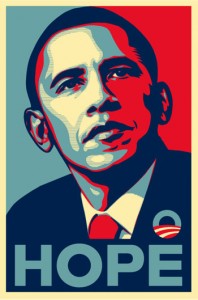 By now, everyone knows the famous Obama “Hope” poster produced by Shepard Fairey. Recently, Fairey has acknowledged that the poster was originally inspired by a photograph belonging to the AP Press, and now the AP is claiming that Fairey has infringed on its copyright and wants “payment for the use of the photo and a portion of any money he makes from it.” (see article in
 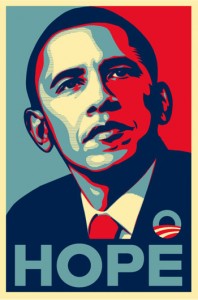 The story behind the artwork that defined the Obama campaign is a fascinating one. Shepard Fairey’s posters achieved prominence much in the same way that Obama did. They rose from the ground up. Everyday people supported and promoted his imaginative posters on the web, until they became something of a public phenomenon. And they turned the status quo — in this case, the tradition political poster — into something fresh and new. In this interview (



