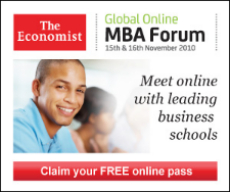
The Economist Presents the Global Online MBA Forum

This com­ing Mon­day and Tues­day (Novem­ber 15 & 16), The Econ­o­mist will host a free online MBA fair, giv­ing busi­ness school can­di­dates the chance to chat with admis­sions offi­cers and cur­rent stu­dents from over 20 inter­na­tion­al b‑schools. Schools par­tic­i­pat­ing in the online forum include Bran­deis, Cor­nell, Pep­per­dine, Queens Uni­ver­si­ty, the Uni­ver­si­ty of Toron­to, and the Copen­hagen Busi­ness School, just to name a few. The two-day event is free and open to the pub­lic. Once par­tic­i­pants reg­is­ter, they will find videos and pod­casts on press­ing MBA ques­tions, and also join chat ses­sions about MBA net­work­ing, career ser­vices, and inter­na­tion­al cur­ricu­lum choic­es. You can reg­is­ter for The Econ­o­mist Glob­al MBA Forum right here (or sim­ply click on the image above), and then get start­ed with the forum itself right here on Mon­day.

by | Permalink | Make a Comment ( 2 ) |

Introduction to Computer Science & Programming: Free Courses

Nowa­days, any well-round­ed stu­dent must learn to mas­ter read­ing, writ­ing and math. And then add some­thing new to the mix: learn­ing to code. If you did­n’t learn to pro­gram soft­ware in school, not to wor­ry. Free mate­ri­als abound on the web, and we have made them easy to find. Above, you can start watch­ing the first lec­ture of an MIT course (Intro­duc­tion to Com­put­er Sci­ence and Pro­gram­ming) that assumes no spe­cial knowl­edge of pro­gram­ming, and it sets out to teach you to think like a com­put­er sci­en­tist. (Find the full set of lec­tures on YouTube, iTunes and MIT’s web­site.) Or alter­na­tive­ly, you can spend time with anoth­er course – Inten­sive Intro­duc­tion to Com­put­er Sci­ence Using C, PHP, and JavaScript – taught by David Malan at Har­vard Exten­sion. (Get it in mul­ti­ple for­mats here.) And then don’t for­get that Stan­ford Uni­ver­si­ty offers sev­er­al intro­duc­to­ry cours­es, all found under the Stan­ford Engi­neer­ing Every­where umbrel­la.

Once you have a good foun­da­tion in place, you can move in a vari­ety of direc­tions. With­in our col­lec­tion of Free Online Cours­es, we have list­ed 27 com­put­er sci­ence cours­es where you can learn all about oper­at­ing sys­tems, com­put­er graph­ics, arti­fi­cial intel­li­gence, build­ing web sites, design­ing iPhone apps and beyond. The cours­es are all free. They’re avail­able 24/7 on the web. You can get going any time…

Relat­ed Con­tent:

Take Stan­ford Com­put­er Sci­ence Cours­es This Fall: Free World­wide

by | Permalink | Make a Comment ( 12 ) |

So You Want to Get a PhD in the Humanities?

So if you want the full case against get­ting a PhD in the human­i­ties, here you go. Every argu­ment the dis­il­lu­sioned aca­d­e­m­ic can pos­si­bly make now packed into one semi-com­ic video. If you’re in the human­i­ties, the litany of com­plaints, whether fair or not, will hard­ly be unfa­mil­iar to you.

Now on a more seri­ous note … Towards the end, the video ref­er­ences SUNY Albany’s recent deci­sion to shut­ter its French, Ital­ian, clas­sics, Russ­ian and the­ater pro­grams. That event that trig­gered a much-dis­cussed series of arti­cles by Stan­ley Fish in The New York Times. If you’re look­ing for some­thing that oper­ates on a slight­ly high­er intel­lec­tu­al plane, you might want to spend some time with “The Cri­sis of the Human­i­ties Offi­cial­ly Arrives: Part 1 and Part 2.” Also don’t miss some of the read­er com­ments. They bring a lot to the dis­cus­sion. Thanks Jason for send­ing our way…

Relat­ed Con­tent:

The Illus­trat­ed Guide to the PhD

by | Permalink | Make a Comment ( 7 ) |

Sir Ken Robinson: A Creative Education

Do schools kill cre­ativ­i­ty? Sir Ken Robin­son asked that ques­tion at the 2006 TED con­fer­ence. And the talk res­onat­ed wide­ly. His short pre­sen­ta­tion remains one of the most watched and “favor­it­ed” videos in TED’s large cat­a­logue of inspir­ing videos. Quite an accom­plish­ment.

Now, with the lat­est RSA video, Sir Ken returns to delve deep­er into this basic ques­tion. He asks, Why do schools kill cre­ativ­i­ty? And why is this prob­lem built into the mod­ern edu­ca­tion­al sys­tem? And how can we bring a “par­a­digm” shift – one that will let schools fos­ter cre­ativ­i­ty at long last?

Run­ning 11 min­utes, the cre­ative­ly-ani­mat­ed video above (how fit­ting!) gives you some answers. But real­ize that the clip is an excerpt from a longer 52 minute lec­ture avail­able in its entire­ty here.

A quick PS: Wired UK recent­ly asked the big ques­tion: “What inno­va­tion would most improve edu­ca­tion in the next decade?” You will find suc­cinct answers by Ken Robin­son, Chris Ander­son (head of TED), yours tru­ly and sev­er­al oth­ers here.

by | Permalink | Make a Comment ( 1 ) |

Open Video, Open Knowledge

Read­ers of Open Cul­ture will appre­ci­ate how video has become, in many ways, our newest vernacular—growing in pop­u­lar­i­ty every day, and esti­mat­ed to reach 90 per­cent of world­wide web traf­fic by 2013. Yet so lit­tle of our mov­ing image her­itage is actu­al­ly online. As of Octo­ber 2010, just sin­gle per­cent­age points of the great col­lec­tions at the BBC Archive, ITN Source, Library of Con­gress, Nation­al Archives, etc., are actu­al­ly dig­i­tized and avail­able over the Inter­net! A new short film out this week from the UK’s JISC Film & Sound Think Tank makes the point with clar­i­ty. (Watch here or above.)

What if it were pos­si­ble to enjoy the world’s largest and most pop­u­lar infor­ma­tion com­mons and enable it with down­load­able video–video of great qual­i­ty, whose orig­i­na­tors, own­ers, and righthold­ers opened to reuse and remix by any­one for free?

Intel­li­gent Tele­vi­sion and iCom­mons have pro­duced a report–just out now–to help cul­tur­al and edu­ca­tion­al insti­tu­tions under­stand and appre­ci­ate the pos­si­bil­i­ties pre­sent­ed by open­ly licensed assets for Wikipedia and the open web. Video for Wikipedia: A Guide to Best Prac­tices for Cul­tur­al and Edu­ca­tion­al Insti­tu­tions describes how Wikipedia is now open­ing its doors to video, and how lead­ing insti­tu­tions can par­tic­i­pate in what is, in effect, the newest knowl­edge rev­o­lu­tion.

The issues are sit­u­at­ed, of course, with­in the larg­er con­text of build­ing a free and informed soci­ety. For uni­ver­si­ties, muse­ums, archives, and oth­ers, bring­ing video online from our cul­tur­al her­itage (and equip­ping stu­dents to use it) has become a new cul­tur­al imper­a­tive. Open video on Wikipedia is not sim­ply a call for free media frag­ments to be stored online. It augurs a new vision of teach­ing and learn­ing, and a new cre­ative and polit­i­cal dis­course. Every­one is invit­ed to par­tic­i­pate in this con­ver­sa­tion just get­ting under­way…

This post was con­tributed by Peter Kauf­man, the CEO and pres­i­dent ofIntel­li­gent Tele­vi­sion, who shares our pas­sion for thought­ful media.

Join the Legion of Creative Commons Superheroes!

Cre­ative Com­mons has kicked off its Legion of Super­heroes fundrais­ing cam­paign say­ing, “Imag­ine a world where knowl­edge flows freely and can be built upon with­out lim­its. Imag­ine a world where cul­ture, art and media are avail­able to every­one, sci­en­tif­ic con­tent is shared by cor­po­ra­tions and research insti­tu­tions, and shared intel­li­gence aug­ments human rights efforts across bor­ders.”

It’s not hard for us to imag­ine that world. We see it every day. Whether you know it or not, the enrich­ing video/audio fea­tured on Open Cul­ture is often released with a Cre­ative Com­mons license, which means that it can be shared freely across the globe. Our col­lec­tion of free online cours­es offers a good exam­ple. Some of the world’s finest uni­ver­si­ties release their cours­es with a CC license, allow­ing an inter­na­tion­al audi­ence to con­tin­ue learn­ing and grow­ing. And we just help get the word out.

Right now, Cre­ative Com­mons is work­ing to raise $550,000 by the end of the year to sup­port their work. I have includ­ed a lit­tle box below where you can make a con­tri­bu­tion of any size. Or you can head over to their site and do the same. If you would like to sup­port open­ness and inno­va­tion, please con­sid­er being a super­hero and giv­ing what you can.

Waiting for Superman (to Fix America’s Broken School System)

Davis Guggen­heim, the Acad­e­my Award-win­ning direc­tor of An Incon­ve­nient Truth, has issued a new clar­i­on call for our times: Wait­ing for Super­man, a new film that takes a hard look at Amer­i­ca’s fail­ing pub­lic edu­ca­tion sys­tem, the chil­dren it’s leav­ing behind, and the reform­ers try­ing to turn things around. Above, you can watch the offi­cial trail­er for the movie being released in select US the­aters. And, right now, if you pledge to pur­chase a tick­et, you can also direct a dona­tion to a class­room of your choice.

Some­where down the line (and ide­al­ly soon­er than lat­er), I hope that Guggen­heim and Para­mount Pic­tures will decide to make this film freely avail­able to the pub­lic. It always struck me that the film­mak­ers lim­it­ed the impact of An Incon­ve­nient Truth by keep­ing it behind a pay wall. Hope­ful­ly, this time, they will recoup their mon­ey and give the film the free­dom to spread an impor­tant mes­sage. There’s gen­er­al­ly not a moral imper­a­tive to make films free. But, in this case, it seems a lit­tle dif­fer­ent.

Note for edu­ca­tion blog­gers: The Huff­in­g­ton Post will be screen­ing the film nation­al­ly, and they invite you to attend. Get details here.

by | Permalink | Make a Comment ( 6 ) |

China’s Open Courses & Other Tech Dispatches from Asia

Back in 2003, the Chi­nese gov­ern­ment launched its answer to MIT’s Open­Course­Ware project. The “Nation­al Qual­i­ty Course Plan” scoured Chi­na’s vast uni­ver­si­ty sys­tem and select­ed 3,000 best-of-breed cours­es in var­i­ous sub­ject areas. Then, mil­lions of dol­lars were ear­marked to put lec­tures and relat­ed course mate­ri­als online, with the hope that oth­er pro­fes­sors could draw inspi­ra­tion from these resources. But, things did­n’t go so well. Appar­ent­ly rough­ly 50% of these mate­ri­als nev­er made their way online. And the mate­ri­als that did were rarely updat­ed. (More on that here.) Will the project get renewed? Jeff Young, a reporter for The Chron­i­cle of High­er Edu­ca­tion, went to Chi­na to find out. His report (read it here) is part of a month long series of dis­patch­es that takes you inside Asi­a’s wired class­rooms and high-tech research labs. You can read Jef­f’s dai­ly posts from Sin­ga­pore, Chi­na, South Korea, and India through­out this entire month.

Update: One of our read­ers wrote a the­sis on Chi­na’s open­course­ware ini­tia­tive and offers much more detail on what went right, and what went wrong. You can down­load Stian HĂĄk­lev’s the­sis (for free) here, and be sure to check out Stian’s oth­er brain­child, Peer2Peer Uni­ver­si­ty, oth­er­wise known more sim­ply as P2PU.

by | Permalink | Make a Comment ( 1 ) |

« Go BackMore in this category... »
Quantcast