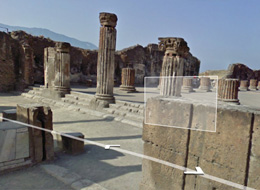
Visit Pompeii (also Stonehenge & Versailles) with Google Street View

pompeiigoogleThe sto­ry of Pom­peii is well known. Back in 79 AD, Mount Vesu­vius erupt­ed and cov­ered the neigh­bor­ing Roman city with 60 feet of ash over the course of two days. The city was wiped out and then entombed for cen­turies, until archae­ol­o­gists start­ed unearthing the ruins in the 18th and 19th cen­turies, offer­ing the mod­ern world an amaz­ing win­dow into the fin­er details of ancient Roman life. (Just for the record, dig­ging con­tin­ues there today, and I even got to do some this past sum­mer.) Today, Google is help­ing deep­en the mod­ern con­nec­tion to the ancient world. Using Google Street view, you can tour Pom­peii in 3D from the com­fort of your own home. To begin walk­ing through the ancient city, just click here.

As a side note, this isn’t the first time Google has used Street View in such a way. You can also find tours of Stone­henge and Louis XIV’s Ver­sailles. Plus, you can also use Google Earth, anoth­er Google pro­gram, to tour the ancient city of Rome.

Final­ly, to dig deep­er into ancient his­to­ry, I’d rec­om­mend look­ing through our pre­vi­ous post, Learn­ing Ancient His­to­ry for Free. This will point you to some of the best free cours­es avail­able on the web.

via Mash­able and the Nation­al Post

Google Puts Supreme Court Opinions Online

A quick fyi: Start­ing today, you can find online legal opin­ions from the Supreme Court, as well as fed­er­al and state courts, thanks to Google Schol­ar. When you vis­it Google Schol­ar, click on the â€śLegal opin­ions and jour­nals” radio but­ton, and then begin your query. If you type â€śsep­a­rate but equal,” Schol­ar with present you with famous Supreme Court Cas­es such as Plessy v. Fer­gu­son and Brown v. Board of Edu­ca­tion. You get the gist. You can read more about this online legal data­base over at Google’s blog.

UPDATE/NOTE FROM READER: “This has already been done for the US Supreme Court, and very well, at oyez.org.  Oyez is easy to use, has lots of addi­tion­al con­tent, includ­ing sum­maries and audio of oral argu­ments, and is ad-free and Cre­ative Com­mons licensed for its orig­i­nal con­tent.  Plus, you can search by court term, Jus­tice, and the name of the legal coun­sel.” An alter­na­tive source to look at…

by | Permalink | Make a Comment ( 2 ) |

US Justice Department Looks to Restructure Google Books Settlement

The US Jus­tice Depart­ment offi­cial­ly weighed in today on the Google Books set­tle­ment with pub­lish­ers and authors. On the plus side for Google, the gov­ern­ment wants to see the project con­tin­ue because it has clear social ben­e­fits. On the down­side, the DOJ has con­cerns about antitrust and copy­right issues, and it’s look­ing for the deal to get restruc­tured. You can get more details in The Wall Street Jour­nal. It’s late. I’m out.

Relat­ed Con­tent:

The Google Book Down­loader

Google Book Search: A Dis­as­ter for Schol­ars?

The Google Book Downloader

A quick heads up: Life­hack­er is high­light­ing today some new soft­ware (Win­dows only) that will let you down­load free access/public domain texts from Google Book Search and then turn them into neat PDF files. To get tips on how to use the soft­ware cre­at­ed by a third par­ty, not Google, head on over to Life­hack­er. I haven’t per­son­al­ly used the Down­loader, main­ly because I work on a Mac. If you try it out, let us know how the soft­ware works for you.

Google Book Search: A Disaster for Scholars?

Crit­ics of Google Book Search (and its class-action set­tle­ment with pub­lish­ers) are pop­ping up every­where. Euro­pean gov­ern­ments have voiced their dis­plea­sure. The US Jus­tice Depart­ment has placed the set­tle­ment under review. Ama­zon is protest­ing. Yahoo and Microsoft have piled on too. And now you can add aca­d­e­mics to the list. Writ­ing in The Chron­i­cle of High­er Edu­ca­tion, Geof­frey Nun­berg, a promi­nent UC Berke­ley lin­guist (who also often appears on NPR), won­ders what will hap­pen to schol­ar­ship if Google Book Search becomes the world’s largest dig­i­tal library (some­thing the class action set­tle­ment would vir­tu­al­ly guar­an­tee). The prob­lem comes down to this:  The aver­age per­son will be able to “google” the dig­i­tal library (“When was the Fran­co-Pruss­ian War?”) and find use­ful infor­ma­tion. But schol­ars will run into prob­lems when they try to ask more fine­ly tuned ques­tions. (“When did the word hap­pi­ness start to replace the word felic­i­ty in the Eng­lish lan­guage?) And that’s because Google’s meta­da­ta is a “train wreck: a mish­mash wrapped in a mud­dle wrapped in a mess.” For exam­ple, accord­ing to Nun­berg, Google meta­da­ta says that all of the fol­low­ing texts were pub­lished in 1899. Ray­mond Chan­dler’s Killer in the RainThe Portable Dorothy Park­er, AndrĂ© Mal­raux’s La Con­di­tion Humaine, Stephen King’s Chris­tineThe Com­plete Short­er Fic­tion of Vir­ginia Woolf, Ray­mond Williams’s Cul­ture and Soci­ety 1780–1950, and Robert Shel­ton’s biog­ra­phy of Bob Dylan. And it dates Tom Wolfe’s Bon­fire of the Van­i­ties back to 1888. You don’t real­ly need to be an aca­d­e­m­ic to get the gist. Google has some kinks to work out, espe­cial­ly if it’s going to be the only major online library in town. For more, you can read Nun­berg’s longer piece here.

Touring Mars with Google Earth

Google Earth has some­what out­grown its name. These days, Google’s satel­lite pro­gram (down­load it here) gives you more than a unique view of our plan­et Earth. It also offers a nice tour of Mars (and the Moon). The Mars tour is guid­ed by a famil­iar voice — the voice of Ira Fla­tow, who hosts the well known NPR pro­gram, Talk Of The Nation: Sci­ence Fri­day. The video below will show you how to access the tour in a quick two min­utes. In the mean­time, you should also note that Google Earth hosts oth­er edu­ca­tion­al con­tent. In the past, we’ve men­tioned how the pro­gram will let you tour the Pra­do Art col­lec­tion in Spain, and also see Ancient Rome in 3D. But that’s not where the edu­ca­tion­al con­tent ends. For more, please vis­it this sum­ma­ry page assem­bled by Google.

Launch the pro­gram, and then tog­gle on the Uranus icon on the top nav bar. Then

Open Books from Google

New from the Google Books Blog:

Try doing a search for [Ham­let] on Google Books. The first few results you’ll get are “Full View” books — which means you can read the full text. And, because the book is in the pub­lic domain, you can also down­load a copy of Ham­let in PDF form.

Start­ing today, you’ll be able to down­load these and over one mil­lion pub­lic domain books from Google Books in an addi­tion­al for­mat. We’re excit­ed to now offer down­loads in EPUB for­mat, a free and open indus­try stan­dard for elec­tron­ic books. It’s sup­port­ed by a wide vari­ety of appli­ca­tions, so once you down­load a book, you’ll be able to read it on any device or through any read­ing appli­ca­tion that sup­ports the for­mat. That means that peo­ple will be able to access pub­lic domain works that we’ve dig­i­tized from libraries around the world in more ways, includ­ing some that haven’t even been built or imag­ined yet.

The post con­tin­ues here.

Google Knol Prediction Revisited

Back in Decem­ber 2007, I made a bet against Google Knol, the search giant’s answer to Wikipedia. In a fair­ly involved piece, I list­ed three rea­sons why Knol would­n’t upend Wikipedia. Now fast for­ward 18+ months: Tech Crunch has report­ed that Knol’s traf­fic is trend­ing down. It peaked in Feb­ru­ary at around 320,000 vis­i­tors per month, accord­ing to Quant­cast esti­mates. Now it’s at around 174,000. (See the graph here.) The bot­tom line? You can’t win at every­thing. But for­tu­nate­ly there’s some good new things com­ing out of Google, and we’ll be men­tion­ing them in the com­ing days.

PS In case you did­n’t hear, Wikipedia is start­ing to put edi­to­r­i­al restric­tions on cer­tain entries. The lais­sez-faire days are com­ing to an end.

by | Permalink | Make a Comment ( 2 ) |

« Go BackMore in this category... »
Quantcast

