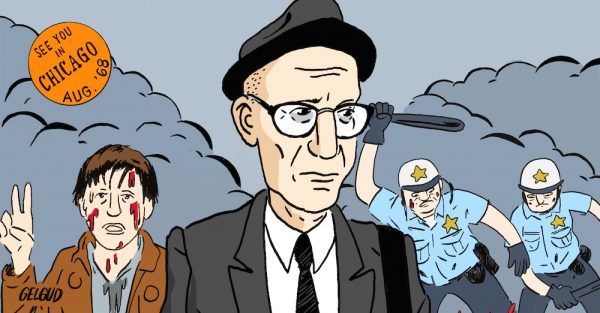
Drawing of William S. Burroughs by Nathan Gelgud/The Paris Review
America’s political circus will soon roll through Cleveland and then Philadelphia–the sites of the Republican and Democratic National Conventions. And, not without some merit, there’s concern that the carnivals could turn violent, as happened in 1968, when Chicago’s mayor Richard Daley, backed by 23,000 police and National Guardsmen, assaulted protesters in the streets. A federal report later called it a display of “unrestrained and indiscriminate police violence.”
This week, that tumultuous ’68 convention is being commemorated in a comic over at The Paris Review. Issued in daily installments by illustrator Nathan Gelgud, the comic–simply titled “Unconventional”–looks at the writers, artists, and demonstrators who attended the convention.Part 1 features poet, singer, activist Ed Sanders. Part 2 puts Jean Genet center stage (who knew he was there?). Part 3 focuses on Norman Mailer, who was always ready for a fight. Part 4 gives us the inimitable William S. Burroughs, and Part 5, Terry Southern. You can follow the series here.
If you would like to support the mission of Open Culture, consider making a donation to our site. It’s hard to rely 100% on ads, and your contributions will help us continue providing the best free cultural and educational materials to learners everywhere. You can contribute through PayPal, Patreon, and Venmo (@openculture). Thanks!
When you learn that Soviet music-lovers bootleged Western rock, pop, jazz, and more on the surfaces of discarded x‑ray plates, you can’t help but want to learn a bit about it. We posted about that curious Cold War phenomenon back in 2014, but much more material on this culture of “bone music” has emerged in the years since, including Stephen Coates and Paul Heartfield’s book X‑Ray Audio: The Strange Story of Soviet Music on the Bone. They also put together the fourteen-minute companion documentary above, featuring conversations with some of the actual participants in this forbidden musical scene which lasted roughly from the late 1940s to the mid-1960s, when tape recorders came around and the censors loosened up.
“This is a truly fascinating subject that seems to captivate people by combining pain and suffering reflected in the X‑rays with the pleasure of listening to music,” writes filmmaker and photographer Michael Dzierza, who produced the short video above on Coates and Hartfield’s work with x‑ray audio in which they discuss the origins of their fascination with this illicit medium and how that fascination turned into a subject for a long-term multimedia research project.
The world of bone music also became the highly suitable subject for an episode of Fugitive Waves, the podcast by radio producers the Kitchen Sisters on “lost recordings and shards of sound, along with new tales from remarkable people around the world — people with a mission, a purpose, a story to tell”:
The Soviets who made it possible for their fellow citizens to enjoy the sounds they craved — whether music forbidden for its foreign origin or music performed by musicians hailing from U.S.S.R. countries but deemed insufficiently loyal to the regime — certainly had a mission, purpose, and story to tell, and their efforts have left as cultural artifacts some of the more fascinating lost recordings and shards of sound in recent history. Now that almost everyone in the developed world takes for granted their 21st-century ability to share high-fidelity music more or less instantly, it can restore a measure of gratitude to learn more about these medical records turned musical records, passed in dark alleys between one trenchcoat to another under the ever-present threat of imprisonment. The vinyl revival has happened; could an x‑ray audio revival be on its way?
“What really matters is what you like, not what you are like,” says the narrator of Nick Hornby’s High Fidelity. “It’s no good pretending that any relationship has a future if your record collections disagree violently.” That master English social novelist of the late 20th century made a point with which Jane Austen, the master English social novelist in the early 19th century, may well have agreed. Hornby, like his character, loves and collects music, even into this 21st century when the very definition of a music collection has expanded into unrecognizability. Jane Austen did as well, though collecting music in her day meant something else again: collecting sheet music.
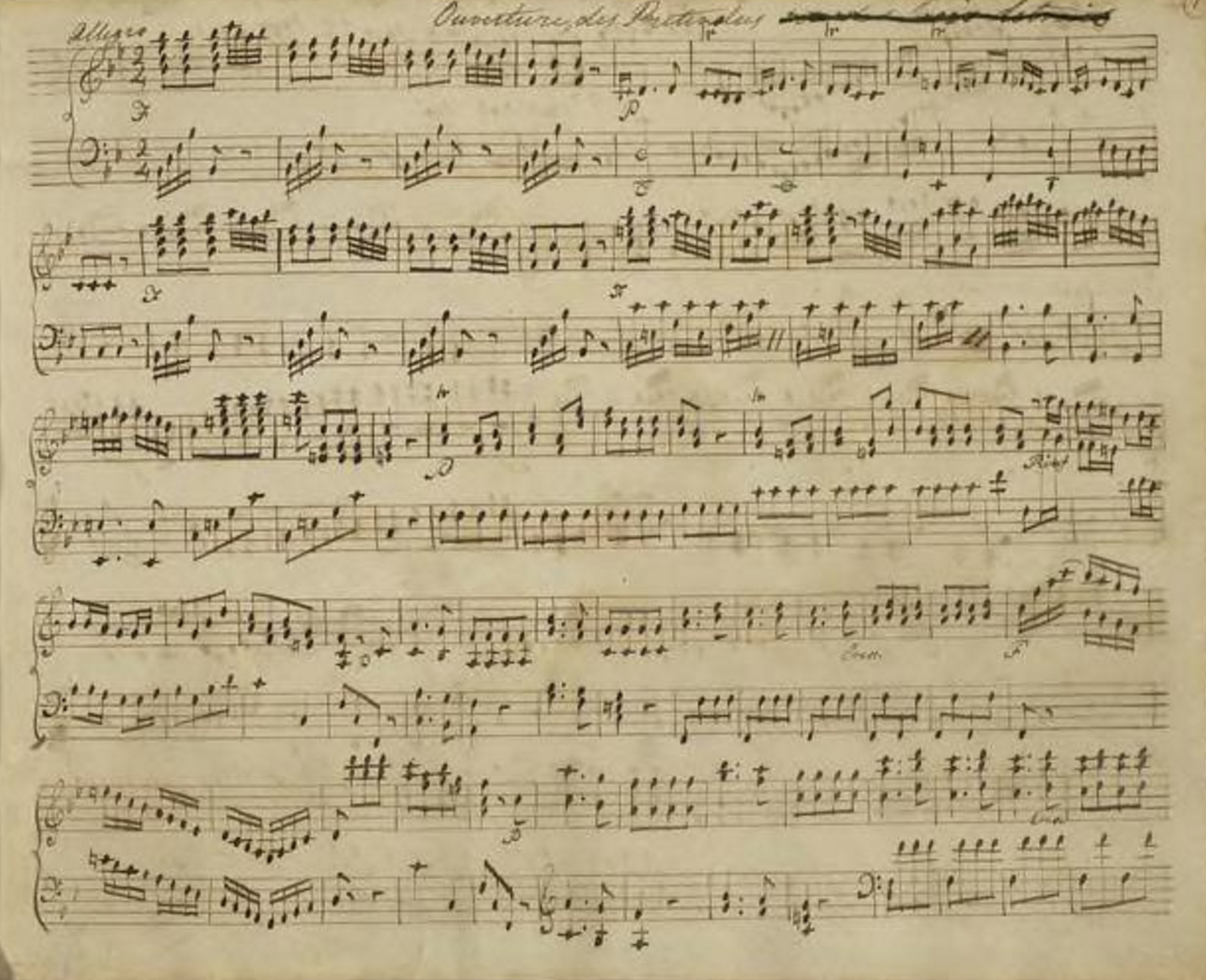
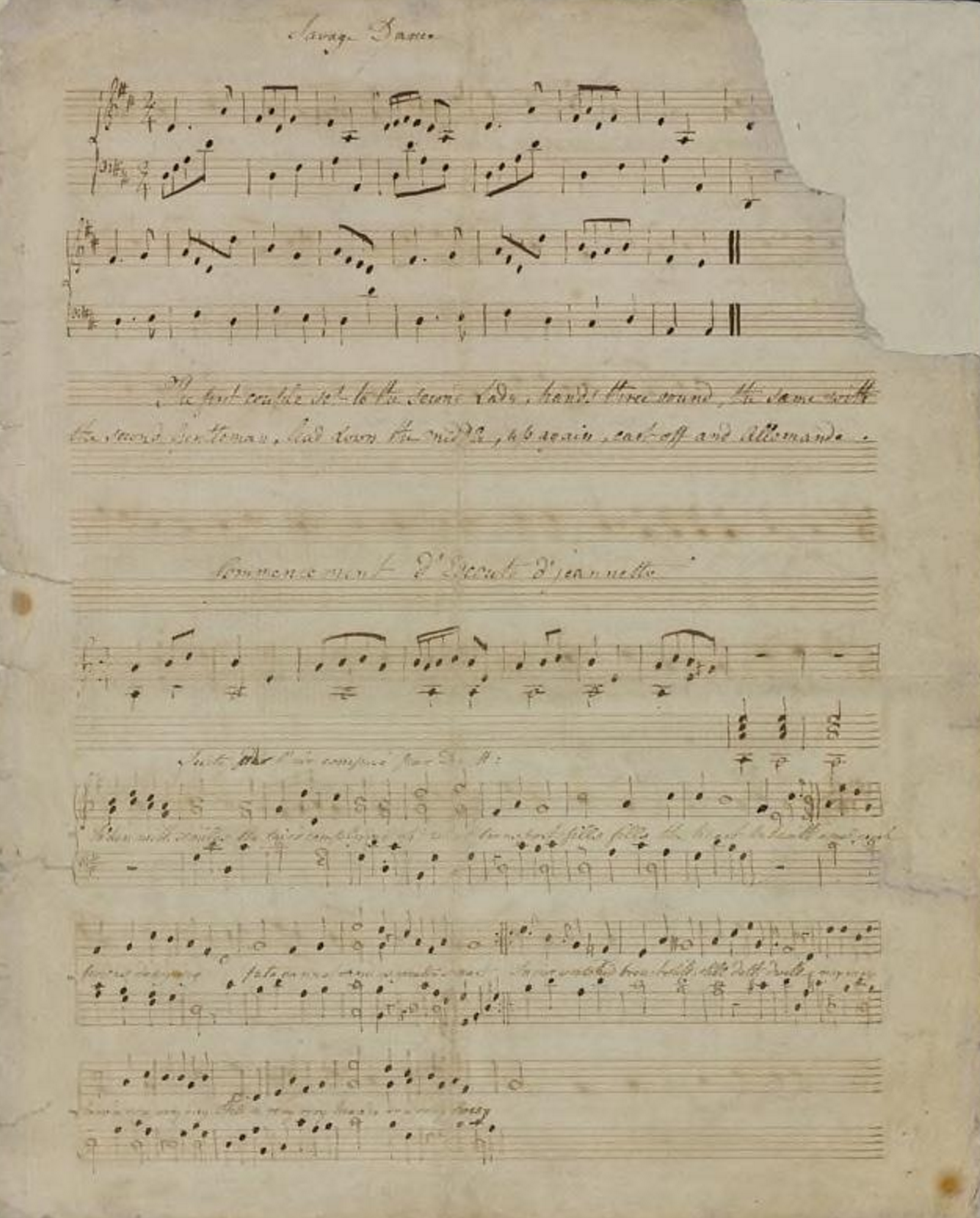
“The Pride and Prejudice author, who also played piano and sang, copied music by hand into personal albums and collected sheet music,” says the BBC about Austen’s personal music collection, part of the Austen family music library now digitized by the University of Southampton’s Hartley Library and made available at the Internet Archive. The article quotes project leader and professor of music Jeanice Brooks as saying these 18 albums of music (the bound kind, not the kind over which High Fidelity’s London thirtysomethings obsess) could not just help explain the “musical environment that fed the novelist’s imagination” and led to novels “full of musical scenes,” but provide a “unique glimpse of the musical life of an extended gentry family in the years around 1800.”
If, as a university spokesman says, a 19th-century sheet music collection reflects the personality of its owner “just as a digital music collection on a mobile phone or MP3 device would today,” what does Jane Austen’s say about her? The items in the collection identified as belonging to Austen herself include one volume containing “two songs from Dalayrac’s Les deux Savoyards, one song, and the ‘Savage Dance,’ ” another containing “Juvenile Songs & Lessons” for “for young beginners who don’t know enough to practise,” and another, according to the BBC, containing “the traditional Welsh song Nos Galan, better known today as Christmas song ‘Deck the Halls.’ ”
Not quite a does-she-like-the-Beatles-or-does-she-like-the-Stones situation, certainly. But Internet Archive allows you to flip at your leisure through these albums, all of them once kept in the Austen family home and some or all once handled by Austen herself, which ought to provide a satisfaction for many of the countless fans always seeking to get a little closer to the writer whose books they’ve read and reread so enjoyably. Some of them have no doubt drawn the inspiration from her work to start writing themselves, composing stories in her style. Those who go so far as to copy out pieces of her beloved prose in their own hand, can now try not just writing the words she wrote, but playing the notes she played as well.
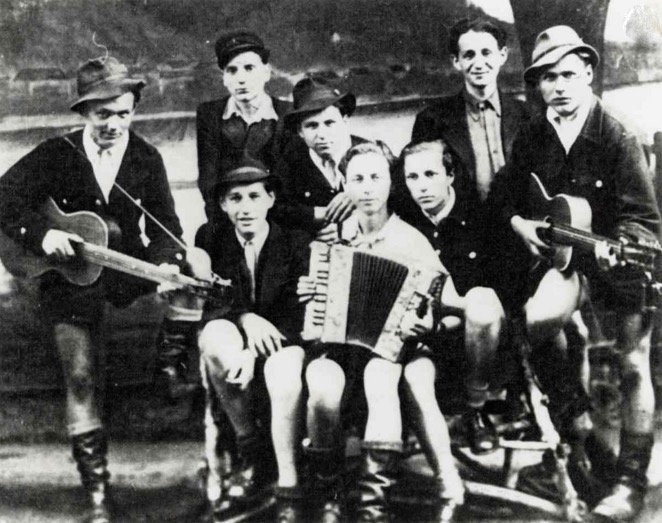
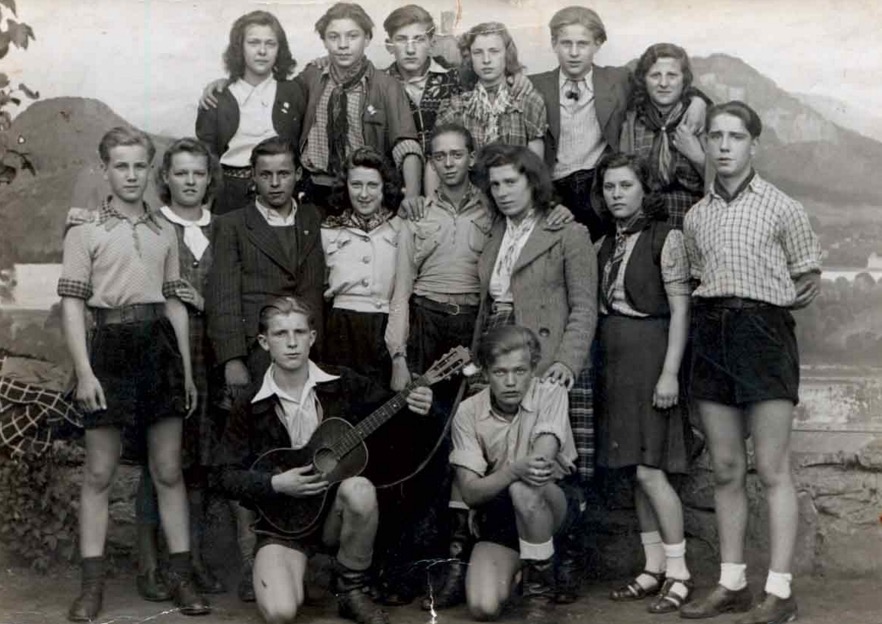
Nearly every Western youth subculture in existence eventually gets its own Hollywood film. Like most such films, 1993’s Swing Kids—which tells the story of jazz-loving German youth during the rise of the Third Reich—managed to be both inaccurate and critically reviled. Roger Ebert hated the film’s celebration of “a very small footnote to a very large historical event,” and compared the Swing Kids to “Nero, who fiddled while Rome burned.” Ebert’s reaction is uncharacteristic of him; he writes critically of the film, but he also seemed to find its subject—the kids themselves—repellant.
The review prompts us to ask: Were these kids—dubbed Swingjugend by the Nazis—participating in a revolutionary act of cultural resistance, or were they no more than typical, naive teenagers who preferred to “listen to big bands than enlist in the military”? (After all, writes Ebert, “who wouldn’t?”) But the question about the Swing Kids’ political motivations may be less relevant than one about whether their pursuit of a carefree, jazz-scored lifestyle under Nazism constitutes a “small footnote” in history. Should we know and care about the Swing Kids, and if so, why?
A German site called Swingstyle compiles information about the subculture and admits that “the real Swing Kids were politically unsophisticated.” Despite being seen as a “youth problem” by Nazi authorities, they “actually cared little for contesting official policies toward Jews or other matters. They just wanted to have fun at a dark time in their country’s history, and avoid the war if possible.” Or, rather, most of them wanted to avoid joining the Hitler Youth, mandated for all young people in 1939: “We must remember the age of most swing kids was between 12 and 16 or 17.”
But as you can see in the short documentary clip at the top, the Swing Kids’ resistance to the by-now familiarly disturbing, paramilitary regimentation of German young people (see above), was in its way a radical act. “Their casual, fun-loving attitude made a mockery of Nazi control,” the documentary narrator says. They embraced what was “considered ‘degenerate music’ by Nazi ideology,” writes MessyNChic, “because it was often performed by black and Jewish musicians and promoted free love.”
We cannot assume the Swing Kids’ love of the music extended to a love for the people who made it. It’s more so the case that the Swing Kids “admired the British and American way of life,” and the free-spiritedness universally represented at the time by jazz in American and British films and records, to which German youth had some limited access. But in their battle for “self-determination and freedom,” informal groups like the Edelweiss Pirates, the Traveling Dudes, and the Navajos resisted subordination into a homogenized Aryan mass—the mechanism by which Hitler turned ordinary Germans into loyal abettors of mass murder.
Through fashion and music, the Swing Kid clubs—like the rockers or punks of the U.S. and U.K. in later decades—formed in conscious resistance to social and political conformity. The Navajos wrote the following song, for example:
Hitler’s dictates make us small, we’re yet bound in chains. But one day we’ll again walk tall, no chain can us restrain. For hard are our fists, Yes! And knives at our wrists, for youth to be free, Navajos lay siege.
The references to violence weren’t purely symbolic. Swing Kid gangs fought Hitler Youth in the streets. Some Swing Kids, writes MessyNChic, became known for “tagging public walls with anti-Nazi slogans like ‘Down with Hitler!’ and ‘Medals for Murder!’. Throwing bricks through windows and sabotaging cars of Nazi officials… raiding military bases… derailing trains… even planning to blow up the Gestapo HQ in Cologne.” And as the educational site Music and the Holocaust documents, the Gestapo fought back “with special cruelty” against Swing Boys and Swing Girls.
In Hamburg, Swing Kids “had to endure discriminating interrogations, torture and detention.” They landed in youth concentration camps, and adult and Jewish “swing members… were deported” to death camps in Bergen-Belson, Buchenwald, Auschwitz, and elsewhere. MessyNChic claims that “a file compiled by the Gestapo is said to have contained more than 3,000 names [of Swing Kids] already by the end of the 1930’s in Cologne alone. In terms of numbers, that would mean these youths represented a much larger resistance potential than any other opposition group in Germany made up by adults.”
Again, none of this organized resistance constituted an explicit political program. “The Swing Kids themselves never intended to have any political effects,” writes Swingstyle, “they did not understand politics” and “they turned their backs on the reality around them: the Jewish roundups, the death camps and the steady stream of manpower reserves disappearing into the cauldrons of Russia and France.” Swing was a means of escapism and identification with the more relaxed, permissive “paradises” of America and Britain.
Like teenagers living under any regime, Swing Kids were mainly motivated by sex and the search for a good time. But perhaps the anarchic strength of their most primal instincts made these young people some of the most effective resistance fighters against the Nazi obsession with purity and order. Their lives—choreographed to the tunes of Count Basie and Benny Goodman—were “in complete opposition to the perceived National Socialist concept of youth,” concludes Swingstyle: “To the extent that the Swing Kids assumed American ideals of personal freedom, relaxed living, and appreciation of the ‘lower races’… they were a grave threat to the upside-down philosophy of Nazism that sought to insulate Germany from the rest of the world.”
Their embrace of an international, racially-mixed culture—jazz—was itself a radical political act in Nazi Germany, even if they had no theoretical concepts of what that embrace meant for the future of their country. And their violent rejection of the Hitler Youth makes them even more compelling. It seems to me that the Swing Kids do indeed deserve a celebratory place in history—and maybe they deserve a better film as well.
Elie Wiesel not only survived the Holocaust but went on to live a full life with a prolific career, the fruits of which included 57 books, most famously 1960’s Night, a short and formally distinctive work drawn from his experience in the concentration camps. “The only role I sought was that of witness,” he wrote in 1978. “I believed that having survived by chance, I was duty-bound to give meaning to my survival, to justify each moment of my life.” And even before his death this past Saturday at age 87, the Nobel Peace Prize winner had learned much about what it means to come to life’s end.
“The body is not eternal, but the idea of the soul is,” Wiesel writes in Open Heart, the 2012 memoir he wrote after undergoing another brush with death, late in life, which necessitated emergency open-heart surgery. “The brain will be buried, but memory will survive it.” Oprah Winfrey reads those words back to him in an interview from that same year, a clip from which you can see above. “Now that you’ve had all this time to think about it,” she asks, “what do you think happens when we die?”
“Somehow,” he replies, “I will become a child. Childhood, for me, is a theme in all my work. Will I meet my parents again? I want to know that.” Winfrey expresses special interest in the visions of his own family he had in the hospital, such as that of his father who had died at Buchenwald, just weeks before the camp’s liberation, and the sight of whose face he had previously glimpsed, just for a moment, during his Nobel award ceremony in 1986. His father’s second posthumous appearance made him think death might not be so bad after all, but “that is the danger. You feel it’s so good to be with the dead, then why not join them?”
But Wiesel, who had done so much already, felt he “had more and more things to do. I haven’t even begun.” Indeed, continuing in his capacity as the “Conscience of the World,” he received four more awards and honors between 2012 and 2014, made many appearances, and surely wrote pages that will see publication in the years, or even decades, to come. But for all his accomplishments, he himself found nothing more unusual, as he said to Winfrey in a previous talk sixteen years ago, than his own normality, “that I survived the Holocaust and went on to love beautiful girls, to talk, to write, to have toast and tea and live my life — that is what is abnormal.”
If you aren’t seriously disturbed, even alarmed, that we in the U.S. have a presidential candidate from a major political party who succeeds by whipping up xenophobic fervor and telling us the country must not only reinstitute torture, but must do “the unthinkable”… well…. I don’t really know what to say to you. Perhaps more symptom than cause of a global turn toward tribal hatred, the GOP candidate has lent his name to a phenomenon characterized by cultish devotion to an authoritarian strongman, serial falsehood, and easy, uncritical scapegoating. We needn’t look far back in time to see the historical analogues, whether in the early 20th century, at the end of the 19th, or during any number of historical moments before and after.
We also needn’t look very far back to find a history of resistance to authoritarian bigotry, and not only from Civil Rights campaigners and leftists, but also, as you can see above, from the U.S. War Department. In 1947, the Department released the short propaganda film, “Don’t Be a Sucker!”, aimed at middle-class American Joes. Shot at Warner Studios, the film opens with some typical noirish crime scenarios, complete with convincingly noir lighting and camera angles, to visually set up the character of the “sucker” who gets taken in by sinister but seductive characters—“people who stay up nights trying to figure out how to take away” what the everyman has. What do naïve potential marks in this analogy have to lose? American plenty: “plenty of food, big factories to make things a man can use, big cities to do the business of a big country, and people, lots of people.”
“People,” the narrator says, working the farms and factories, digging the mines and running the businesses: “all kinds of people. People from different countries with different religions, different colored skins. Free people.” Is this disingenuous? You bet. We’re told this aggregate of people is “free to vote”—and we know this to be largely untrue in practice for many, necessitating the Voting Rights Act almost twenty years later. Free to “pick their own jobs”? Employment discrimination, segregation, and sexism effectively prevented that for millions. But the sentiments are noble, even if the facts don’t fully fit. As our average Joe wanders along, contemplating his advantages, he happens upon a reactionary streetcorner demogague haranguing against foreigners, African-Americans, Catholics, and Freemasons (?) on behalf of “real Americans.” Sounds plenty familiar.
The voice of reason comes from a naturalized Hungarian professor who witnessed the rise of Nazism in Berlin and who explains to our everyman the strategy of fanatics and fascists—divide and rule. “We human beings are not born with prejudices,” says the wise professor, “always they are made for us. Made by someone who wants something. Remember that when you hear this kind of talk. Somebody’s going to get something out of it. And it isn’t going to be you.” The remainder of the film mostly consists of the Hungarian professor’s recollections of how the Nazis won over ordinary Germans.
“Don’t Be a Sucker!” uses a clever rhetorical strategy, appealing to the self-interest and vanity of the everyman while couching that appeal in egalitarian values. The very recent historical example of fascist Europe carries significant weight, where too often today that history gets treated like a joke, turned into crude and muddled memes. This film would have had real impact on the viewing audience, who would have seen it before their feature in theaters across the country.
It’s worth noting that this film came out during a period of increasing American prosperity and comparative economic equity. The jobs “Don’t Be a Sucker!” lists with pride have disappeared. Today’s everyman, we might say, has even more reason for susceptibility to the demagogue’s appeals. The Internet Archive notes an irony here “in the light of Cold War anti-Communist politics, which really came into their own in the year this film was made.” The streetcorner populist calls to mind people like Joseph McCarthy and J. Edgar Hoover (and he looks like George Wallace)—powerful government authorities who cast suspicion on every movement for Civil Rights and social equality.
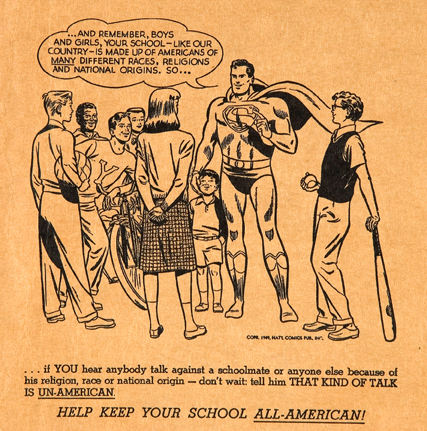
“Don’t Be a Sucker!” may seem like an outlier, but it’s reminiscent of another piece of patriotic, anti-racist-and-religious-bigotry propaganda—the Superman cartoon above, which first appeared in 1949, distributed to school children as a book cover by something called The Institute for American Democracy. You may have seen versions of a full-color poster, reprinted in subsequent years. Here, Superman expresses the same egalitarian values as “Don’t Be a Sucker!” only instead of calling racism a con-job, he calls it “Un-American,” using the favorite denunciation of HUAC and other anti-Communist groups.
History and the present moment may often prove otherwise—showing us just how very American racism and bigotry can be, but so too are numerous counter-movements on the left and, as these examples show, from more conservative, establishment corners as well.
Many of us, whether born there, residing there, or just interested in the place, describe the United States of America as “a nation of immigrants.” What exactly that phrase means has in recent times become the subject of heated public debate. As this year’s presidential candidates strain to appeal to voters with a wide variety of views on the question of what role immigration should play in America’s future (to say nothing of what’s going on in Britain right now), it might help to look at what role immigration has played in its past, and a new animated infographic of who has immigrated from where since 1820 gives the clearest possible look at the whole picture.
“Through most of the 1800s, immigration came predominantly from Western Europe (Ireland, Germany, the U.K.),” writes the data visualization’s creator Max Galka at Metrocosm. “Toward the end of the century, countries further east in Europe (Italy, Russia, Hungary) took over as the largest source of migration. Beginning in the early 1900’s, most immigrants arrived from the Americas (Canada, Mexico). And the last few decades have seen a rise in migration from Asia.”
Each colored dot flying toward the U.S. represents a part of that country’s population, and the brightness of a country’s color on the map corresponds to its total migration to the U.S. at that particular time. Galka provides other charts that show immigration flows by country of origin over time, which makes immigration look higher than ever, and then the same data as a percentage of the total population of the United States, which makes it look almost lower than ever. (And as an American who moved to Korea last year, I can’t help but ask whether we should now give as much thought to emigration out of the U.S. as we have to immigration into it.)
To really feel the advantages and complications of the nation of immigrants first-hand, you’ll want to spend time in a major American city, those always vibrant, often troubled places that people like The Wire creator David Simon have dedicated themselves to observing. “You look at what New Orleans is capable of, as a product of the American melting pot, and it’s glorious,” he once said. “It’s in the friction and in the dynamic between the various groups that inhabit a city that creativity really happens. What makes cities work is a level of tolerance and human endeavor and wit that is absolutely required on the part of all people. Whether or not we succeed as an urban people is the only question worth asking.” And in America, an urban people has always been a diverse people.
From 1930 to 1941, Pathetone Weekly ran film clips that highlighted ‘the novel, the amusing and the strange.’ At some point during the 1930s (the exact date isn’t clear), Pathetone asked American designers to look roughly 70 years into the future and hazard a guess about how women might dress in Year 2000. Apparently, fashion designers don’t make great futurists, and the designs fell rather wide of the mark — unless you want to count Lady Gaga’s wardrobe, in which case they didn’t do a half bad job. Or, for that matter, the male connected 24/7 to his phone and sundry gadgets…
If you would like to support the mission of Open Culture, consider making a donation to our site. It’s hard to rely 100% on ads, and your contributions will help us continue providing the best free cultural and educational materials to learners everywhere. You can contribute through PayPal, Patreon, and Venmo (@openculture). Thanks!
We're hoping to rely on loyal readers, rather than erratic ads. Please click the Donate button and support Open Culture. You can use Paypal, Venmo, Patreon, even Crypto! We thank you!
Open Culture scours the web for the best educational media. We find the free courses and audio books you need, the language lessons & educational videos you want, and plenty of enlightenment in between.