How does one rise to public office? In part, by flattering the sensibilities of those one seeks to serve.
Do you appeal to their higher nature, their sense of civic responsibility and interconnectness?
Or do you capitalize on pre-existing biases, stoking already simmering fears and resentments to the boiling point?
The world paid a ghastly price when Germany’s Chancellor and eventual Führer Adolf Hitler proved himself a master of the latter approach.
It seems like we’ve been hearing about Hitler’s rise to power a lot lately… and not in anticipation of the fast-approaching 80th anniversary of the 1936 Olympic Games in Berlin.
We must always resist the temptation to oversimplify history, especially when doing so serves our own ends. There are way too many contributing factors to Hitler’s ascendancy to squeeze into a five minute animation.
On the other hand, you can’t dump a ton of information on people’s heads and expect them to absorb it all in one sitting. You have to start somewhere.
The video doesn’t touch on Hitler’s mental illness or the particulars of Weimar era political structures, but even viewers with limited historical context will walk away from it with an understanding that Hitler was a master at exploiting the German majority’s mood in the wake of WWI. (A 1933 census shows that Jews made up less than one percent of the total population.)
Hitler’s reputation as a charismatic speaker is difficult to accept, given hindsight, modern sensibilities, and the herky-jerky quality of archival footage. He seems unhinged. How could the crowds not see it?
Perhaps they could, Gendler and Hazard suggest. They just didn’t want to. Businessmen and intellectuals, wanting to back a winner, rationalized that his more monstrous rhetoric was “only for show.”
Quite an attention-getting show, as it turns out.
Could it happen again? Gendler and Hazard, like all good educators, present students with the facts, then open the floor for discussion.
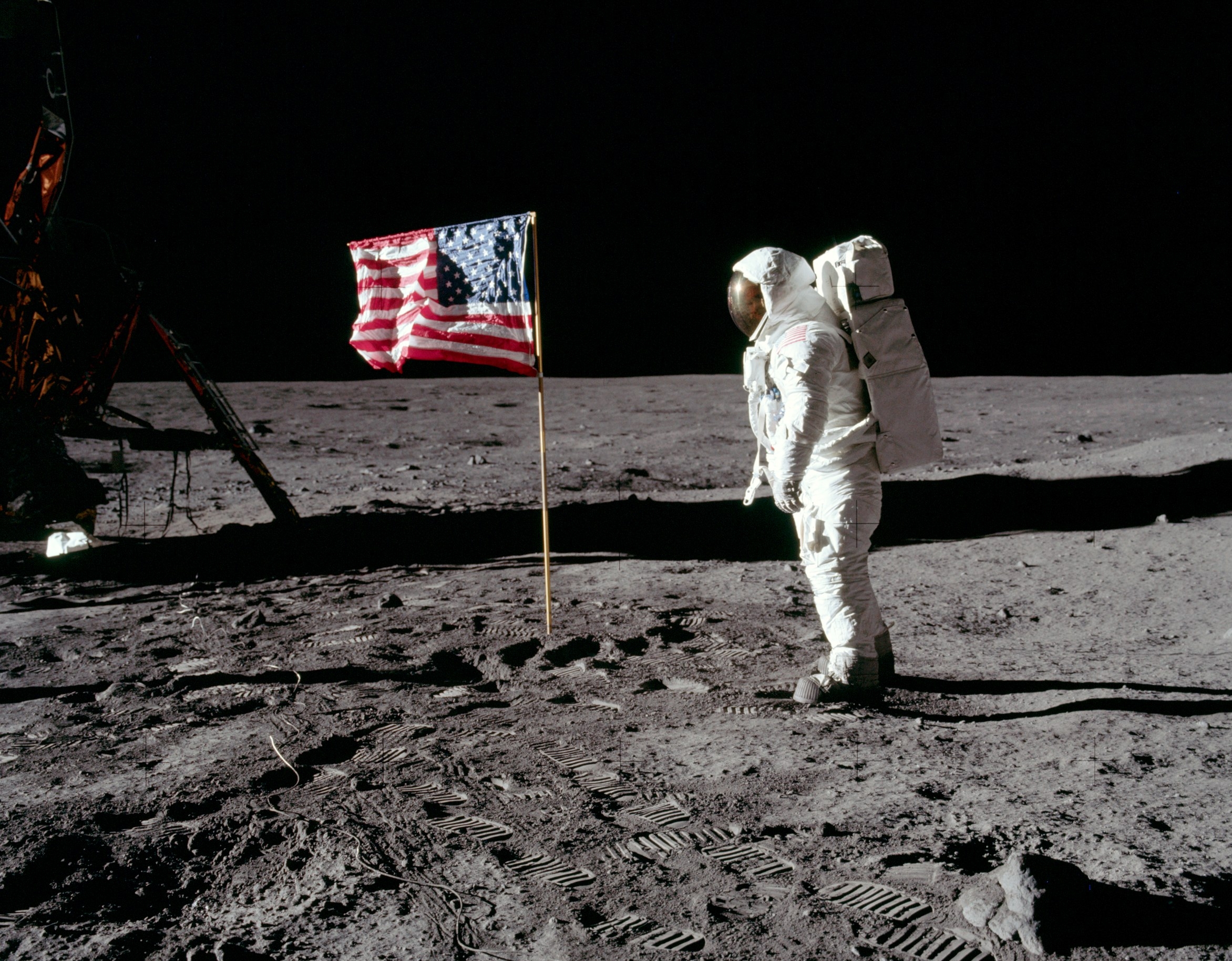
All moon-landing conspiracy theorists refuse to believe that the United States landed on that much-mythologized rock 250,00 miles away in 1969. As to why the rest of us believe that it did happen, moon-landing conspiracy theorists vary in the specifics of their stories. Perhaps the most interesting element of the lore — interesting to cinephiles, at least — holds that Stanley Kubrick, fresh off the production of 2001: A Space Odyssey, secretly shot the landing video seen across America in a studio, later cashing in on the favor by borrowing one of NASA’s custom-made Zeiss lenses to shoot 1975’s Barry Lyndon.
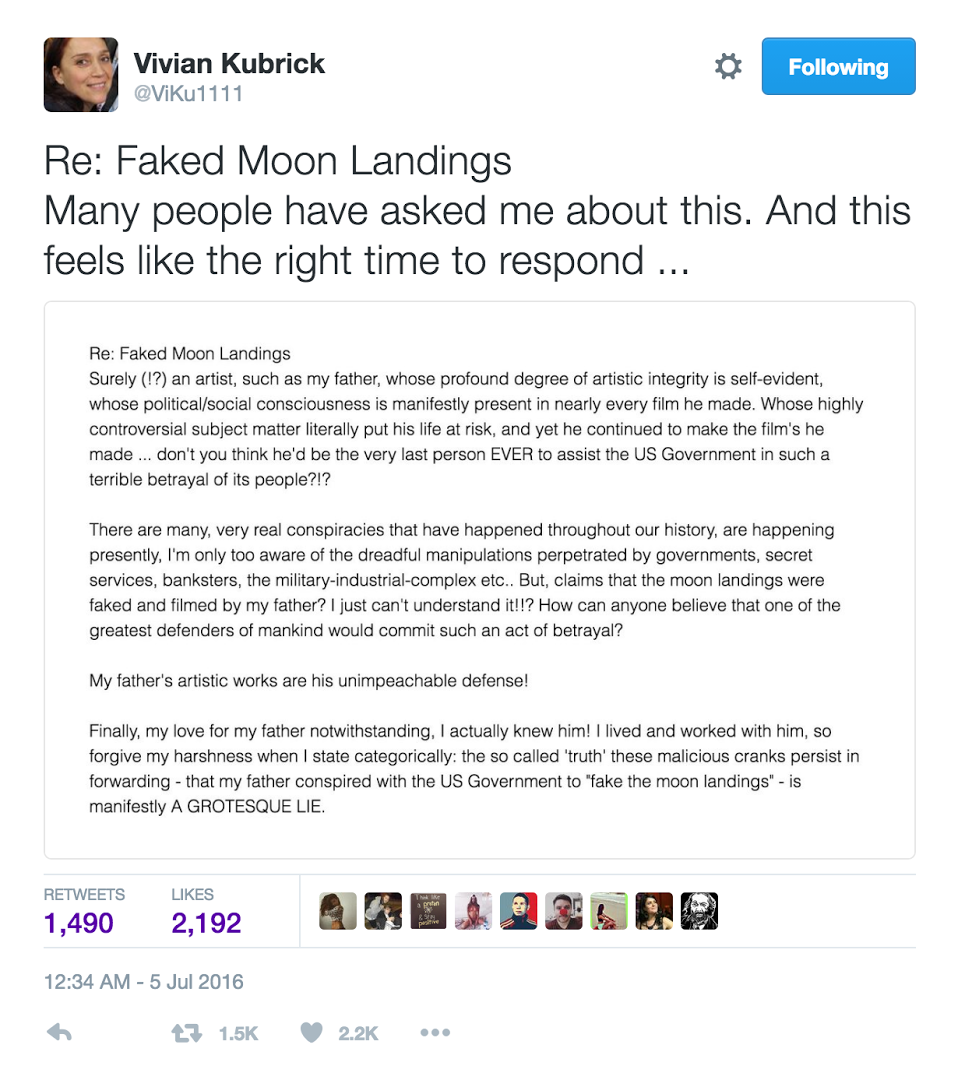
Kubrick died in 1999, and so can’t clear up the matter himself, unless you believe the “confession” video that circulated last year, convincing nobody but the already-convinced. But his daughter Vivian took to Twitter just this month to put the matter to rest herself, embedding an impassioned defense of her father’s integrity (and an encouragement to focus on the more plausible abuses of power quite possibly going on right this moment) that goes way beyond 140 characters:
“Vivian Kubrick worked on the set of The Shining with her father where she shot a behind-the-scenes making-of documentary about the film,” adds Variety’s Lamarco McClendon. “Theorists have purported [Stanley] even used the film to admit to shooting the hoax by leaving behind clues. One such clue was Danny Lloyd wearing an Apollo 11 sweater.” The Shining has given rise to a fair few theories, conspiracy and otherwise, of its own, proving that Kubrick fans can get obsessive, watching and re-watching his work while seeking out symbols and patterns, seeing connections and drawing conclusions by building elaborate interpretive structures atop thin evidence. Come to think of it, you’d think they and the moon-landing conspiracy theorists would have a lot to talk about.
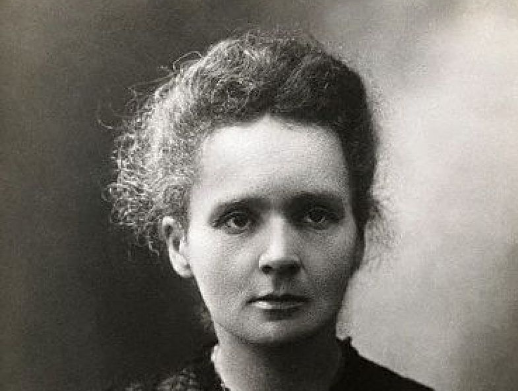
Marie Curie has long stood in the pantheon of scientists for her research on radioactivity — research so close to the subject that, as we posted about last year, her papers remain radioactive over a century later. She’s also become the most prominent historical role model for female students with an interest in science, not least because of the obstacles she had to surmount to arrive at the position where she could do her research in the first place. Born in 19th-century Poland to a family financially humbled by their participation in political struggles for independence from Russia (whose authorities took laboratory instruction out of the country’s schools), she hardly had a smooth road to follow, or even much of a road at all.
“I was only fifteen when I finished my high-school studies, always having held first rank in my class,” Curie wrote of those years. “The fatigue of growth and study compelled me to take almost a year’s rest in the country.” But when she returned to the capital, she couldn’t continue her formal learning there, given the University of Warsaw’s refusal to admit women. So she continued her learning informally, getting involved with the “Flying University” (or “Floating University”) that in the late 19th and early 20th century clandestinely offered an education in ever-changing locations, often private houses, throughout the city. (Over 5,000 Poles, male and female, benefited from its services, including the writer Zofia Nałkowska and doctor Janusz Korczak.)
Marie Curie and the Science of Radioactivityauthor Naomi Pasachoff writes that “the mission of the patriotic participants of the Floating University,” as its name is also translated, “was to bring about Poland’s eventual freedom by enlarging and strengthening its educated classes.” Youngsters eager to read more about Curie’s experience there might like to read Marie Curie and the Discovery of Radium, whose authors Ann E. Steinke and Roger Xavier write of Curie’s experience listening to “lessons on anatomy, natural history, and sociology. In turn she gave lessons to women from poor families.” She would later describe her time there as the origin of her interest in experimental scientific work.
With their sights set on Western Europe, Curie (then Maria Skłodowska) and her sister Bronislawa (known as Bronya) made a pact: “Maria would work as a governess to help pay for Bronya’s medical studies in Paris. As soon as Bronya was trained and began to earn money, she would help cover the costs of Maria’s university training.” Curie earned two degrees in Paris in 1893 and 1894, and her first Nobel Prize in 1903. The Flying University lasted until 1905, and the operation would later return to activity in the late 1970s and early 80s with Poland under the thumb of communism. We now live in more enlightened times, with proper educations, scientific or otherwise, available to students male or female across most of the world — thanks to the will that drove unconventional institutions like the Flying University, and its unconventional students like Marie Curie.
The shibboleths of our political culture have trended lately toward the loathesome, crude, and completely specious to such a degree that at least one prominent columnist has summed up the ongoing spectacle in Cleveland as “grotesquerie… on a level unique in the history of our republic.” It’s impossible to quantify such a thing, but the sentiment feels accurate in the fervor of the moment. We’ll hear a torrent of well-worn counter-clichés at the other party’s big convention, and one of them that’s sure to come up again and again is the phrase “nation of immigrants.” The U.S., we’re told over and over, is a “nation of immigrants.” And it is. Or has become so, though the term “immigrant” is not an uncomplicated one, as we’ve seen in the EU’s struggle to parse “refugees” from “economic migrants.”
The U.S. is also a nation of indigenous people and former slaves, indentured servants, and settler colonists, all very different histories—and academic historians are careful not to blur the categories, even if politicians, ordinary citizens, and textbook publishers often do. Yet rhetoric about who owns the country, and who gets to “take it back,” clouds every issue—it belongs to everyone and no one, or as Wallace Stevens put it, “this is everybody’s world.”
But when we talk about the history of immigration, we usually talk about a specific history dating from the mid-19th to early-20th century, during which diverse groups of people arrived from all over the world, bringing with them their languages, customs, food, and cultures, and only slowly becoming “Americans” as they naturalized and assimilated to various degrees, forcibly or otherwise. We also talk about a legal history that proscribed certain kinds of people and created hierarchies of desirable and undesirable immigrants with respect to ethnic and national origin and economic status.
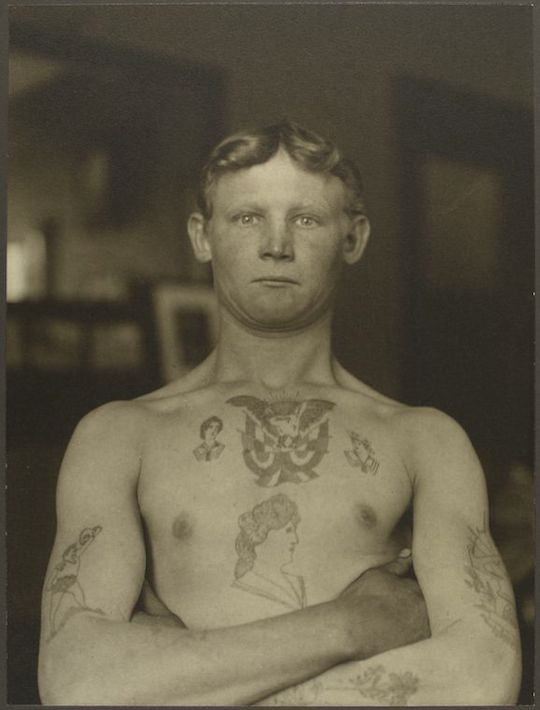
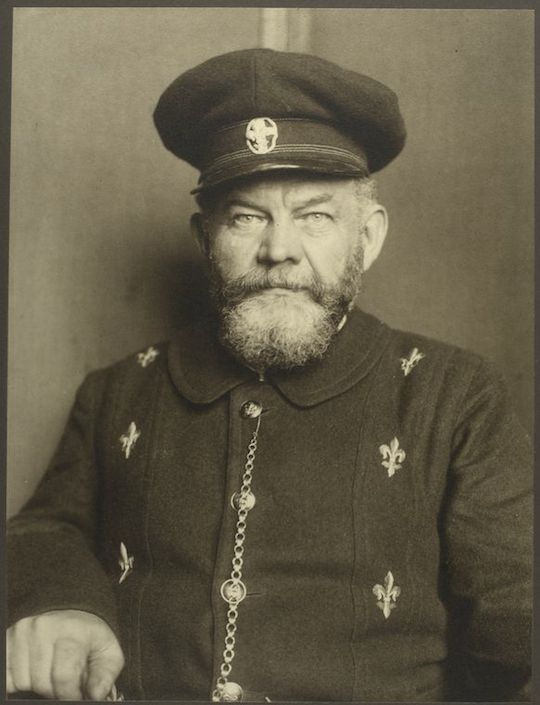
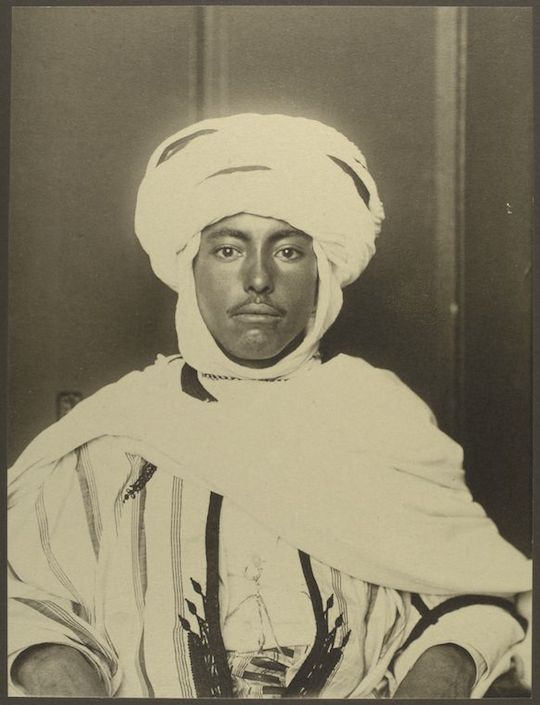
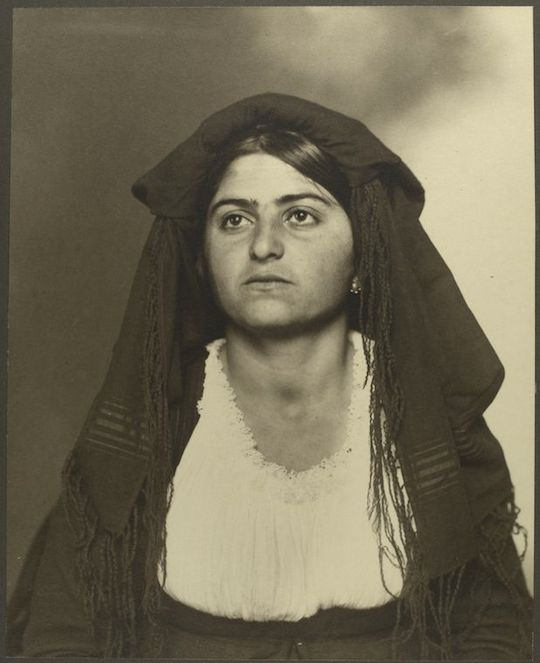
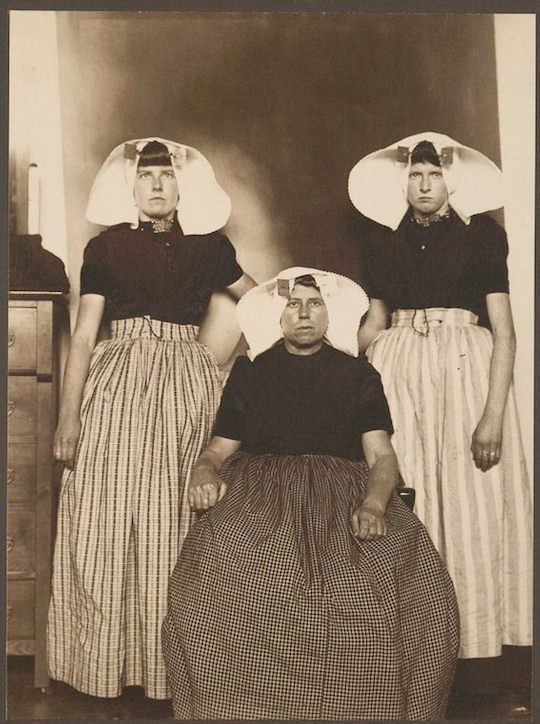
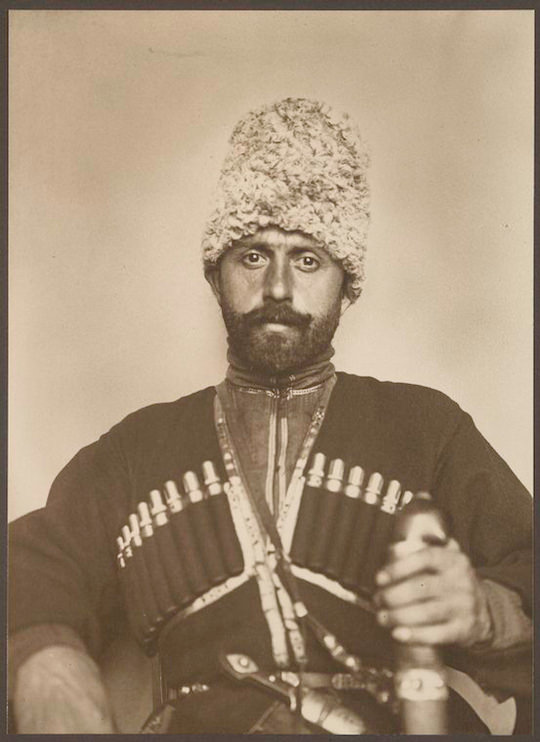
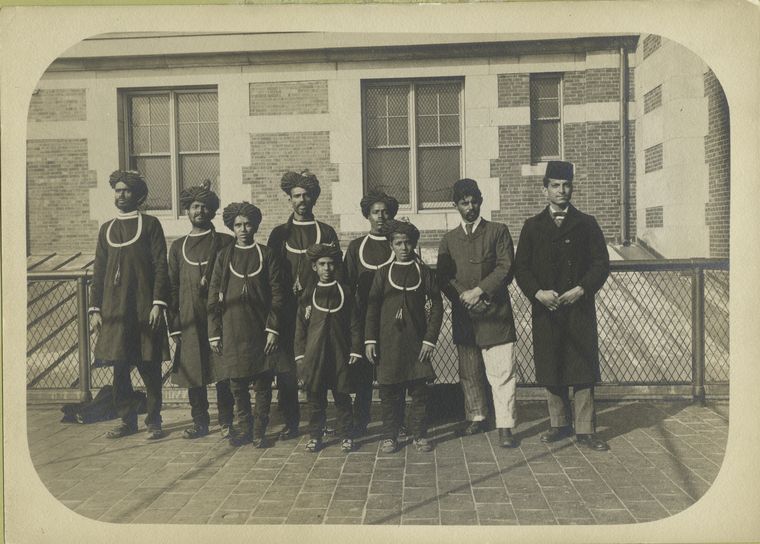
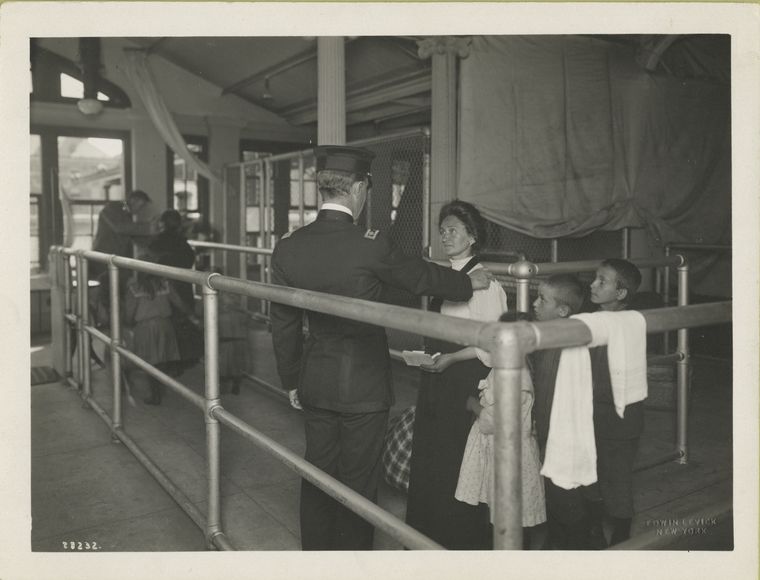
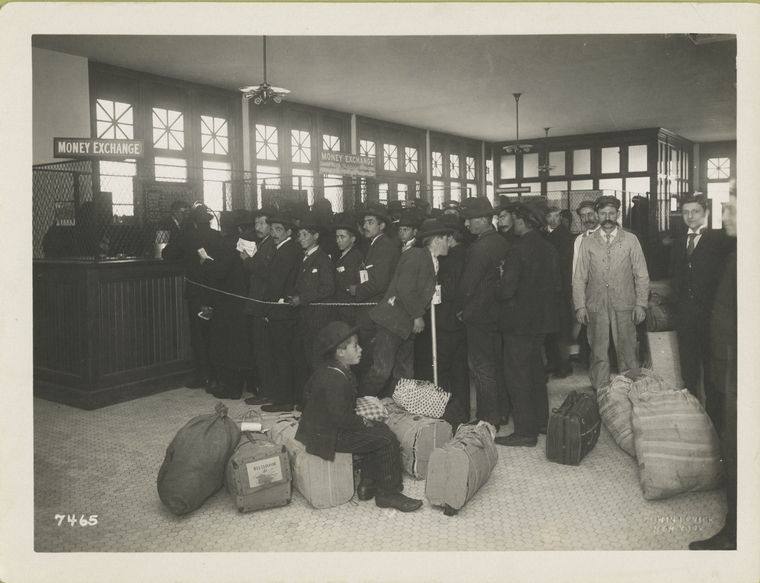
Millions of the people who arrived during the peak of U.S. immigration passed through the immigration inspection station at New York’s Ellis Island, which operated between the years 1882 and 1954. The individuals and families who spent any time there were working people and peasants. Among new arrivals, “the first and second class passengers were considered wealthy enough,” writes The Public Domain Review, “not to become a burden to the state and were examined onboard the ships while the poorer passengers were sent to the island where they underwent medical examinations and legal inspections.”
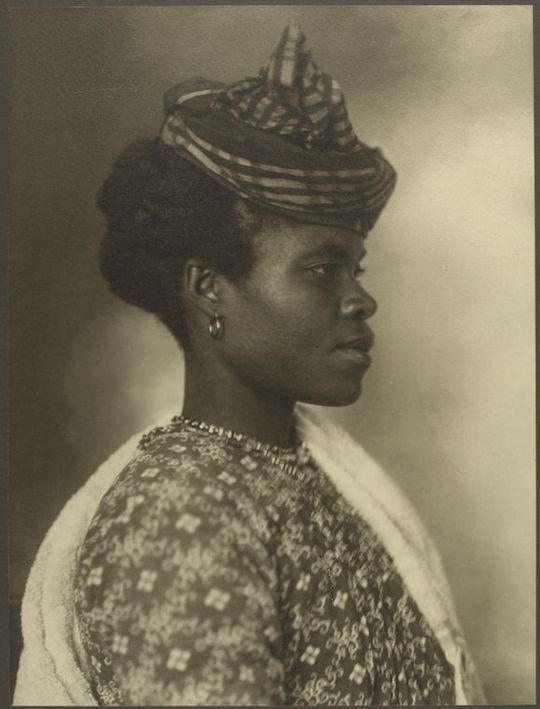
Many of these individuals also sat for portraits taken by the Chief Registry Clerk Augustus Sherman while “waiting for money, travel tickets or someone to come and collect them from the island.” Sherman’s camera captured striking images like the poised Guadeloupean woman in profile at the top, the defiant German stowaway below her, stern Danish man further down, Algerian man and Italian woman above, and severe-looking trio of Dutch women and Georgian man below.
These photographs date from before 1907, which was the busiest year for Ellis Island, “with an all-time high of 11,747 immigrants arriving in April.” About two percent of immigrants at the time were denied entry because of disease, insanity, or a criminal background. That percentage of people turned away rose in the following decade, and the diversity of people coming to the country narrowed significantly in the 1920s, until the 1924 immigration act imposed strict quotas, “as immigrants from Southern and Eastern Europe were seen as inferior to the earlier immigrants from Northern and Western Europe” and those from outside the European continent were limited to a tiny fraction of the almost 165,000 allowed that year.
“Following the Red Scare of 1919,” writes the Densho Encyclopedia, “widespread fear of radicalism fueled anti-foreign sentiment and exclusionist demands. Supporters of immigration legislation stressed recurring themes: Anglo-Saxon superiority and foreigners as threats to jobs and wages.” Not coincidentally, during this time the country also saw the resurgence of the Klu Klux Klan, which—notes PBS—“moved in many states to dominate local and state politics.” It was a time that very much resembled our own, sadly, as fanatical nativism and white supremacy became dominant strains in the political discourse, accompanied by much fearmongering, demagoguery, and violence. (It was also in the teens and twenties that the idea of a superior “Western Civilization” was invented.)
The portraits above were published in National Geographic and “hung on the walls of the lower Manhattan headquarters of the federal Immigration Service” in 1907, before the hysteria began. They show us the human face of an abstract phenomenon far too often used as an epithet or catch-all scare word rather than a fact of human existence since humans have existed. Becoming acquainted with the history of immigration in the U.S. allows us to see how we have handled it well in the past, and how we have handled it badly, and the photographic evidence preserves the dignity of the various individual people from all over the world who were lumped together collectively—as they are today—with the loaded word “immigrant.”
You might have seen a new type of ancient human on the news recently, nicknamed, affectionately, ‘the hobbit’ (not because they were taking the ring to Mordor, but because of their rather diminutive stature).
If you didn’t, here’s the news in brief: a team of scientists went digging for the first Australians and instead found a completely new (and tiny) ancient human. Since then they’ve been trying to work out what happened to these small ancestors of ours.
To share their findings, some of the scientists involved in understanding ‘the hobbit’ have put together a 4 week free online course to explain how the discovery unfolded…
The course has been created with FutureLearn and will take you inside the world of this new species, giving you a run through modern scientific archaeological techniques along the way.
Here’s what’s on the syllabus:
Week 1 — Human Origins and Introduction to Archaeology
Learn about where you, me and everyone came from — before getting onto the moment ‘the hobbit’ was discovered.
Week 2 — Archaeological Methods: In the Cave
You think a festival is bad? Get to grips with how science translates in somewhere without electricity or water.
Week 3 — Archaeological Science: In the Lab
Understand what happens once all the archaeological finds are delicately hauled back to the lab.
Week 4 — Future Directions
‘The Hobbit’, despite it’s size, is having a big impact in the world of archaeology — find out exactly what this little ancient human might mean for the story of our origins.
Intrigued? Join the course today — it started this week, and you’re not too late to join.
Jess Weeks is a copywriter at FutureLearn. She has never conducted ground-breaking science in a cave, or discovered a new species, but there’s still time.
Over on iTunes, you can find a short course (8 lectures in total) on the age-old mystery: How did Hannibal and his elephants cross the Alps during the Second Punic War? The course was presented by archeologist Patrick Hunt in the Continuing Studies program at Stanford University, back in 2007. Here’s the description for the course:
Hannibal is a name that evoked fear among the ancient Romans for decades. His courage, cunning and intrepid march across the dangerous Alps in 218 BCE with his army and war elephants make for some of the most exciting passages found in ancient historical texts written by Polybius, Livy, and Appian. And they continue to inspire historians and archaeologists today. The mystery of his exact route is still a topic of debate, one that has consumed Patrick Hunt (Director of Stanford’s Alpine Archaeology Project) for more than a decade. This course examines Hannibal’s childhood and his young soldierly exploits in Spain. Then it follows him over the Pyrenees and into Gaul, the Alps, Italy, and beyond, examining his victories over the Romans, his brilliance as a military strategist, and his legacy after the Punic Wars. Along the way, students will learn about archaeologists’ efforts to retrace Hannibal’s journey through the Alps and the cutting-edge methods that they are using. Hunt has been on foot over every major Alpine pass and has now determined the most probable sites where archaeological evidence can be found to help solve the mystery.
If you live in the San Francisco Bay Are, you’ll definitely want to check out the courses offered by Stanford Continuing Studies (where I also happen to work). The program also regularly offers online courses, for students living anywhere on this planet.
If you would like to support the mission of Open Culture, consider making a donation to our site. It’s hard to rely 100% on ads, and your contributions will help us continue providing the best free cultural and educational materials to learners everywhere. You can contribute through PayPal, Patreon, and Venmo (@openculture). Thanks!
It’s fair to say that every period which has celebrated the literature of antiquity has held epic Roman poet Virgil in extremely high regard, and that was never more the case than during the early Christian and medieval eras. Born in 70 B.C.—writes Clyde Pharr in the introduction to his scholarly Latin text—“Vergil was ardently admired even in his own day, and his fame continued to increase with the passing centuries. Under the later Roman Empire the reverence for his works reached the point where the Sortes Virgilianae came into vogue; that is, the Aeneid was opened at random, and the first line on which the eyes fell was taken as an omen of good or evil.”
This cult of Virgil only grew until “a great circle of legends and stories of miracles gathered around his name, and the Vergil of history was transformed into the Vergil of magic.” The spelling of his name also transformed from Vergil to Virgil, “thus associating the great poet with the magic or prophetic wand, virgo.” Pharr quotes from J.S. Tunison’s Master Virgil, a study of the poet “as he seemed in the Middle Ages”:
The medieval world looked upon him as a poet of prophetic insight, who contained within himself all the potentialities of wisdom. He was called the Poet, as if no other existed; the Roman, as if the ideal of the commonwealth were embodied in him; the Perfect in Style, with whom no other writer could be compared; the Philosopher, who grasped the ideas of all things…
Virgil, after all, acted as the wise guide through the Inferno for late medieval poet Dante, who was accorded a similar degree of reverence in the early modern period.
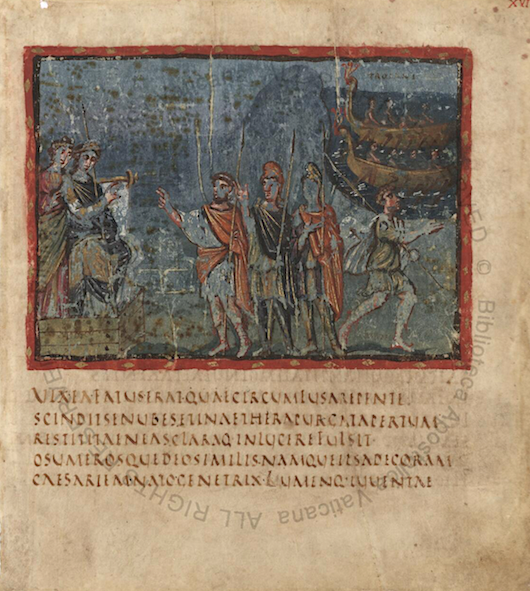
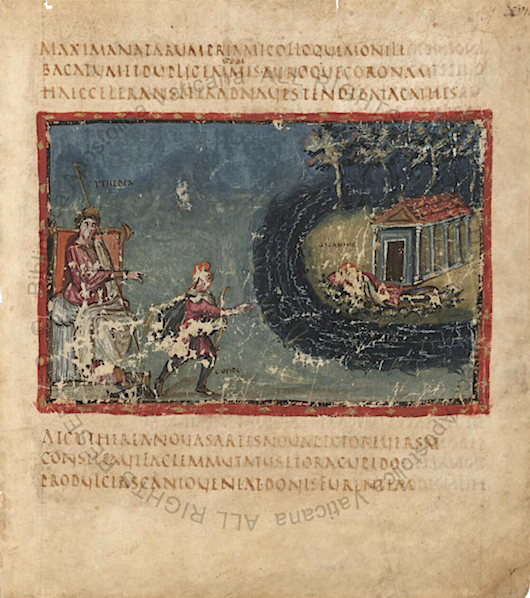
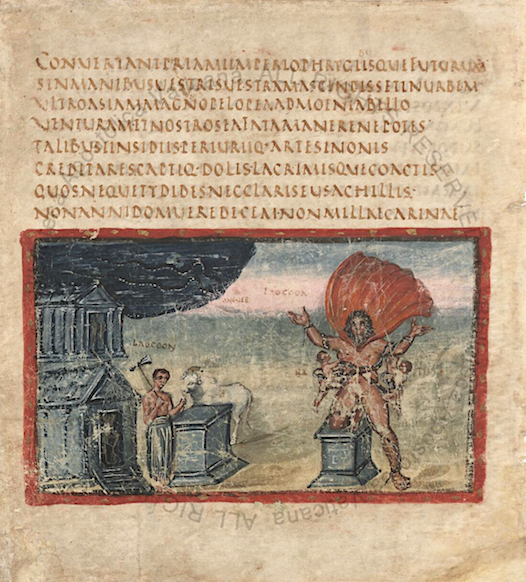
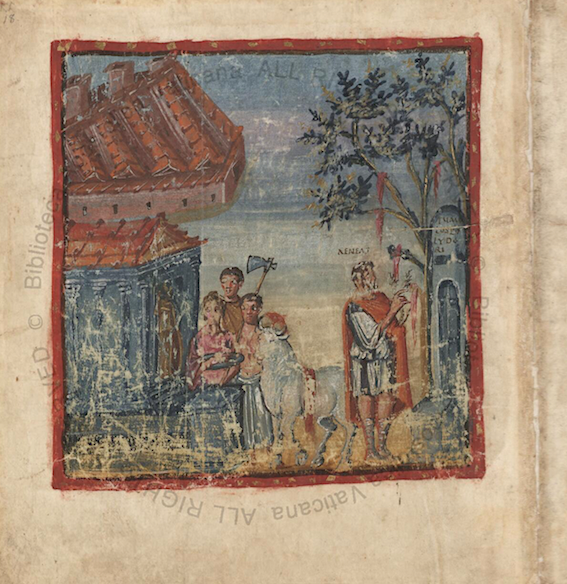
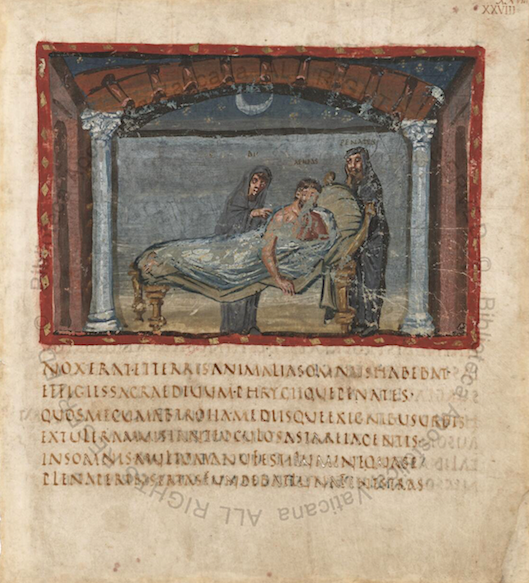
We should keep the cult of Virgil, and of his epic poem The Aeneid, in mind as we survey the text you see represented here—an illuminated manuscript from Rome created sometime around the year 400 (view the full, digitized manuscript here). Beginning at the end of another great epic—The Iliad—Virgil’s long poem connects the world of Homer to his own through Aeneas and his companions, Trojan refugees and mythical founders of Rome. It is somewhat ironic that the Christian world came to venerate the poem for centuries—claiming that Virgil predicted the birth of Christ—since the Roman poet’s purpose, writes Pharr, was “to see effected… a revival of faith in the old-time religion”—the old-time pagan religion, that is.
But the careful preservation of this ancient manuscript, some 1,600 years old, testifies to the Catholic church’s profound respect for Virgil. “Known as the Vergilius Vaticanus,” writes Hyperallergic, it’s one of the world’s oldest versions of the Latin epic poem, and you can browse it for free online” at Digita Vatica, a nonprofit affiliated with the Vatican Library.
Written by a single master scribe in rustic capitals, an ancient Roman calligraphic script, and illustrated by three different painters, Vergilius Vaticanus is one of only three illuminated manuscripts of classic literature. Granulated gold, applied with a brush, highlights meticulously colored images of famous scenes from the poem: Creusa as she tries to keep her husband Aeneas from going into battle; the islands of the Cyclades and the city of Pergamea destroyed by pestilence and drought; Dido on her funeral pyre, speaking her final soliloquy.
Hyperallergic describes the painstaking care a Tokyo-based firm took in digitizing the fragile text. Digita Vaticana is currently in the midst of scanning its entire collection of 80,000 delicate, ancient manuscripts, a process expected to take 15 years and cost 50 million euros.
Should you wish to contribute to the effort, you can make a donation to the project. The first 200 donors willing and able to fork over at least 500 euros (currently about $533), will receive a printed reproduction of the Vergilius Vaticanus, sure to impress the classics lovers in your life. Should you wish to read the Aeneid in its original language, a true undertaking of love, you can’t go wrong with Pharr’s excellent scholarly text of the first six books (or see an online Latin text here). If you’d rather skip the genuinely difficult and laborious translation, you can always read John Dryden’s translation free online.
People have spoken for decades, and with great certainty, of the impending death of print. But even here into the 21st century, presses continue to run around the world, putting out books and periodicals of all different shapes, sizes, and print runs. The technology has endured so well in part because it has had so long to evolve. Everyone knows that printing began with something called the Gutenberg Press, and many know that Gutenberg himself (Johannes, a German blacksmith) unveiled his invention in 1440, introducing movable type to the world. Ten years later came the Gutenberg Bible, the first major book printed using it, still considered among the most beautiful books ever mass-produced.
But how did the Gutenberg press actually work? In the video above, you can watch a demonstration of “the most complete and functioning Gutenberg Press in the world” at the Crandall Historical Printing Museum in Provo, Utah. While it certainly marked a vast improvement in efficiency over the hand-copying used to make books before, it still required no small amount of labor on the part of an entire staff specially trained to apply the ink, square up the paper, and turn a not-that-easy-to-turn lever. The guide, who’s clearly put in the years mastering his routine, has both clear explanations and plenty of corny jokes at hand throughout the process.
One can hardly overstate the importance of the machine we see in action here, which facilitated the spread of ideas all around Europe and the world and turned the book into what no less a technophile than Stephen Fry calls “the building block of our civilization.” He says that in an episode of the BBC series The Medieval Mind in which he explores the world of Gutenberg printing in even greater depth. We’ve grown so accustomed to the near-instantaneous transfer of information over the internet that dealing with print can feel like a hassle. I myself just recently resented having to buy a printer for work reasons, even though its sheer speed and clarity would have seemed like a miracle to Gutenberg, whose invention — and the labor of the countless skilled workers who operated it — set in motion the developments that let us spread ideas so impossibly fast on sites like this today.
We're hoping to rely on loyal readers, rather than erratic ads. Please click the Donate button and support Open Culture. You can use Paypal, Venmo, Patreon, even Crypto! We thank you!
Open Culture scours the web for the best educational media. We find the free courses and audio books you need, the language lessons & educational videos you want, and plenty of enlightenment in between.