Back in June we highlighted Neil Halloran’s 15 minute film, The Fallen of World War II, which used “innovative data visualization techniques to put the human cost of WW II into perspective, showing how some 70 million lives were lost within civilian and military populations across Europe and Asia, from 1939 to 1945.” It’s a pretty staggering illustration of the deadliest war. As the film went viral, Halloran raised money that would enable him to develop new films exploring “other trends of war and peace — from drones and terrorism to democracy and peacekeeping.” He has also translated the film into six different languages. They all went online in the last few weeks. Here they are: Russian, Japanese, Polish, French, German, and Serbian.
Above, you can watch the original in English (certainly worth doing if you were vacationing in June), and you might also explore the accompanying interactive web site here.
Follow Open Culture on Facebook and Twitter and share intelligent media with your friends. Or better yet, sign up for our daily email and get a daily dose of Open Culture in your inbox. And if you want to make sure that our posts definitely appear in your Facebook newsfeed, just follow these simple steps.
The lag time between our imagining of social equality and its arrival can be significantly long indeed, or it least it can seem so, given the limitations of human mortality. 113 years may not be an especially long time for a tree, say, or even a very healthy Galapagos tortoise, but if you or I had been alive in 1902, chances are we’d never know that in 2015 the president of Europe’s most powerful nation is a woman, as are two major presidential candidates in the United States. Given the amount of inequality we still see worldwide, this may not always feel like a triumph. In 1902, it might have seemed like “nothing but fantasy.”
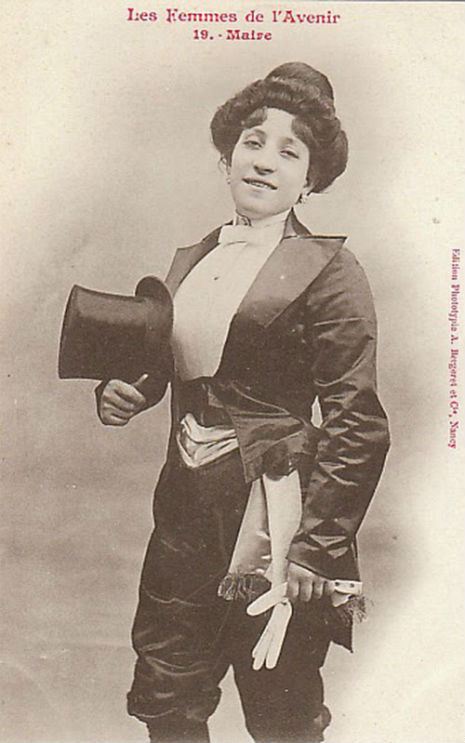
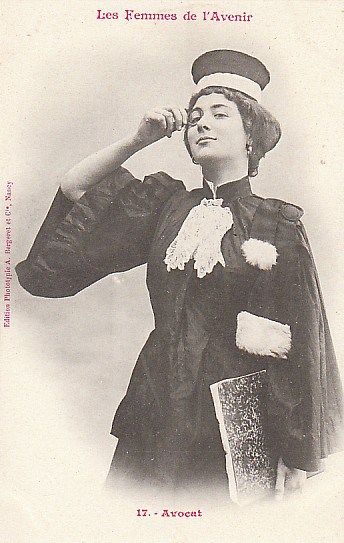
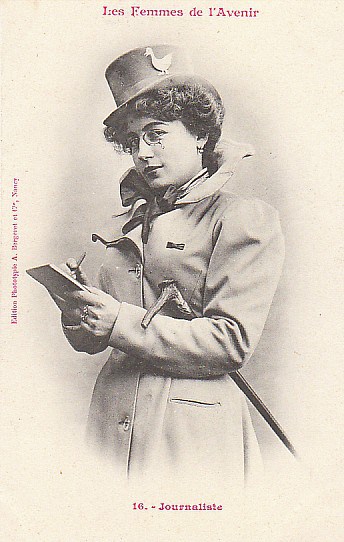
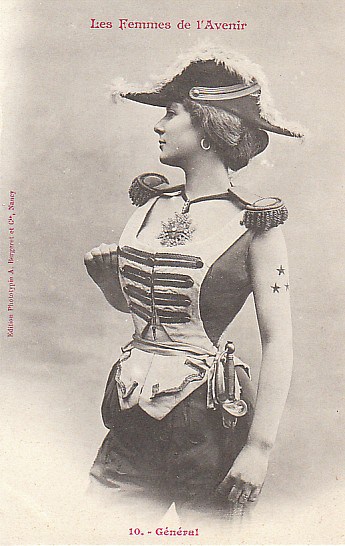
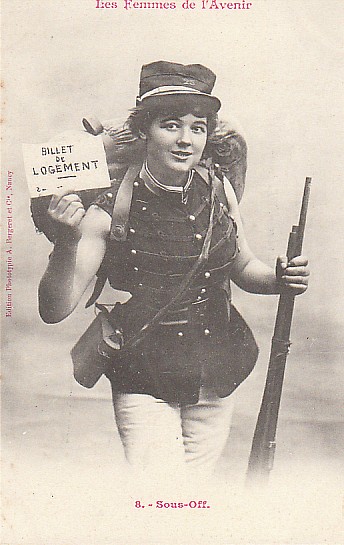
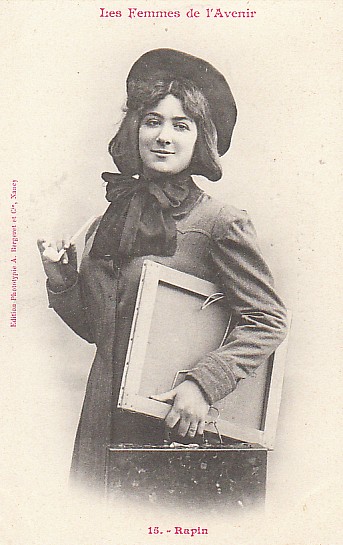
And yet even then, it was certainly possible to foresee women occupying all the roles that men did, through the lenses, writes Laura Hudson at Boing Boing, of “fantasy and science fiction,” which “can often help us open our minds behind the limitations of the world we live in and imagine a better one instead.” In 1902, artist Albert Bergeret was commissioned to create the trading cards you see here—just a small selection of twenty total photographs called “Les Femmes de l’Avenir”—Women of the Future. Only one theme among many in a series of different sets of cards, this “retrofuturistic attempt to expand the role of women in society” showed us a “small and fashionable world” where “women were given a more equal role in society, not to mention spectacular hats.”
That may be so, but just as we can never accurately see the future, we can also never reach consensus on the meaning of the past. The Daily Mail’s Maysa Rawi agrees with Hudson about the “pin-up quality to many of the images,” which show “an awful lot of arm.” And yet Rawi disparages the entire set as “meant to capture men’s fantasies rather than be part of any feminist movement.” I’ll admit, I don’t see the cards this way at all, nor do I think the categories are mutually exclusive. Pin-up girls have also represented social power, albeit mainly sexual power. Scantily-clad female superheroes like Wonder Woman, though crafted to appeal to the fantasies of teenage boys, are also powerful because… well, they have superpowers.
Perhaps that’s one way to look at Bergeret’s cards. He is not mocking his subjects, nor hyper-sexualizing them, but presenting, as each card indicates, advanced futuristic beings who didn’t yet exist in his time. The Daily Mail captions several of the photos with factoids about women’s advances in French history. In some cases, Bergeret did not have to extrapolate far. Women could practice law in 1900; women served in the army during the French Revolution, but did not fight. Colleges had been open to women since 1879. A few women worked as doctors and journalists in Bergeret’s time. Marie Curie, you’ll recall, had discovered polonium, coined the term “radioactivity,” and would win the Nobel Prize in 1903. Queen Victoria had ruled over half the world.
But French women would have to wait several more decades to enter most of the professions represented. No matter how sexy—and in some cases ridiculous—some of the costumes in these photos, Bergeret shot the models with poise, style, and dignity. Perhaps he and many in his audience could easily imagine female generals, mayors, firewomen, soldiers, etc. Yet one particular card stands out. It portrays a self-satisfied, Bohemian model labeled “rapin”—which a reader below informs us is “an argot word for (bad) painter.”
The Gandhi of history doesn’t line up with the Gandhi of legend, just as the beatified Mother Teresa presents a very different picture in certain astute critics’ estimation. But as with most saints, ancient and modern, people tend to ignore Gandhi’s many contradictions and troublingly racist and casteist views. He comes to us more as myth and martyr than deeply flawed human individual. An indispensable part of the mythmaking, Richard Attenborough’s 1982 biopic, Gandhi, may be “over-sanitized,” as The Guardian writes, but Ben Kingsley’s performance as the anti-colonial leader is genuinely “sublime” in his evocation of Gandhi’s “intensity… wit and even the distinctive, determined walk.” It’s these personal qualities—and of course Gandhi’s defeat of the largest empire on the planet with nonviolent action and a spiritual philosophy—that continue to inspire movements for justice and civil rights.
We see a little of that determined walk in the short newsreel interview above, the very first “talking picture” made of Gandhi, and we also hear his intensity and wit, though much subdued by his physical frailty after years of fasting. Taken in 1947 by Fox Movietone News, the film marks a pivotal period in the Indian leader’s life. Very shortly after this Parliament passed the Indian Independence Act. That year also marked the start of a bloody new struggle, instigated by another colonial intervention, as the British partitioned India into two warring countries, an act so poignantly dramatized in Salmon Rushdie’s Midnight’s Children.
This year of turmoil was also Gandhi’s last; he was assassinated in 1948 by a Hindu nationalist who accused him of siding with Pakistan. In the interview, we hear what we might think of as some of Gandhi’s final public pronouncements on such subjects as child marriage, prohibition, his deeply held convictions about an authentic Indian cultural identity, and the lengths that he would go for his country’s independence. At the end of the short interview, the American reporter asks Gandhi, presciently, “would you be prepared to die in the cause of India’s Independence?” to which Gandhi replies, “this is a bad question.”
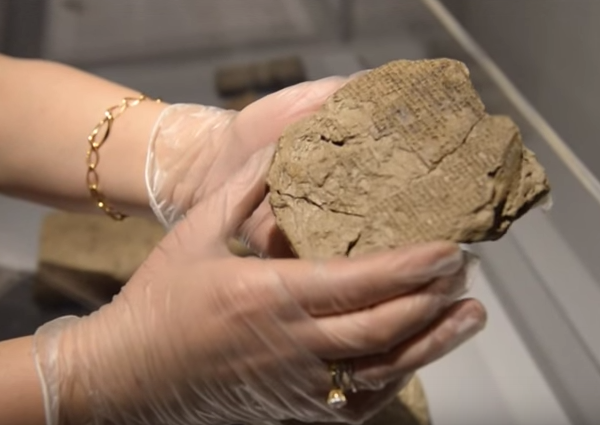
The Epic of Gilgamesh, one of the oldest narratives in the world, got a surprise update last month when the Sulaymaniyah Museum in the Kurdistan region of Iraq announced that it had discovered 20 new lines of the Babylonian-Era poem of gods, mortals, and monsters. Since the poem has existed in fragments since the 18th century BC, there has always been the possibility that more would turn up. And yet the version we’re familiar with — the one discovered in 1853 in Nineveh — hasn’t changed very much over recent decades. The text remained fairly fixed — that is, until the fall of Baghdad in 2003 and the intense looting that followed yielded something new.
the [Sulaymaniyah] museum has a matter of policy paid smugglers to keep artifacts from leaving the country, no questions asked. The tablet was acquired by the museum in late 2011 as part of a collection of 80–90 tablets sold by an unnamed shady character. Professor Farouk Al-Rawi examined the collection while the seller haggled with museum official Abdullah Hashim. When Al-Rawi saw this tablet, he told Hashim to pay whatever the seller wanted: $800.
That’s a pretty good deal for these extra lines that not only add to the poem’s length, but have now cleared up some of the mysteries in the other chapters. These lines come from Chapter Five of the epic and cast the main characters in a new light. Gilgamesh and his companion Enkidu are shown to feel guilt over killing Humbaba, the guardian of the cedar forest, who is now seen as less a monster and more a king. Just like a good director’s cut, these extra scenes clear up some muddy character motivation, and add an environmental moral to the tale.
In the video above, Hazha Jalal, manager of the tablet’s section of the Sulaymaniyah Museum talks (in Kurdish) about the new discovery, saying (in translation): “The tablet dates back to the Neo-Bablyonian period, 2000–1500 BCE. It is a part of tablet V of the epic. It was acquired by the Museum in the year 2011 and [then] Dr. Farouk Al-Raw transliterated it. It was written as a poem and many new things this version has added, for example Gilgamesh and his friend met a monkey. We are honored to house this tablet and anyone can visit the Museum during its opening hours from 8:30 morning to noon. The entry is free for you and your guests. Thank you.”
Ted Mills is a freelance writer on the arts who currently hosts the FunkZone Podcast. You can also follow him on Twitter at @tedmills, read his other arts writing at tedmills.com and/or watch his films here.
On May 27, 1956, millions of Americans tuned in to The Ed Sullivan Show, expecting the usual variety of comedians, talents and musical guests. What they weren’t prepared for was a short animated film that Sullivan introduced thusly:
Just last week you read about the H‑bomb being dropped. Now two great English writers, two very imaginative writers — I’m gonna tell you if you have youngsters in the living room tell them not to be alarmed at this ‘cause it’s a fantasy, the whole thing is animated — but two English writers, Joan and Peter Foldes, wrote a thing which they called “A Short Vision” in which they wondered what might happen to the animal population of the world if an H‑bomb were dropped. It’s produced by George K. Arthur and I’d like you to see it. It is grim, but I think we can all stand it to realize that in war there is no winner.
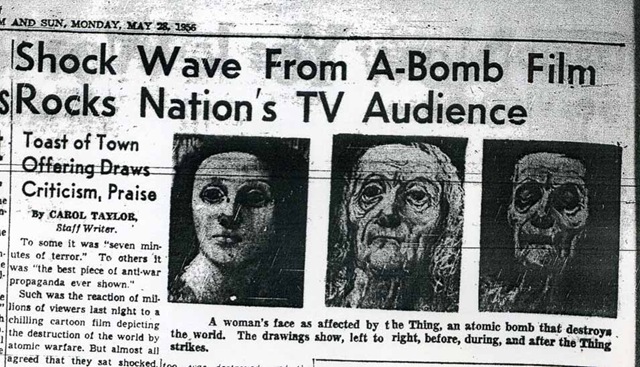
And with that, he screened the horrific bit of animation you can watch above. At the height of the atomic age, this film was a short sharp shock. Its vision of a nuclear holocaust is told in the style of a fable or storybook, with both animals and humans witnessing their last moments on earth, and ending with the extinguishing of a tiny flame. The mostly static art work is all the more effective when faces melt into skulls.
It was as formative a moment as The Day After would be to children of the ‘80s. The papers the next day reported on the short in salacious detail (“Shock Wave From A‑Bomb Film Rocks Nation’s TV Audience”) and Sullivan not only defended his decision, but showed the film again on June 10.
The film was created by married couple Peter and Joan Foldes, and shot for little money in their kitchen on a makeshift animation table. Peter was a Hungarian immigrant who had studied at the Slade School of Art and the Courtlaud Institute and apprenticed with John Halas where he learned animation.
(Halas is best known for the animated feature version of Orwell’s Animal Farm.)
A Short Vision would go on in September of that year to win best experimental film at the 17th Venice Film Festival. (Peter Foldes would later make another disturbing and award-winning short called Hunger.)
Once so shocking, A Short Vision fell out of circulation. But a generation grew up remembering that they had seen something horrific on television that night (in black and white, not the color version above.) For a time, it was hard to find a mention of the film on IMDB and a damaged educational print was one of the few copies circulating around. Fortunately the British Film Institute has made a pristine copy available of this important Cold War document.
Ted Mills is a freelance writer on the arts who currently hosts the FunkZone Podcast. You can also follow him on Twitter at @tedmills, read his other arts writing at tedmills.com and/or watch his films here.
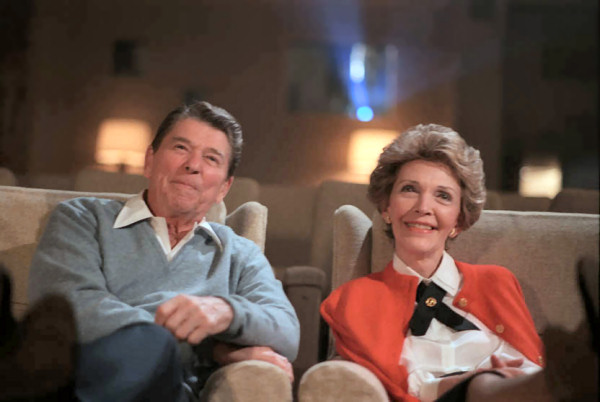
Many of us keep a record of the movies we watch. Few of us, however, lead the free world. As the reliable sales numbers of presidential biographies (no matter how thick) attest, the actions of the President of the United States of America, no matter who that President may be and no matter what sort of actions that President takes, always draw interest. For instance, you may have seen that Paleofuture’s Matt Novak recently went through Jimmy Carter’s diaries to draw up a list of every single movie Carter watched during his Presidency.
“Part of my fascination with the movies that presidents watch is just cheap voyeurism,” Novak writes. “But the other part is an earnest belief that popular culture influences things in the real world. President Nixon was obsessed with the film Patton during the Vietnam War. President Reagan urged Congress to take computer security seriously after seeing War Games in 1983.” And you can learn what else they watched by pulling up What Nixon Saw and When He Saw It by Nixon at the Movies author Mark Feeney, and the list of films Mr. and Mrs. Reagan viewed from the Ronald Reagan Presidential Library.
Nixon watched several depictions of hard-bitten heroes (and antiheroes) toughing out their troubles: not just Patton, but Bullitt, True Grit, Ice Station Zebra, Our Man in Havana, The Treasure of the Sierra Madre, Spartacus, and Lawrence of Arabia— with the occasional Paint Your Wagon or Auntie Mame thrown in there as well. Carter hewed a bit closer to the overall American cinematic zeitgeist, watching such era-defining films as Rocky, Network, Star Wars, Airport ’77, Annie Hall, Animal House, The Last Picture Show, Apocalypse Now, Alien, and 10.
Reagan, famously a film actor himself, watched all sorts movies, though his list shows a certain preference for military-themed spectacles like Gallipoli, Inchon, Das Boot, Firefox, Red Dawn, Iron Eagle, and Top Gun, as well as sports pictures like Breaking Away, The Winning Team, and even Knute Rockne, All American, in which he himself portrayed football player George Gipp, a role that anointed him with the nickname that would stick until the end.
The Freedom of Information act assures us that we’ll have the chance to study the in-office viewing habits of many presidents to come. Novak, in fact, has already put in a request for the lists from George H.W. Bush, Bill Clinton, and George W. Bush: “They said I can expect the list in 46 months.” Well, the wheels of government do grind slowly, after all — we’ve learned that from the movies.
Below you can find a list of the first 10 films each president watched upon taking office. The difference in their cultural sensibilities immediately leaps out.
In 1973, the book Sybil - about a young woman struggling with 16 distinct personalities — became a cultural sensation, spawning a hugely successful made-for-TV movie in 1976 and an utterly unnecessary remake in 2007.
The condition of multiple personality disorder (MPD) was so exotic and strange that it soon became fodder for daytime talk shows like Jerry Springer and campy storylines in soap operas. But the case and the controversial treatment prescribed by Sybil’s doctor Cornelia Wilbur had long-term and serious implications for healthcare in this country. Above, you can watch a video by the New York Times that lays out much of the controversy.
MPD was first diagnosed in the early 1950s with a patient named Eve White (above) who seemed to have three personalities. When Wilbur found that one of her own patients, a troubled graduate student named Shirley Mason (later known to the world as “Sybil”) exhibited some of the same symptoms as Eve, she started an aggressive therapy that included hypnosis and the use of sodium thiopental, truth serum. Wilbur suspected that Mason’s problems were the result of some childhood trauma and her therapy aimed at uncovering them.
Under Wilbur’s care, Mason revealed a host of different personalities from the assertive Peggy, to the emotional Marcia, to Mike, who was not only male but also a carpenter. Through the voice of each personality, Wilbur also uncovered what she believed to be terrifying accounts of childhood rape and abuse.
But as Mason wrote in a 1958 letter to Wilbur, the abuse and the multiple disorders were lies. “I am not going to tell you there isn’t anything wrong,” Mason writes. “But it is not what I have led you to believe.… I do not have any multiple personalities .… I do not even have a ‘double.’ … I am all of them. I have been essentially lying.”
Wilbur dismissed Mason’s claims as an excuse to avoid going deeper in her treatment.
The popularity of Sybil’s story soon turned what was previously a very rare condition into a trendy psychological disorder. The video details the case of Jeanette Bartha who states, “I came in for depression and I left with multiple personalities.” Under treatment with hypnotic drugs, Bartha started to believe not only that she had MPD but also her parents abused her as a part of a satanic cult. Years later, Bartha realized to her grief and horror that these memories were false.
Subsequent research has thoroughly debunked the validity of Wilbur’s methods and even her diagnosis. MPD has been replaced with the broader, and less pulpy sounding, dissociative-identity disorder.
“The problem is fragmentation of identity, not that you really are 12 people,” says Dr. David Siegel, a critic of Wilbur. “You have not more than one but less than one personality.”
Jonathan Crow is a Los Angeles-based writer and filmmaker whose work has appeared in Yahoo!, The Hollywood Reporter, and other publications. You can follow him at @jonccrow. And check out his blog Veeptopus, featuring lots of pictures of badgers and even more pictures of vice presidents with octopuses on their heads. The Veeptopus store is here.
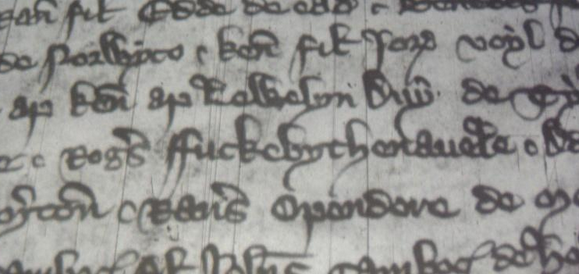
We previously thought that the first use of the “F word” dated back to 1528 — to when a monk jotted the word in the margins of Cicero’s De Officiis. But it turns out that you can find traces of this colorful curse word in English court documents written in 1310.
Dr. Paul Booth, a former lecturer in medieval history at Keele University, was looking through court records from the age of Edward II when he accidentally stumbled upon the name “Roger Fuckebythenavele.” The name was apparently used three times in the documents, suggesting it was hardly a mistake. According to The Daily Mail, Booth believes “Roger Fuckebythenavele” was a nickname for a defendant in a criminal case. And, going further, he suggests the nickname could mean one of two things: ‘Either this refers to an inexperienced copulator, referring to someone trying to have sex with the navel, or it’s a rather extravagant explanation for a dimwit, someone so stupid they think this that is the way to have sex.’ Booth has notified the Oxford English Dictionary of his discovery.
We're hoping to rely on loyal readers, rather than erratic ads. Please click the Donate button and support Open Culture. You can use Paypal, Venmo, Patreon, even Crypto! We thank you!
Open Culture scours the web for the best educational media. We find the free courses and audio books you need, the language lessons & educational videos you want, and plenty of enlightenment in between.