On January 28, 1986, NASA Challenger mission STS-51‑L exploded in the sky, into a twisting plume of smoke, a mere 73 seconds after takeoff. It left a nation stunned, and seven astronauts dead. Among them was the pilot, physicist and MIT grad Ronald McNair, who, in 1984, had become only the second African-American to travel into outer space.
As this animation narrated by his own brother explains, McNair’s path to becoming an astronaut wasn’t easy. Born and raised in the Jim Crow South (in Lake City, South Carolina, to be precise) McNair encountered racism in his everyday life. One touching story helps crystallize what his experience was like. As a nine-year-old, McNair tried to check out books from the “public” library — only to discover that “public” meant books were for whites, not blacks. The video tells the rest of the story. And I’ll just flag one important detail mentioned at the very end: On January 28, 2011, exactly 25 years after his death, the library was renamed The Dr. Ronald E. McNair Life History Center. You’ll also find a Ronald E. McNair Building on MIT’s campus too. And deservedly so.
In 1962, during the height of the Cold War, the United States launched nuclear weapons (bigger than the ones dropped on Hiroshima and Nagasaki) into space and detonated them. Ostensibly, the goal was to see what these high altitude nuclear blasts might do to the Earth’s magnetic field.
The explosions took place some 400 kilometers (250 miles) above Johnston Island in the Pacific Ocean. And, as the NPR video above describes it, folks living in the Pacific watched the light show while gathered on rooftops and blithely sipping drinks. Below, you can view arresting footage of the tests — without having to worry about getting radioactive fallout in your cocktail.
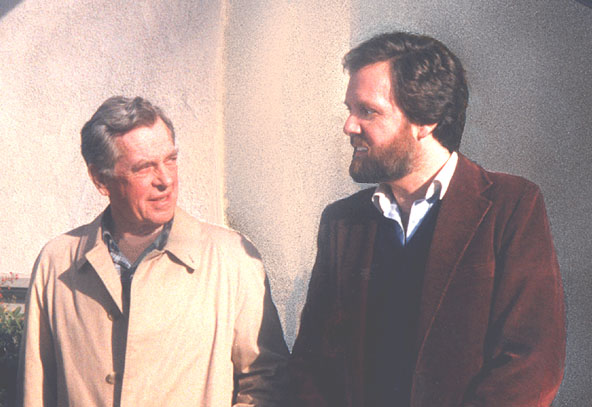
You may not be interested in politics, they say, but politics is interested in you. The same, if you believe famed mythologist Joseph Campbell, goes for myth: far from explaining only the origin of the world as believed by extinct societies, it can explain the power of stories we enjoy today — up to and including Star Wars.
The man behind PBS’ well-known series The Power of Myth left behind many words in many formats telling us precisely why, and now you can hear a fair few of them — 48 hours worth — for free on this Spotify playlist. (If you don’t have Spotify’s software already, you can download it free here.)
“From the Star Wars trilogy to the Grateful Dead,” says the Joseph Campbell Foundation, “Joseph Campbell has had a profound impact on our culture, our beliefs, and the way we view ourselves and the world.” This collection, The Lectures of Joseph Campbell, which comes from early in his career, offers “a glimpse into one of the great minds of our time, drawing together his most wide-ranging and insightful talks” in the role of both “a scholar and a master storyteller.” So not only can Campbell enrich our understanding of all the stories we love, he can spin his lifetime of mythological research into teachings that, in the telling, weave into a pretty gripping yarn in and of themselves.
If you would like to support the mission of Open Culture, consider making a donation to our site. It’s hard to rely 100% on ads, and your contributions will help us continue providing the best free cultural and educational materials to learners everywhere. You can contribute through PayPal, Patreon, and Venmo (@openculture). Thanks!
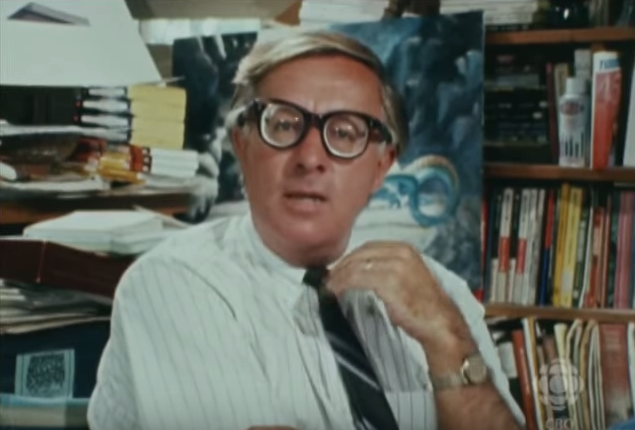
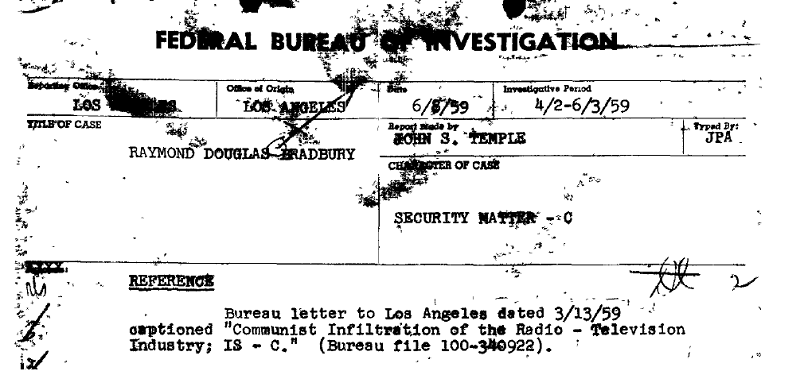
When you think of the most astute minds of our time, you might well think of Ray Bradbury’s — but you probably don’t think of him as one of the most astute terrorist minds of our time. The Federal Bureau of Investigation, however, saw things differently. Collaborative news site MuckRock found that out through files “released to former MuckRocker Inkoo Kang [which] document the decade the Bureau spent trying to determine if Bradbury was, if not a card-carrying Communist, at least a sympathetic ‘fellow traveler.’ ” See snippets of documents here from 1959.
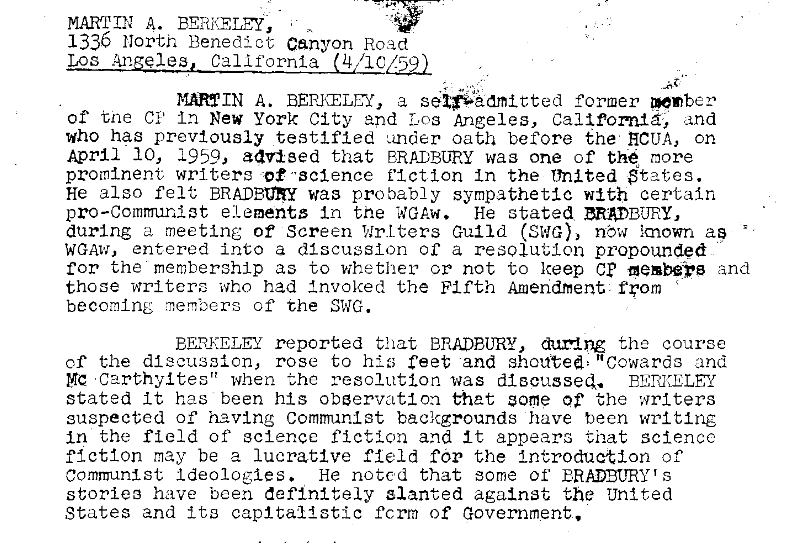
You can view the files themselves, obtained under the Freedom of Information Act, at MuckRock. There, the site’s JPat Brown also summarizes the organization’s basis for suspicion against the author: his “membership in the Screen Writer’s Guild, as well as his vocal opposition to McCarthyism, drew particular attention,” as did the use in TheMartian Chronicles of the “repeated theme that earthmen are despoilers and not developers.” Not just Bradbury’s work but the whole of science fiction, which informant Martin Berkeley calls a possibly “lucrative field for the introduction of Communist ideology,” comes in for an indictment.
“Communists have found fertile opportunities for development,” Berkeley says, “for spreading distrust and lack of confidence in America [sic] institutions in the area of Science Fiction writing.” Another, unsurprisingly clearer view of the genre comes from Bradbury himself, quoted disapprovingly in the file from a 1959 Women’s Legislative Action Bulletin. There, he said he uses the medium of science fiction to “try to bring to light some of the current fallacies in human values today” — the one thing, as the author of Fahrenheit 451 must have known full well, that the powers that be least want anybody to do. Get more at MuckRock.
For a certain period of time, it became very hip to think of classic tattoo artist Norman “Sailor Jerry” Collins as the epitome of WWII era retro cool. His name has become a prominent brand, and a household name in tattooed households—or those that watch tattoo-themed reality shows. But I submit to you another name for your consideration to represent the height of vintage rebellion: Maud Wagner (1877–1961).
No, “Maud” has none of the rakish charm of “Sailor Jerry,” but neither does the name Norman. I mean no disrespect to Jerry, by the way. He was a prototypically American character, tailor-made for the marketing hagiography written in his name. But so, indeed, was Maud Wagner, not only because she was the first known professional female tattoo artist in the U.S., but also because she became so, writes Margo DeMello in her history Inked, while “working as a contortionist and acrobatic performer in the circus, carnival, and world fair circuit” at the turn of the century.
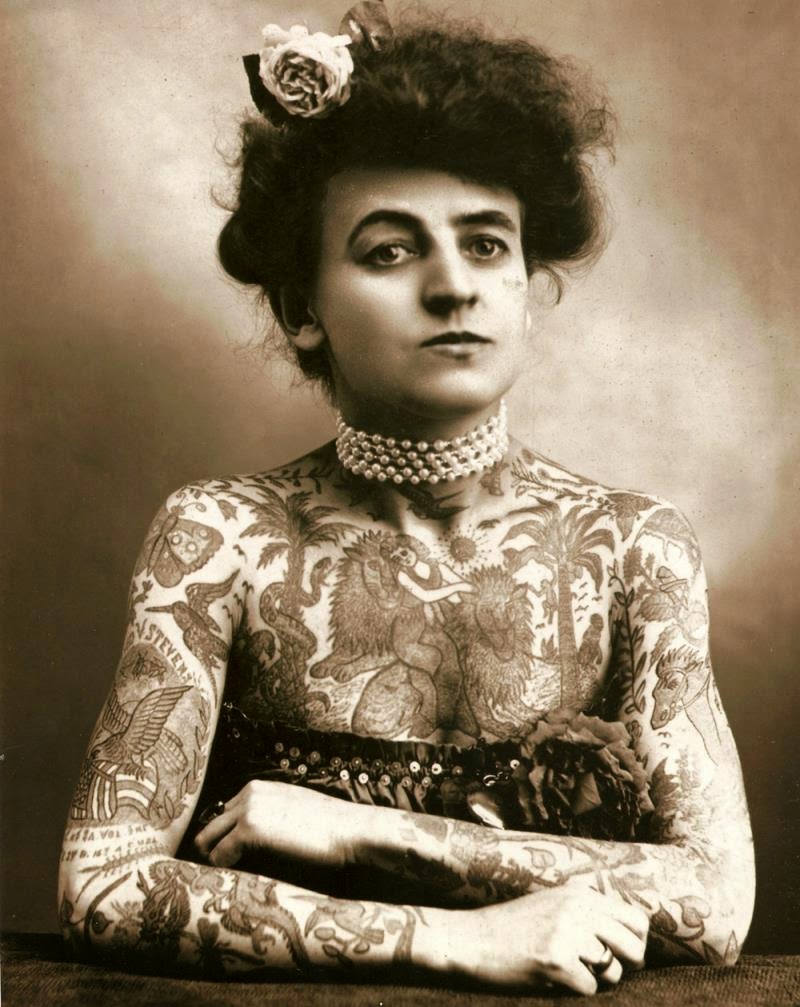
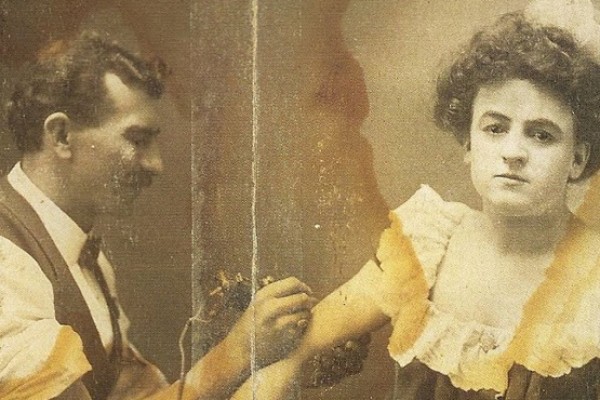
Aside from the cowboy perhaps, no spirit is freer in our mythology than that of the circus performer. The reality of that life was of course much less romantic than we imagine, but Maud’s life—as a side show artist and tattooist—involves a romance fit for the movies. Or so the story goes. She learned to tattoo from her husband, Gus Wagner, an artist she met at the St. Louis World’s Fair, who offered to teach her in exchange for a date. As you can see in her 1907 picture at the top, after giving her the first tattoo, he just kept going (see the two of them above). “Maud’s tattoos were typical of the period,” writes DeMello, “She wore patriotic tattoos, tattoos of monkeys, butterflies, lions, horses, snakes, trees, women, and had her own name tattooed on her left arm.”
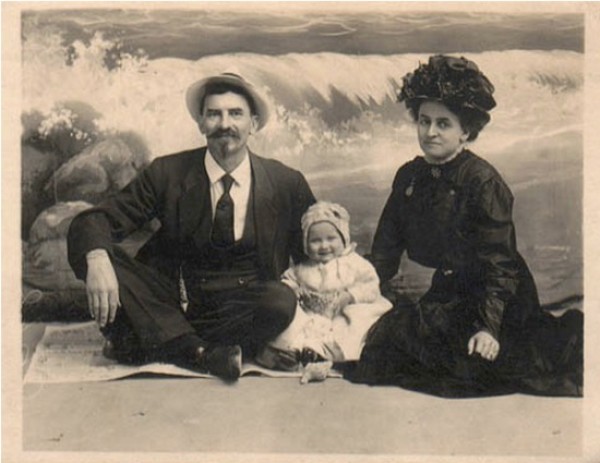
Unfortunately there seem to be no images of Maud’s own handiwork about, but her legacy lived on in part because Gus and Maud had a daughter, given the endearing name Lovetta (see the family above), who also became a tattoo artist. Unlike her mother, however, Lovetta did not become a canvas for her father’s work or anyone else’s. According to tattoo site Let’s Ink, “Maud had forbidden her husband to tattoo her and, after Gus died, Lovetta decided that if she could not be tattooed by her father she would not be tattooed by anyone.” Like I said, romantic story. Unlike Sailor Jerry, the Wagner women tattooed by hand, not machine. Lovetta gave her last tattoo, in 1983, to modern-day celebrity artist, marketing genius, and Sailor Jerry protégée Don Ed Hardy.
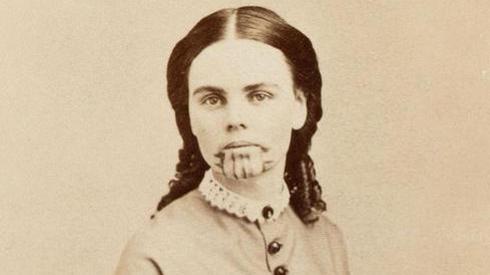
The cultural history of tattooed and tattooing women is long and complicated, as Margot Mifflin documents in her 1997 Bodies of Subversion: A Secret History of Women and Tattoo. For the first half of the twentieth century, heavily-inked women like Maud were circus attractions, symbols of deviance and outsiderhood. Mifflin dates the practice of displaying tattooed white women to 1858 with Olive Oatman (above), a young girl captured by Yavapis Indians and later tattooed by the Mohave people who adopted and raised her. At age nineteen, she returned and became a national celebrity.
Tattooed Native women had been put on display for hundreds of years, and by the turn of the 20th century World’s Fair, “natives… whether tattooed or not, were shown,” writes DeMello, in staged displays of primitivism, a “construction of the other for public consumption.” While these spectacles were meant to represent for fairgoers “the enormous progress achieved by the West through technological advancements and world conquest,” another burgeoning spectacle took shape—the tattooed lady as both pin-up girl and rebellious thumb in the eye of imperialist Victorianism and its cult of womanhood.
And here I submit another name for your consideration: Jessie Knight (above, with a tattoo of her family crest), Britain’s first female tattoo artist and also onetime circus performer, who, according to Jezebel, worked in her father’s sharp shooting act before striking out on her own as a tattooist. The Mary Sue quotes an unnamed source who writes that her job was “to stand before [her father] so that he could hit a target that was sometimes placed on her head or on an area of her body.” Supposedly, one night he “accidentally shot Jesse in the shoulder,” sending her off to work for tattoo artist Charlie Bell. As the narrator in the short film below from British Pathe puts it, Knight (1904–1994), “was once the target in a sharp shooting act. Now she’s at the business end of the target no more.”
The remark sums up the kind of agency tattooing gave women like Knight and the independence tattooed women represented. Popular stereotypes have not always endorsed this view. “Over the last 100 years,” writes Amelia Klem Osterud in Things & Ink magazine, “a stigma has developed against tattooed women—you know the misconceptions, women with tattoos are sluts, they’re ‘bad girls,’ just as false as the myth that only sailors and criminals get tattoos.”
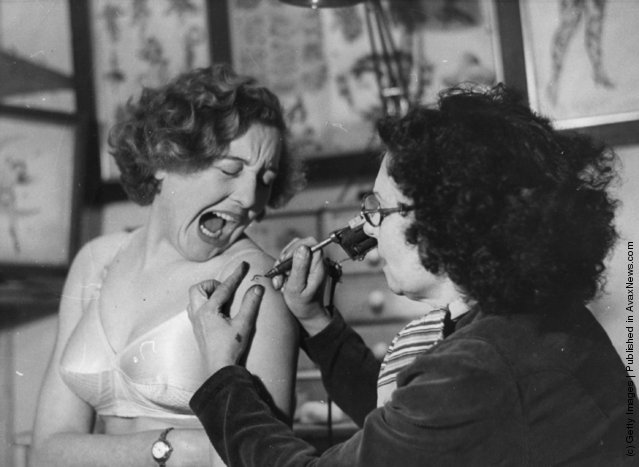
Jesse Knight—as you can see from the Pathe film and the photo above from 1951—was portrayed as a consummate professional, and in fact won 2nd place in a “Champion Tattoo Artist of all England” in 1955. See several more photos of her at work at Jezebel, and see a gallery of tattooed—and tattooist—ladies from Mifflin’s book at The New Yorker, including such characters as Botticelli and Michelangelo-tattooed Anna Mae Burlington Gibbons, Betty Broadbent, the tattooed contestant in the first televised beauty pageant, and Australian tattoo artist Cindy Ray, “The Classy Lassy with the Tattooed Chassis.” Now there’s a name to remember.
One often hears lamented the lack of well-spoken public intellectuals in America today. Very often, the lamenters look back to James Baldwin, who in the 1950s and 1960s wrote such powerful race‑, class‑, and sex-examining books as Go Tell It on the Mountain, Giovanni’s Room, and The Fire Next Time, as one of the greatest figures in the field.Though Baldwin expatriated himself to France for much of his life, he seems never to have let the state of his homeland drift far from his mind, and his opinions on it continued to put a charge into the grand American debate.
Upon one return from Paris in 1957, Baldwin found himself wrapped up in the controversy around the Civil Rights Act and the related movements across the south. He wrote several high-profile essays on the subject, even ending up himself the subject of a 1963 Time magazine cover story on his views. That same year, he went on a lecture tour on race in America which put him in close contact with a variety of student movements and other protests, whose efficacy he and Malcolm X debated in the broadcast above.
“While Malcolm X criticized the sit-in movement as passive,” writes Rhonda Y. Williams in Concrete Demands: The Search for Black Power in the 20th Century, “Baldwin argued that ‘maintaining calm in the face of vitriol demands a tremendous amount of power.’ ” He goes on to say that “when the sit-in movement started or when a great many things started in the western world, I think it had a great deal less to do with equality than with power.” This got him wondering about what he saw as the all-important distinction between “power and equality” and “power and freedom.”
Two years later, Baldwin appeared in another high-profile debate with about as different an interlocutor from Malcolm X as one can imagine: Firing Line host William F. Buckley, across from whom every well-spoken public intellectual in America of that era must have sat at one time or another. They discussed whether the American Dream comes “at the expense of the American negro.” Buckley, as Josh Jones wrote here in 2012, “had come out four years earlier against desegregation and Civil Rights legislation” and could ably defend his positions, but “Baldwin proved the more persuasive voice.”
Dissecting the skills of Baldwin the debater, John Warner of Inside Higher Education writes that “Baldwin’s remarks display all the skill and moves of an expert persuader” such as “the attendance to audience, the acknowledgement of their needs, the combination of both emotional and logical argument.” His arguments also have their roots not in “attitudes or beliefs, which are varied and changeable, but values, which are widely shared and immutable.”
Baldwin, Warner continues, “reminds us that America is the land of the free, the home of the brave, that all men are created equal, that we are here to pursue life, liberty, happiness,” but “while these values are powerful and timeless, our understanding of how they may be best achieved, the conditions under which they can be fostered change all the time.” Whether on the air or in text, against Malcolm X, William F. Buckley, or anyone else, his performance in debate shows that “the best and most lasting persuasion is simply the act of reminding people of what they already believe to be true.”
The assignment wasn’t as easy as he’d anticipated, the telegenic chef confesses before whipping up a lovely brown miche that appears far more mouth watering than the carbonized round found in the Herculaneum oven.
His recipe could be mistaken for modern sourdough, but he also has a go at several details that speak to bread’s role in ancient Roman life:
Its perimeter has a cord baked in to provide for easy transport home. Most Roman homes were without ovens. Those who didn’t buy direct from a bakery took their dough to community ovens, where it was baked for them overnight.
The loaf was scored into eight wedges. This is true of the 80 loaves found in the ovens of the unfortunate baker, Modestus. Locatelli speculates that the wedges could be used as monetary units, but I suspect it’s more a business practice on par with pizza-by-the-slice.
The crust bears a telltale stamp. Locatelli takes the opportunity to brand his with the logo of his Michelin-starred restaurant, Locanda Locatelli. His inspiration is stamped ‘Property of Celer, Slave of Q. Granius Verus.’ To me, this suggests the possibility that the bread was found in a communal oven.
Locatelli also introduces a Flintstonian vision when he alludes to specially-devised labor saving machines to which Roman bakers yoked “animals,” presumably donkeys…or knowing the Romans and their class system, slaves.
His published recipe is below. Here is a conversion chart for those unfamiliar with metric measurements.
INGREDIENTS
400g biga acida (sourdough)
12g yeast
18g gluten
24g salt
532g water
405g spelt flour
405g wholemeal flour
Melt the yeast into the water and add it into the biga. Mix and sieve the flours together with the gluten and add to the water mix. Mix for two minutes, add the salt and keep mixing for another three minutes. Make a round shape with it and leave to rest for one hour. Put some string around it to keep its shape during cooking. Make some cuts on top before cooking to help the bread rise in the oven and cook for 30–45 minutes at 200 degrees.
For an even more artisanal attempt (and extremely detailed instructions) check out the Artisan Pompeii Miche recipe on the Fresh Loaf bread enthusiast community.
Yes, this color newsreel above shows Berlin in 1936 as it gets ready to welcome the world for the Olympic Games. It’s a PR film meant to show the upside of the Reich, as Germans looked forward to a “better future”, and indeed the city looks just as gorgeous and exciting as other bustling European metropolises. There’s new construction alongside the classical architecture. There’s couples dancing to the latest hit tunes—Malneck and Mercer’s “Goody Goody” (which Benny Goodman had just released in February). There’s young men frolicking in the Wannsee while ladies sunbathe.
But then there’s those Nazis, ruining everybody’s travel plans. The streets are “festively decorated with flags with the current pattern” (ie. the swastika); we see a group of Hitler youth on a parade for the Führer; and while the “changing of the guard” may put some in mind of Buckingham Palace, here they’ve got the full goose-stepping going on. And the film ends very oddly: a shot of the guards outside the Ministry of Aviation, home to morphine addict and concentration camp co-creator Hermann Göering.
Flash forward to July 1945, and what a difference surrender to the Allies makes: Berlin in ruins, large posters of Stalin, and the signs of the divisions that eventually end in the 1961 building of the Berlin Wall. The newsreel concludes with a dramatic aerial shot of the entire city, taking in the amount of destruction.
We’ve featured this 1945 film before, but this before-and-after comparison speaks to the devastation of war and the determination to rebuild.
If you would like to support the mission of Open Culture, consider making a donation to our site. It’s hard to rely 100% on ads, and your contributions will help us continue providing the best free cultural and educational materials to learners everywhere. You can contribute through PayPal, Patreon, and Venmo (@openculture). Thanks!
Ted Mills is a freelance writer on the arts who currently hosts the FunkZone Podcast. You can also follow him on Twitter at @tedmills, read his other arts writing at tedmills.com and/or watch his films here.
We're hoping to rely on loyal readers, rather than erratic ads. Please click the Donate button and support Open Culture. You can use Paypal, Venmo, Patreon, even Crypto! We thank you!
Open Culture scours the web for the best educational media. We find the free courses and audio books you need, the language lessons & educational videos you want, and plenty of enlightenment in between.
 must have known full well, that the powers that be least want anybody to do. Get more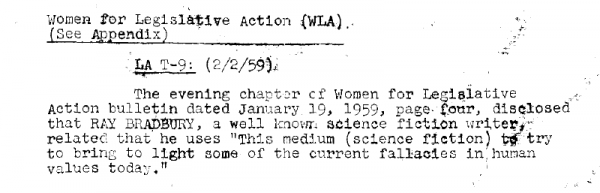
 . For the first half of the twentieth century, heavily-inked women like Maud were circus attractions, symbols of deviance and outsiderhood. Mifflin dates the practice of displaying tattooed white women to 1858 with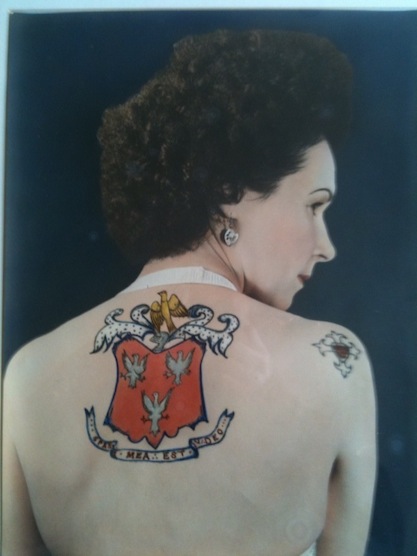
 ,
,  , and
, and  , “Baldwin argued that ‘maintaining calm in the face of vitriol demands a tremendous amount of power.’ ” He goes on to say that “when the sit-in movement started or when a great many things started in the western world, I think it had a great deal less to do with equality than with power.” This got him wondering about what he saw as the all-important distinction between “power and equality” and “power and freedom.”



