Now free for the world to see on the Cambridge University Digital Library are some treasures from the library’s Chinese collections. Fire up that time machine called the Internet, and you can start perusing:
The oracle bones (pieces of ox shoulder blades and turtle shells used for divination in ancient China) which importantly bear the earliest surviving examples of Chinese writing. They’re over three thousand years old.
A 14th-century banknote. According to Cambridge, “Paper currency first appeared in China during the 7th century, and was in wide circulation by the 11th century, 500 years before its first use in Europe.”
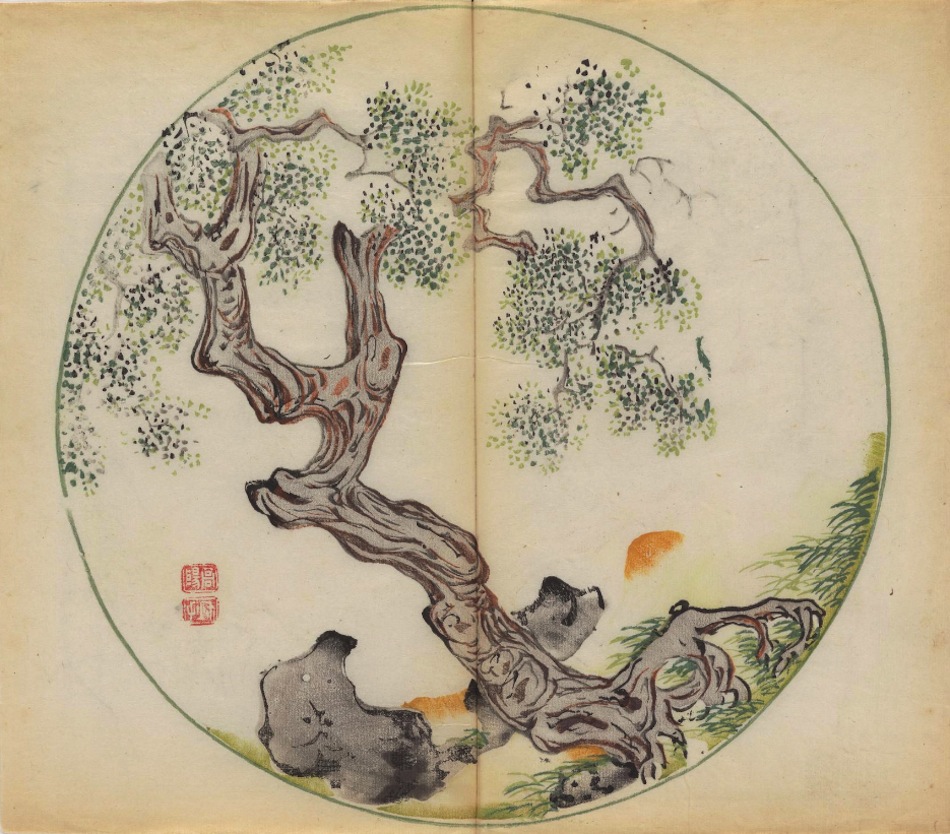
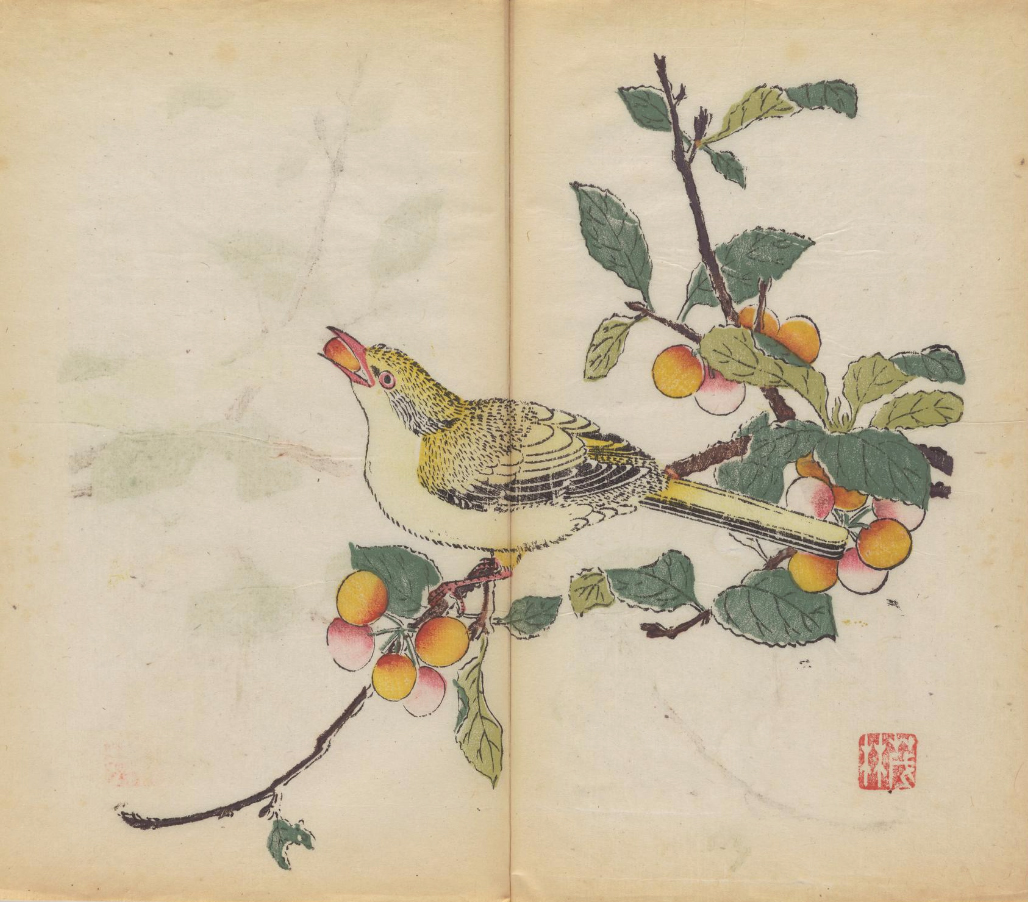
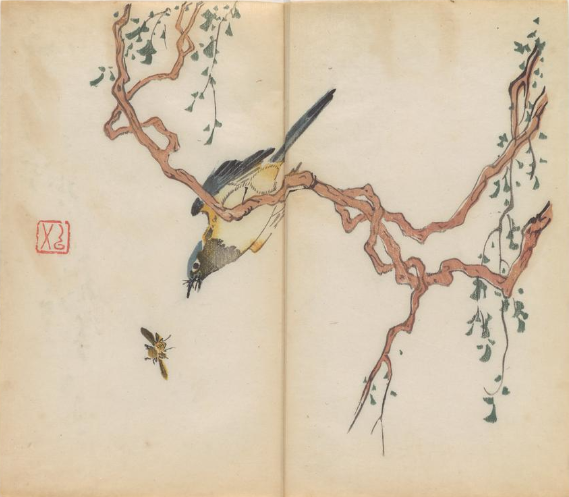
Made in 1633 in Nanjing, the Manual of Calligraphy and Paintingis noteworthy partly because “It is the earliest and finest example of multi-colour printing anywhere in the world, comprising 138 paintings and sketches with associated texts by fifty different artists and calligraphers.” And partly because “The binding is so fragile, and the manual so delicate, that until it was digitized, we have never been able to let anyone look through it or study it – despite its undoubted importance to scholars,” says Charles Aylmer, Head of the Chinese Department at Cambridge University Library.
Begin your digital tour of the 388-page Manual here (or see a few samples above) and be among the first to lay eyes on it.
If you would like to support the mission of Open Culture, consider making a donation to our site. It’s hard to rely 100% on ads, and your contributions will help us continue providing the best free cultural and educational materials to learners everywhere. You can contribute through PayPal, Patreon, and Venmo (@openculture). Thanks!
This is usually what happens when I write a piece for Open Culture: As I drink an overpriced coffee at my local coffee shop, I research a topic on the internet, write and edit an article on Microsoft Word and then copy and paste the whole thing into WordPress. My editor in Open Culture’s gleaming international headquarters up in Palo Alto gives it a look-over and then, with the push of a button, publishes the article on the site.
It’s sobering to think what I casually do over the course of a morning would require the effort of dozens of people 40 years ago.
Until the 1970s, with the rise in popularity of computer typesetting, newspapers were printed the same way for nearly a century. Linotype machines would cast one line at a time from molten lead. Though an improvement from handset type, where printers would assemble lines of type one character at a time, linotype still required numerous skilled printers to assemble each and every newspaper edition.
The New York Timestransitioned from that venerated production method to computer typesetting on Sunday, July 2, 1978. David Loeb Weiss, a proofreader at the Times, documented this final day in the documentary Farewell — Etaoin Shrdlu.
The title of the movie, by the way, comes from the first two lines of a printer’s keyboard, which are arranged according to a letter’s frequency of use. When a printer typed “etaoin shrdlu,” it meant that the line had a mistake in it and should be discarded.
Watching the movie, you get a sense of just how much work went into each page and how printers were skilled craftsmen. (You try spotting a typo on a page of upside down and backwards type.) The film also captures the furious energy and the cacophony of clinks and clanks of the composing room. You can see just how much physical work was involved. After all, each page was printed off of a 40-pound plate made of lead.
The tone of the movie is understandably melancholy. The workers are bidding farewell to a job that had existed for decades. “All the knowledge I’ve acquired over my 26 years is all locked up in a little box now called a computer,” notes one printer. “And I think most jobs are going to end up the same way.” Someone else wrote the following on the composing room’s chalkboard. “The end of an era. Good while it lasted. Crying won’t help.”
Jonathan Crow is a Los Angeles-based writer and filmmaker whose work has appeared in Yahoo!, The Hollywood Reporter, and other publications. You can follow him at @jonccrow. And check out his blog Veeptopus, featuring lots of pictures of vice presidents with octopuses on their heads. The Veeptopus store is here.
In January, in the dead of winter, we got you thinking about warmer times by highlighting the Noam Chomsky Garden Gnome, a real product described as follows:
Standing at just under 17 inches, Gnome Chomsky the Garden Noam clutches his classic books, ‘The Manufacture of Compost’ and ‘Hedgerows not Hegemony’ – with his open right hand ready to hold the political slogan of your choosing. His clothes represent a relaxed but classy version of regular gnome attire, including: a nice suit jacket-tunic, jeans, boots, traditional gnome cap, and glasses. Additionally, Noam Gnome stands on a base complete with a carved title – for anyone who may not immediately realize the identity of this handsome and scholarly gnome.
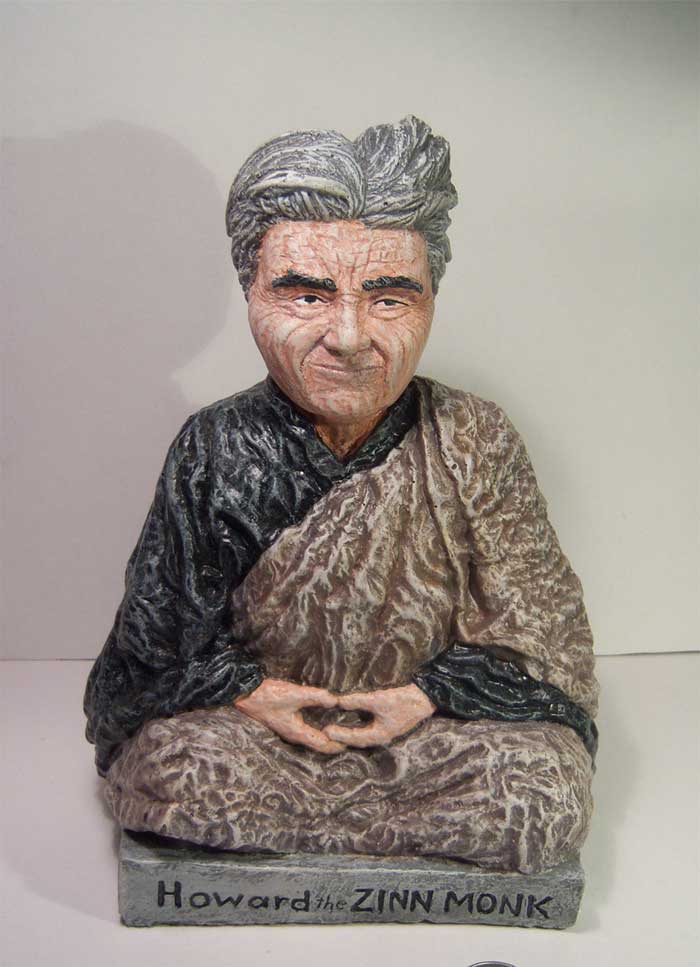
Now that it’s summer, imagine Gnome Chomsky hanging in your garden with Howard the Zinn Monk. Zinn Monk, get it?
First published in 1980, Zinn’s famous book A People’s History of the United Statestells “America’s story from the point of view of—and in the words of—America’s women, factory workers, African-Americans, Native Americans, the working poor, and immigrant laborers.” It has sold more than two million copies over the past 35 years. And, as I write this post, it’s the #1 bestselling book in US history on Amazon.
Howard the Zinn Monk isn’t quite selling at the same brisk clip. But the web site justsaygnome.net might make you a Zinn gnome if you ask nicely.
Both Faulkner and the physicists may be right: the passage of time is an illusion. And yet, for as long as we’ve been keeping score, it’s seemed that history really exists, in increasingly distant forms the further back we look. As Jonathan Crow wrote in a recent post on news service British Pathé’s release of 85,000 pieces of archival film on YouTube, seeing documentary evidence of just the last century “really makes the past feel like a foreign country—the weird hairstyles, the way a city street looked, the breathtakingly casual sexism and racism.” (Of course there’s more than enough reason to think future generations will say the same of us.) British Pathé’s archive seems exhaustive—until you see the latest digitized collection on YouTube from AP (Associated Press) and British Movietone, which spans from 1895 to the present and brings us thousands more past tragedies, triumphs, and hairstyles
This release of “more than 1 million minutes” of news, writes Variety, includes archival footage of “major world events such as the 1906 San Francisco earthquake, exclusive footage of the bombing of Pearl Harbor in 1941, the fall of the Berlin Wall and the 2001 terrorist attacks on the U.S.” And so much more, such as the newsreel above, which depicts Berlin in 1945, eventually getting around to documenting the Potsdam Conference (at 3:55), where Churchill, Stalin, and Truman created the 17th parallel in Vietnam, dictated the terms of the German occupation, and planned the coming Japanese surrender. No one at the time could have accurately foreseen the historical reverberations of these actions.
Another strange, even uncanny piece of film shows us the English football team giving the Nazi salute in 1938 at the commencement of a game against Germany. “That’s shocking now,” says Alwyn Lindsay, the director of AP’s international archive, “but it wasn’t at the time.” Films like these have become of much more interest since The Sun published photographs of the royal family—including a young Queen Elizabeth II and her uncle Prince (later King, then Duke) Edward VIII—giving Nazi salutes in 1933. Though it was not particularly controversial, and the children of course had little idea what it signified, it did turn out that Edward (seen here) was a would-be Nazi collaborator and remained an unapologetic sympathizer.
This huge video trove doesn’t just document the grim history of the Second World War, of course. As you can see in the AP’s introductory montage at the top of the post, there is “a world of history at your fingertips”—from triumphant video like Nelson Mandela’s release from prison, above, to the below film of “Crazy 60s Hats in Glorious Colour.” And more or less every other major world event, disaster, discovery, or widespread trend you might name from the last 120 or so years.
Movietone’s one nod to the present takes the form of “The Archivist Presents,” in which a historian offers quirky context on some bit of archival footage, like that above of the Kinks getting their hair curled. The completely unironic lounge music and casually sexist narration will make you both smile and wince, as do Ray Davies and company when they see their new hair. Most of the films in this million minutes of news footage (and counting) tend to elicit either or both of these two emotional reactions—joy (or amusement) or mild to intense horror, and watching them makes the past they show us feel paradoxically more strange and more immediate at once.
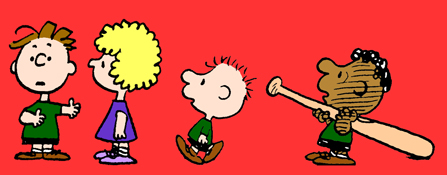
Like many children of the 70s, I was wild for Charles Schulz’s Peanuts, and had the merchandise to prove it. I was a Snoopy girl, for the most part, but not averse to receiving items featuring other characters—Linus, Schroeder, the caustic Lucy, PigPen, and, of course, Charlie Brown. My father was a sucker for the comparatively butch Peppermint Patty, and Marcie, the bespectacled hanger-on who referred to Patty as “Sir.”
But there was one character I don’t remember seeing on any Peanuts swag in 1970s Indiana…. Actually, that’s not accurate. I don’t remember any Shermy sweatshirts. Female second bananas like Violet, the original, i.e. non-Peppermint Patty, and Frieda were also underrepresented, despite the latter’s oft-mentioned naturally curly hair.
The character I’m thinking of never became a major player, but he was notable. Ground-breaking even. Can you guess?
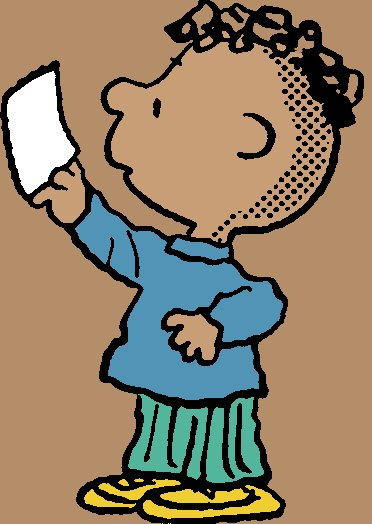
Thats right: Franklin, the only African-American member of the Peanuts gang.
(An African-American toddler, Milo, below, had a 17-strip run in 1977 when Charlie Brown had to skip town after exacting his revenge on the kite-eating tree… That’s it. Poor Franklin.)
Franklin owes his existence, in large part, to Harriet Glickman, a white teacher from LA, who found letter writing one of the few forms of activism in which a mother of three children—all squarely within the Peanuts demographic—could fully participate. Raised by liberal parents to consider herself a global citizen, and to speak out against injustice, she wrote the authors of several leading comic strips in the wake of Dr. Martin Luther King’s assassination in April, 1968. Would the creators of Peanuts and Mary Worth consider introducing a black character into the mix, as a first step on what Glickman foresaw as a “long and tortuous road” toward a future climate of “open friendship, trust and mobility” between the races?
Mary Worth’sAllen Saunders declined, apparently saying that he shared Glickman’s sentiments but feared the syndicate would drop his strip if he followed her suggestion.
Schulz didn’t exactly leap at the chance, either, saying that he was in the same boat as the other sympathetic cartoonists who’d begged off. What he feared wasn’t so much the syndicate’s response, as the suspicion that he might be seen as “patronizing our Negro friends.”
Glickman persisted, asking his permission to share his letter with some of her “Negro friends,” all parents. Perhaps they could offer some thoughts that might induce the cartoonist to say yes.
I’d like to express an opinion as a Negro father of two young boys. We have a situation in America in which racial enmity is constantly portrayed.
Like Glickman, he felt that a “casual day-to-day scene” featuring a non-white character would give his sons and other children of color a chance to see themselves reflected in the strip, while promoting “racial amity” to readers of all races.
Glickman expressed hope that Peanuts would eventually grow to include more than one black child:
Let them be as adorable as the others…but please…allow them a Lucy!
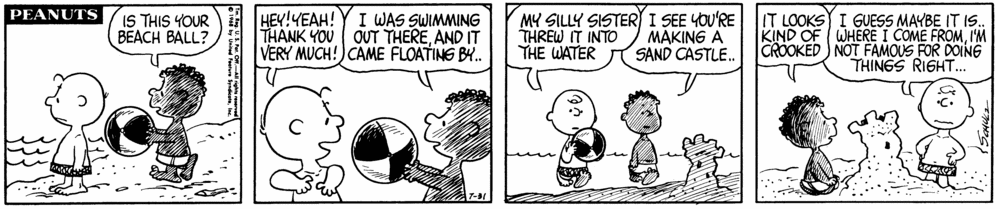
Within weeks of receiving Kelly’s letter, and just over two months into Glickman’s letter-writing campaign, Schulz reached a decision. He wrote Glickman that she should check the paper the week of July 29, 1968.
Franklin, his skin tone indicated by closely set diagonal lines, made his debut in a bathing suit, returning Charlie Brown’s runaway beach ball. The encounter took three days to play out, during which Franklin and Charlie Brown form an alliance of vacationing children whose usual playmates are elsewhere. It would seem that the major difference between them is that Franklin’s dad is in Vietnam. Obviously, a lot of thought went into their casual dialogue.
Benign as Franklin was, his presence sparked outrage. Some Southern readers cried foul when he showed up in the same classroom as Marcie and Peppermint Patty. Others felt Franklin wasn’t black enough.
Ultimately Franklin never achieved A‑list status, but he did resonate with certain readers, notably William Bell, a diversity officer working with the Cincinnati Police Department.
Visit Mashable to see reproductions of Glickman and Schulz’s correspondence. And watch the video above to hear more about her upbringing and another comic that featured black characters, Dateline: Danger!, a collaboration between Saunders’ son John and artist Al McWilliams.
Gallagher worked for ten months to counteract the various indignities it had suffered, including a re-stretching that left the original canvas severely creased, and a Gilded Age application of varnish that weathered poorly over time.
It’s a painstaking process, restoring such a work to its original glory, requiring countless Q‑tips and a giant roller that allowed staffers to safely flip all 9 x 10.75 feet of the massive canvas. Gallagher identifies the last step, a sprayed-on coat of varnish necessary for teasing out the painting’s original luster, as the most nerve-wracking part of the odyssey.
Now that you know what went into it, you really should go visit it in person, if only to marvel at how the majority of visitors stream obliviously past, bound for the gift shop, the cafe, or other more name brand attractions.
(Certainly Le Brun, First Painter to Louis XIV, was a name brand in his day.)
Somewhere along the line today, take a break from the festivities and remind yourself what we’re actually celebrating here in America — the signing of America’s founding document 239 years ago. Drafted by Thomas Jefferson, The Declaration of Independence remains perhaps the best statement of our country’s aspirations. And after the Supreme Court’s recent Obergefell v. Hodges decision, many would say that the document — proclaiming that “all men are created equal” and have inalienable rights, “Life, Liberty and the pursuit of Happiness” — feels more alive than it has for some time. But no matter where you sit on the political spectrum, it’s helpful to return to The Declaration and its core principles. You can read the opening lines below, and the full text here.
Above, we have some very recognizable Hollywood celebs (including eight Oscar winners) reading The Declaration. (Beneath it, we’ve included a grainier version that features a nice preface by Morgan Freeman). For the sake of making this worthwhile, pretend it isn’t the infamous Mel Gibson reading the very first lines.
When in the Course of human events, it becomes necessary for one people to dissolve the political bands which have connected them with another, and to assume among the powers of the earth, the separate and equal station to which the Laws of Nature and of Nature’s God entitle them, a decent respect to the opinions of mankind requires that they should declare the causes which impel them to the separation.
We hold these truths to be self-evident, that all men are created equal, that they are endowed by their Creator with certain unalienable Rights, that among these are Life, Liberty and the pursuit of Happiness.–That to secure these rights, Governments are instituted among Men, deriving their just powers from the consent of the governed, –That whenever any Form of Government becomes destructive of these ends, it is the Right of the People to alter or to abolish it, and to institute new Government, laying its foundation on such principles and organizing its powers in such form, as to them shall seem most likely to effect their Safety and Happiness. Prudence, indeed, will dictate that Governments long established should not be changed for light and transient causes; and accordingly all experience hath shewn, that mankind are more disposed to suffer, while evils are sufferable, than to right themselves by abolishing the forms to which they are accustomed. But when a long train of abuses and usurpations, pursuing invariably the same Object evinces a design to reduce them under absolute Despotism, it is their right, it is their duty, to throw off such Government, and to provide new Guards for their future security.–Such has been the patient sufferance of these Colonies; and such is now the necessity which constrains them to alter their former Systems of Government. The history of the present King of Great Britain is a history of repeated injuries and usurpations, all having in direct object the establishment of an absolute Tyranny over these States. To prove this, let Facts be submitted to a candid world.
If you would like to support the mission of Open Culture, consider making a donation to our site. It’s hard to rely 100% on ads, and your contributions will help us continue providing the best free cultural and educational materials to learners everywhere. You can contribute through PayPal, Patreon, and Venmo (@openculture). Thanks!
I recently heard someone say his college-bound nephew asked him, “What’s a union?” Whether you love unions, loathe them, or remain indifferent, the fact that an ostensibly educated young person might have such a significant gap in their knowledge should cause concern. A historic labor conflict, after all, provided the occasion for Ronald Reagan to prove his bona fides to the new conservative movement that swept him into power. His crushing of the Professional Air Traffic Controllers Organization (PATCO) in 1981 set the tone for the ensuing 30 years or so of economic policy, with the labor movement fighting an uphill battle all the way. Prior to that defining event, unions held sway over politics local and national, and had consolidated power blocks in the American political landscape through decades of struggle against oppressive and dehumanizing working conditions.
In practical terms, unions have stood in the way of capital’s unceasing search for cheap labor and new consumer markets; in social and cultural terms, the politics of labor have represented a formidable ideological challenge to conservatives as well, by way of a vibrant assemblage of anarchists, civil libertarians, anti-colonialists, communists, environmentalists, pacifists, feminists, socialists, etc. A host of radical isms flourished among organized workers especially in the decades between the 1870s and the 1970s, finding their voice in newsletters, magazines, pamphlets, leaflets, and posters—fragile mediums that do not often weather well the ravages of time. Thus the advent of digital archives has been a boon for students and historians of workers’ movements and other populist political groundswells. One such archive, the Joseph A. Labadie Collection at the University of Michigan Library, has recently announced the digitization of over 2,200 posters from their collection, a database that spans the globe and the spectrum of leftist political speech and iconography.
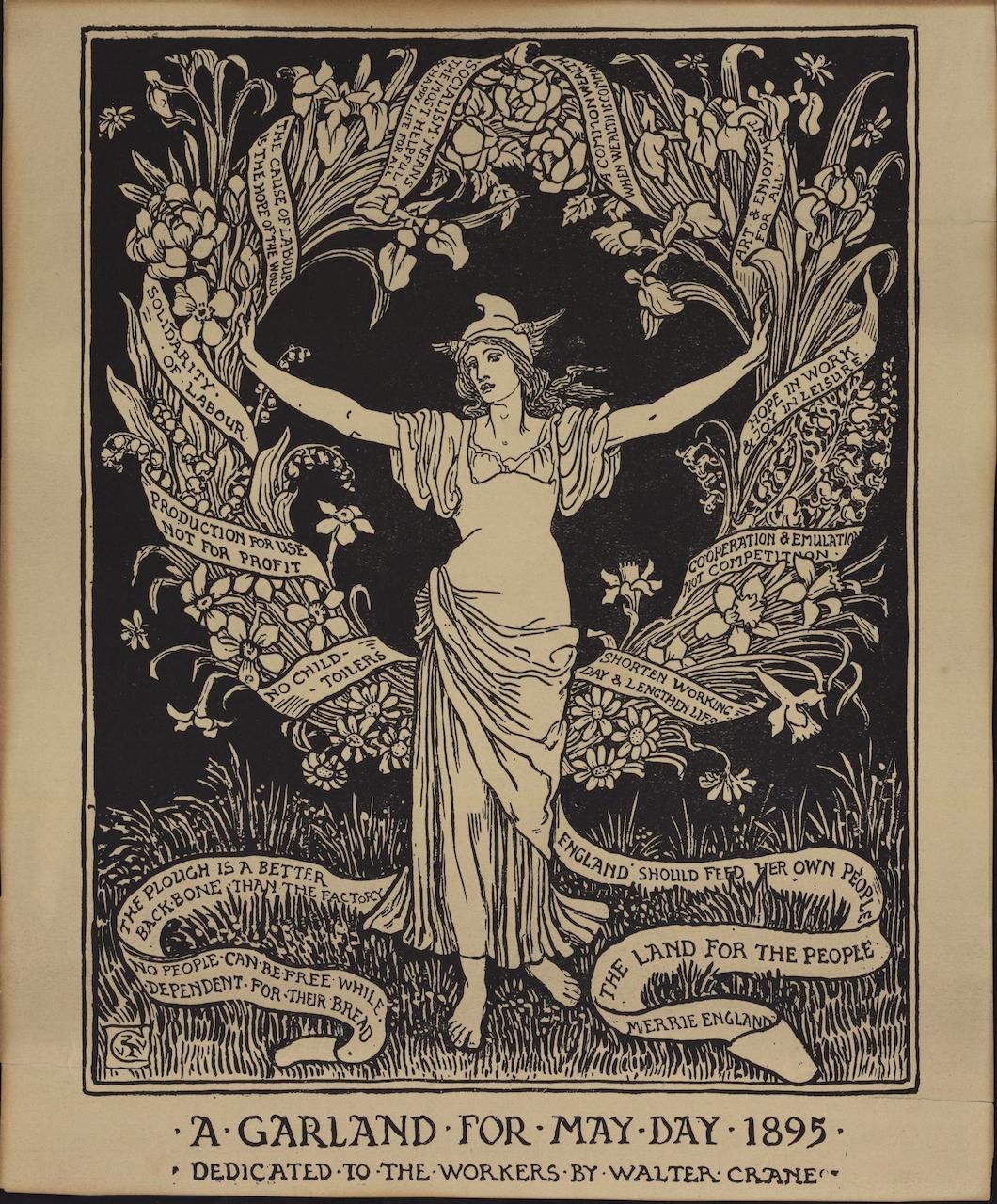
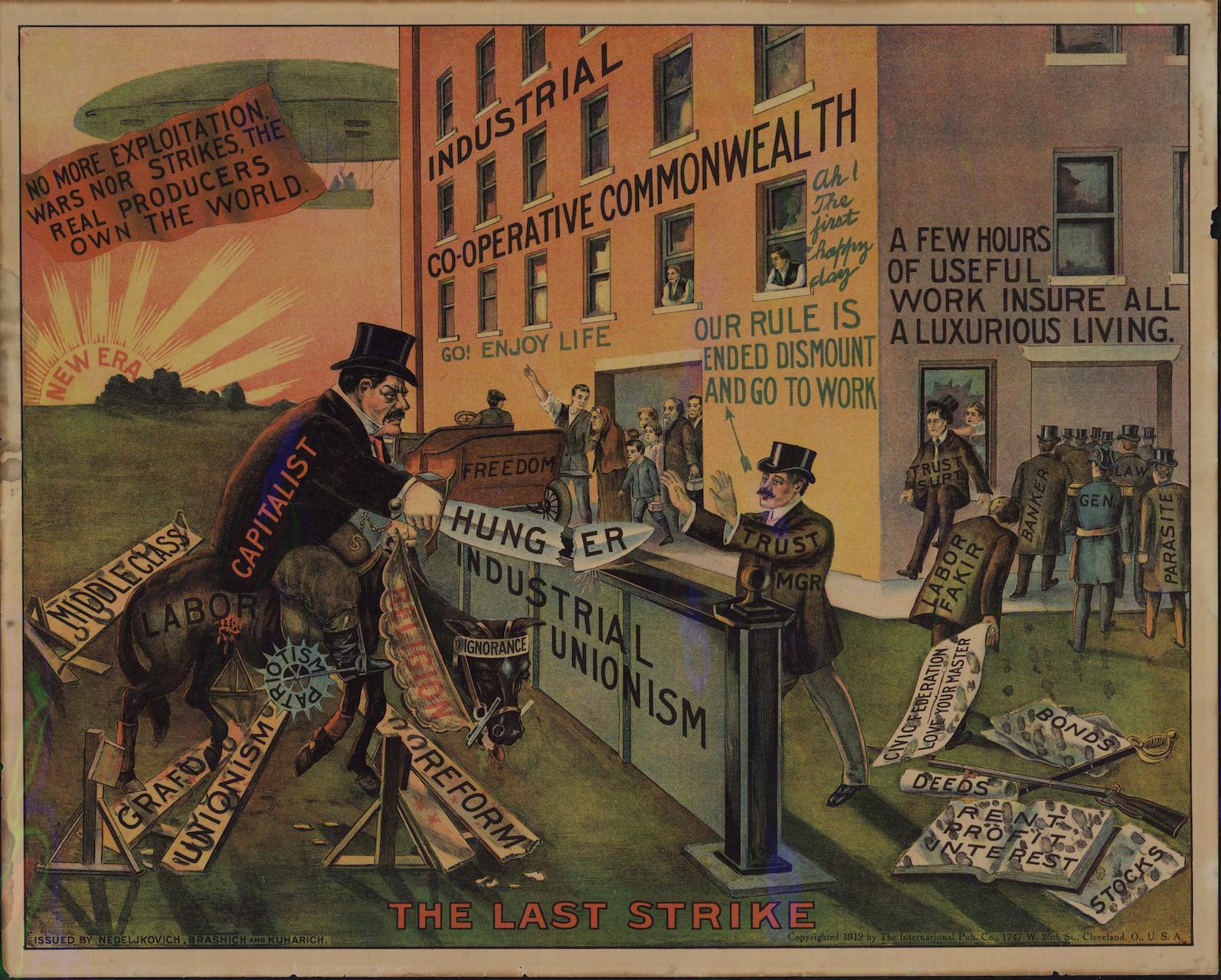
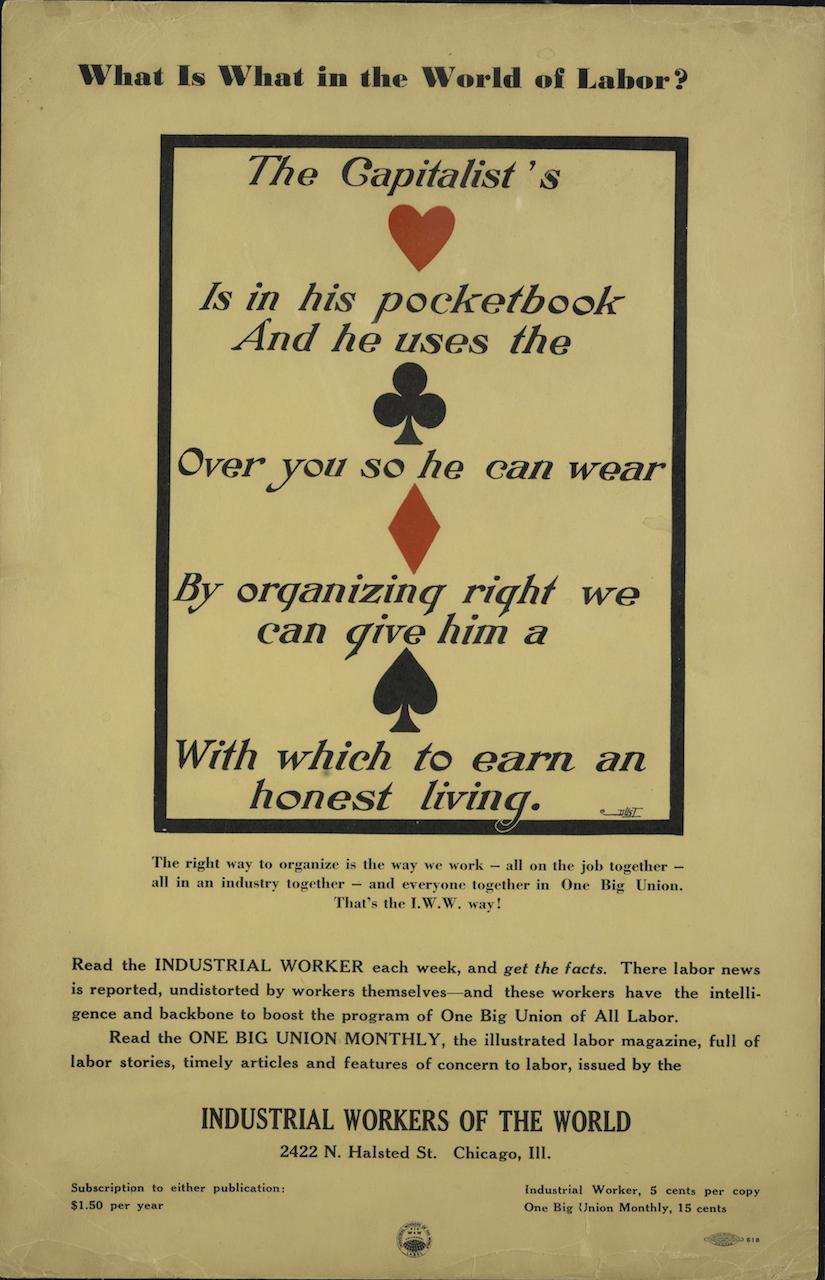
We have cleverly-designed visual puns like the Chicago Industrial Workers of the World poster just above, titled “What is what in the world of labor?” Promoting itself as “One Big Union of All Labor,” the IWW made some of the most ambitious propaganda, like the 1912 poster (middle) in which an “Industrial Co-Operative Commonwealth” replaces the tyranny of the capitalist, who is told by his “trust manager” peer, “Our rule is ended, dismount and go to work.” In this post-revolutionary fantasy, the IWW promises that “A few hours of useful work insure all a luxurious living,” though it only hints at the details of this utopian arrangement. Up top, we have an ornate May Day poster from 1895 by Walter Crane, hoping for a “Merrie England” with “No Child Toilers,” “Production for Use Not For Profit,” and “The Land For the People,” among other, more nationalist, sentiments like “England Should Feed Her Own People.”
“While all of the posters were scanned at high resolution,” writes Hyperallergic, “they appear online as thumbnails with navigation to zoom.” You can download the images, but only the smaller, thumbnail size in most cases. These hundreds of posters represent “just a portion of the material in the Labadie Collection”—named for a “Detroit-area labor organizer, anarchist, and author” who “had the idea for the social protest archive at the university in 1911.” You can view other political artifacts in the UMich library’s digital collections here, including anarchist pamphlets, political buttons, and a digital photo collection. The collection as a whole gives us a potentially inspiring, or infuriating, mosaic of political thought at its boldest and most graphically assertive from a time before online petitions and hashtag campaigns took over as the primary circulators of popular radical thought.
We're hoping to rely on loyal readers, rather than erratic ads. Please click the Donate button and support Open Culture. You can use Paypal, Venmo, Patreon, even Crypto! We thank you!
Open Culture scours the web for the best educational media. We find the free courses and audio books you need, the language lessons & educational videos you want, and plenty of enlightenment in between.