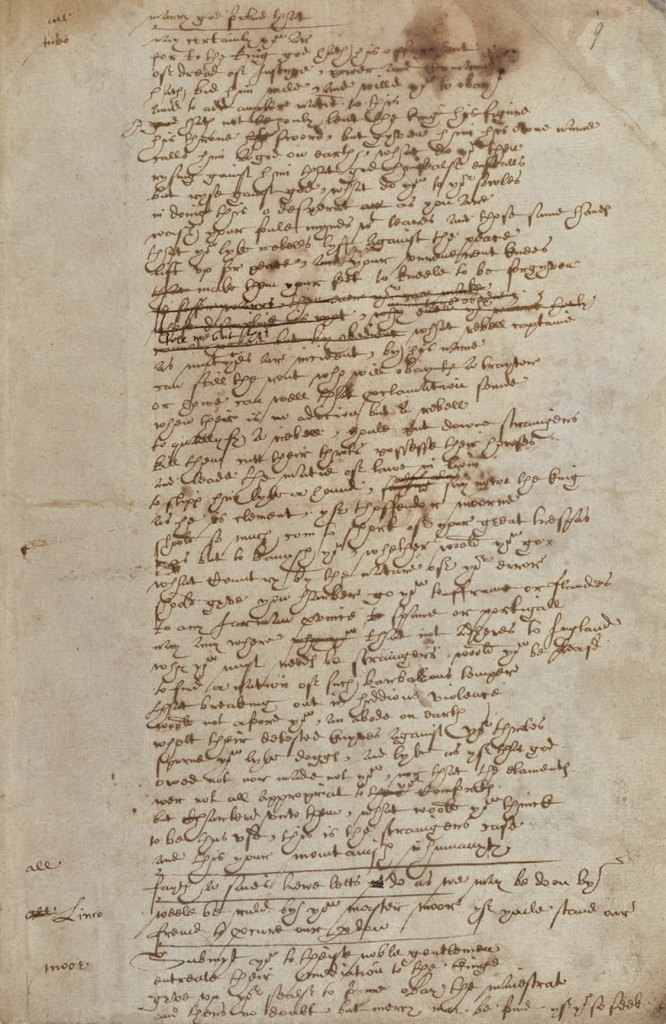
Last week, we posted on how scholars have tried to recover the original pronunciations of Shakespeare’s plays and poems when performed on the stage. Today, we bring you the bard’s original handwriting. Shakespeare’s handwriting has recently become the focus of a new article by Professor Douglas Bruster at UT Austin, who is using an analysis of the playwright’s quirky spellings and penmanship to solve a very old question of authorship. The page of handwriting you see above is a fragment of a lost play called Sir Thomas More and it goes by the name of “Hand D” (click the image above, and then the image that appears — for a much larger version).
Bruster’s short essay, published this month in the Oxford journal Notes & Queries, is far too inside baseball for anyone but hardcore textual scholars to make much sense of, but this New York Times article does a good job of distilling the finer points. Suffice it to say that thanks to Bruster’s painstaking analysis of Shakespeare’s distinctive handwriting, we can be fairly certain that a 1602 revision of Thomas Kyd’s enormously popular Renaissance play The Spanish Tragedy—in the words of Shakespeare scholar Eric Rasmussen—has the bard’s “fingerprints all over it.”
If you look closely at Francis Bicknell Carpenter’s 1864 painting “First Reading of the Emancipation Proclamation by President Lincoln” (see above — click image for a larger version) you will notice a map in the lower right-hand corner, next to the group that includes Lincoln and his cabinet.
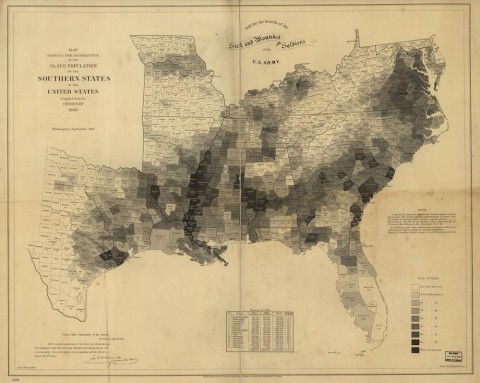
The map in the painting was a document Lincoln consulted often during the Civil War. It was created by the United States Coast Survey using data from the 1860 Census to show the geographic distribution of the South’s vast slave population.
The map (click it to see a larger version) is an early example of statistical cartography. The slave population of each county is represented numerically and through a graded scale of shading. The higher the number of slaves, the darker the shade. In a 2010 piece in the New York Times “Opinionator” blog, Schulten writes:
The map reaffirmed the belief of many in the Union that secession was driven not by a notion of “state rights,” but by the defense of a labor system. A table at the lower edge of the map measured each state’s slave population, and contemporaries would have immediately noticed that this corresponded closely to the order of secession. South Carolina, which led the rebellion, was one of two states which enslaved a majority of its population, a fact starkly represented on the map.
The map helped Lincoln visualize what he was up against. Areas along the Atlantic coast and Mississippi River, for example, are darkly shaded. The white populace in those areas was fanatically resistant to emancipation. “Conversely,” writes Schulten, “the map illustrated the degree to which entire regions — like eastern Tennessee and western Virginia — were virtually devoid of slavery, and thus potential sources of resistance to secession. Such a map might have reinforced President Abraham Lincoln’s belief that secession was animated by a minority and could be reversed if Southern Unionists were given sufficient time and support.”
Anyone whose job involves interaction with the general public will be subjected to a certain number of boneheaded questions on any given day. Those numbers skyrocket when one must remain in both costume and character, charged with bringing history to life.
Azie Dungey, the creator and star of the new web series, Ask a Slave, claims to have “played every black woman of note that ever lived” when she was employed as an historic interpreter in the Washington DC area. These included Caroline Branham, Martha Washington’s enslaved lady’s maid, a gig that compelled her to keep a record of questions posed by visitors to Mount Vernon.
Now, as the tea-sipping, fictional Lizzie Mae, Dungey is able to answer those questions with greater freedom. A middle-aged, seemingly educated white man wonders if a newspaper ad is what led to Lizzie Mae’s position in the home of “such a distinguished Founding Father” as George Washington.
“Did I read the advertisement in the newspaper?” Lizzie Mae echoes pleasantly. “Why, yes. It said Wanted: One housemaid. No pay. Preferably mulatto, saucy with breeding hips. Must work 18 hour a days, seven days a week, no holidays. But you get to wear a pretty dress, and if you’re lucky you just might carry some famous white man’s bastard child. So, you better believe I read that and I ran right over and said, “Sign me up!””
Her default tone is one of professionally patient indulgence, though occasionally, the mask slips, as when another visitor asserts that “slavery isn’t really that bad.”
Sticking to the historic interpreter’s schtick of not recognizing non-period inventions like cameras pays dividends when the subject turns to internships, the underground railroad, and what George Washington thinks of Abraham Lincoln freeing all his slaves.
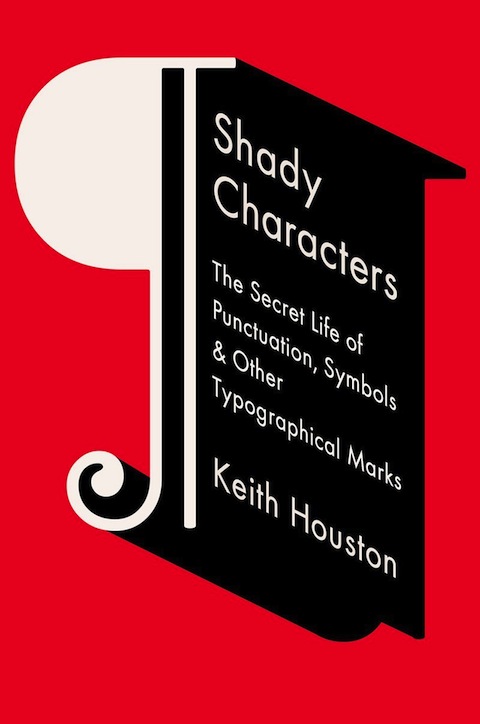
All things we humans use, from our advanced mobile phones to our very arms and legs, reached their current states through a process of evolution. The same, naturally, goes for our punctuation marks. These tools we use to separate, connect, or draw attention to our words and sentences had different forms and uses in bygone times, and Scotland-based medical visualization software programmer Keith Houston has taken it upon himself to trace paths through all of them. In the introduction to his history-of-punctuation blog Shady Characters, he recounts his unlikely source of inspiration in Eric Gill’s Essay on Typography: “my interest was piqued by the unusual character resembling a reversed capital ‘P’ — ‘¶’ — which peppered the text at apparently random intervals.” This little-discussed mark, called a pilcrow, led Houston to ask the sort of questions that drive his project: “How did the pilcrow’s curious reverse‑P form come about? What were the roots of its pithy, half-familiar name? What caused it to fall out of use, and having done just that, why did Eric Gill see fit to place them seemingly at random in his only published work on typography? What, in other words, was the pilcrow all about?”
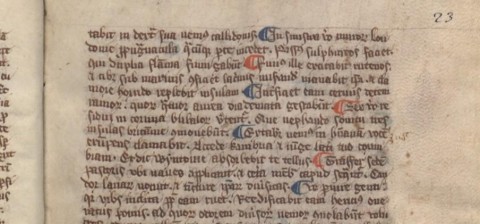
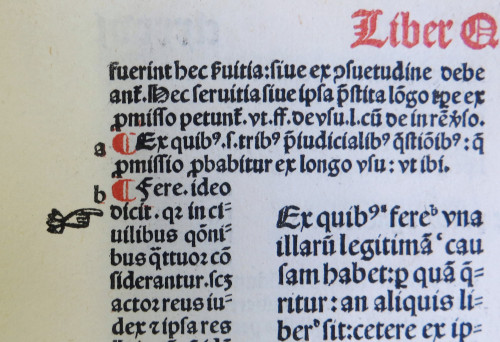
In a recent New Yorker post, Houston works toward the answers by looking back to the pilcrow’s precursors. “Before there was any other punctuation there was the paragraphos—from the Greek para-, ‘beside,’ and graphein, ‘write’,” he explains. “A simple horizontal stroke placed in the left margin beside a line of text, the paragraphos was used in ancient Greece to call attention to conceptual changes in an otherwise unbroken block of text: a new topic, perhaps, or a new stanza in a poem.” This, over the centuries, became the pilcrow, just as “the Latin abbreviation ‘lb,’ for the Roman term libra pondo, or ‘pound weight,’ ” turned into the #, or the hash mark, or — better yet —the octothorpe. As for ☞, that little hand, Houston tells us its proper name: manicule, “taken,” naturally enough, “from the Latin maniculum, or ‘little hand.’ ” With earliest use found in the Domesday Book of 1086, the manicule, “a mark that readers drew to call out points of interest,” enjoyed great prevalence until the fifteenth-century printing press came along, when, “with printed versions of the symbol—and of other reference marks such as * and †—now available to writers, ‘authorized’ notes began to spring up in the margins, encroaching upon the space once available to the reader.”
In 1953, the BBC filmed a train journey from London to Brighton, “squeezed into just four minutes.” 30 years later, in 1983, they recorded the same journey again. And then for a third time in 2013. Above, you can watch all three journeys side by side. The videos are perfectly in sync, which makes it particularly easy to see what has changed — and what hasn’t — over the course of 60 years. You will see similarities and differences in the landmarks along the routes. But the biggest contrast? It’s the people who get off of the train at the end. Enjoy the ride. Follow us on Facebook, Twitter and now Google Plus and share intelligent media with your friends! They’ll thank you for it. If you want a daily email digest of our posts, you can sign up here.
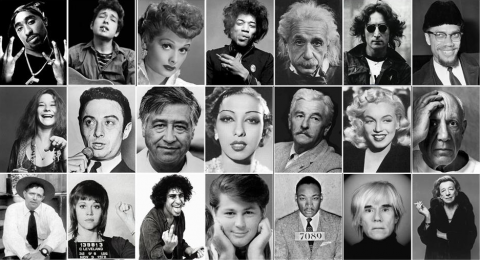
Yesterday we featured pages from Charles Bukowski’s FBI file and, along the way, mentioned William T. Vollman’s. But the Federal Bureau of Investigation has kept tabs on a much wider variety of cultural figures than just writers: musicians, comedians, filmmakers, scientists, actors, and activists have also caught its much-seeing eye. You can browse a great many of these files, now declassified, in The Vault, the FBI’s “new electronic reading room, containing 6,700 documents and other media that have been scanned from paper into digital copies so you can read them in the comfort of your home or office.” The FBI helpfully breaks down the files into categories, from anti-war (Abbie Hoffman,Howard Zinn) to gangster era (Al Capone, John Dillinger) to unexplained phenomena (Roswell UFO, extra-sensory perception). But you, Open Culture reader, might find the most material of interest in The Vault’s popular culture section.
There you’ll find materials pertaining to:
Ernest Hemingway’s “intelligence work on behalf of the U.S. Embassy in Havana, Cuba between 1942 and 1944″
Orson Welles’ “potential ties to communist activities in 1940s Hollywood”
Charlie Chaplin’s ties to communist organizations (along with an interstate prostitution investigation)
John Lennon’s connections to anti-war groups, which you’d expect, and an investigation of a threat made against him, which you may not
Marilyn Monroe’s connections to communism through her onetime husband Arthur Miller and otherwise
Jefferson Airplane’s “involvement in concerts at demonstrations such as one organized by the Youth International Party [ … ] to impeach President Nixon”
The Doors’ ”trash” music and its dissemination
The potential obscenity of the Kingmen’s “Louie, Louie” (nobody could tell for sure)
If you dig into the Vault, you’ll see that not every FBI investigation begins with a suspicion that the luminary in question is up to no good. In many cases, cultural figures received threats (usually extortion-related) from mysterious parties and called in the FBI to, well, investigate. As with any tool in human hands, nations can use their investigation organizations for good, or for, shall we say, more ambiguous purposes. Whatever their aims, they do produce fascinating reading.
Above you can find a mosaic of cultural figures that were on the FBI radar. The image comes from decryptedmatrix.com.
If certain well-known writers come off as a bit paranoid, they may have good cause. Then again, the Powers That Be conduct their surveillance in mysterious ways, never targeting quite whom you’d expect. William T. Vollmann, for instance, a novelist known less for his paranoia than his productivity, recently revealed in Harper’s that the Federal Bureau of Investigation, on the lookout for Unabomber suspects, built up quite a file on him. “Individuals this bright are capable of most anything,” reads one of its starkly typewritten pages. “By all accounts, VOLLMANN is exceedingly intelligent and possessed with an enormous ego.” Perhaps writerly ego, albeit of an entirely different stripe, also got post office-working poet Charles Bukowski in trouble. “In 1968 various branches of the U.S. government performed an investigation into the background of civil servant Charles Bukowski,” according to bukowski.net. “Apparently the FBI and the Postal Service took offense to some of his writing (mainly the Notes From a Dirty Old Man column he wrote for the Los Angeles hippie tabloid Open City),” the page continues, “and had their ‘informants’ report Bukowski to higher-ups in the post office.”
Bukowski.net offers 113 pages of Bukowski’s FBI file, directly scanned. “He stated that BUKOWSKI is an excellent tenant who never associates with any of his neighbors,” one page reports, apparently from an interview with the landlord of Bukowski’s now-famous bungalow at 5124 De Longpre in Los Angeles. And from an interrogation of the writer himself: “He explained that these articles are ‘an inter-mixture of fiction and fact’ and are ‘highly romanticized in order to give the story juice.’ ” Released FBI files of this type tend to give an impression of fruitlessness and ineptitude, but at least Bukowski’s did make one discovery that may fascinate avid fans: “Bukowski claimed he was married to Jane Cooney,” says bukowski.net. “Every Bukowski biography written thus far names Barbara Frye as his first wife. However, in 1952 (three years before his marriage to Barbara Frye) Bukowski stated that he was married to Jane Cooney Baker — the ‘Jane’ of many of his most heartfelt works.” Once America puts its terrorism problems behind it, perhaps the FBI can devote its resources to more literary research — albeit of a non-invasive variety.
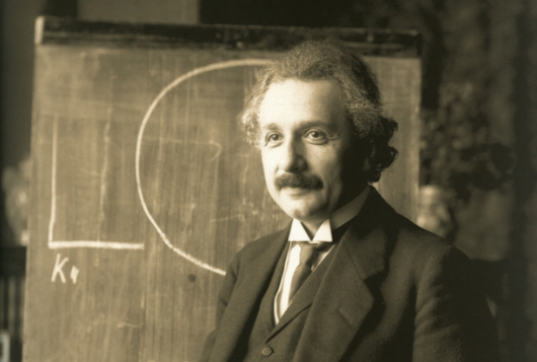
Albert Einstein’s activities as a passionate advocate for peace were well-documented during his lifetime. His celebrity as a famous physicist and one of the world’s most recognizable faces lent a great deal of weight to his pacifism, a view otherwise not given much consideration in the popular press at almost any time in history. However, according to a 2006 book titled Einstein on Race and Racism by Fred Jerome and Roger Taylor, the scientist was also as passionate about combating racism and segregation as he was about combating war. This facet of Einstein’s life was virtually ignored by the media, as was a visit he made in 1946 to Lincoln University in Pennsylvania, the first degree-granting college for African-Americans and the alma mater of Langston Hughes and Thurgood Marshall.
Invited to Lincoln to receive an honorary degree, Einstein gave a lecture on physics but also bluntly addressed the racial animus that held the country in its grip, reportedly calling racism, “a disease of white people” and saying he “did not intend to be quiet” about his opposition to segregation and racist public policy. Lest anyone think the Nobel-prize-winning physicist was pandering to his audience, the Harvard Gazette offers a comprehensive summary of Einstein’s support of progressive anti-racist causes, including his personal support of members of Princeton’s black community (he paid one man’s college tuition), a town Princeton native Paul Robeson once called “the northernmost town in the south.”
Einstein formed relationships with several prominent black leaders—inviting opera singer Marian Anderson to stay in his home after she was refused a room at the Nassau Inn and appearing as a character witness for W.E.B. Dubois when the latter stood accused of “failing to register as a foreign agent.” But it was his 20-year friendship with Robeson that seems central to his involvement in civil rights causes. The Harvard Gazette writes:
Einstein met Paul Robeson when the famous singer and actor came to perform at Princeton’s McCarter Theatre in 1935. The two found they had much in common. Both were concerned about the rise of fascism, and both gave their support to efforts to defend the democratically elected government of Spain against the fascist forces of Francisco Franco. Einstein and Robeson also worked together on the American Crusade to End Lynching, in response to an upsurge in racial murders as black soldiers returned home in the aftermath of World War II.
At the time of the Gazette article, 2007, a movie about Einstein and Robeson’s friendship was apparently in the works, with Danny Glover as Robeson and Ben Kingsley as Einstein. The project is apparently stalled, but with the upsurge in popular interest in the history of civil rights—with the overturning of the Voting Rights Act and the widespread coverage of the 50th anniversary of the March on Washington—perhaps the project will see new life soon. I certainly hope so.
We're hoping to rely on loyal readers, rather than erratic ads. Please click the Donate button and support Open Culture. You can use Paypal, Venmo, Patreon, even Crypto! We thank you!
Open Culture scours the web for the best educational media. We find the free courses and audio books you need, the language lessons & educational videos you want, and plenty of enlightenment in between.