If you’re a New Yorker, you know this stretch of subway inside and out. You’ve schlepped from Union Square to Grand Central Station on the 4, 5, or 6 trains how many times? Probably more than you care to count. But don’t worry, you’re in good company. New Yorkers have been making this journey since 1904, and here we have some vintage video to prove it. Shot on May 21, 1905, seven months after the IRT subway line opened, the video shows a train moving uptown. And then, during the last minute, you can see the New Yorkers exiting the train, svelte and dressed to the nines.
If you’re wondering how this clip was shot, let me add this: A camera was mounted on a subway train following another train on the same track. Lighting was provided by a specially constructed work car on a parallel track.
If you would like to support the mission of Open Culture, consider making a donation to our site. It’s hard to rely 100% on ads, and your contributions will help us continue providing the best free cultural and educational materials to learners everywhere. You can contribute through PayPal, Patreon, and Venmo (@openculture). Thanks!
For centuries, seafaring explorers and merchants reckoned with the longitude problem. It was relatively easy to figure out a ship’s location on a north-south axis, but nearly impossible to determine how far east or west it was. And the stakes were high. Sail too far astray and your ship (and men) could end up so far afield that getting home before the food and water ran out might be impossible. The sailing world needed better tools to determine location at sea.
In 1714 the British government established the Board of Longitude, offering a cash prize to anyone who could figure out how to detect how far east or west a ship was at sea. The Board was abolished in 1828, but only after fostering innovative techniques that would forever change the nature of marine navigation.
Cambridge University and the National Maritime Museum at Greenwich recently released an archive making all of the letters, objects, and documents related to the Board’s work available, along with a spiffy set of videos that brings the Board’s history and achievements to life.
During the Board’s tenure, clockmaker John Harrison figured out that sailors could find out their location if they knew local time at sea and compared that to the time at a common reference point. The moon was seen as a giant clock, and its position relative to stars was recorded in the Nautical Almanac, giving sailors the data to compare against the time at sea. One of the innovations vetted by the Board of Longitude is John Harrison’s Sea Clock. Also during that time, Greenwich became the prime meridian.
All of this work led to more accurate maps. The Board sponsored journeys, including some aboard Captain Cook’s ships with portable observatories for mapmakers to sketch and use triangulation to determine accurate location on voyages, including one to the Northwestern United States.
“If this Revolution falls, what we will have here in Cuba is a hell,” Fidel Castro said in Havana in 1959. “Hell itself.”
Castro was 32 when he made the proclamation during an interview recorded just weeks after the overthrow of dictator Fulgencio Batista. The new Cuba was still taking shape after the revolution led by the 26th of July Movement. Castro spoke extensively about his vision for Cuba during a 35-minute interview with an American journalist that has never been heard publicly until now.
The interview was discovered a few years ago when Laura Galloway found a tape in her late grandfather’s archives that simply said “Galloway/Castro.” Clark Hewitt Galloway was the intra-American affairs editor for U.S. News and World Report. Galloway covered Latin and South America for the magazine after serving in the same region with the U.S. Army Intelligence corps during WWII. Blank on Blank’s new episode for its PBS series animates the story behind the tape and a collection of outtakes from the interview. Castro talks about: why Che Guevara, Raul Castro and the 26th of July Movement were not Communist; and why Cuba had issues with the American presence in the Guantanamo Naval Base and, specifically, American sailors stirring up trouble while out on the town in Guantanamo.
Blank on Blank has also posted the entire 35-minute interview in Spanish with the English translation by Sebastian Betti. During the full interview, Castro goes into great detail about how the Cuban economy would be rebuilt and how the agrarian reform plan would be put into effect. He disputes whether American interests in Cuba would be nationalized. And he downplays the idea of being asked to be a presidential candidate.
The release of this unearthed interview comes as Castro’s brother, Raul, just gave a lengthy speech about the demise of Cuban culture and conduct despite what the revolution has brought to the country.
Here’s a fascinating glimpse of the very first Bloomsday celebration, filmed in Dublin in 1954.
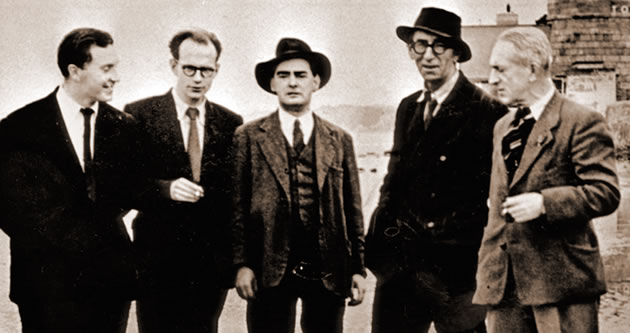
The footage shows the great Irish comedic writer Brian O’Nolan, better known by his pen name Flann O’Brien, appearing very drunk as he sets off with two other renowned post-war Irish writers, Patrick Kavanagh and Anthony Cronin, and a cousin of James Joyce, a dentist named Tom Joyce, on a pilgrimage to visit the sites in James Joyce’s epic novel Ulysses.
The footage was taken by John Ryan, an artist, publisher and pub owner who organized the event. The idea was to retrace the steps of Leopold Bloom and other characters from the novel, but as Peter Costello and Peter van de Kamp explain in this humerous passage from their book, Flann O’Brien: An Illustrated Biography, things began to go awry right from the start:
The date was 16 June, 1954, and though it was only mid-morning, Brian O’Nolan was already drunk.
This day was the fiftieth anniversary of Mr. Leopold Bloom’s wanderings through Dublin, which James Joyce had immortalised in Ulysses.
To mark this occasion a small group of Dublin literati had gathered at the Sandycove home of Michael Scott, a well-known architect, just below the Martello tower in which the opening scene of Joyce’s novel is set. They planned to travel round the city through the day, visiting in turn the scenes of the novel, ending at night in what had once been the brothel quarter of the city, the area which Joyce had called Nighttown.
Sadly, no-one expected O’Nolan to be sober. By reputation, if not by sight, everyone in Dublin knew Brian O’Nolan, otherwise Myles na Gopaleen, the writer of the Cruiskeen Lawn column in the Irish Times. A few knew that under the name of Flann O’Brien, he had written in his youth a now nearly forgotten novel, At Swim-Two-Birds. Seeing him about the city, many must have wondered how a man with such extreme drinking habits, even for the city of Dublin, could have sustained a career as a writer.
As was his custom, he had been drinking that morning in the pubs around the Cattle Market, where customers, supposedly about their lawful business, would be served from 7:30 in the morning. Now retired from the Civil Service, on grounds of “ill-health”, he was earning his living as a free-lance journalist, writing not only for the Irish Times, but for other papers and magazines under several pen-names. He needed to write for money as his pension was a tiny one. But this left little time for more creative work. In fact, O’Nolan no longer felt the urge to write other novels.
The rest of the party, that first Bloomsday, was made up of the poet Patrick Kavanagh, the young critic Anthony Cronin, a dentist named Tom Joyce, who as Joyce’s cousin represented the family interest, and John Ryan, the painter and businessman who owned and edited the literary magazine Envoy. The idea of the Bloomsday celebration had been Ryan’s, growing naturally out of a special Joyce issue of his magazine, for which O’Nolan had been guest editor.
Ryan had engaged two horse drawn cabs, of the old fashioned kind, which in Ulysses Mr. Bloom and his friends drive to poor Paddy Dignam’s funeral. The party were assigned roles from the novel. Cronin stood in for Stephen Dedalus, O’Nolan for his father, Simon Dedalus, John Ryan for the journalist Martin Cunningham, and A.J. Leventhal, the Registrar of Trinity College, being Jewish, was recruited to fill (unkown to himself according to John Ryan) the role of Leopold Bloom.
Kavanagh and O’Nolan began the day by deciding they must climb up to the Martello tower itself, which stood on a granite shoulder behind the house. As Cronin recalls, Kavanagh hoisted himself up the steep slope above O’Nolan, who snarled in anger and laid hold of his ankle. Kavanagh roared, and lashed out with his foot. Fearful that O’Nolan would be kicked in the face by the poet’s enormous farmer’s boot, the others hastened to rescue and restrain the rivals.
With some difficulty O’Nolan was stuffed into one of the cabs by Cronin and the others. Then they were off, along the seafront of Dublin Bay, and into the city.
In pubs along the way an enormous amount of alcohol was consumed, so much so that on Sandymount Strand they had to relieve themselves as Stephen Dedalus does in Ulysses. Tom Joyce and Cronin sang the sentimental songs of Tom Moore which Joyce had loved, such as Silent, O Moyle. They stopped in Irishtown to listen to the running of the Ascot Gold Cup on a radio in a betting shop, but eventually they arrived in Duke Street in the city centre, and the Bailey, which John Ryan then ran as a literary pub.
They went no further. Once there, another drink seemed more attractive than a long tour of Joycean slums, and the siren call of the long vanished pleasures of Nighttown.
Celebrants of the first Bloomsday pause for a photo in Sandymount, Dublin on the morning of June 16, 1954. From left are John Ryan, Anthony Cronin, Brian O’Nolan (a.k.a. Flann O’Brien), Patrick Kavanagh and Tom Joyce, cousin of James Joyce.
The story of Oskar Schindler, savior of thousands of Polish Jews, produced an epic novel, Schindler’s Ark, which in turn produced Steven Spielberg’s epic Schindler’s List. Like that of Anne Frank, Schindler’s story contains actions both unimaginably courageous and relatably human, and so his drama moves us past the stupefyingly brutal machinery of the Nazi death camps and into the lives of the real people under threat and those who helped them. But when we step out of the memoirs and fictionalizations and back into the dry history of documents, memos, and orders, the inhuman bureaucratic cast of Nazi efficiency returns, even in the case of Oskar Schindler.
Take the actual list (page one above). A featureless business ledger, the list is indistinguishable from the many concentration camp registers and death records Schindler’s fellow Nazis kept assiduously as they went about the business of eradicating a whole population. We know, of course, that Schindler played the part of a party believer to save lives instead of take them, but it’s still quite eerie to look over this faceless list of names and contemplate how close these men and women came to the horrors of the camps that took so many of their neighbors, friends, and relatives.
The list above is now on sale through an Ebay auction, starting bid 3 million dollars. It is certified authentic as the actual list typed up by Shindler’s accountant Itzhak Stern (played by Ben Kingsley in the film). The auction page provides the following information:
Itzhak Stern typed up the 14 page list on onion skin paper. Up for auction is not a copy of that list, but the actual one. It was sold by Itzhak Stern’s nephew to the current owner. It is dated in pencil on the first page, April 18, 1945. The auction will also include a copy of the affidavit from Stern’s nephew, recounting more details and provenance on The List. There’s a complete history of the composition of the list in David Crowe’s brilliant bio, Oskar Schindler: The Untold Account of His Life, Wartime Activities, and the True Story Behind the List.
Before Anne Frank was forced into hiding during World War II, there was a time when she, her family and friends could do normal things that many people take for granted. Like play in a sandbox on a warm summer day. In the shot above, Anne is 2nd from the left. More photos of Frank can be viewed at AnneFrank.org. And here you can watch the only known video showing the world’s most famous memoir writer.
One of the most stunning views a traveler can have in Paris is to round a corner and see the massive four-legged base of the Eiffel Tower. One of the beautiful things about Eiffel’s tower is that it is so colossal and yet so airy and delicate.
The view from the top is also amazing (though truth be told the views from Notre Dame and Sacré-Coeur may be better because they include the Eiffel Tower too)—so much so that Google photographers hoisted their panoramic Street View camera into the tower and recorded breathtaking views from the three main levels.
The day Google showed up was a typically overcast Paris day. The sky is even a little threatening. After so much gazing out at the city, you might want to dip into a café for un petit café crème.
But keep your laptop with you. The Street View exhibit is one of three that Google now offers about the tower. Google’s Cultural Institute collaborated with the Eiffel Tower Operating Company to create three additional exhibits: The Birth of the Eiffel Tower, the tower’s construction, and another about its inauguration and early visitors.
Built to display France’s engineering prowess at the centenary of the French Revolution, the tower’s construction is amazing to contemplate. Four men were needed to install one rivet: one to heat it up, another to hold it in place, a third to shape the head and a fourth to beat it with a sledgehammer. A total of 2,500,000 rivets were used to hold the tower together.
For a much older view of the ride up the tower’s elevator, check out this film by the Lumière brothers, made the year the tower opened in 1898.
Hannah Arendt’s work has come under some critical fire lately, what with the release of the Margarethe Von Trotta-directed biopic, starring German actress Barbara Sukowa as the controversial political theorist. At issue in the film and the surrounding commentary are Arendt’s (allegedly misleading) characterizations of the subject of her 1963 book Eichmann in Jerusalem, as well as her ambivalent—some have said callous, even “victim-blaming”—treatment of other Jews. None of these controversies are new, however. As Arendt scholar Roger Berkowitz notes in a recent New York Times editorial, at the time of her book’s publication, “Nearly every major literary and philosophical figure in New York chose sides in what the writer Irving Howe called a ‘civil war’ among New York intellectuals.”
While acknowledging Arendt’s flaws, Berkowitz seeks to exonerate the best-known concept that emerged from her work on Eichmann’s trial, the “banality of evil.” And while it can be comforting to have an interpreter explain, and defend, the work of a major, controversial, thinker, there is no intellectual substitute for engaging with the work itself.
In the age of the media interview—radio, television, podcast and otherwise—one can usually see and hear an author explain her views in person. And so we have the interview above (in German with English subtitles), in which Arendt sits with television presenter and journalist Gunter Gaus for a German program called Zur Person (The Person), a Charlie Rose-like show that featured celebrities, important thinkers, and politicians (including an appearance by Henry Kissinger).
A blogger at Jewish Philosophy Place writes that Arendt’s interview—a transcript of which was later published in The Portable Hannah Arendt as “What Remains? Language Remains”—is “slow and deliberative, not sharp and declarative, moving in circles, not straight lines.” The interview touches on a variety of topics, drawing on ideas expressed in Arendt’s earlier works, The Origins of Totalitarianismand The Human Condition. She is somewhat cagey when it comes to the so-called “Eichmann Controversy,” and she may have had personal as well as professional reasons for indirection. Her affair with her former professor, avowed and unrepentant Nazi Martin Heidegger, dogged her post-war career, and the aforementioned intellectual “civil war” probably increased her circumspection.
Arendt’s critics, then and now, often remark upon what the Jewish Philosophy Place writer succinctly calls her “disdain for others.” While the new biopic (trailer above) may obscure much of this critical controversy—unfilmable as such things are anyway—readers wishing to understand one of the Holocaust’s most famous interpreters should read, and hear, her in her own words before making any judgments.
We're hoping to rely on loyal readers, rather than erratic ads. Please click the Donate button and support Open Culture. You can use Paypal, Venmo, Patreon, even Crypto! We thank you!
Open Culture scours the web for the best educational media. We find the free courses and audio books you need, the language lessons & educational videos you want, and plenty of enlightenment in between.