The Math Behind Beethoven’s Music

Almost all the biggest math enthu­si­asts I’ve known have also loved clas­si­cal music, espe­cial­ly the work of Bach, Mozart, and Beethoven. Of course, as San Fran­cis­co Sym­pho­ny music direc­tor Michael Tilson Thomas once put it, you can’t have those three as your favorite com­posers, because “they sim­ply define what music is.” But don’t tell that to the math­e­mat­i­cal­ly mind­ed, on whom all of them, espe­cial­ly Bach and Beethoven, have always exert­ed a strong pull.

But why? Do their musi­cal com­po­si­tions have some under­ly­ing quan­ti­ta­tive appeal? And by the way, “how is it that Beethoven, who is cel­e­brat­ed as one of the most sig­nif­i­cant com­posers of all time, wrote many of his most beloved songs while going deaf?” The ques­tion comes from a TED-Ed seg­ment and its accom­pa­ny­ing blog post by Natalya St. Clair which explains, using the exam­ple of the “Moon­light Sonata,” what the for­mi­da­ble com­pos­er did it using math. (You might also want to see St. Clair’s oth­er vides: The Unex­pect­ed Math Behind Van Gogh’s “Star­ry Night.”)

beethoven music gif

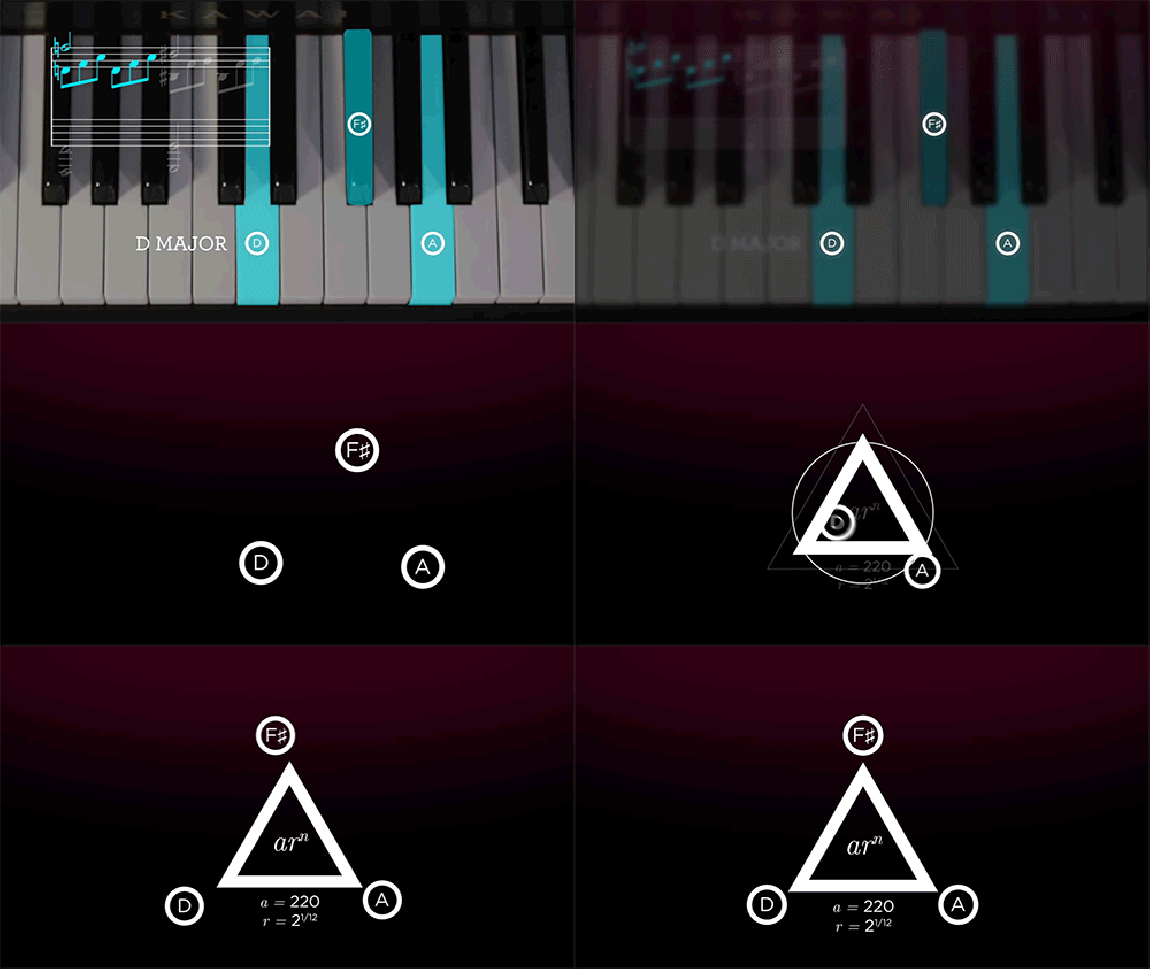
“The stan­dard piano octave con­sists of 13 keys, each sep­a­rat­ed by a half step,” St. Clair writes. “A stan­dard major or minor scale uses 8 of these keys with 5 whole step inter­vals and 2 half step ones.” So far, so good. “The first half of mea­sure 50 of ‘Moon­light Sonata’ con­sists of three notes in D major, sep­a­rat­ed by inter­vals called thirds that skip over the next note in the scale. By stack­ing the first, third, and fifth notes — D, F sharp, and A — we get a har­mon­ic pat­tern known as a tri­ad.” These three fre­quen­cies togeth­er cre­ate “ ‘con­so­nance,’ which sounds nat­u­ral­ly pleas­ant to our ears. Exam­in­ing Beethoven’s use of both con­so­nance and dis­so­nance can help us begin to under­stand how he added the unquan­tifi­able ele­ments of emo­tion and cre­ativ­i­ty to the cer­tain­ty of math­e­mat­ics.”

Explained in words, Beethoven’s use of math­e­mat­ics in his music may or may not seem easy to under­stand. But it all gets clear­er and much more vivid when you watch the TED-Ed video about it, which brings togeth­er visu­als of the piano key­board, the musi­cal score, and even the rel­e­vant geo­met­ric dia­grams and sine waves. Nor does it miss the oppor­tu­ni­ty to use music itself, break­ing it down into its con­stituent sounds and build­ing it back up again into the “Moon­light Sonata” we know and love — and can now, hav­ing learned a lit­tle more about what math­e­mati­cian James Sylvester called the “music of the rea­son” under­ly­ing the “math­e­mat­ics of the sense,” appre­ci­ate a lit­tle more deeply.

Relat­ed Con­tent:

Stream the Com­plete Works of Bach & Beethoven: 250 Free Hours of Music

Beethoven’s 5th: The Ani­mat­ed Score

Leonard Bern­stein Con­ducts Beethoven’s 9th in a Clas­sic 1979 Per­for­mance

Beethoven’s Ode to Joy Played With 167 Theremins Placed Inside Matryosh­ka Dolls in Japan

Man Hauls a Piano Up a Moun­tain in Thai­land and Plays Beethoven for Injured Ele­phants

Slavoj Žižek Exam­ines the Per­verse Ide­ol­o­gy of Beethoven’s Ode to Joy

Oliv­er Sacks’ Last Tweet Shows Beethoven’s “Ode to Joy” Mov­ing­ly Flash­mobbed in Spain

Does Math Objec­tive­ly Exist, or Is It a Human Cre­ation? A New PBS Video Explores a Time­less Ques­tion

Based in Seoul, Col­in Mar­shall writes and broad­casts on cities, lan­guage, and style. He’s at work on a book about Los Ange­les, A Los Ange­les Primer, the video series The City in Cin­e­ma, the crowd­fund­ed jour­nal­ism project Where Is the City of the Future?, and the Los Ange­les Review of Books’ Korea Blog. Fol­low him on Twit­ter at @colinmarshall or on Face­book.

Scientists Discover That James Joyce’s Finnegans Wake Has an Amazingly Mathematical “Multifractal” Structure

Fractal Finnegan's Wake

It has long been thought that the so-called “Gold­en Ratio” described in Euclid’s Ele­ments has “impli­ca­tions for numer­ous nat­ur­al phe­nom­e­na… from the leaf and seed arrange­ments of plants” and “from the arts to the stock mar­ket.” So writes astro­physi­cist Mario Liv­io, head of the sci­ence divi­sion for the insti­tute that over­sees the Hub­ble Tele­scope. And yet, though this math­e­mat­i­cal pro­por­tion has been found in paint­ings by Leonar­do da Vin­ci to Sal­vador Dali—two exam­ples that are only “the tip of the ice­berg in terms of the appear­ances of the Gold­en Ratio in the arts”—Livio con­cludes that it does not describe “some sort of uni­ver­sal stan­dard for ‘beau­ty.’” Most art of “last­ing val­ue,” he argues, departs “from any for­mal canon for aes­thet­ics.” We can con­sid­er Liv­io a Gold­en Ratio skep­tic.

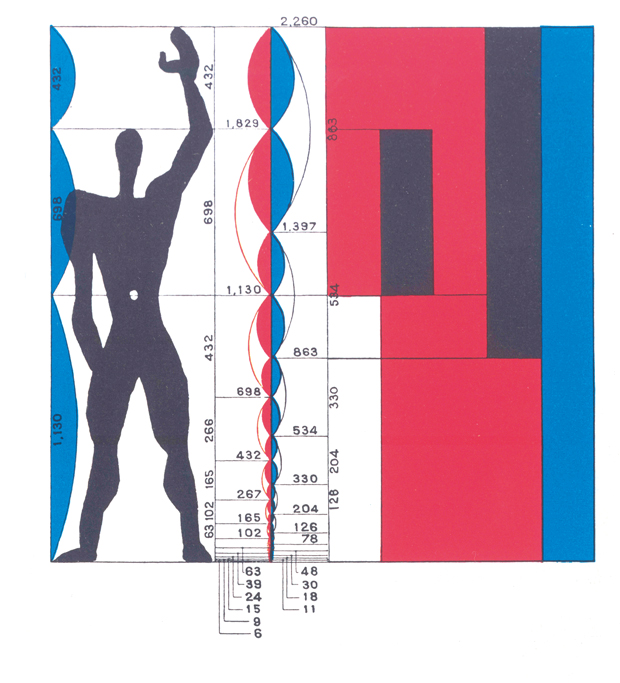
Far on the oth­er end of a spec­trum of belief in math­e­mat­i­cal art lies Le Cor­busier, Swiss archi­tect and painter in whose mod­ernist design some see an almost total­i­tar­i­an mania for order. Using the Gold­en Ratio, Cor­busier designed a sys­tem of aes­thet­ic pro­por­tions called Mod­u­lor, its ambi­tion, writes William Wiles at Icon, “to rec­on­cile maths, the human form, archi­tec­ture and beau­ty into a sin­gle sys­tem.”

Praised by Ein­stein and adopt­ed by a few of Corbusier’s con­tem­po­raries, Mod­u­lor failed to catch on in part because “Cor­busier want­ed to patent the sys­tem and earn roy­al­ties from build­ings using it.” In place of Leonardo’s Vit­ru­vian Man, Cor­busier pro­posed “Mod­u­lor Man” (below) the “mas­cot of [his] sys­tem for reorder­ing the uni­verse.”

44-main-Modulor

Per­haps now, we need an artist to ren­der a “Frac­tal Man”—or Frac­tal Gen­der Non-Spe­cif­ic Person—to rep­re­sent the lat­est enthu­si­as­tic find­ings of math in the arts. This time, sci­en­tists have quan­ti­fied beau­ty in lan­guage, a medi­um some­times char­ac­ter­ized as so impre­cise, opaque, and unsci­en­tif­ic that the Roy­al Soci­ety was found­ed with the mot­to “take no one’s word for it” and Lud­wig Wittgen­stein deflat­ed phi­los­o­phy with his con­clu­sion in the Trac­ta­tus, “Where­of one can­not speak, there­of one must be silent.” (Speak­ing, in this sense, meant using lan­guage in a high­ly math­e­mat­i­cal way.) Words—many sci­en­tists and philoso­phers have long believed—lie, and lead us away from the cold, hard truths of pure math­e­mat­ics.

And yet, reports The Guardian, sci­en­tists at the Insti­tute of Nuclear Physics in Poland have found that James Joyce’s Finnegans Wakea nov­el we might think of as per­haps the most self-con­scious­ly ref­er­en­tial exam­i­na­tion of lan­guage writ­ten in any tongue—is “almost indis­tin­guish­able in its struc­ture from a pure­ly math­e­mat­i­cal mul­ti­frac­tal.” Try­ing to explain this find­ing in as plain Eng­lish as pos­si­ble, Julia Johanne Tolo at Elec­tric Lit­er­a­ture writes:

To deter­mine whether the books had frac­tal struc­tures, the aca­d­e­mics looked at the vari­a­tion of sen­tence lengths, find­ing that each sen­tence, or frag­ment, had a struc­ture that resem­bled the whole of the book.

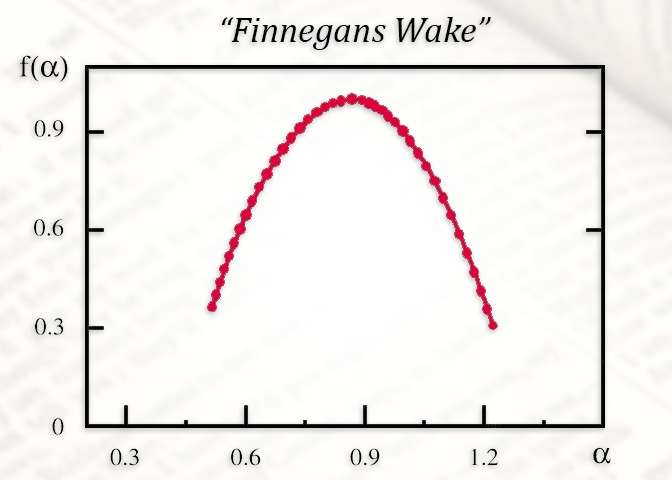
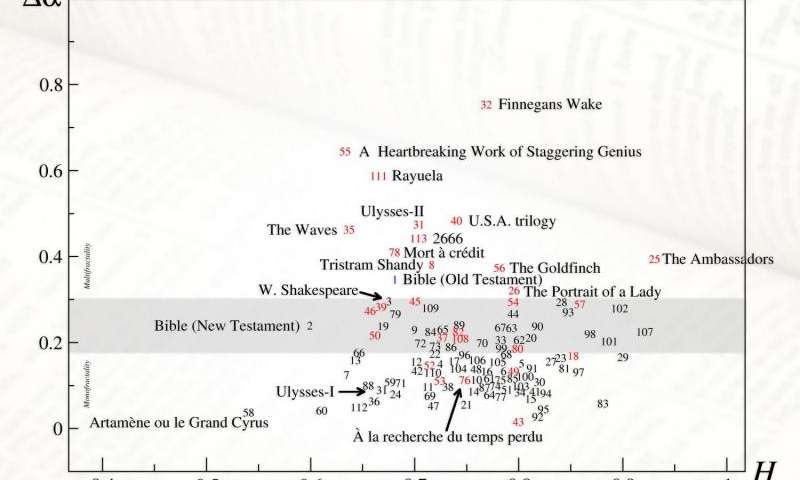
And it isn’t only Joyce. Through a sta­tis­ti­cal analy­sis of 113 works of lit­er­a­ture, the researchers found that many texts writ­ten by the likes of Dick­ens, Shake­speare, Thomas Mann, Umber­to Eco, and Samuel Beck­ett had mul­ti­frac­tal struc­tures. The most math­e­mat­i­cal­ly com­plex works were stream-of-con­scious­ness nar­ra­tives, hence the ulti­mate com­plex­i­ty of Finnegans Wake, which Pro­fes­sor Stanisław Drożdż, co-author of the paper pub­lished at Infor­ma­tion Sci­ences, describes as “the absolute record in terms of mul­ti­frac­tal­i­ty.” (The graph at the top shows the results of the nov­el­’s analy­sis, which pro­duced a shape iden­ti­cal to pure math­e­mat­i­cal mul­ti­frac­tals.)

Fractal Novels Graph

This study pro­duced some incon­sis­ten­cies, how­ev­er. In the graph above, you can see how many of the titles sur­veyed ranked in terms of their “mul­ti­frac­tal­i­ty.” A close sec­ond to Joyce’s clas­sic work, sur­pris­ing­ly, is Dave Egger’s post-mod­ern mem­oir A Heart­break­ing Work of Stag­ger­ing Genius, and much, much fur­ther down the scale, Mar­cel Proust’s Remem­brance of Things Past. Proust’s mas­ter­work, writes Phys.org, shows “lit­tle cor­re­la­tion to mul­ti­frac­tal­i­ty” as do cer­tain oth­er books like Ayn Rand’s Atlas Shrugged. The mea­sure may tell us lit­tle about lit­er­ary qual­i­ty, though Pro­fes­sor Drożdż sug­gests that “it may some­day help in a more objec­tive assign­ment of books to one genre or anoth­er.” Irish nov­el­ist Eimear McBride finds this “upshot” dis­ap­point­ing. “Sure­ly there are more inter­est­ing ques­tions about the how and why of writ­ers’ brains arriv­ing at these com­plex, but seem­ing­ly instinc­tive, frac­tals?” she told The Guardian.

Of the find­ing that stream-of-con­scious­ness works seem to be the most frac­tal, McBride says, “By its nature, such writ­ing is con­cerned not only with the usu­al load-bear­ing aspects of language—content, mean­ing, aes­thet­ics, etc—but engages with lan­guage as the object in itself, using the re-form­ing of its rules to give the read­er a more pris­mat­ic under­stand­ing…. Giv­en the long-estab­lished con­nec­tion between beau­ty and sym­me­try, find­ing works of lit­er­a­ture frac­tal­ly quan­tifi­able seems per­fect­ly rea­son­able.” Maybe so, or per­haps the Pol­ish sci­en­tists have fall­en vic­tim to a more sophis­ti­cat­ed vari­ety of the psy­cho­log­i­cal sharpshooter’s fal­la­cy that affects “Bible Code” enthu­si­asts? I imag­ine we’ll see some frac­tal skep­tics emerge soon enough. But the idea that the worlds-with­in-worlds feel­ing one gets when read­ing cer­tain books—the sense that they con­tain uni­vers­es in miniature—may be math­e­mat­i­cal­ly ver­i­fi­able sends a lit­tle chill up my spine.

via The Guardian

Relat­ed Con­tent:

Hear All of Finnegans Wake Read Aloud: A 35 Hour Read­ing

See What Hap­pens When You Run Finnegans Wake Through a Spell Check­er

James Joyce Reads From Ulysses and Finnegans Wake In His Only Two Record­ings (1924/1929)

Josh Jones is a writer and musi­cian based in Durham, NC. Fol­low him at @jdmagness

Hear Tom Lehrer Sing the Names of 102 Chemical Elements to the Tune of Gilbert & Sullivan

Tom Lehrer earned a BA and MA in math­e­mat­ics from Har­vard dur­ing the late 1940s, then taught math cours­es at MIT, Har­vard, Welles­ley, and UC-San­ta Cruz. Math was his voca­tion. But, all along, Lehrer nur­tured an inter­est in music. And, by the mid 1950s, he became best known for his satir­i­cal songs that touched on some­times polit­i­cal, some­times aca­d­e­m­ic themes.

Today we’re pre­sent­ing one of his clas­sics: “The Ele­ments.” Record­ed in 1959, the song fea­tures Lehrer recit­ing the names of the 102 chem­i­cal ele­ments known at the time (we now have 115), and it’s all sung to the tune of Major-Gen­er­al’s Song from The Pirates of Pen­zance by Gilbert and Sul­li­van. You can hear a stu­dio ver­sion below, and watch a nice live ver­sion taped in Copen­hagen, Den­mark, in Sep­tem­ber 1967.

Decades lat­er, this clas­sic piece of “Tom­fool­ery” stays with us, pop­ping up here and there in pop­u­lar cul­ture. For exam­ple, Daniel Rad­cliffe (of Har­ry Pot­ter fame) per­formed Lehrer’s song on the BBC’s Gra­ham Nor­ton Show in 2010. Enjoy.

Fol­low Open Cul­ture on Face­book and Twit­ter and share intel­li­gent media with your friends. Or bet­ter yet, sign up for our dai­ly email and get a dai­ly dose of Open Cul­ture in your inbox. And if you want to make sure that our posts def­i­nite­ly appear in your Face­book news­feed, just fol­low these sim­ple steps.

Relat­ed Con­tent:

Free Online Math Cours­es

The Math in Good Will Hunt­ing is Easy: How Do You Like Them Apples?

Math­e­mat­ics in Movies: Har­vard Prof Curates 150+ Scenes

Cal­cu­lus Life­saver: A Free Online Course from Prince­ton


Citizen Maths: A Free Online Course That Teaches Adults the Math They Missed in High School

Many peo­ple still have a major fear of math­e­mat­ics, hav­ing suf­fered through school and not real­ly hav­ing been in the right frame of mind to grasp con­cepts that we’ve been told will come in handy in our future work­ing lives. When Britons get to the age of 16, many can choose to leave school, escap­ing the ter­ror of math (or, as they say, maths).

But we shouldn’t live in fear, so along comes Cit­i­zen Maths, a UK-based free online course that pur­ports to help adults catch up with Lev­el 2 math (aka what a 16-year-old should know) with­out get­ting hit with a ruler or a spit wad. The course is fund­ed by the UFI Char­i­ta­ble Trust, which focus­es on pro­vid­ing free edu­ca­tion for adults.

The Cit­i­zen Maths course cur­rent­ly con­sists of three units—Proportion, Uncer­tain­ty, and Rep­re­sen­ta­tion. Addi­tion­al sec­tions on Pat­tern and Mea­sure­ments will soon fol­low. All units come with videos and tests that take about an hour of the viewer’s time. As the nar­ra­tor says, you can “learn in safe­ty, with­out fear of being told off or exposed.” The full course takes, on aver­age, about 20 hours.

And the tuto­ri­als bring in the real world, not just the abstract. Ratios and odds are expe­ri­enced through roulette, horse rac­ing, and play­ing dice. Under­stand­ing insur­ance comes into the tuto­r­i­al on mak­ing deci­sions. Mod­el­ing is explained by try­ing to under­stand weath­er pat­terns. And pro­por­tion is explained through bak­ing recipes and mak­ing cock­tails.

You will need a Google Account to get start­ed, though, for those with­out one, there is a sim­ple guide to get you start­edThe tuto­ri­als fea­ture YouTube instruc­tion along with an embed­ded app called Scratch.

As of this post, three of the five sec­tions are avail­able, with the com­plete course due up by next year. You can find more advanced Math cours­es in our col­lec­tion of Free Online Math Cours­es.

via Boing­Bo­ing

Relat­ed Con­tent:

Free Online Math Cours­es

Free Math Text­books

The Unex­pect­ed Math Behind Van Gogh’s “Star­ry Night”

Ted Mills is a free­lance writer on the arts who cur­rent­ly hosts the FunkZone Pod­cast. You can also fol­low him on Twit­ter at @tedmills, read his oth­er arts writ­ing at tedmills.com and/or watch his films here.

Adam Savage’s Animated Lesson on the Simple Ideas That Lead to Great Scientific Discoveries

Edu­ca­tor, indus­tri­al design fab­ri­ca­tor and Myth Busters cohost Adam Sav­age is dri­ven by curios­i­ty.

Sci­ence gets his wheels turn­ing faster than the notched disc Hip­poly­te Fizeau used to mea­sure the speed of light in 1849.

In his TED-Ed talk on how sim­ple ideas lead to sci­en­tif­ic dis­cov­er­ies, above, Sav­age zips across the cen­turies to share the work of three game chang­ers — Fizeau, Eratos­thenes, and Richard Feyn­man (one of the de fac­to patron saints of sci­ence-relat­ed TED talks).

I found it dif­fi­cult to wrap my head around the sheer quan­ti­ties of infor­ma­tion Sav­age shoe­horns into the sev­en minute video, giv­ing sim­i­lar­ly vol­u­ble and omniv­o­rous math­mu­si­cian Vi Hart a run for her mon­ey. Clear­ly, he under­stands exact­ly what he’s talk­ing about, where­as I had to take the review quiz in an attempt to retain just a bit of this new-to-me mate­r­i­al.

I’m glad he glossed over Feynman’s child­hood fas­ci­na­tion with iner­tia in order to spend more time on the less­er known of his three sub­jects. Lit­tle Feynman’s obser­va­tion of his toy wag­on is charm­ing, but the Nobel Prize winner’s life became an open book to me with Jim Otta­viani and Leland Myrick’s excel­lent graph­ic biog­ra­phy. What’s left to dis­cov­er?

How about Eratos­thenes? I’d nev­er before heard of the Alexan­dri­an librar­i­an who cal­cu­lat­ed the Earth­’s cir­cum­fer­ence with aston­ish­ing accu­ra­cy around 200 BC. (It helped that he was good at math and geog­ra­phy, the lat­ter of which he invent­ed.) Inspi­ra­tion fuels the arts, much as it does sci­ence, and I’d like to learn more about him.

Dit­to Fizeau, whom Sav­age describes as a less sexy sci­en­tif­ic swash­buck­ler than method­i­cal fact check­er, which is what he was doing when he wound up crack­ing the speed of light in 1849. Two cen­turies ear­li­er Galileo used lanterns to deter­mine that light trav­els at least ten times faster than sound. Fizeau put Galileo’s num­ber to the test, exper­i­ment­ing with his notched wheel, a can­dle, and mir­rors and ulti­mate­ly set­ting the speed of light at a much more accu­rate 313,300 Km/s. Today’s mea­sure­ment of 299792.458 km/s was arrived at using tech­nol­o­gy unthink­able even a few decades ago.

Per­son­al­ly, I would nev­er think to mea­sure the speed of light with some­thing that sounds like a zoetrope, but I might write a play about some­one who did.

Relat­ed Con­tent:

Neil deGrasse Tyson Deliv­ers the Great­est Sci­ence Ser­mon Ever

The Feyn­man Lec­tures on Physics, The Most Pop­u­lar Physics Book Ever Writ­ten, Now Com­plete­ly Online

Sam Har­ris: Sci­ence Can Answer Moral Ques­tions

Ayun Hal­l­i­day is an author, illus­tra­tor, and Chief Pri­ma­tol­o­gist of the East Vil­lage Inky zine. Her play, Fawn­book, opens in New York City lat­er this fall. Fol­low her @AyunHalliday

The Shortest-Known Paper Published in a Serious Math Journal: Two Succinct Sentences

shortest math paper

Euler’s con­jec­ture, a the­o­ry pro­posed by Leon­hard Euler in 1769, hung in there for 200 years. Then L.J. Lan­der and T.R. Parkin came along in 1966, and debunked the con­jec­ture in two swift sen­tences. Their arti­cle — which is now open access and can be down­loaded here — appeared in the Bul­letin of the Amer­i­can Math­e­mat­i­cal Soci­ety. If you’re won­der­ing what the con­jec­ture and its refu­ta­tion are all about, you might want to ask Cliff Pick­over, the author of 45 books on math and sci­ence. He brought this curi­ous doc­u­ment to the web last week.

Relat­ed Con­tent:

60 Free Online Math Cours­es

Free Math Text­books

The Math in Good Will Hunt­ing is Easy: How Do You Like Them Apples?

Does Math Objec­tive­ly Exist, or Is It a Human Cre­ation? A New PBS Video Explores a Time­less Ques­tion

by | Permalink | Make a Comment ( 24 ) |

1000 Digits of Pi, Recited by Jane Barbe, Famous Voice of Telephone Company Recordings

If you came of age dur­ing the 1960s and 1970s, you knew the voice of Jane Barbe, aka “The Tele­phone Lady.” Her voice appeared on tele­phone com­pa­ny record­ings and voice­mail sys­tems across the US. Just lis­ten to this clip, and you will imme­di­ate­ly know who I’m talk­ing about.

Any­way, Ms. Barbe appar­ent­ly had more in her reper­toire than “If you’d like to make a call, please hang up.” A lot more.

Above, we have her recit­ing the first 1,000 dig­its of Pi. The back­sto­ry remains unknown to us. We did some research and came up bone dry. If you know some­thing about the cir­cum­stances behind the record­ing, please let us know in the com­ments sec­tion below. To read along with a tran­script of the record­ing, just click here.

If you would like to sign up for Open Culture’s free email newslet­ter, please find it here. It’s a great way to see our new posts, all bun­dled in one email, each day.

If you would like to sup­port the mis­sion of Open Cul­ture, con­sid­er mak­ing a dona­tion to our site. It’s hard to rely 100% on ads, and your con­tri­bu­tions will help us con­tin­ue pro­vid­ing the best free cul­tur­al and edu­ca­tion­al mate­ri­als to learn­ers every­where. You can con­tribute through Pay­Pal, Patre­on, and Ven­mo (@openculture). Thanks!

via Laugh­ing Squid

Relat­ed Con­tent:

Hunter S. Thomp­son Calls Tech Sup­port, Unleash­es a Tirade Full of Fear and Loathing (NSFW)

Saul Bass Gives Ma Bell a Com­plete Makeover, 1969

The World’s First Mobile Phone Shown on 1922 Vin­tage Film

How Pi Was Near­ly Changed to 3.2 … and Copy­right­ed!

by | Permalink | Make a Comment ( 3 ) |

How Vi Hart Makes Her Viral Videos: A Look Inside Her Creative Process

Spend some time pok­ing around on the Khan Acad­e­my, or this site for that mat­ter, and your chances of run­ning into math­e­mu­si­cian Vi Hart are extreme­ly favor­able. 

I’ve tried—and failed—to keep up with her high­ly digres­sive, rapid fire, doo­dle-based expla­na­tions on such top­ics as net neu­tral­i­ty and the space-time con­tin­u­um. I had bet­ter luck fol­low­ing her direc­tions for turn­ing squig­gles into snakes, a math-based par­lor trick that seems more like mag­ic to me.

What I real­ly want­ed to know is how does she make those fun­ny lit­tle videos of hers?  Doubt­less, any sev­en-year-old who’s logged two or three hours in an after-school pro­gram devot­ed to stop motion ani­ma­tion would have the chops to explain how to make sim­ple draw­ings ren­dered in Sharpie on a spi­ral bound note­book come to life, but what if I still did­n’t get it? I would­n’t want to give the short­ies the impres­sion that the lay­men and women of my gen­er­a­tion are too dim to keep up with mod­ern tech­nol­o­gy.

Then on a whim, I typed “how does Vi Hart make her videos” into a search engine and voila! The video above, in which the doyenne her­self reveals exact­ly how she does just that.

Actu­al­ly “exact­ly” might be over­stat­ing things a bit, giv­en that she does so in her imme­di­ate­ly rec­og­niz­able style. If I under­stand cor­rect­ly, she starts with a script, which she pares to the essen­tials, before shoot­ing the seg­ment with a team of interns, some of whom serve as body dou­bles for her hands, their arms encased in funky, detach­able sleeves. Then she speeds things up by delet­ing the frames in which the mov­ing hand obscures the page. I’m pret­ty sure she wings it when record­ing her voiceover nar­ra­tion, but I could be wrong.

She also seems to have a thing for pin­ning her long brown hair up with a turkey feath­er. Even so, I’ll bet the deci­sion to give her ador­ing pub­lic a glimpse of some­thing beyond mere hands cement­ed many a celebri­ty crush. She’s a Tina Fey for the geek set. (Not that Tina Fey isn’t already serv­ing that func­tion for the same demo­graph­ic.)

As win­some as she is, I have to say, I pre­ferred her 14-year-old intern Ethan Bres­nick’s con­sci­en­tious behind-the-scenes look at how these things come togeth­er. Have a look above if you’d like some straight dope on soft­ware, cam­era posi­tions, and the like.

(Depend­ing on how much work you’ve got to get done today, you may also enjoy the extreme­ly infor­mal, hour-plus inter­view Ethan con­duct­ed via Skype, dur­ing which Hart eats her din­ner and invites fans to join them via Twit­ter.)

The only thing lack­ing is the nit­ty grit­ty on how and where Hart stores her enor­mous video files. With­out a benev­o­lent Khan Acad­e­my to over­see my work, such tech­ni­cal specs would def­i­nite­ly come in handy for a begin­ner such as myself. The Sharpies on spi­ral bound I can fig­ure out on my own.

Relat­ed Con­tent:

Vi Hart Uses Her Video Mag­ic to Demys­ti­fy Stravin­sky and Schoenberg’s 12-Tone Com­po­si­tions

Vi Hart Explains & Defends Net Neu­tral­i­ty in a New Doo­dle-Filled Video

Math­e­mu­si­cian Vi Hart Explains the Space-Time Con­tin­u­um With a Music Box, Bach, and a Möbius Strip

Ayun Hal­l­i­day is the author of sev­en books, a cou­ple of which have mor­phed into ebooks. Fol­low her @AyunHalliday

« Go BackMore in this category... »
Quantcast