For a good long while, or at least a few decades, the best things on TV in the U.S. happened outside the major broadcast and national cable networks. And like a great many other cultural happenings of the previous century, you would have to live in New York to experience them. I mean, of course, the weird, wonderful world of Manhattan public access cable TV. Here you could watch, for example, Glenn O’Brien’s TV Party, created by the titular host as “a drug-fueled re-interpretation of Hugh Hefner’s Playboy After Dark”—as we noted in a recent post—and featuring the most cutting-edge artists and musicians of the day.
Around the same time, Andy Warhol conducted his version of a celebrity interview show on local cable, and as the banal infotainment of daytime talk show and 24-hour-cable news developed on mainstream TV, a dozen bizarre, hilarious, raunchy, and ridiculous interview and call-in shows took hold on New York cable access in the years to follow (some of them still exist).
I happened to catch the tail end of this golden era, which tapered off in the nineties as the internet took over for the communities these shows served. But oh, what it must have been like to watch the thriving downtown scene document itself on TV from week-to-week, alongside the legendarily flamboyant Manhattan subcultures that found their voices on cable access?
Quite a few people remember it well, and were thrilled when the video at the top emerged from obscurity: an episode of TV-CBGB shot in 1981, “an odd glimpse,” writes Martin Schneider at Dangerous Minds, “of a CBGB identity that never took shape, as a cable access mainstay.” It is unclear how many episodes of the show were shot, or aired, or still exist in some form, but what we do have above seems representative, according to two Billboard articles describing the show. The first, from July 11, 1981, called the project “the first rock’n’roll situation comedy on cable television.”
Created by CBGBs owner, Hilly Kristal, the show aimed to give viewers slices of life from the Bowery institution, which was already famous, according to Billboard, as “the club that pioneered new music.” Kristal told the trade magazine, “There will always be a plot, though a simple plot. It will be about what happens in the club, or what could happen.” He then goes on to describe a series of plot ideas which, thankfully, didn’t dominate the show—or at least what we see of it above. The episode is “90% performance,” though “not true concert footage,” Schneider writes.
After an odd opening intro, we’re thrown into a song from Idiot Savant. Other acts include The Roustabouts, The Hard, Jo Marshall, Shrapnel, and Sic Fucks. While not among the best or most well-known to play at the club, these bands put on some excellent performances. By November of the following year, it seems the first episode had still not yet aired. Billboard quotes Kristal as calling TV-CBGB “one step further in exposing new talent. Radio and regular tv aren’t doing it. MTV is good, but it’s showing mostly top 40.”
Had the show migrated to MTV, Schneider speculates, it might have become a “national TV icon,” fulfilling Kristal’s vision for a new means of bringing obscure downtown New York musicians to the world at large. It might have worked. Though the sketches are lackluster, notable as historical curiosities, the music is what makes it worthwhile, and there’s some really fun stuff here—vital and dramatic. While these bands may not have had the mass appeal of, say, Blondie or the Ramones, they were stalwarts of the early 80s CBGB scene.
The awkward, strangely earnest, and often downright goofy skits portraying the goings-on in the lives of club regulars and employees are both somehow touching and tedious, but with a little polish and better direction, the whole thing might have played like a punk rock version of Fame—which maybe no one needed. As it stands, given the enthusiasm of several YouTube commenters who claim to have watched it at the time or been in the club themselves, the episode constitutes a strange and rare document of what was, if not what could have been.
If you know just one piece by avant-garde composer and all-around oracle of indeterminacy John Cage, you know 1952’s 4′33″, which consists, for that length of time, of no deliberately played sounds at all. You’d think that if any piece could be played without a score, Cage’s signature composition could, but he did make sure to write one, and we featured it here on Open Culture a few years ago. Look at that score, of sorts, and you’ll sense that Cage had an interest not just in unconventional music, but in equally unconventional ways of notating that music. Hence the Notations project, Cage’s 1969 book collecting pieces of scores by 269 different composers and accompanying them with short texts.
Assembling the book from materials archived at the Foundation for Contemporary Arts, Cage did include a page of one of his own scores, though not that of 4′33″ but of Music of Changes, a piano piece he’d composed the year before it for his friend David Tudor.
Tudor, a pianist as well as a composer of experimental music in his own right, also gets a page in Notations from his 1958 work Solo for Piano (Cage) for Indeterminacy. Lest this sound like a too-neat structure of reciprocity, rest assured that in the composition of the book’s text, as Cage explains in the book’s introduction, indeterminacy ruled, with “a process employing I‑Ching chance operations” dictating the number of words to be written, about which scores, and in what size and typeface as well.
Notations, which also includes scores from the Beatles, Leonard Bernstein, Paul Bowles, Charles Ives (from whose archive Cage picked a blank piece of song paper), Gyorgy Ligeti, Yoko Ono, Nam June Paik, Steve Reich, Igor Stravinsky, Toru Takemitsu, and many others, inspired a more recent follow-up project called Notations 21, which you can learn about in the video just below. A collaboration between musicologist and composer Theresa Sauer and designer Mike Perry, that 2009 book collects more than a hundred pieces of creative notation from some of the composers featured in Cage’s original, but also many who weren’t composing or indeed even alive in his day.
Notations 21 stands as a testament to Cage’s enduring influence as not just a composer but as the promoter of a worldview all about harnessing the forces of chance to enrich our lives, and to put us in a clearer frame of mind to see what comes next. “Musical notation is one of the most amazing picture-language inventions of the human animal,” Ross Lee Finney writes in the text of the original Notations. “It didn’t come into being of a moment but is the result of centuries of experimentation. It has never been quite satisfactory for the composer’s purposes and therefore the experiment continues.”
Based in Seoul, Colin Marshall writes and broadcasts on cities and culture. His projects include the book The Stateless City: a Walk through 21st-Century Los Angeles and the video series The City in Cinema. Follow him on Twitter at @colinmarshall or on Facebook.
FYI: David Bowie died two years ago today. And to commemorate the anniversary, HBO has just started airing David Bowie: The Last Five Years, a 90-minute BBC documentary that revisits Bowie’s less public final years. If you don’t already have HBO, you could always watch the doc by signing up for a free trial for HBO Now (HBO’s streaming service). Here’s a quick summary/overview of the film:
In the last years of his life, David Bowie ended nearly a decade of silence to engage in an extraordinary burst of activity, producing two groundbreaking albums and a musical. David Bowie: The Last Five Years explores this unexpected end to a remarkable career.
On the 2003–2004 “Reality” tour, David Bowie had a frightening brush with mortality, suffering a heart attack during what was to be his final full concert. He then disappeared from public view, only re-emerging in the last five years of his life to make some of the most important music of his career. Made with remarkable access, Francis Whately’s documentary is a revelatory follow-up to his acclaimed 2013 documentary David Bowie: Five Years,which chronicled Bowie’s golden ‘70s and early-‘80s period.
While illuminating iconic moments of his extraordinary and prolific career, David Bowie: The Last Five Years focuses on three major projects: the albums The Next Day and the jazz-infused Blackstar (released on Bowie’s 69th birthday, two days before his death in 2016), and the musical Lazarus, which was inspired by the character he played in the 1976 film The Man Who Fell to Earth.
Dispelling the simplistic view that his career was simply predicated on change, the film includes revealing interviews with many of Bowie’s closest creative collaborators, including: Tony Visconti, Bowie’s long-time producer; musicians who contributed to The Next Day and Blackstar; Jonathan Barnbrook, the graphic designer of both albums; Robert Fox, producer of Lazarus, along with cast members from the show, providing a unique behind-the-scenes look at Bowie’s creative process; and Johan Renck, director of Bowie’s final music video, “Lazarus,” which was widely discussed as foreshadowing his death.
You can watch a trailer for the new film up above.
If you would like to sign up for Open Culture’s free email newsletter, please find it here. It’s a great way to see our new posts, all bundled in one email, each day.
If you would like to support the mission of Open Culture, consider making a donation to our site. It’s hard to rely 100% on ads, and your contributions will help us continue providing the best free cultural and educational materials to learners everywhere. You can contribute through PayPal, Patreon, and Venmo (@openculture). Thanks!
Even if you don’t know the name György Ligeti, you probably already associate his music with a set of mesmerizing visions. The work of that Hungarian composer of 20th-century classical music appealed mightily to Stanley Kubrick, so much so that he used four of Ligeti’s pieces to score 2001: A Space Odyssey. One of them, 1962’s Aventures, plays over the final scenes in an electronically altered form, which drew a lawsuit from the composer who’d been unaware of the modification. But he didn’t do it out of purism: though he wrote, over his long career, almost entirely for traditional instruments, he’d made a couple forays into electronic music himself a decade earlier.
Ligeti fled Hungary for Vienna in 1956, soon afterward making his way to Cologne, where he met the electronically innovative likes of Karlheinz Stockhausen and Gottfried Michael Koenig and worked in West German Radio’s Studio for Electronic Music.
There he produced 1957’s Glissandi and 1958’s Artikulation, the latter of which lasts just under four minutes, but, in the words of TheGuardian’s Tom Service, “packs a lot of drama in its diminutive electronic frame.” Ligeti himself “imagined the sounds of Artikulation conjuring up images and ideas of labyrinths, texts, dialogues, insects, catastrophes, transformations, disappearances,” which you can see visualized in shape and color in the “listening score” in the video above.
Created in 1970 by graphic designer Rainer Wehinger of the State University of Music and Performing Arts Stuttgart, and approved by Ligeti himself, the score’s “visuals are beautiful to watch in tandem with Ligeti’s music; there’s an especially arresting sonic and visual pile-up, about 3 mins 15 secs into the piece. This isn’t electronic music as postwar utopia, a la Stockhausen, it’s electronics as human, humorous drama,” writes Service. Have a watch and a listen, or a couple of them, and you’ll get a feel for how Wehinger’s visual choices reflect the nature of Ligeti’s sounds. Just as 2001 still launches sci-fi buffs into an experience like nothing else in the genre, those sounds will still strike a fair few self-described electronic music fans of the 21st century as strange and new — especially when they can see them at the same time.
Based in Seoul, Colin Marshall writes and broadcasts on cities and culture. His projects include the book The Stateless City: a Walk through 21st-Century Los Angeles and the video series The City in Cinema. Follow him on Twitter at @colinmarshall or on Facebook.
Postmodernism began as an architectural term to describe the loss of a seemingly stable social order and the building of new forms in the 1960s and 70s. The new architecture was an elaborate patchwork of high and low culture and past and present design trends. In both theory and practice, postmodernism delighted in odd juxtapositions and self-referential irony. It did not shy away from politics but made sardonic critical commentary its métier rather than the totalizing agendas of late modernism.
Postmodernism added to modernism’s genre-hopping a broader cultural scope and wider inclusivity of forms of expression. We can see a similar cultural shift happening in popular music in the mid- to late-20th century. The pop and rock of the sixties fragmented into dozens of radio friendly genres, all of which met their critical match in the aggressiveness of punk, a movement with high aesthetic commitments and a corresponding desire to detonate cultural norms by any means necessary.
When we arrive at the “post-punk,” we find all things counter-culture rubbing up against each other, filling the void left by the old social order with new sounds and visions, some determinedly grim, some playful and ironic, nearly all of them danceable.
A fine description for what the world of “post-punk” looked like comes from a recent personal essay by the poet Patrick Rosal:
It was the early 1980s, a brief few years when punk rock kids, b‑boys, new wave freaks, and disco fiends might all get down on the same dance floor: this one in moccasin boots this one in a track suit with three side-stripes down the sleeves and legs, this one in a baggy neon sweater and extra eyeliner.
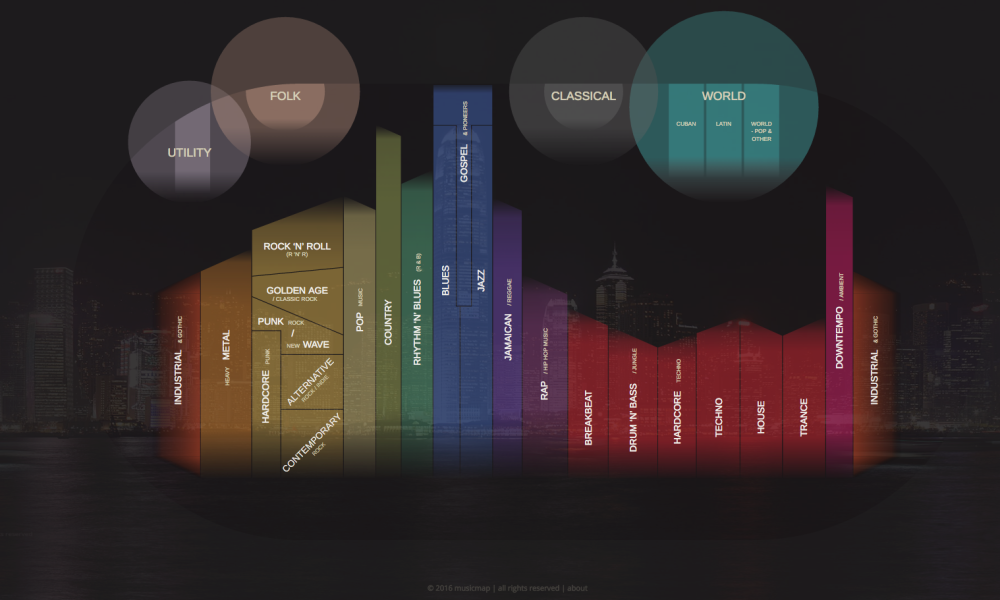
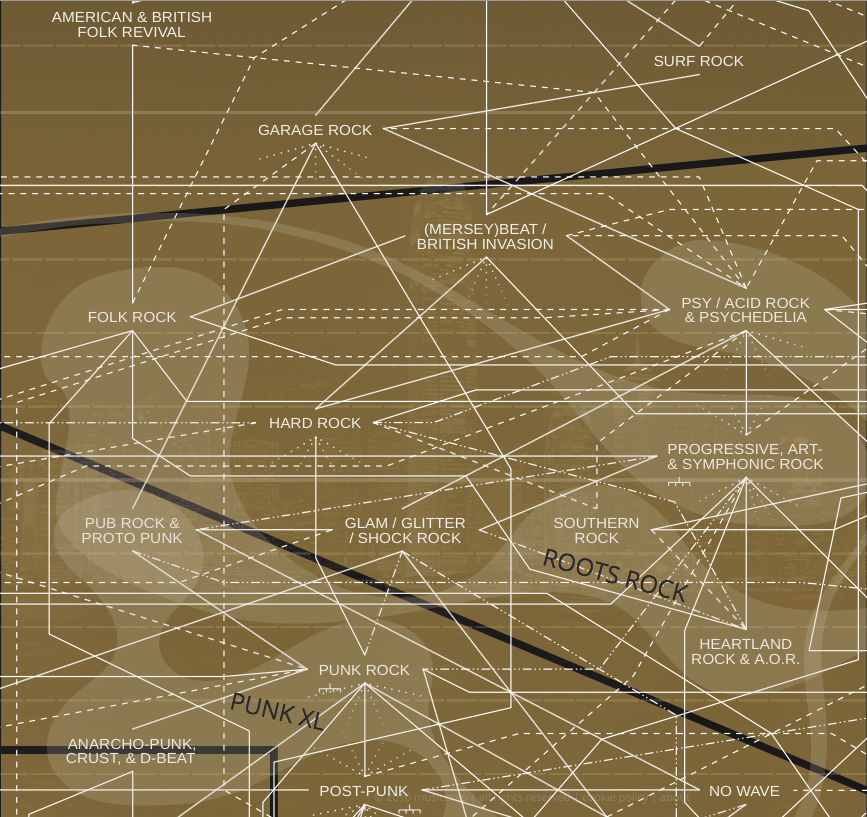
This was a time when bands like Public Image Limited (John Lydon’s post Sex Pistols project) and Bauhaus incorporated dub reggae rhythms, basslines, and studio effects into the core of their sound. The Clash had already embarked on such experiments, and Clash guitarist Mick Jones took things further with Big Audio Dynamite, a punk/funk/reggae/hip hop hybrid that didn’t make the list of Paste Magazine’s “50 Best Post-Punk Albums,” but was certainly representative of a strain of post-punk expansiveness.
Bauhaus doesn’t make the list either, but Public Image Limited’s 1979 Metal Box appears, at number 14, an album of wobbly, dub-inflected “death disco” that won a special place in the hearts and record collections of an eclectic group of fans as the eighties dawned. At #36 we find the equally experimental Dub Housing, the 1978 second album of Ohio’s Pere Ubu, a project that coalesced in the midst of Cleveland’s punk scene to make what frontman David Thomas called “avant garage.”
These disparate bands define post-punk as much as do the jangly, southern, Byrds-influenced sounds of R.E.M. or The dB’s, the surf-rock revivalism of The B52’s, jazzy, angular art-rock of Television, jittery, So-Cal punk/jazz/country/funk of Minutemen, dark drone of Joy Division, chaotic blues-punk of Birthday Party, anarchic noise and motorik beats of Swell Maps or Sonic Youth, shambling rants of The Fall, new romantic pop of The Smiths or Orange Juice, satirical synthpunk of Devo…. The list can and does go on and on. You can see the full 50 at Paste Magazine, chosen and annotated by the magazine’s writers. Above, we’ve compiled 48 of these albums in a Spotify playlist—save Metal Box and Dub Housing, which are not available on Spotify.
This is music made by people “interested in seeing where music could go.” Many of them former punks, many new to the scene. Many of them left behind these early experimental phases to become more conventionally genre-based, while some had only started to push in new directions later in their career. Some of these bands arrived at a sound, made it their own, and rarely deviated, some shifted and changed throughout their career; some burned brightly, or darkly, for a short time, leaving indelible marks of odd greatness in a time when popular music took more risks than before or maybe since.
At least that’s what it feels like looking back. If this is a nostalgia trip for you, you’ll find it’s pretty comprehensive, with the inevitable omission of a favorite album, band, or two (where, I must ask, is My Bloody Valentine?) If you’re new to the range of this music, consider that, for all the vagary a term like “post-punk” might evoke, like the “postmodern,” it has a specific historical context, one in which a handful of artists saw tremendous creative opportunity amidst a general sense of cultural malaise.
Over the weekend, “Sleep Good,” a psychedelic pop band from Austin, TX, took their own whack at shifting Nirvana’s 1991 song into major key. And the result will catch you a bit off-guard. A grunge anthem abruptly turns into a cheery pop song, and the bopping cheerleaders in the original music video strangely fit into the mood of the adapted song.
You can find a version of “Teen Sprite,” as the song has been dubbed, over on Soundcloud.
If you would like to sign up for Open Culture’s free email newsletter, please find it here. It’s a great way to see our new posts, all bundled in one email, each day.
If you would like to support the mission of Open Culture, consider making a donation to our site. It’s hard to rely 100% on ads, and your contributions will help us continue providing the best free cultural and educational materials to learners everywhere. You can contribute through PayPal, Patreon, and Venmo (@openculture). Thanks!
Some classical music enthusiasts are purists with regard to visual effects, listening with eyes firmly fixed on liner notes or the ceilings of grand concert halls.
Those open to a more avant-garde ocular experience may enjoy the short motion capture animation above.
Motivated by the London Symphony Orchestra’s desire for a hipper identity, the project hinged on recently appointed Musical Director Sir Simon Rattle’s willingness to conduct Edward Elgar’s Enigma Variations with a specially modified baton, while 12 top-of-the-range Vicon Vantage cameras noted his every move at 120 frames per second.
Digital designer Tobias Gremmler, who’s previously used motion-capture animation as a lens through which to consider kung fu and Chinese Opera, stuck with musical metaphors in animating Sir Simon’s data with Cinema 4D software. The movements of conductor and baton morph into a “vortex of wood, brass, smoke and strings” and “wires reminiscent of the strings of the instruments themselves.” Elsewhere, he draws on the atmosphere and architecture of classic concert halls.
(The uninitiated may find themselves flashing on less rarified sources of inspiration, from lava lamps and fire dancing to the 80’s‑era digital universe of Tron.)
We're hoping to rely on loyal readers, rather than erratic ads. Please click the Donate button and support Open Culture. You can use Paypal, Venmo, Patreon, even Crypto! We thank you!
Open Culture scours the web for the best educational media. We find the free courses and audio books you need, the language lessons & educational videos you want, and plenty of enlightenment in between.