In honor of Debbie Harry’s 68th birthday today, we bring you some very early clips of Blondie at CBGB. Above, the band plays “A Girl Should Know Better” in 1975, an unreleased track that’s got all the garage rock, girl-group sound the band rode in on before going new wave in the 80s. Guitarist Chris Stein looks and sounds like Johnny Thunders and Harry performs the almost-wholesome, semi-vacant sexuality of her Playboy bunny past. While this track didn’t make it onto their first album, 1976’s Blondie, it’s a fun little number all the same.
Down below watch the band play “Rip Her to Shreds” in 1977, looking a little less trash-rock but still sounding harder than they would in later, slicker years. For more vintage Harry moments, pop on over to Dangerous Minds to see her arm wrestle Andy Kaufman, recount a run-in with Ted Bundy, and introduce Americans to the pogo dance on Glenn O’Brien’s local New York show TV Party.
At some point during his 1948 mania for the Rube Goldberg pieces of prepared pianos, John Cage, inspired by minimalist French composer Erik Satie, decided to turn back to melody for a moment. Still building with a dull percussive tonal palate, he wrote solely for the keyboard this time… of a toy piano. “Suite for Toy Piano” consists of five short movements, none over two minutes. Cage liked the abrasive chiming and limited range of the instrument.
The piece can be mechanical or structurally immersive, depending on the player. In the performance above, Portuguese pianist Joana Gama achieves the latter effect, imbuing the composition with dynamic energy many other renditions lack, though I do not know whether Cage intended a flat affect. In any case, he tended to appreciate improvisatory takes on his work at all times, so he wouldn’t have been bothered.
The surrounding audience—shuffling, whispering, wheezing—only add to Gama’s intensity. The event marked the 2011 opening of the Centre for Art and Architecture Affairs in Guimarães, Portugal.
Josh Jones is a writer and musician based in Washington, DC. Follow him @jdmagness
Last week, Colin Marshall told you all about The Art of Punk, the new documentary series from the Museum of Contemporary Art in Los Angeles. This week, the series continues with a new video looking at The Dead Kennedys and the artist behind their striking artwork, Winston Smith. A “punk art surrealist” known for his “hand-carved” collages, Smith is perhaps best known for creating The Dead Kennedys’ iconic logo and other arresting images (see a slideshow here). The new MOCA video covers all of that, and then some, above.
In the summer of 1964, two young boys from the North Shore suburbs of Chicago took a tape recorder and set out to interview jazz legend Louis Armstrong for their high school radio station. Armstrong was playing a concert at the Ravinia Festival in Highland Park, not far from the boys’ school in Winnetka. He agreed to an interview, and as a group of professional reporters from the city’s major news outlets waited impatiently outside his dressing room door, Armstrong spent 20 minutes answering questions for a little 10-watt FM radio station.
The story is told above, in the latest installment of PBS’s ongoing animation project with Blank on Blank, a group that brings unheard interviews back to life. Michael Aisner, who was 15 when he met Armstrong, and his friend James R. Stein, who was 14, recount their adventure and play a few highlights from the interview. Armstrong explains how he got the nickname “Satchmo” and talks a little about his Dickensian childhood and how he learned to play the coronet in the Home for Colored Waifs in New Orleans. He talks about the need for practicing hard every day, and about the talent that was his ticket out of the slums. “You’ve got to be good,” Armstrong says, “or bad as the devil.”
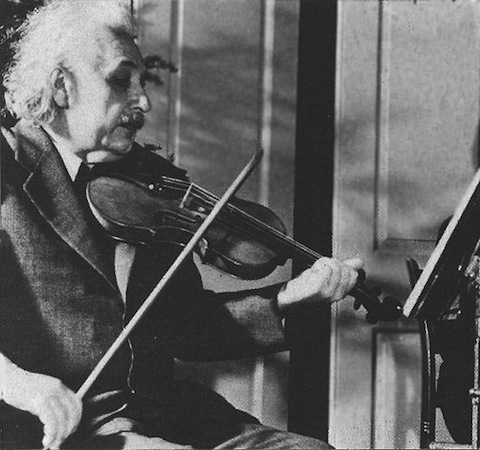
At the height of Albert Einstein’s popularity, the public knew him not only as the world’s foremost theoretical physicist, but also as an enthusiastic sometime violinist. As a publication for the 2005 “World Year of Physics” puts it: “to the press of his time… Einstein was two parts renowned scientist, one jigger pacifist and Zionist fundraiser, and a dash amateur musician.” While this description may get at the public perception of his composition, Einstein himself seems to have favored the musician over all of his other “parts.” “Life without playing music is inconceivable for me,” he once said, “I live my daydreams in music. I see my life in terms of music… I get most joy in life out of music.”
The famous scientist never travelled without his beloved violin, “Lina.” His affair with music began with violin lessons in Munich at the age of 5. However, his early experiences with the instrument seem at best perfunctory and, at worst, antagonistic (one anecdote has him throwing a chair at his teacher, who left the house in tears).
He did not truly fall in love until discovering Mozart at age 13. A high school friend reported to biographer Carl Seeling that at this time, when the young Einstein’s “violin began to sing, the walls of the room seemed to recede—for the first time, Mozart in all his purity appeared before me, bathed in Hellenic beauty with its pure lines, roguishly playful, mightily sublime.”
This gushing recollection must inevitably prompt the question, raised in every account of Einstein and music—was he really any good? Since he played mostly for his own enjoyment, the answer seems irrelevant; yet, as particle physicist Brian Foster says in the video above, Einstein was “competent.” In his Berlin years, he played with renowned musicians like Austrian violinist Fritz Kreisler and pianist Artur Schnabel (as well as with founder of quantum theory, Max Planck). His scientific notoriety garnered invitations to perform at benefit concerts. One critic remarked, “Einstein plays excellently. However… there are many violinists who are just as good.” Another concert-goer quipped, “I suppose now Fritz Kreisler is going to start giving physics lectures.” Accounts of his abilities do differ.
Brian Foster’s interest in Einstein the musician transcends the man’s virtuosity, or lack thereof. Since 2005—the 100th anniversary of Einstein’s “miracle year,” during which he published his most influential papers—Foster has teamed up with British violinist Jack Liebeck and other classical musicians to present lectures and concerts on the role of music in Einstein’s life and work. Einstein’s devotion to Mozart may be of particular interest to historians of science. Foster describes Einstein’s tastes as “conservative”; he found Beethoven too “creative,” but Mozart, on the other hand, revealed to him a universal harmony he believed existed in the universe. As another author puts it:
Einstein relished Mozart, noting to a friend that it was as if the great Wolfgang Amadeus did not “create” his beautifully clear music at all, but simply discovered it already made. This perspective parallels, remarkably, Einstein’s views on the ultimate simplicity of nature and its explanation and statement via essentially simple mathematical expressions.
While the interpretation of Einstein as a “realist” has its detractors, his insistence on the beauty and simplicity of scientific theories is not in dispute. Foster points out above that part of Einstein’s legacy is his push for beauty, unification, and harmony in our physical understanding of reality, a push that Foster credits to the scientist’s musical mind.
In 1967, two icons of French popular culture went out on a date. It didn’t go well. The usually cool Serge Gainsbourg was so intimidated by Brigitte Bardot’s beauty that his notorious charm failed him. Believing he had blown his chance, Gainsbourg was surprised when Bardot telephoned and said he could make amends by writing her “the most beautiful love song you can imagine.”
Gainsbourg responded by writing two songs. One was called “Bonnie and Clyde.” It was inspired by that year’s hit film of the same name by Arthur Penn, starring Faye Dunaway and Warren Beatty as the notorious 1930s outlaws Bonnie Parker and Clyde Barrow.
You’ve read the story of Jesse James of how he lived and died. If you’re still in need; of something to read, here’s the story of Bonnie and Clyde.
Now Bonnie and Clyde are the Barrow gang I’m sure you all have read. how they rob and steal; and those who squeal, are usually found dying or dead.
There’s lots of untruths to these write-ups; they’re not as ruthless as that. their nature is raw; they hate all the law, the stool pigeons, spotters and rats.
They call them cold-blooded killers they say they are heartless and mean. But I say this with pride that I once knew Clyde, when he was honest and upright and clean.
But the law fooled around; kept taking him down, and locking him up in a cell. Till he said to me; “I’ll never be free, so I’ll meet a few of them in hell.”
The scene above, with Gainsbourg and Bardot performing the song, was broadcast on The Brigitte Bardot Show in early 1968. The song was released later that year on two albums: Initials B.B. and Bonnie and Clyde. The romance between Gainsbourg and Bardot was short. She returned to her second husband and he met actress Jane Birkin, with whom he recorded the second song he wrote for Bardot: “Je t’aime…mois non plus,” which means “I Love You…Me Neither.”
Those of us who spent hours sitting in front of the record player with our dads’ Radio Shack recorders, striving to duplicate the hilarity of Dickie Goodman’s novelty hit 1975 “Mr. Jaws,” will find much to appreciate in the staged spat above.
Musical pranksters Collective Cadenza raided the Beatles’ catalogue for seventeen songs to drive the narrative of a suspicious wife confronting her philandering husband. Which hussy sent him that passionate text? Lady Madonna? Julia? Michelle? Eleanor Rigby seems to have more comic potential than a tired ageist dig, and given their high production values, I’m mystified that the creators shied away from hiring a realistically hot plumber.
Perhaps I’m over-thinking things. It’s a lark, that’s all. Don’t expect Shakespeare, and you won’t lose sleep wondering why they failed to include“I Am the Walrus.”
I moved to New York City in 2000, and to the Lower East Side in 2002. To my dismay, the gritty downtown New York I’d loved from afar since childhood—represented by films like The Warriors, bands like Sonic Youth, and graffiti artists like Zephyr—was nearly at an end. CBGB’s was staggering toward its final years; local venue Brownies, right across the street, closed during my tenure, then re-opened as another bar, the live bands replaced by a jukebox; the few remaining artists from the old days holed up in their apartments, surly and forgotten; and rumors of Whole Foods and glass & steel condos proved true in the coming years. It was sad.
But oh, to be there in the 80s and early 90s, when flowers of dirty punk art grew from the needle-strewn Tompkins Square Park and the decaying squatters paradises along Avenue A. Of course I’m romanticizing a time of high crime, poverty, and low expectations, a time many native New Yorkers do not remember fondly (then again, it seems, just as many do). There are many, many documents of the old East Village mean streets—too many to properly list in this short post. But I can imagine no better tour guide to pre-millennial NYC than Iggy Pop.
In the short film above, watch him show Dutch filmmaker Bram van Splunteren around Alphabet City. Granted this is 1993. Things weren’t nearly as hairy as they were a few years prior (a fact Iggy points out right away), but it’s still a world away from the Lower East Side of today. Pop traipses through the neighborhood, pointing out favorite landmarks and pieces of graffiti. No stranger to urban decay, the Detroit native seems right at home. This being New York, Pop can stroll around without being molested (or mostly even recognized). All in all it’s a pretty leisurely tour of the 90s Lower East Side on a bright and sunny day with the guy who more-or-less invented punk. What more could you want?
We're hoping to rely on loyal readers, rather than erratic ads. Please click the Donate button and support Open Culture. You can use Paypal, Venmo, Patreon, even Crypto! We thank you!
Open Culture scours the web for the best educational media. We find the free courses and audio books you need, the language lessons & educational videos you want, and plenty of enlightenment in between.