“Remixing” has figured centrally in the Web 2.0 vocabulary. But, remixing isn’t new. It has a long history, going back as long as we’ve been making art. Artists have always been collecting material, combining it, and transforming it into something new. Kirby Ferguson’s new video, Everything is a Remix, teases this apart as he brings you back to 1960s Paris and London – to the cut-up literature of William S. Burroughs and the songs written by Led Zeppelin with a liberal amount of borrowing. This video, the first in a series of four, appears on Ferguson’s web site in a nice large format. Have a look and consider donating to his Everything is a Remix project.
Mark this on your calendar. This coming Saturday, at 7:30 a.m. California time, Gustavo Dudamel (soon to open the 2010-11 season of the Los Angeles Philharmonic) will conduct a concert with the Vienna Philharmonic at the Lucerne Festival in Switzerland. As the LA Times reports, the concert will be webcast live for free at www.medici.tv. It will also be available for 90 days on demand. Pieces will include Rossini’s overture to “La gazza ladra,” Orbón’s “Tres versiones sinfónicas,” Bernstein’s “Divertimento for Orchestra” and Ravel’s “Pavane pour une infante défunte” and “Boléro.”
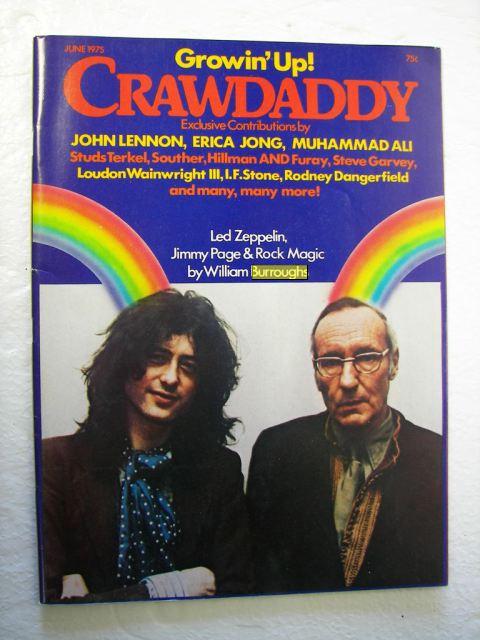
Crawdaddy! It was the first US magazine of rock music criticism, preceding both Rolling Stone and Creem. Paul Williams, then a student at Swarthmore College, first launched the magazine in 1966. And by the 1970s, Crawdaddy! hit its stride, publishing exclusive contributions by John Lennon, Joseph Heller, and Studs Terkel, to name a few. On one occasion, the self-described “first magazine to take rock and roll seriously” sent William S. Burroughs, the great beat writer, to a Led Zeppelin concert. He came back in June 1975 with a rather offbeat concert review. There’s a strange innocence, even naivete, to the whole piece (though we know better than to confuse Burroughs himself with innocence). We give you an excerpt right below, and the rest here.
So there we sat, I decline earplugs; I am used to loud drum and horn music from Morocco, and it always has, if skillfully performed, an exhilarating and energizing effect on me. As the performance got underway I experienced this musical exhilaration, which was all the more pleasant for being easily controlled, and I knew then that nothing bad was going to happen. This was a safe and friendly area–but at the same time highly charged. There was a palpable interchange of energy between the performers and the audience which was never frantic or jagged. The special effects were handled well and not overdone.
A few special effects are much better than too many. I can see the laser beams cutting dry ice smoke, which drew an appreciative cheer from the audience. Jimmy Page’s number with the broken guitar strings came across with a real impact, as did John Bonham’s drum solo and the lyrics delivered with unfailing vitality by Robert Plant. The performers were doing their best, and it was very good. The last number, “Stairway to Heaven”, where the audience lit matches and there was a scattering of sparklers here and there, found the audience well-behaved and joyous, creating the atmosphere of a high school Christmas play. All in all a good show; neither low nor insipid. Leaving the concert hall was like getting off a jet plane.
Google Instant rolled out this week, backed by a promotional advertisement (right above). Fans of Bob Dylan will instantly recognize the footage: A young Dylan flipping hand-drawn cards to the tune of “Subterranean Homesick Blues,” an iconic scene from D.A. Pennebaker’s 1967 documentary, Don’t Look Back. This isn’t the first time the famous scene (watch it here) has been used in a marketing campaign. Just a few years ago, while promoting his new greatest hits album, Dylan let fans rework their own versions of the scene. The gimmick is still available online. So have some fun with it.
Finally, don’t miss the new book Bob Dylan in America by Sean Wilentz, an eminent American historian at Princeton who is also the historian-in-residence for Dylan’s official Web site, bobdylan.com. The book is now out and reviewed by The New York Times.
It’s getting hard to dismiss the cultural influence of Lady Gaga, especially when you see the Gaga phenomenon inspiring György Ligeti’s satirical “anti-anti-opera” Le Grand Macabre staged at The New York Philharmonic this summer. In this clip, we encounter Gaga-inspired costumes and performance as we watch Gepopo, chief of the secret service, telling Prince Go Go about the panic breaking out in the streets…
You’ve perhaps seen the “Nine Minute Sopranos” (all 6 seasons summed up in 9 minutes) or “The Wire Wrap Up” (5 seasons of The Wire recapped in five short minutes). Now you get 11 Great Operas in 10 Minutes along with their plot lines that rival the dark twists and turns of any HBO series. (Or maybe it’s the other way around.) La traviata, Carmen, Don Giovanni, Aida – they’re all covered here.
Last week, we caught Christopher Walken, the Oscar winning actor, hosting an NYC talk radio show for a day. This week, we have him “covering” Lady Gaga’s “Poker Face” in a funny short minute. The Walken reading originally aired last year on the BBC’s Friday Night with Jonathan Ross. The clip comes to us via Jason Kottke.
If you would like to support the mission of Open Culture, consider making a donation to our site. It’s hard to rely 100% on ads, and your contributions will help us continue providing the best free cultural and educational materials to learners everywhere. You can contribute through PayPal, Patreon, and Venmo (@openculture). Thanks!
We're hoping to rely on loyal readers, rather than erratic ads. Please click the Donate button and support Open Culture. You can use Paypal, Venmo, Patreon, even Crypto! We thank you!
Open Culture scours the web for the best educational media. We find the free courses and audio books you need, the language lessons & educational videos you want, and plenty of enlightenment in between.