This video combines three things that make me happy: the voice of Sean Connery, the music of Vangelis (Blade Runner, Chariots of Fire), and the poetry of C.P. Cavafy. Put them all together and you get a blissful soundscape of rolling synth lines, rolling Scottish R’s, and a succession of Homeric images and anaphoric lines. And the video’s quite nice as well.
Cavafy, whose work, I’m told, is really untranslatable from the original Greek, always seems to come out pretty well to me in English. “Ithaca,” one of his most popular poems, expresses what in lesser hands might be a banal sentiment akin to “it’s the journey, not the destination.” But in Cavafy’s poem, the journey is both Odysseus’s and ours; it’s epic where our lives seem small, and it translates our minor wanderings to the realm of mythic history.
Anyway, it seems rude to say much more and drown the poem in commentary. So, follow along with Sean Connery and enjoy… happy Friday.
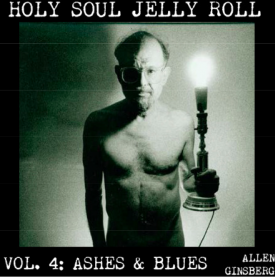
Today marks the release of the final volume in the Allen Ginsberg box set Holy Soul Jelly Roll: Poems & Songs 1949–1993, a collection of previously released and unreleased recordings. For whatever reason, Ginsberg Recordings decided to stagger the digital release of the set over the month of September, beginning with Volume Four (Ashes & Blues), followed by Three (Ah!), Two (Caw! Caw!), and finally, today, Volume One (Moloch!). The last volume “contains the stunning 1956 Berkeley Town Hall reading of Ginsberg’s seminal poem ‘Howl,’ as well as other important historic early poems.” You can preview and buy all four volumes on iTunes, but you needn’t pay to hear some full tracks: Ginsberg Recordings made the “8 song sampler” available on Soundcloud for us. Here is the track listing:
1. A Supermarket In California
2. Green Valentine Blues
3. Kral Majales (King Of May)
4. CIA Dope Calypso
5. Laughing Song
6. First Party at Ken Kesey’s With Hell’s Angels
7. Vomit Express
Listening to these poems brings a couple things to mind. One, the realization, too often lost, that “There was a time when not every moment of our lives was recorded, photographed, tweeted, facebooked, or otherwise made instantly available to the global billions of the connected,” in the words of Ginsberg friend and archivist Stephen Taylor. In those ancient days, recordings mattered and the things people chose to put on tape or film or whatever medium they chose were precious because of their rarity and their fragile physicality. Two, these recordings underscore the perfect pitch of the collection’s title, which takes in all at once the complementary natures of Ginsberg the holy fool—mystic, trickster, and sensual “white Negro” (to take Norman Mailer’s snide 50s term for hipster bohemians). Ginsberg was all these things, usually in the same poem. His voice can slide in subtle or startling turns from bathos to pathos, from the fantastic imaginary to keenly-observed social critique.
In the first recorded poem above, “A Supermarket in California,” Ginsberg imagines himself shopping for groceries at night with Walt Whitman, an elaborate extended excursion into the poet’s process. In an intro, he calls this a “coming down” poem after writing “a lot of great poetry.” Reminiscent of Wallace Stevens’ “The Man on the Dump,” Ginsberg describes “shopping for images” in a “hungry fatigue… dreaming of your enumerations.” The “you” here is Whitman, and in the poem the two stroll down store aisles, sampling the “neon fruit” without paying. In a funny image, Ginsberg asks his muse, “which way are we going? Which way does your beard point tonight?” Maybe Ginsberg thought it a minor poem, but I’d call it a tiny delicacy next to the sprawling monster “Howl.”
Another short autobiographical poem above—well-stocked with images as precise, but not so neon, as “Supermarket”—is “First Party at Ken Kesey’s with Hell’s Angels.” I can only imagine this is an accurate account of events not much embellished but perceptively edited to give us an elliptical succession of loosely connected vignettes. None of the images surprise so much as confirm exactly what one expects to find at Ken Kesey’s (with Hell’s Angels): “Cool black night through the red woods,” “a few tired souls hunched over in black leather jackets,” “a yellow chandelier at three a.m.,” “twenty youths dancing through the vibration in the floor,” “a little marijuana in the bathroom,” and, of course, “four police cars parked outside the painted gate.” It’s not a masterpiece, but it’s a little showcase of Ginsberg’s talent for compression and, to use the word he applies to his hero Walt Whitman, “enumerations” of jazz-inflected lines that pop into focus with pleasing immediacy.
“CIA Dope Calypso” is also true to its title, an upbeat island-style ditty with congas, guitar and maracas–a song about the Southeast Asian heroin trade (allegedly!), Ginsberg sings, “supported by the C‑I-A.” Never afraid to hurl verbal Molotovs at his imperialist foes, Ginsberg does so here with strained and silly rhymes and a good deal of tongue-in-cheek in-joking. It’s a “jelly roll” performance—wickedly subversive.
All of these recordings are great fun, but Ginsberg seems best known for the “Holy Soul” part of his persona, the thundering prophet mystic warrior of “Howl,” and that’s here in the box set too, with “Howl” and other poems. We’ve previously featured Ginsberg’s riveting 1955 reading of the epic “Howl” at San Francisco’s Six Gallery, dramatized in Rob Epstein and Jeffrey Friedman’s semi-biopic Howl, with James Franco as Ginsberg. Below, see the poem’s apocalyptic “Moloch” section set to some terrifying animated images from the 2010 film:
If Holy Soul Jelly Roll doesn’t fully sate your taste for Ginsberg’s voice, never fear: there is much more to come from Ginsberg Recordings.
Josh Jones is a doctoral candidate in English at Fordham University and a co-founder and former managing editor of Guernica / A Magazine of Arts and Politics.
Although her own works are seldom read, Gertrude Stein cast an imposing shadow over the evolution of 20th century literature. Like other high modernists, she broke from tradition to experiment with new forms, but whereas her rival James Joyce’s writing became more dense and complex over time, Stein’s became abstract and simple. Like Paul Cézanne and other modern painters, Stein sought to transcend representation and reveal an underlying structure in the perceptual world. Her nonlinear prose and poetry are like paintings, frozen in what she called a “continuous present.” As Jonathan Levin writes in the Barnes & Noble Classics edition of Stein’s Three Lives:
Stein clearly takes pleasure in words, almost in a way that a seven-year-old might, endlessly repeating a word, and variously inflecting it, to the point that it is effectively emptied of all meaning. Relying mostly on simple, often monosyllabic words, Stein wields language much as the modern painters she admired and collected were wielding paint, suggesting form through a radically simplified use of line and color.…By combining and repeating such simple words and phrases, Stein helped reinvent the English language for the twentieth century. Much as Paul Cézanne, Henri Matisse, and Pablo Picasso helped people understand how the eye constructs its field of vision, so Stein helped readers understand how words construct a field of meaning.
But most readers find Stein tedious and unintelligible. As Edmund Wilson writes in Axel’s Castle: A Study in the imaginative Literature of 1870–1930, “Most of us balk at her soporific rigmaroles, her echolaliac incantations, her half-witted-sounding catalogues of numbers; most of us read her less and less. Yet, remembering especially her early work, we are still always aware of her presence in the background of contemporary literature.”
Among the writers who knew Stein and were influenced by her was Ernest Hemingway. Echoes of Stein’s rhythms and repetitions can be sensed in some of Hemingway’s prose. In his postumously published memoir, A Moveable Feast, Hemingway offers his own frank assessment of Stein and the nature of her influence:
She had such a personality that when she wished to win anyone over to her side she would not be resisted, and critics who met her and saw her pictures took on trust writing of hers that they could not understand because of their enthusiasm for her as a person, and because of their confidence in her judgement. She had also discovered many truths about rhythms and the uses of words in repetition that were valid and valuable and she talked well about them.
For a sense of Stein’s experimental style you can listen above as she recites “If I Told Him: A Completed Portrait of Picasso,” a poem Stein wrote in the summer of 1923 while visiting her friend Pablo Picasso on the French Riviera. (To read along as you listen, click here to open the text in a new window.) The recording was made in New York during the winter of 1934–35, when Stein was promoting her popular but less experimental book The Autobiography of Alice B. Toklas. Encountering Stein today, we can still feel the same annoyed bewilderment that her first readers felt. “Perhaps,” writes Levin, “this is because language, unlike paint, does not simply become ‘beautiful’ once a style is widely accepted. In any event, we might consider ourselves fortunate to be able still to feel what is shocking and irritating in modern writing. It reminds us that we are in the presence of something that still feels genuinely new and different.”
To hear more of Stein reciting, and to hear a rare recorded interview of her from 1934, visit the archive at PennSound. And toread several of Stein’s works, please visit our collection of 375 Free eBooks.
In my book Cate Blanchett can do no wrong, but her performance in the Lord of the Rings movies was particularly spellbinding, especially when she spoke the Elvish language of J.R.R. Tolkien’s fantasy universe. Of course, the spell was cast long before when Tolkien used his background as a linguist, historian, and literary scholar to create the elaborate tongue that he called Quenya. In the short clip above, Tolkien himself recites the Elvish poem Namarie, or Galadriel’s lament, from The Fellowship of the Ring novel (it doesn’t appear in the film). Namarie translates as “Farewell,” and the poem in English reads thus:
Ah! like gold fall the leaves in the wind, long years
numberless as the wings of trees! The long years
have passed like swift draughts of the sweet mead
in lofty halls beyond the West, beneath the blue
vaults of Varda wherein the stars tremble in the
song of her voice, holy and queenly.
Who now shall refill the cup for me?
For now the Kindler, Varda, the Queen of Stars,
from Mount Everwhite has uplifted her hands like
clouds, and all paths are drowned deep in shadow;
and out of a grey country darkness lies on the
foaming waves between us, and mist covers the
jewels of Calacirya for ever. Now lost, lost for
those from the East is Valimar!
Farewell! Maybe thou shalt find Valimar. Maybe
even thou shalt find it. Farewell!
The Tolkien recording predates by two years the 1954 publication of the novel—the first of the Ring trilogy. As sci-fi blog i09 notes, Namarie has been set to music, sometimes against Tolkien’s wishes, by several composers. Tolkien did authorize one composition from Donald Swann, included on the album Poems and Songs of Middle Earth (1967), a song cycle from The Lord of the Rings. Tolkien gave Swann the melody, and singer William Elvin’s tenor accentuated the medieval, Celtic quality of the poem. A fan put together the video below.
The other thirteen compositions on Poems and Songs are in English (Tolkien’s poetic skill in his own tongue is perhaps underappreciated). In the short clip below, hear him read “The Song of Durin,” from Fellowship of the Ring, a song sung by Gimli the dwarf as the fellowship journeys deep into the mines of Moria.
As Peter Jackson brings Middle Earth back to life in the theater this December, it’s a good time to brush up on your Tolkien lore. Don’t have time to reread The Hobbit? Listen to Youtube user “Ephemeral Rift” read the entire novel in a whisper. He’s up to Chapter 2 and promises to finish in time for the first film’s release.
Josh Jones is a doctoral candidate in English at Fordham University and a co-founder and former managing editor of Guernica / A Magazine of Arts and Politics.
Charles Bukowski, “Hank” to his friends, was once called the “best poet in America” by kindred spirit Jean Genet. He was a writer who told the truth, when he wasn’t lying, and who could tell a great story, whether sober or drunk. Bukowski once told Sean Penn in a 1987 Interview magazine piece: “Alcohol is probably one of the greatest things to arrive upon the earth — alongside of me. Yes…these are two of the greatest arrivals upon the surface of the earth. So…we get along.” This statement encapsulates the qualities Bukowski is best known for—lifelong heavy drinking and bravado. They tend to go hand in hand, especially in novelists of his generation. But what made him a poet was another quality the booze helped him cope with, his tendency to be “a shy, withdrawn person,” an almost tender person, and humane in his own low-rent way. In the video above, he tells the story of his worst hangover ever. I’ll let him tell it. There’s no way a paraphrase could come close to Bukowski’s own voice.
Josh Jones is a doctoral candidate in English at Fordham University and a co-founder and former managing editor of Guernica / A Magazine of Arts and Politics.
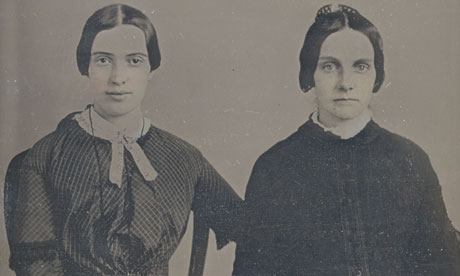
Until now, we’ve only had one authenticated photo of the nineteenth century poet, Emily Dickinson (1830–1886). The photo (above), taken when she was only 16 years old, shows Dickinson as a youngster in high school circa 1847, well before her literary career came into full bloom. That has been the only visual trace of her to date.
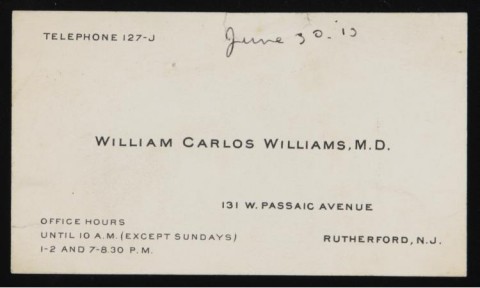
There you have it: the business card of William Carlos Williams. Yes, thatWilliam Carlos Williams. Imagist poet, novelist, playwright, essayist, critic, writer of short stories — and New Jersey pediatrician. Would any of us, upon reading his written work, have advised him not to quit his day job? And yet quit it he did not, practicing medicine by day and writing in the evenings. Given that his office hours evidently ran to 8:30 p.m., he must have spent some seriously late nights at his desk. But because Williams burnt the candle at both ends, we may today enjoy poems like The Red Wheelbarrow, This is Just to Say, and the vastly longer Paterson, an adaptation into verse of the city of Paterson, New Jersey. Such poems show that the concrete and the everyday — just the things you’d expect a small-town family doctor to deal with — never escaped Williams’ attention. Critics tend to cite one phrase from Paterson that sums up this sensibility: “No ideas but in things.”
In the clip just above, you can hear Allen Ginsberg, a friend of Williams but a decidedly more bohemian sort, read from Williams’ Spring and All. It certainly seems possible that the poet’s maintenance of a day job and all its trappings of the non-poetic life not only failed to hamper but actually fueled his writing. Wallace Stevens, another poet who famously held a seemingly mundane parallel career, said as much about his own traditional employment. He credited the daily walk to his lawyer’s job at the American Bonding Company, and later the Hartford Accident and Indemnity Company, with providing the mental space that made what we think of as his lasting work possible. This work led to a Pulitzer Prize in 1955. An offer of a place on Harvard’s faculty followed, but he turned it down. Sometimes we simply hit upon a lifestyle that lets us express what we need to express. Did Stevens’ lifestyle work for him? Have a listen to him reading Final Soliloquy of the Interior Paramour. Perhaps the results speak for themselves:
A special thanks goes to Steve Silberman (aka @stevesilberman) for sending Williams’ business card our way.
When Dylan Thomas was a little boy his father would read Shakespeare to him at bedtime. The boy loved the sound of the words, even if he was too young to understand the meaning. His father, David John Thomas, taught English at a grammar school in southern Wales but wanted to be a poet. He was bitterly disappointed with his station in life.
Many years later when the father lay on his deathbed, Dylan Thomas wrote a poem that captures the profound sense of empathy he felt for the dying old man. The poem, “Do Not Go Gentle into That Good Night,” was written in 1951, only two years before the poet’s own untimely death at the age of 39. Despite the impossibility of escaping death, the anguished son implores his father to “Rage, rage against the dying of the light.”
The poem is a beautiful example of the villanelle form, which features two rhymes and two alternating refrains in verse arranged into five tercets, or three-lined stanzas, and a concluding quatrain in which the two refrains are brought together as a couplet at the very end. You can hear Thomas’s famous 1952 recital of the poem above. To see the poem’s structure and read along as you listen, click here to open the text in a new window.
And to hear more of Thomas reciting his own works you can visit HarperAudio, where you will find a treasure trove of recordings from a number of writers, including these from Thomas:
Part 1: “No Sun Shines,” “The Hand that Signed the Paper,” “Should Lanterns Shine,” “And Death Shall Have No Dominion,” and the first verse of “Alterwise by Owl Light.”
Part 2: “Poem in October,” “This Side of the Truth,” Love in the Asylum,” and “The Hunchback in the Park.”
Part 3: “Do Not Go Gentle into That Good Night,” “On the Marriage of a Virgin,” “In My Craft or Sullen Art,” and “Ceremony After a Fire Raid.”
All poems have been added to our collection of Free Audio Books.
We're hoping to rely on loyal readers, rather than erratic ads. Please click the Donate button and support Open Culture. You can use Paypal, Venmo, Patreon, even Crypto! We thank you!
Open Culture scours the web for the best educational media. We find the free courses and audio books you need, the language lessons & educational videos you want, and plenty of enlightenment in between.