Novelist, educator, and vlogger John Green has drawn a lot of press lately, including but not limited to a New Yorker profile by Margaret Talbot, in the wake of the film version of his popular young-adult novel The Fault in Our Stars. But we here at Open Culture can say we featured him before that magazine of cultural record did: in 2012 we posted his Crash Course in World History, and last October, his Crash Course on Literature. If you keep up with this site, you probably know Green less as a coming-of-age-tragedy-writing “teen whisperer” (in the words of the New Yorker) than as the mile-a-minute, constantly wisecracking, but nevertheless wholesome teacher you never had. You may not know that he has an equally educational brother named Hank, who first came to internet prominence in a back-and-forth video series of John’s devising called Vlogbrothers, which Talbot describes as “less a conversation than an extended form of parallel play.”
Now you can find Hank, possessed of a similarly fast and funny delivery style, prepared to inform you on a whole range of other subjects, teaching crash courses just like John does. At the top of the post, we have his 30-part Crash Course in Psychology, in which he covers everything about the study of the human mind from sensation and perception to the theory of the homunculus to remembering and forgetting to language to depression. (You can watch the series from start to finish above.) Psychology has long ranked among the most popular undergraduate majors in American universities, and given humanity’s ever-increasing curiosity (and gradually accumulating knowledge) about the workings of its brains, that shouldn’t come as a surprise. But those of us who felt compelled to pick a more “practical” course of study back in college, can now turn to Hank Green, who offers us a surprisingly thorough psychological grounding with only about five hours of “lecturing” — much less than the major would have taken us, and with many more corny jokes. Perhaps the course will help you understand why we laugh at them anyway.
If you’re one of our philosophically-minded readers, you’re perhaps already familiar with Stanford professor John Perry. He’s one of the two hosts of the Philosophy Talk radio show that airs on dozens of public radio stations across the US. (Listen to a recent show here.) Perry has the rare ability to bring philosophy down to earth. He also, it turns out, can help you work through some worldly problems, like managing your tendency to procrastinate. In a short essay called “Structured Procrastination” — which Marc Andreessen (founder of Netscape, Opsware, Ning, and Andreessen Horowitz) read and called “one of the single most profound moments of my entire life” – Perry gives some tips for motivating procrastinators to take care of difficult, timely and important tasks. Perry’s approach is unorthodox. It involves creating a to-do list with theoretically important tasks at the top, and less important tasks at the bottom. The trick is to procrastinate by avoiding the theoretically important tasks (that’s what procrastinators do) but at least knock off many secondary and tertiary tasks in the process. The approach involves “constantly perpetrating a pyramid scheme on oneself” and essentially “using one character flaw to offset the bad effects of another.” It’s unconventional, to be sure. But Andreesen seems to think it’s a great way to get things done. You can read “Structured Procrastination” here.
Have your procrastination tips? Add them to the comments section below. Would love to get your insights.
I don’t know about other disciplines, but academic writing in the humanities has become notorious for its jargon-laden wordiness, tangled constructions, and seemingly deliberate vagary and obscurity. A popular demonstration of this comes via the University of Chicago’s academic sentence generator, which allows one to plug in a number of stock phrases, verbs, and “-tion” words to produce corkers like “The reification of post-capitalist hegemony is always already participating in the engendering of print culture” or “The discourse of the gaze gestures toward the linguistic construction of the gendered body”—the point, of course, being that the language of academia has become so meaningless that randomly generated sentences closely resemble and make as much sense as those pulled from the average journal article (a point well made by the so-called “Sokal hoax”).
There are many theories as to why this is so. Some say it’s several generations of scholars poorly imitating famously difficult writers like Hegel and Heidegger, Lacan and Derrida; others blame a host of postmodern ‑isms, with their politicized language games and sectarian schisms. A recent discussion cited scholarly vanity as the cause of incomprehensible academic prose. A more practical explanation holds that the publish or perish grind forces scholars to turn out derivative work at an unreasonable pace simply to keep their jobs, hence stuffing journals with rehashed arguments and fancy-sounding puffery that signifies little. In the above video, Harvard cognitive scientist and linguist Steven Pinker offers his own theory, working with examples drawn from academic writing in psychology.
For Pinker, the tendency of academics to use “passives, abstractions, and ‘zombie nouns’” stems not primarily from “nefarious motives” or the desire to “sound sophisticated and recherché and try to bamboozle their readers with high-falutin’ verbiage.” He doesn’t deny that this takes place on occasion, but contra George Orwell’s claim in “Politics and the English Language” that bad writing generally hopes to disguise bad political and economic motives, Pinker defers to evolutionary biology, and refers to “mental habits” and the “mismatch between ordinary thinking and speaking and what we have to do as academics.” He goes on to explain, in some fairly academic terms, his theory of how our primate mind, which did not evolve to think thoughts about sociology or literary criticism, struggles to schematize “learned abstractions” that are not a part of everyday experience. It’s a plausible theory that doesn’t rule out other reasonable alternatives (like the perfectly straightforward claim that clear, concise writing poses a formidable challenge for academics as much as anyone else.)
Pinker’s talk was part of a larger Harvard conference called “Stylish Academic Writing” and sponsored by the Office of Faculty Development & Diversity. The full conference seems designed primarily as professional development for other academics, but layfolks may find much here of interest as well. See more talks from the conference, as well as a number of unrelated videos on good academic writing here. Or, for more amusement at the expense of clunky academic prose, see the results of the Philosophy and Literature bad writing contest, which ran from 1995–98 and turned up some almost shockingly unreadable sentences from a variety of scholarly texts.
Feelings about James Joyce’s Ulysses tend to fall roughly into one of two camps: the religiously reverent or the exasperated/bored/overwhelmed. As popular examples of the former, we have the many thousand celebrants of Bloomsday—June 16th, the date on which the novel is set in 1904. These revelries approach the level of saints’ days, with re-enactments and pilgrimages to important Dublin sites. On the other side, we have the reactions of Virginia Woolf, say, or certain friends of mine who left wry comments on Bloomsday posts about picking up something more “readable” to celebrate. (A third category, the scandalized, has more or less died off, as scatology, blasphemy, and cuckoldry have become the stuff of sitcoms.) Another famous reader, Carl Jung, seems at first to damn the novel with some faint praise and much scathing criticism in a 1932 essay for Europäische Revue, but ends up, despite himself, writing about the book in the language of a true believer.
A great many readers of Jung’s essay may perhaps nod their heads at sentences like “Yes, I admit I feel I have been made a fool of” and “one should never rub the reader’s nose into his own stupidity, but that is just what Ulysses does.” To illustrate his boredom with the novel, he quotes “an old uncle,” who says “’Do you know how the devil tortures souls in hell? […] He keeps them waiting.’” This remark, Jung writes, “occurred to me when I was plowing through Ulysses for the first time. Every sentence raises an expectation which is not fulfilled; finally, out of sheer resignation, you come to expect nothing any longer.” But while Jung’s critique may validate certain hasty readers’ hatred of Joyce’s nearly unavoidable 20th century masterwork, it also probes deeply into why the novel resonates.
For all of his frustration with the book—his sense that it “always gives the reader an irritating sense of inferiority”—Jung nonetheless bestows upon it the highest praise, comparing Joyce to other prophetic European writers of earlier ages like Goethe and Nietzsche. “It seems to me now,” he writes, “that all that is negative in Joyce’s work, all that is cold-blooded, bizarre and banal, grotesque and devilish, is a positive virtue for which it deserves praise.”Ulysses is “a devotional book for the object-besotted white man,” a “spiritual exercise, an aesthetic discipline, an agonizing ritual, an arcane procedure, eighteen alchemical alembics piled on top of one another […] a world has passed away, and is made new.” He ends the essay by quoting the novel’s entire final paragraph. (Find longer excerpts of Jung’s essay here and here.)
Jung not only wrote what may be the most critically honest yet also glowing response to the novel, but he also took it upon himself in September of 1932 to send a copy of the essay to the author along with the letter below. Letters of Note tells us that Joyce “was both annoyed and proud,” a fittingly divided response to such an ambivalent review.
Dear Sir,
Your Ulysses has presented the world such an upsetting psychological problem that repeatedly I have been called in as a supposed authority on psychological matters.
Ulysses proved to be an exceedingly hard nut and it has forced my mind not only to most unusual efforts, but also to rather extravagant peregrinations (speaking from the standpoint of a scientist). Your book as a whole has given me no end of trouble and I was brooding over it for about three years until I succeeded to put myself into it. But I must tell you that I’m profoundly grateful to yourself as well as to your gigantic opus, because I learned a great deal from it. I shall probably never be quite sure whether I did enjoy it, because it meant too much grinding of nerves and of grey matter. I also don’t know whether you will enjoy what I have written about Ulysses because I couldn’t help telling the world how much I was bored, how I grumbled, how I cursed and how I admired. The 40 pages of non stop run at the end is a string of veritable psychological peaches. I suppose the devil’s grandmother knows so much about the real psychology of a woman, I didn’t.
Well, I just try to recommend my little essay to you, as an amusing attempt of a perfect stranger that went astray in the labyrinth of your Ulysses and happened to get out of it again by sheer good luck. At all events you may gather from my article what Ulysses has done to a supposedly balanced psychologist.
With the expression of my deepest appreciation, I remain, dear Sir,
Yours faithfully,
C. G. Jung
With this letter of introduction, Jung was “a perfect stranger” to Joyce no longer. In fact, two years later, Joyce would call on the psychologist to treat his daughter Lucia, who suffered from schizophrenia, a tragic story told in Carol Loeb Schloss’s biography of the novelist’s famously troubled child. For his care of Lucia and his careful attention to Ulysses, Joyce would inscribe Jung’s copy of the book: “To Dr. C.G. Jung, with grateful appreciation of his aid and counsel. James Joyce. Xmas 1934, Zurich.”
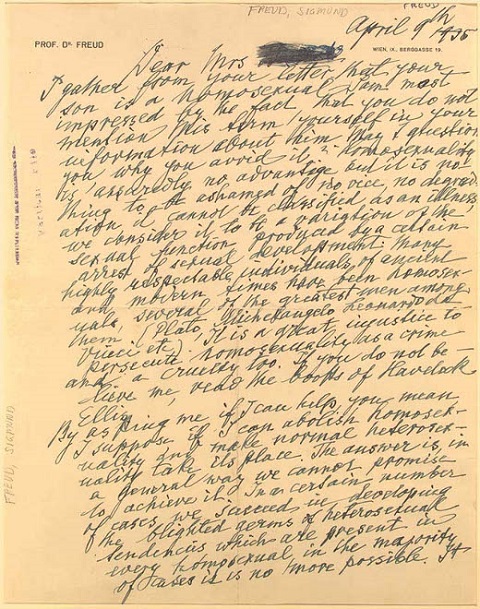
Freud and Jung. Jung and Freud. History has closely associated these two who did so much examination of the mind in early 20th-century Europe, but the simple connection of their names belies a much more complicated relationship between the men themselves. At the top of the post, you can see the letter that Sigmund Freud, father of psychoanalysis, wrote to Carl Gustav Jung, founder of analytical psychology, in order to end that relationship entirely. “At first Freud saw in Jung a successor who might lead the psychoanalytic movement into the future,” say the curator’s comments at the Library of Congress’ web site, “but by 1913 relations between the two men had soured.
While Freud claims in his letter that it is ‘demonstrably untrue’ that he treats his followers as patients, in the very same letter we find him alluding to Jung’s ‘illness.’ ” Freud calls it “a convention among us analysts that none of us need feel ashamed of his own neurosis. But one [meaning Jung] who while behaving abnormally keeps shouting that he is normal gives ground for the suspicion that he lacks insight into his illness. Accordingly, I propose that we abandon our personal relations entirely.”
“I shall lose nothing by it,” he continues, “for my only emotional tie with you has been a long thin thread — the lingering effect of past disappointments — and you have everything to gain, in view of the remark you recently made to the effect that an intimate relationship with a man inhibited your scientific freedom.” This relationship, writes Lionel Trilling in a review of The Correspondence Between Sigmund Freud and C.G. Jung, “had its bright beginning in 1906 and came to its embittered end in 1913,” when Freud wrote this letter. “Freud and Jung were not good for one another; their connection made them susceptible to false attitudes and ambiguous tones. [ … ] The intellectual and professional differences between the two men, profound as these eventually became, would perhaps not of themselves have brought about a break so drastic as did take place had not their alienating tendency been reinforced by personal conflicts.” Only a comparative study of Freud and Jung’s methods would yield a complete understanding of their roles in the struggle for the soul of psychoanalysis. But on a more basic level, this hardly counts as the first nor the last collapse, in any field of human endeavor, of a perhaps overdetermined succession between an eminence and his would-be protege — though it may count as one of the most eloquently documented ones.
What, I wonder, would Sigmund Freud have made of Hannibal Lector? The fictional psychoanalyst, so sophisticated and in control, moonlighting as a bloodthirsty cannibal… a perfectly grim rejoinder to Freud’s ideas about humankind’s perpetual discontent with the painful repression of our darkest, most antisocial drives. While Freud’s primary taboo was incest, not cannibalism, I’m sure he would have appreciated the irony of an ultra-civilized psychiatrist who gives full steam to his most primal urges.
Freud—who was born on this day in 1856, in the small town of Freiberg—also had a carefully controlled image, though his passionate avocation was not for the macabre, salacious, or prurient, but for the archaeological. He once remarked that he read more on that subject than on his own, an exaggeration, most likely, but an indication of just how much his interest in cultural artifacts and ritual contributed to his theoretical explication of individual and social psychology.
In the film above, we see Freud in conversation with a friend, a professor of archaeology, whom the psychiatrist consulted on his extensive collection of antiquities. Later, we see Freud with his dog, then reclining outdoors with a book. Over this footage we hear the narration of Freud’s daughter Anna, who only allowed this film to be viewed by a small circle until her death in 1982.
Though Freud lived many decades into the era of recording technology, precious little film and audio of the founder of psychoanalysis exists. While the home movies at the top may be the only moving image of him, perhaps the only audio recording of his voice, above, was made in 1938, the year before his death. At 81 years old, Freud’s advanced jaw cancer left him in considerable torment. Nonetheless, he agreed to record this brief message for the BBC from his London home in Maresfield Gardens. Read a transcript of the speech, and see Freud’s handwritten copy, below.
I started my professional activity as a neurologist trying to bring relief to my neurotic patients. Under the influence of an older friend and by my own efforts, I discovered some important new facts about the unconscious in psychic life, the role of instinctual urges, and so on. Out of these findings grew a new science, psychoanalysis, a part of psychology, and a new method of treatment of the neuroses. I had to pay heavily for this bit of good luck. People did not believe in my facts and thought my theories unsavory. Resistance was strong and unrelenting. In the end I succeeded in acquiring pupils and building up an International Psychoanalytic Association. But the struggle is not yet over. –Sigmund Freud.
The Library of Congress online exhibit Sigmund Freud: Conflict & Culture has many more primary documents including a holograph page from Freud’s manuscript of Civilization and its Discontents, in which he theorized the bedrock impulse of serial killers, fictional and real: the so-called “Death Drive,” our “human instinct of aggression and self-destruction.”
As David Bowie had his cocaine period, so too did Sigmund Freud, beginning in 1894 and lasting at least two years. Unlike the rock star, the doctor was just at the beginning of his career, “a nervous fellow” of 28 “who wanted to make good,” says Howard Markel, author of An Anatomy of Addiction: Sigmund Freud, William Halsted, and the Miracle Drug Cocaine. Markel tells Ira Flatow in the NPR Science Friday episode below that Freud “knew if he was going to get a professorship, he would have to discover something great.”
Freud’s experiments with the drug led to the publication of a well-regarded paper called “Über Coca,” which he described as “a song of praise to this magical substance” in a “pretty racy” letter to his then-fiancé Martha Bernays. (He also promised she would be unable to resist the advances of: “a big, wild man who has cocaine in his body.”) Two years later, his health suffering, Freud apparently stopped all use of the drug and rarely mentioned it again.
Freud’s cocaine use began, in fact, with tragedy, “the anguished death of one of his dearest friends,” writes TheNew York Times in a review of Markel’s book:
[T]he accomplished young phsyiologist Ernst von Fleischl-Marxow, whose morphine addiction Freud had tried to treat with cocaine, with disastrous results. As Freud wrote almost three decades later, “the study on coca was an allotrion” — an idle pursuit that distracts from serious responsibilities — “which I was eager to conclude.”
The drug was at the time touted as a panacea, and Fleischl-Marxow, Markel says, was “the first addict in Europe to be treated with this new therapeutic.” Freud also used himself as a test subject, unaware of the addictive properties of his cure for his friend’s addiction and his own depression and reticence.
While Freud conducted his experiments, another medical pioneer—American surgeon William Halsted, one of Johns Hopkins “four founding physicians”—simultaneously found uses for the drug in his practice. Freud and Halsted never met and worked completely independently in entirely different fields, says Markel in the news segment above, but “their lives were braided together by a fascination with cocaine,” as addicts, and as readers and writers of “several medical papers about the latest, newest miracle drug of their era, 1894.” Halstead is responsible for many of the modern surgical techniques without which the prospect of surgery by today’s standards is unimaginable —the proper handling of exposed tissue, operating in aseptic environments, and surgical gloves. He injected patients with cocaine to numb regions of their body, allowing him to operate without rendering them unconscious.
Halsted, too, used himself as a guinea pig. “No doctor knew at this point,” says Markel above, “of the terrible addictive effects of cocaine” before Freud and Halsted’s experiments. Both men irrevocably changed their fields and almost destroyed their own lives in the process (see a short documentary on Halsted’s medical advances below). In Freud’s case, much of the work of psychoanalysis has come to be seen as pseudoscience—his work on dreams significantly so, as Markel says above: “Cocaine haunts the pages of the Interpretation of Dreams. The model dream is a cocaine dream.” The “talking cure,” however, engendered by the “loosening of the tongue” Freud experienced while on cocaine, endures as, of course, do Halsted’s innovations.
If subtitles don’t play automatically, please click the “CC” button at the bottom of each video.
When Sigmund Freud died in 1939, the year Hitler invaded Poland, W.H. Auden wrote a eulogy in verse and remarked “We are all Freudians now.” One might have said something similar of Michel Foucault after his death in 1984. Foucault became a fiercely political philosopher after the May 1968 Paris student uprising and in a year that saw the Tet Offensive in Vietnam and the assassinations of Martin Luther King Jr. and Robert Kennedy. In the following year—after the Manson murders and the grim events at Altamont—the sixties effectively came to an end as its utopian projects flared up and fizzled.
In the next repressive decade, Foucault published Discipline and Punish (1974) and his History of Sexuality (1976). Even as he used Freudian concepts, he declared Freudian psychoanalysis complicit in what he called “disciplinary society,” another method, like prisons, schools, and hospitals, of keeping masses of people under constant surveillance and in states of submission. It is this post-‘68 Foucault many of us came to know—an anti-philosopher whose deep distrust of all institutional forms of power seemed the perfect ally for post-adolescent college students in comfortable rebellion. This is why it is a little surprising to see the Foucault above, in a 1965 conversation with philosopher Alain Badiou, ensconced in the bourgeois world of a French philosophical culture, with its lineages and ordinary citizens browsing paperback copies of Marx and Hegel, instead of staging Situationist actions to disrupt the social order.
But of course, it’s only logical to infer that the one culture led directly to the other. For all his rhetorical theatrics, Foucault never gave up on the humanist institution of the university, but always made his home in classrooms, lecture halls, and yes, even TV interviews. His topic in conversation with Badiou is “Philosophy and Psychology” and they came together on the educational television program L’enseignement de la philosophie—another testament, like the well-stocked bookstores and cultural landmarks, to a sixties French culture steeped in philosophical attitudes. Unfortunately we have only the first two parts of the interview, above, with English subtitles (the third and final part is still waiting to be translated). You can, however, see the full interview in French below.
The interview opens with the question “What is psychology?” Foucault’s answer, which he would revise many times in the coming decades, along with his terminology, begins by asking that we “interrogate” the discipline of Psychology “like any other type of culture.” Prodded by Badiou, he elaborates: Psychology is yet another institutionalized “form of knowing” that makes up a disciplinary society, the core concept of his philosophy. Foucault’s interviewer Badiou is now an elder statesman of French philosophy, its “greatest living exponent,” writes his publisher. His most recent book documents forty years of what he calls the “’French moment’ in contemporary thought”—one greatly inspired by Michel Foucault.
We're hoping to rely on loyal readers, rather than erratic ads. Please click the Donate button and support Open Culture. You can use Paypal, Venmo, Patreon, even Crypto! We thank you!
Open Culture scours the web for the best educational media. We find the free courses and audio books you need, the language lessons & educational videos you want, and plenty of enlightenment in between.