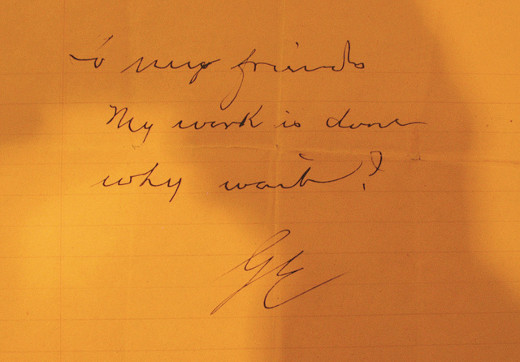
In 1932 George Eastman, the 77 year old entrepreneur who established the Eastman Kodak Company, popularized the use of roll film, and brought photography to the mainstream, found himself in declining health. Suffering from lumbar spinal stenosis, a narrowing of the spinal canal that can lead to considerable back pain and difficulty walking, Eastman was depressed and increasingly disabled. On March 14th, he committed suicide by firing a single gunshot through his heart. An act as brief, and to the point, as the note he left behind. It read:
To my friends
My work is done
Why wait?
GE
If you would like to support the mission of Open Culture, consider making a donation to our site. It’s hard to rely 100% on ads, and your contributions will help us continue providing the best free cultural and educational materials to learners everywhere. You can contribute through PayPal, Patreon, and Venmo (@openculture). Thanks!
It’s a reality of big city living that one occasionally stumbles upon some famous person behaving like a mere civilian, out walking the dog, buying a latte, or taking the kids to some child-centric event. I’m bad at recognizing these luminaries out of context, which may be why I’m great at mistakenly believing some random citizen standing beside me at an intersection is in fact a noted author or beloved character actor. I have thus far never labored under the delusion that the guy across the aisle on the F train to Brooklyn is a one-eared Dutch post-Impressionist who died over a hundred years ago, but that could change.
Or not. According to Lithuanian architect and photographer Tadao Cern, the friend who served as the model for his digital recreation of Vincent Van Gogh’s iconic self-portrait doesn’t resemble the painter all that much beyond his ginger hair and beard. After taking his picture, Cern devoted a day to adjusting colors and exposure in Lightroom and fine tuning a host of details in Photoshop. Suddenly, the similarities were uncanny.
And since every Frankenstein needs a bride, Cern has cobbled together a Mona Lisa to keep Van Gogh company.
Ayun Halliday is posting from the wilds of Cape Cod, where she once spotted John Waters riding his bicycle to Safeway in a yellow slicker and matching all-weather pants. Follow her @AyunHalliday
If you’re a New Yorker, you know this stretch of subway inside and out. You’ve schlepped from Union Square to Grand Central Station on the 4, 5, or 6 trains how many times? Probably more than you care to count. But don’t worry, you’re in good company. New Yorkers have been making this journey since 1904, and here we have some vintage video to prove it. Shot on May 21, 1905, seven months after the IRT subway line opened, the video shows a train moving uptown. And then, during the last minute, you can see the New Yorkers exiting the train, svelte and dressed to the nines.
If you’re wondering how this clip was shot, let me add this: A camera was mounted on a subway train following another train on the same track. Lighting was provided by a specially constructed work car on a parallel track.
If you would like to support the mission of Open Culture, consider making a donation to our site. It’s hard to rely 100% on ads, and your contributions will help us continue providing the best free cultural and educational materials to learners everywhere. You can contribute through PayPal, Patreon, and Venmo (@openculture). Thanks!
One of the most stunning views a traveler can have in Paris is to round a corner and see the massive four-legged base of the Eiffel Tower. One of the beautiful things about Eiffel’s tower is that it is so colossal and yet so airy and delicate.
The view from the top is also amazing (though truth be told the views from Notre Dame and Sacré-Coeur may be better because they include the Eiffel Tower too)—so much so that Google photographers hoisted their panoramic Street View camera into the tower and recorded breathtaking views from the three main levels.
The day Google showed up was a typically overcast Paris day. The sky is even a little threatening. After so much gazing out at the city, you might want to dip into a café for un petit café crème.
But keep your laptop with you. The Street View exhibit is one of three that Google now offers about the tower. Google’s Cultural Institute collaborated with the Eiffel Tower Operating Company to create three additional exhibits: The Birth of the Eiffel Tower, the tower’s construction, and another about its inauguration and early visitors.
Built to display France’s engineering prowess at the centenary of the French Revolution, the tower’s construction is amazing to contemplate. Four men were needed to install one rivet: one to heat it up, another to hold it in place, a third to shape the head and a fourth to beat it with a sledgehammer. A total of 2,500,000 rivets were used to hold the tower together.
For a much older view of the ride up the tower’s elevator, check out this film by the Lumière brothers, made the year the tower opened in 1898.
Earlier today, we showed you what goes into making a Steinway grand piano. Now we’re heading clear across the country, from New York to California, to the factory where the Tesla Model S is made. The process couldn’t be more different. Steinway is all about wood and craftsmen; Tesla about metal and mind-blowing robotics. A piano takes a year to build; a Tesla, 3–5 days. But what do they ultimately have in common? A price tag that can rise well north of $60,000.
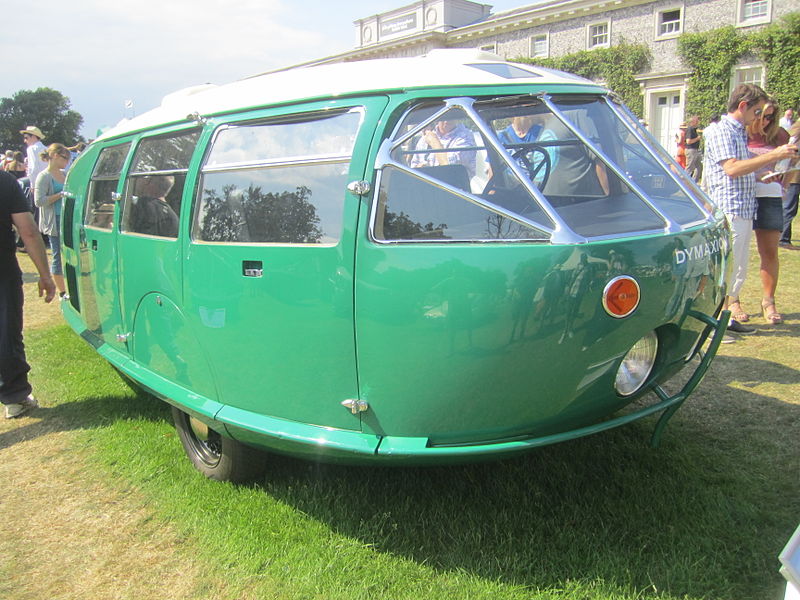
To those who haven’t delved deeply into his considerable body of work, twentieth-century architect, inventor, and futurist Buckminster Fuller seems to have left behind a single lasting contribution to the built environment: the geodesic dome. This I remember whenever I pass by the Cinerama Dome on Sunset Boulevard, a famous movie theater built according to Fuller’s sphere-intensive architectural principles. But the fact that you don’t see many other geodesic domes these days — you never did see many, I suppose — belies the abundant fruits of Fuller’s imagination and know-how. Vigilantly mindful of humanity’s potential for a better tomorrow, he also designed a suite of seemingly Utopian, surprisingly innovative, and ultimately unpopular tools for better living. He branded them with a portmanteau of dynamic, maximum, and tension: “Dymaxion” came to stand, or at least Fuller seemed to want it to stand, for unceasing dedication to improving our patterns of life.
To that end, he conceived of the Dymaxion House, or “Dymaxion Dwelling Machine,” a cheaply mass-producible, naturally heated and cooled, nearly maintenance-free, easily modifiable, and, of course, round housing solution. The satisfied resident of Fuller’s future would drive to and from his Dymaxion House, along with ten passengers, in his aerodynamic Dymaxion Car, capable of reaching 90 miles per hour at 30 miles to the gallon. And no matter where he drove, he could find his way with the Dymaxion Map (also known as the “Fuller Projection map”), the only flat whole-earth map with no visual distortions in its representation of what Fuller called Spaceship Earth. You can see the Dymaxion Car in action, and hear Fuller talk about its development, in the video just above. A 1946 newsreel tour of the Dymaxion House appears at the top of the post. If you now find yourself eager to live according to Buckminster Fuller’s ideals, try keeping his ultra-detailed form of a diary, the Dymaxion Chronofile, or taking his periodic 30 minute Dymaxion naps. I know I’d like to get a Dymaxion bathroom installed.
Think growing feelings of isolation in a world of modern conveniences is a new phenomenon? Slap a dial on that smartphone, shove a collectible rocket in your kid’s cereal box, hop in a Caddy with fins and think again, pal!
Have I Told You Lately That I Love You, a cautionary tale created by University of Southern California students in 1958, is a far-from-silent film marked by a near-total absence of human speech. The little boy character seems happy enough with his popsicle and television Westerns, but his white-collar dad and housewife mom are marooned in their individual existential hells, unable to connect. Could the newfangled, labor saving devices with which their home and dad’s workplace abound be to blame?
The newsy radio report playing intermittently in the background would certainly have it so. Stories of hair loss, headaches and a kid shooting his father over a TV-related dispute suggest none too subtly that progress has long been a source of anxiety.
I might suggest that the mother is suffering more from the rigid gender roles of her era than the tyranny of an automatic dishwasher. Perhaps the suburbs weren’t offering them much in the way of community. Isn’t it possible that the relationship has gone cold due to the father’s penchant for hopping in bed with the girls from the steno pool?
That’s pretty standard behavior on Mad Men, no?
While this short film offers none of the aforementioned’s sexy, booze-soaked highs, there’s quite a bit of black-and-white design porn on display. Dictaphones, gleaming kitchen appliances, a music box that dispenses cigarettes…
Otherwise it’s a vision of an average American 1950’s family as conceived of by Ingmar Bergman.
Today, as the U.S. celebrates the “nation’s birthday,” we also round the corner of the 150th anniversary of Gettysburg, the bloodiest and arguably most decisive battle of an internal struggle that never ceases to haunt the national psyche. With over 50,000 Union and Confederate soldiers killed, injured, gone missing, or captured during the days of July 1–3, 1863, historians continue to pore over the most minute details of the battle strategies of Generals Lee and Meade. Today’s digital imaging and satellite technology means that our views of the action are in many ways far superior to anything commanders on the field could have hoped for.
Since 2000, the National Park Service has used military engineering techniques to restore the historic battlefield to something resembling its 1863 state, and, in the past few years, cartographers and researchers Anne Kelly Knowles, Dan Miller, Alex Tait, and Allen Carroll have analyzed new and old maps of the Pennsylvania terrain in and around Gettysburg to get a renewed appreciation for what the generals could and could not see during the conflict. Confederate officers had their views obstructed not only by limited mapping technology and relative field positions, but also by their own communication failures. As Knowles points out at the Smithsonian’s website:
We know that Confederate general Robert E. Lee was virtually blind at Gettysburg, as his formerly brilliant cavalry leader J.E.B. Stuart failed to inform him of Federal positions, and Confederate scouts’ reconnaissance was poor. The Confederates’ field positions, generally on lower ground than Yankee positions, further put Lee at a disadvantage. A striking contrast in visual perception came when Union Gen. Gouvernour K. Warren spotted Confederate troops from Little Round Top and called in reinforcements just in time to save the Federal line.
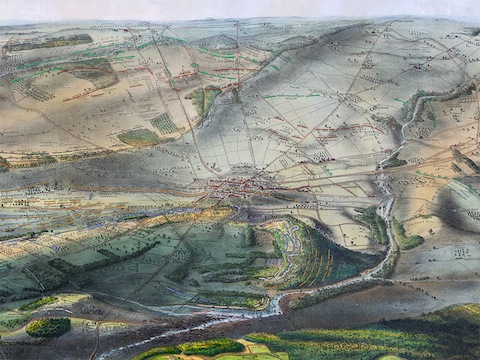
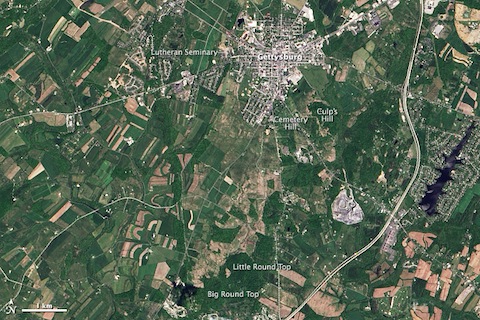
Using so-called GIS (Geographic Information Systems), Knowles and her team are able to show what was hidden from the solders’ views during such key moments as Pickett’s Charge. The team used several period maps, like the 1863 “isometrical drawing” at the top, in their reconstructions. They also used satellite images from NASA, including the May 2013 picture below from the Operational Land Imager (OLI). You can see Knowles and her team’s painstaking geographical and topographic reconstructions of the country’s costliest rift at the Smithsonian Magazine’s site.
We're hoping to rely on loyal readers, rather than erratic ads. Please click the Donate button and support Open Culture. You can use Paypal, Venmo, Patreon, even Crypto! We thank you!
Open Culture scours the web for the best educational media. We find the free courses and audio books you need, the language lessons & educational videos you want, and plenty of enlightenment in between.