Don Pardo voiced the introductions of Saturday Night Live for 38 seasons. He began calling out the names of the S.N.L. cast members during the first episode in October, 1975, and (except for the 1981–82 season) he kept calling out those names straight through last May. Chevy Chase, Gilda Radner, John Belushi, Bill Murray, Eddie Murphy, Tina Fey — he called them all. Thanks to an impersonator, you can hear a compilation of Pardo’s call for every cast member.
Don Pardo died yesterday at 96 years of age. Earlier in his career, he was the announcer for a number of American TV shows, including The Price Is Right, Jackpot, and Jeopardy!. But his voice became part of the fabric of America’s greatest comedy show, Saturday Night Live. And he continued voicing the intro long after his formal retirement from NBC in 2004. Not lacking energy (watch him blow out his candles on his 90th birthday), Pardo flew from Tucson to New York weekly to get S.N.L. started. Above, we have a short video that features Pardo, then 88, showing off, his sheer linguistic awesomeness.
Somehow, I’m now hoping that whenever my day comes, Don Pardo’s voice will introduce me on the other side.
Living in Los Angeles, I suppose I could go up and have a look (albeit a distant one) at Charles and Ray Eames’ Eames House any time I like. But I’ve never got around to visiting that most notable of all works of midcentury modern California architecture, since I have another example of their era- (and coast-) defining design much closer at hand. Whenever I look to my left, I see an Eames’ Lounge Chair — not my Eames Lounge Chair, per se, but the one my girlfriend brought with her when we moved in together. Much more than the sum of its molded plywood and leather parts, the Eames Chair made even more of a mark on the design sensibility of the 20th century than did the Eames House. Could the Eamses themselves have known, when they first rolled it out in 1956, that the chair would remain unsurpassed in its furniture niche more than 55 years later? Watch them debuting the Eames Chair on TV, to Home Show host Arlene Francis,and see if you can read it between the lines.
We first see the Eames Chair only in silhouette — but already we recognize it. “Well, that is quite a departure, Charles, and it looks wonderfully comfortable,” says host to designer. He takes the question quite literally: “It’s rosewood, plywood, and it’s black leather, and its insides are all feathers and down. I think it’d be a better idea if we would just build it for you right here.” We then see a short film, produced in a combination of live action and stop motion, showing the complete assembly and subsequent disassembly of an Eames Chair. It also includes the packing of its parts into a box with the logo of Herman Miller, the company for whom the Eames originally designed it, and one that, so Charles says, allowed them seemingly complete aesthetic independence, dependent on no specific market or season. Hence the range of timeless Eames-designed chairs displayed on the segment that reveal the design evolution leading up to the Eames Chair itself, the most timeless of them all. “You really create your own market, don’t you?” Francis asks. Charles remains modest (and Ray has already exited stage left), but on some level must have understood that every important designer does just that.
Osamu Tezuka is one of the great creative forces of the 20th century. Known in his native Japan as the “god of manga,” Tezuka was mind-bogglingly productive, cranking out around 170,000 pages of comics in his 60 years of life. He almost single-handedly made manga respectable to read for adults, creating tales that were both universal and emotionally complex. And he worked in pretty much every genre you can imagine from horror, to girly fantasy, to an epic series about the life of the Buddha. Yet of all of Tezuka’s many volumes of comics, his best beloved work was Tetsuwan Atomu, otherwise known as Astro Boy.
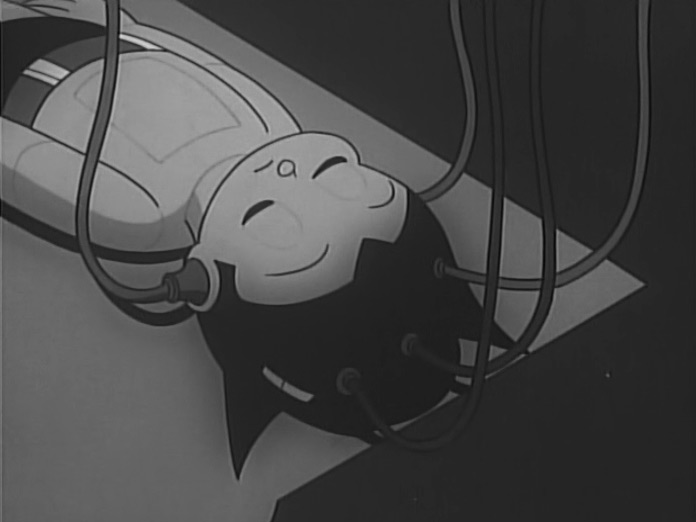
In 1962, Tezuka fulfilled a childhood dream by opening an animation studio. One of his first projects was to adapt was Astro Boy. The television series premiered in 1963 and proved to be hugely popular in Japan. It wasn’t long before American TV started airing dubbed versions of the show. You can see the very first episode, “Birth of Astro Boy,” above.
After his son dies in a freak car accident, scientist Dr. Astor Boynton is driven mad by grief. He develops an insane laugh and, with it, an equally insane plan to build a robot who looks just like his dead son. After a Frankenstein-esque montage, Astro Boy is born. All seems well for the adorable, sweet-natured robot, until Boynton freaks out over Astro Boy’s lack of growth. “I’ve been a good father to you, haven’t I?” he whines. “Well then, why can’t you be a good son to me and grow up to be a normal human adult?” How’s that for a parental guilt trip?
So Dr. Boynton casts Astro Boy out, selling him into slavery to The Great Cacciatore, an evil circus ringleader who forces him to be the world’s cutest robot gladiator. Fortunately, Dr. Elefun, a colleague of Dr. Boynton, takes pity on Astro Boy and works to free him from his bondage.
The whole story plays out as if Mary Shelley and Fritz Lang collaborated to make Dumbo. Tezuka throws in a lot of wacky slapstick comedy, which just barely takes the edge off the story’s Dickensian melodrama, which relentlessly mines all those primal fears you thought you got over. In short, it’s brilliant.
The series ran for two years in the States and then continued on re-runs thoughout the decade. One of the shows fans was apparently Stanley Kubrick. During the mid-60s, Kubrick sent Tezuka a letter asking if he would be interested in helping with the art direction and design of his new movie 2001: A Space Odyssey. The offer would have required that Tezuka spend a year or more in London. Though greatly flattered, Tezuka turned the offer down. The workaholic artist simply couldn’t spend that much time away from his studio. One has to wonder what Kubrick’s masterpiece would have looked like seen through the prism of Tezuka.
In 2001, Steven Spielberg premiered a movie that was a long gestating project of Kubrick’s – the wildly underrated A.I. Artificial Intelligence. The parallels between that movie, about a robot child cast out by his parents into a cruel world, and Astro Boy are striking. Kubrick, as it turns out, might have been even a bigger fan of the God of Manga than previously thought.
Here’s the trailer for A.I. Artificial Intelligence.
Jonathan Crow is a Los Angeles-based writer and filmmaker whose work has appeared in Yahoo!, The Hollywood Reporter, and other publications. You can follow him at @jonccrow. And check out his blog Veeptopus, featuring one new drawing of a vice president with an octopus on his head daily.
If you call yourself a Tolkien fanboy or fangirl, you’ve almost certainly kept up with the various film and television adaptations of not just the Lord of the Rings trilogy, but of its predecessor, The Hobbit, or There and Back Again. Tolkien’s first children’s novel (or so the literary world first received it). The story it tells of the reluctant hero Bilbo Baggins and the band of raffish compatriots who drag him out to claim some treasure from Smaug the dragon offers understandably irresistible material for adaptation: the richly detailed, often funny high-fantasy adventure has, over the decades, made for numerous productions on the stage, radio, and screen.
Known in English as The Fairytale Journey of Mr. Bilbo Baggins, The Hobbit and in Russian, in full, as Сказочное путешествие мистера Бильбо Бэггинса, Хоббита, через дикий край, чёрный лес, за туманные горы. Туда и обратно. По сказочной повести Джона Толкина “Хоббит,”the hourlong TV movie debuted on the Leningrad TV Channel’s children’s showTale After Tale in 1985. This unlicensed adaptation frames itself with the words of a Tolkien stand-in called “the Professor,” using live actors to play the main characters like Bilbo, Thorin, Gandalf, and Gollum, portraying the more exotic ones with either puppets or, according to Tolkien Gateway, dancers from the Leningrad State Academic Opera and Ballet Theatre. The fact that this version of The Hobbitonly recently became available with real English subtitles (as opposed to goofy parody ones) goes to show just how seriously the Tolkien fandom has taken it, but it does retain a kind of handcrafted charm. Plus, it gives the internet the chance to indulge in the obligatory Yakov Smirnoff gag: in Soviet Russia, ring finds you.
Think back, if you will to the dawn of the 60’s, or failing that, the third season of Mad Men, when Broadway musicals could still be considered legitimate adult entertainment and Bye Bye Birdie was the hottest ticket in town.
The showcase also afforded the American viewing public their first glimpse of the man who would outlast Sullivan as a fixture in their living rooms, Hollywood’s most outrageous Square, Paul Lynde.
Lynde had his camp and ate it too in the role of a solidly Midwestern father of two who, by virtue of his association with his teenage daughter, finds himself appearing on none other than… The Ed Sullivan Show! It’s a truly meta moment. The studio audience seems to enjoy the joke, and Sullivan appears pleased too, when he wanders on after “Hymn for a Sunday Evening” as the song is properly called. According to his biography, Always on Sunday, his response upon first hearing was less enthusiastic. When the merry Broadway crowd turned to check Sullivan’s response to Lynde’s gulping final admission, (“I love you, Ed!”), Sullivan reported that he wanted the floor to open up and swallow both him and his wife.
Way to get with the joke, Ed!
Later in the episode, there’s some graceful Van Dyke footwork on “Put on a Happy Face,” a song that even the most seasoned theatergoers tend to forget originated with this show, probably because it does nothing to advance the plot.
Lynde and Van Dyke reprised their roles in the 1962 film, but in a typical tale of stage-to-screen heartbreak, Susan Watson, Lynde’s original Birdie daughter, was replaced by 22-year-old bombshell, Ann-Margret. (The deliciously bitchy remark Maureen Stapleton made about her at the wrap party turns out to be apocryphal, or at least intended more kindly than it would seem.) See what she brings to “Hymn for a Sunday Evening” below.
Have you heard of the Society for the Prevention of Cruelty to Long-Haired Men? If not, you can’t say you know all of David Bowie’s groups. Fifty years ago, in his very first television interview, Bowie appeared in the capacity of its spokesman, as well as that of “President of the International League for the Preservation of Animal Filament.” “I think we’re all fairly tolerant,” says the 17-year-old then known as David (or even Davey) Jones, “but for the last two years we’ve had comments like ‘Darling!’ and ‘Can I carry your handbag?’ thrown at us, and I think it just has to stop now.” Cliff Michelmore, host of the BBC program Tonight where this all went down in November 1964, asks if such behavior surprises him, because, “after all, you’ve got really rather long hair, haven’t you?” “We have, yes,” replies the proto-Bowie Bowie. “I think we all like long hair, and we don’t see why other people should persecute us because of this.”
The “we” to which he refers comprises all the equally mop-topped young dudes flanking him. Together, they would later appear on another BBC program, Gadzooks! It’s All Happening, as the group — this time musical — the Manish Boys, performing their big number, a cover of Bobby Bland’s “I Pity the Fool.” But according to the David Bowie FAQ, producer Barry Langford had, for that appearance, previously “insisted that David cut his 17” long hair,” resulting in the brief formation of the Society for the Prevention of Cruelty to Long-Haired Men and, consequently, “numerous newspaper reports… of course it was all a scam for some free publicity.” Whatever his style — and he’s had a few — Bowie has clearly always known how to work the ever-reengineered publicity machine. Sometimes he’s done it by going with the flow, but only partially, as we see here, where he and the Manish Boys sport roughly nine-inch hair rather than cuts to the harsh early-1960s standard. Bowie, never one of rock’s dedicated longhairs, can’t have found this too terribly oppressive in reality, although when he returned to the BBC 35 years later for a chat with the more strident Jeremy Paxman, he did so with a look that might have done the old Society proud.
“Merdre,” the very first word spoken in Alfred Jarry’s Ubu Roi, needs no introduction. When it first opened — and closed — on stage in 1896, it didn’t have to do much more than that to get its audience worked up. As soon as this hyper-vulgar satire of the powerful came to its deliberately undramatic end, a “riot” broke out, history books invariably note. Something in Jarry’s tale of the savage, infantile, and all-desiring royalty of the title touched a nerve, and the Surrealist and Theatre of the Absurd movements that followed would strive to keep on touching it. But the strange, low-minded Ubu Roi and its sequels would, while no longer liable to prompt fisticuffs, retain a kind of power over the next century and beyond. That legacy is visible even in French political discourse, where the insult “Ubuesque” tends to get thrown around to describe a certain impulsive, self-satisfying kind of public figure.
Jean-Christopher Averty’s television production of Ubu Roiabove first aired in 1965. Its content, presumably by then familiar enough to the viewing audience, no longer shocked, but its aesthetic choices still look striking today. “I can almost guarantee you will never see another film that looks even remotely like this,” says The Sick, the Strange, and the Awful. It “dispels any types of camera panning, zooms and even moving the camera at all,” placing, “at any one time, three, four, six different mini-scenes onscreen, all interacting with each other in bizarre ways. Characters will pass things to each other, and the item will change size depending on where the camera is. It’s visually disorientating, and cool as hell.” The simply attired characters against backgrounds reduced to their most basic elements (when not just a black void) retain the theatricality of the material, but it all comes together visually with the kind of optical effects that had only recently become possible. Jarry’s daring presaged the era of anything-goes theatre; only natural that his work would go on to explore the limitless visual possibilities opened at the dawn of the video age. But if it started any riots in middle-class French living rooms, history has left them unrecorded.
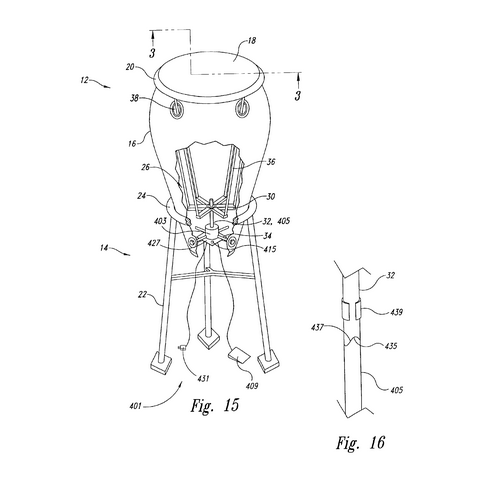
Maybe you knew about Marcel Duchamp’s passion for chess. But did you know about Marlon Brando’s passion for conga drums? Longtime fans may have first picked up on it in 1955, when the actor gave a microwave-link television tour of his Hollywood Hills home to Edward R. Murrow on Person to Person. Halfway through the segment (above), Brando gets into his history with the instrument, and even offers to “run downstairs and give you a lick or two” — and the always highly-prepared program had cameras in the conga room ready to capture this “impromptu” performance. While the interests actors keep on the side may tend to wane, Brando’s seems to have waxed, and later in life he even, writes Movieline’s Jen Yamato, “enlisted the help of Latin jazz percussionist Poncho Sanchez while developing a new tuning system for conga drums.” We can behold the extent and seriousness of Brando’s pursuit of conga perfection with a look at one of those patents, filed in 2002, for an automatic “drumhead tensioning device and method.”
As The Atlantic’s Rebecca Greenfield explains in a post on “Patents of the Rich and Famous,” “tightening a drum takes a lot of effort. Once the drum head loses its tension, there are typically six separate rods that need tightening. Far too many rods for Marlon. Brando explains that others have tried to develop mechanisms that would improve the drum tightening experience but none of them provided a simple or affordable solution.” Hence his motorized “simple and inexpensive drum tuning device that is also accurate and reliable and not subject to inadvertent adjustments.” And if you have no need for an automatic conga drum tuner, perhaps we can interest you in another of Brando’s achievements? “He had these shoes that you can wear in the pool, that would increase friction as you walk on the bottom of the pool to give you a better workout,” says patent attorney Kevin Costanza in an NPR story on Brando’s inventions. Or maybe you’d prefer to simply watch The Godfather again.
We're hoping to rely on loyal readers, rather than erratic ads. Please click the Donate button and support Open Culture. You can use Paypal, Venmo, Patreon, even Crypto! We thank you!
Open Culture scours the web for the best educational media. We find the free courses and audio books you need, the language lessons & educational videos you want, and plenty of enlightenment in between.